
Semantic SEO For HoReCa And Tourism: How Hotels, Restaurants And Destinations Win In AI Search
Semantic SEO for tourism is not about adding more city keywords. It is about making hotels, restaurants and destinations understandable by location, experience, facilities, reviews, intent and trust.
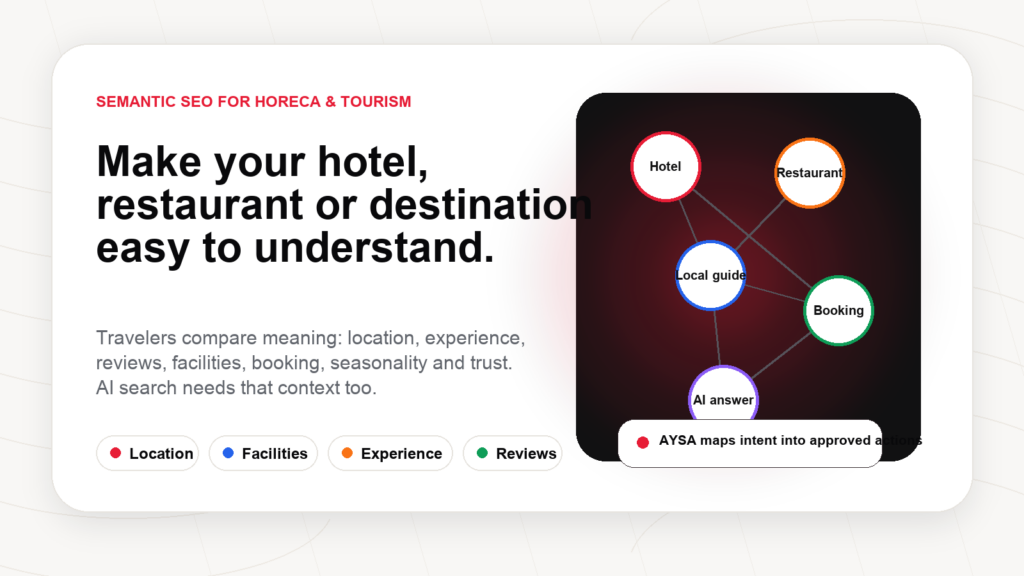
Semantic SEO becomes especially powerful in tourism because travel decisions are rarely linear. A person does not simply search a Keyword, click one result and book. They compare a destination, a budget, a season, a neighborhood, a hotel, a room type, reviews, parking, food, family needs, cancellation rules, attractions nearby and the emotional promise of the trip.
That is why HoReCa SEO cannot be reduced to “hotel + city,” “restaurant + city,” or “tourism + destination.” Those keywords still matter, but they are only entry points into a much richer decision system.
For hotels, restaurants, guesthouses, resorts, event venues, local experiences and destination businesses, semantic SEO means building a website that explains meaning: who you are, where you are, what experience you provide, who it is for, what makes you trustworthy and how a traveler should decide.
In classic SEO, this improves Topical relevance and Internal linking. In AI Search, it also helps answer engines and AI assistants understand whether your business deserves to be cited, compared or recommended. No one can guarantee AI citation, but semantic clarity gives systems more reliable information to work with.
Why tourism is naturally a semantic search problem
Travel is full of entities and relationships. A hotel is connected to a city, a neighborhood, landmarks, airports, beaches, ski areas, event venues, room types, amenities, restaurants, policies, reviews, prices and seasonal demand. A restaurant is connected to cuisine, location, opening hours, delivery, reservations, dietary options, events, reviews and Local intent. A destination is connected to attractions, transport, weather, itineraries, culture, safety, family suitability and time of year.
Search engines need to understand those relationships. AI assistants need them even more because the user often asks a decision-style question:
- “Where should I stay in Sibiu for a weekend with kids and parking?”
- “What boutique hotels in Brasov are close to the old town but quiet?”
- “Which restaurants in Bucharest are good for a business dinner and online reservation?”
- “What should I compare before booking a seaside hotel in Romania?”
- “Find a mountain guesthouse with breakfast, private parking and easy access to hiking trails.”
These are not simple keyword queries. They are bundles of meaning. A website that only says “best hotel in Brasov” is not answering the real question. A website that explains room types, distance to landmarks, parking, breakfast, noise level, family suitability, accessibility and nearby attractions is much stronger.
decision context
Thin keyword page
Focus: “hotel in city,” generic copy, one gallery, one booking button.
The page may be visible, but it does not help a traveler compare the real experience.
Semantic tourism page
Focus: location, experience, facilities, audiences, proof, nearby attractions and next steps.
The page becomes easier for search engines, Maps and AI assistants to understand.
The entities every HoReCa website should make clear
Google’s documentation on how Search works explains that Search uses many systems to understand meaning, relevance, quality, usability and context. For tourism websites, that means entity clarity is not optional.
The most important entities usually include:
- The business: hotel, restaurant, resort, guesthouse, travel agency, event venue or local experience provider.
- The location: city, neighborhood, region, airport, beach, mountain area, landmark or transport hub.
- The offering: rooms, suites, menu, spa, conference rooms, events, tours, packages or seasonal experiences.
- The audience: families, couples, business travelers, digital nomads, groups, pet owners, ski tourists, beach tourists or event guests.
- The decision criteria: price, parking, breakfast, cancellation, reviews, booking, accessibility, distance, check-in, safety and amenities.
- The proof: reviews, awards, photos, author experience, local knowledge, media mentions, certifications and customer examples.
When these entities are scattered, inconsistent or hidden behind generic marketing text, the site becomes harder to understand. When they are organized into pages, headings, internal links, structured data and visible explanations, the site becomes more useful.
This also connects to entity SEO. A tourism business should not only optimize for isolated phrases. It should build a recognizable entity footprint across its website, Google Business Profile, review platforms, social profiles, booking platforms and local citations.
Travel intent clusters: how people actually search
Semantic SEO starts with intent. In tourism, intent is richer than “informational” or “transactional.” A useful HoReCa content model usually covers several clusters.
Destination intent
These users are deciding where to go. They search for destinations, neighborhoods, itineraries, attractions, weather, seasonality and transport. Examples include “what to do in Brasov in winter,” “best area to stay in Bucharest” or “seaside resorts Romania families.”
Comparison intent
These users already have options. They compare hotels, restaurants, locations, packages, room types, price levels or experiences. Examples include “hotel near old town vs hotel near airport,” “private parking hotel Sinaia,” or “restaurant for corporate dinner Bucharest.”
Trust intent
These users want reassurance. They look for reviews, photos, policies, safety, cancellation, family suitability, accessibility, real examples and credibility. This is where Google Business Profile, reviews and visible website proof matter.
Booking intent
These users are ready to act. They need availability, price, booking flow, payment, cancellation, opening hours, directions and contact details. If the website is unclear at this stage, semantic SEO cannot compensate for poor conversion UX.
Experience intent
These users want to imagine the trip. They search for breakfast, spa, views, menu, room atmosphere, nearby walks, kid-friendly activities, romantic weekends, hiking routes or event setup. This content is often underdeveloped on SME tourism websites.
not one landing page
The semantic content model for hotels, restaurants and tourism SMEs
A strong HoReCa website should behave like a structured local travel guide around the business, not like a brochure with a booking button.
For a hotel, the semantic model might include:
- hotel entity page with clear positioning;
- room type pages with features, audience and photos;
- location page explaining the area, landmarks, parking and transport;
- experience pages for families, couples, business travelers or events;
- seasonal pages for summer, winter, holidays or local events;
- FAQ pages answering booking, cancellation, breakfast, pets, children and accessibility questions;
- local guides that connect the hotel to the destination;
- structured internal links between all of the above.
For a restaurant, the model might include:
- restaurant entity page with cuisine, location and atmosphere;
- menu pages that are crawlable, not only PDF images;
- reservation and events pages;
- dietary pages for vegetarian, gluten-free or allergy-related questions where relevant;
- local intent pages such as “business dinner,” “family lunch,” or “romantic dinner” if true to the business;
- review and reputation signals;
- clear opening hours, parking, payment and contact information.
For a destination or tour operator, the model should include itineraries, attractions, timing, transport, difficulty, safety, seasonality, local expertise and booking conditions.
Google’s documentation on structured data is relevant here. Structured data can help Google understand visible content and make pages eligible for certain search features. For HoReCa, schema should support real content: Organization, LocalBusiness, LodgingBusiness, Restaurant, BreadcrumbList, FAQPage, Product or Offer where appropriate. It should never describe information that users cannot see.
What changes in AI Search and answer engines
Google’s AI optimization guidance does not tell website owners to abandon SEO fundamentals. It reinforces the importance of crawlable, indexable, helpful, technically sound and people-first content.
For tourism, AI-assisted search creates a stronger need for comparison-ready content. A user may ask:
I am traveling to Brasov with two children in December. I want a quiet hotel, parking, breakfast, easy access to the old town and indoor activities nearby. What should I compare?
An AI assistant answering that question needs structured information. It needs to understand which hotels are family-friendly, which are close to the old town, whether parking exists, what breakfast includes, what reviews mention, what attractions are nearby and whether the business is trustworthy.
If a hotel website has that information clearly organized, it has a stronger chance of being useful. If the website only has a hero image, a room gallery and generic “perfect location” copy, it is weaker.
This is the same pattern we discussed in our article about Google information agents. Search is becoming more persistent and context-rich. Tourism websites must prepare for travelers who ask deeper questions and expect synthesized answers.
The AYSA view: HoReCa needs semantic execution, not another content calendar
My opinion is that most tourism SMEs do not lose SEO opportunities because they lack ideas. They lose because ideas do not get executed consistently.
A hotel owner may know that guests ask about parking, breakfast, distance to the center, spa access, cancellation and family rooms. A restaurant owner may know that people ask about reservations, menu, parking, private events or dietary options. A guesthouse owner may know the area better than any agency. But that knowledge rarely becomes a structured SEO system.
That is the gap AYSA is designed to close.
AYSA can help a HoReCa website by learning the business context, monitoring search and AI visibility signals, identifying missing pages, mapping internal links, preparing FAQ opportunities, suggesting structured data, finding weak pages and turning those insights into approval-ready website actions.
The important part is execution after approval. A dashboard can show that a hotel lacks content about family stays. AYSA can prepare the page structure, the internal links, the metadata, the FAQ block and the on-page improvements, then ask for approval and execute accepted changes inside the website workflow.
For HoReCa and tourism, semantic SEO is not a theory. It is the practical work of making a business understandable as a destination, a service, a local entity and a trusted choice.
Sources and further reading
- Search Engine Land: Semantic SEO guide
- Google Search Central: How Search works
- Google Search Central: Creating helpful, reliable, people-first content
- Google Search Central: AI optimization guide
- Google Search Central: Introduction to structured data
- Schema.org: Hotel
- Schema.org: Restaurant
- AYSA: Semantic SEO in the AI Search era
- AYSA: SEO for hotels and HoReCa in the AI era
Turn local travel intent into approved website execution.
If your HoReCa website has scattered pages, weak location content, unclear facilities or missing AI-ready answers, AYSA can prepare the improvements, ask for approval and execute accepted changes inside your website workflow.
Continue the AI search topic inside AYSA.
Use these pages to connect the article with AI SEO tools, AI visibility monitoring, AI Overviews and approved website execution.
Turn this topic into a website action plan.
Use these AYSA hubs to move from reading to technical fixes, AI visibility monitoring, research, glossary context and approval-first SEO execution.

