
Cloudflare Agent Readiness Score: What It Means For SEO, AI Search And SMEs
Cloudflare’s Agent Readiness Score is not a new ranking factor. It is a signal that websites now need to be understandable, controllable and useful for AI agents, crawlers and answer engines.
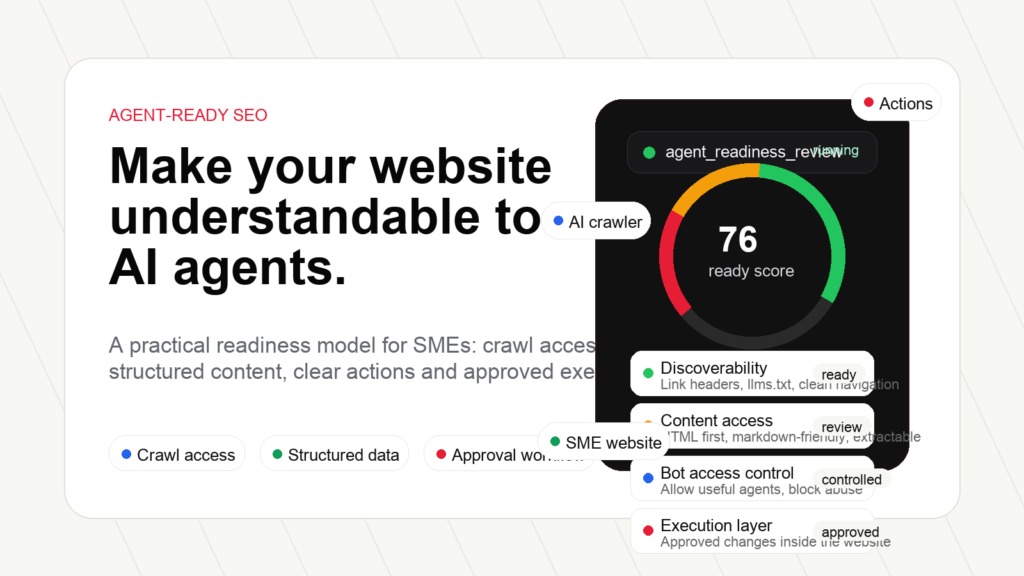
Cloudflare has introduced a useful phrase for a problem many website owners are only starting to notice: agent readiness.
The idea is simple. The web is no longer visited only by humans and classic search crawlers. It is increasingly accessed by AI crawlers, AI assistants, answer engines, shopping agents, research agents, browser agents and automated workflows that can read, compare, retrieve and sometimes act on behalf of users.
That does not mean we should panic. It also does not mean every business should blindly open everything to every AI bot. But it does mean the website has a new audience: machines that need clear content, clear permissions and clear structure.
Cloudflare’s announcement matters because it moves this conversation from abstract “AI SEO” talk into something more operational. A website can be assessed for whether it is easy for agents to discover, access, understand and work with. That is the right direction.
But the wrong conclusion would be to chase a score while ignoring the business. In my opinion, the real question is not “How do we get 100?” The real question is: Can our website be understood and safely used by the systems that now mediate discovery?
What Cloudflare’s Agent Readiness Score is
Cloudflare describes Agent Readiness as a way to understand whether a website is prepared for the agentic web. The company’s official announcement frames the issue around how AI agents discover, access and interact with websites, and introduces a score that examines several practical areas of readiness.
Search Engine Journal’s coverage of the launch also highlights the important SEO angle: this is not just about AI hype. It is about whether websites are technically and structurally ready for non-human visitors that may influence how people find brands, products and answers.
At a high level, agent readiness includes questions like:
- Can important content be discovered through crawlable links?
- Can AI agents access the right resources without being blocked by accident?
- Are access rules clear through Robots.txt and crawler controls?
- Is the content readable in HTML, not trapped inside heavy scripts or images?
- Are products, services, prices, locations, authors and policies clear?
- Does Structured data reflect visible content?
- Can agents understand what the business does and who it serves?
- Is the website fast and stable enough to retrieve at scale?
That list will sound familiar to experienced SEOs. Agent readiness is not a complete replacement for SEO. It is a new layer on top of Technical SEO, content quality, Entity Clarity, authority and governance.
Not only crawlable. Understandable.
Old website readiness
Question: Can a user open the page and can Google index it?
That still matters, but it is no longer the whole story.
Agent-ready website
Question: Can search engines, AI systems and agents understand, cite, compare and safely act on the information?
This is where SEO, AEO, GEO and technical execution start to merge.
Why agent readiness matters now
The timing is not accidental.
AI Overviews, AI Mode, ChatGPT Search, Perplexity, Gemini, shopping agents and browser-level assistants are changing how users move from a question to an action. Instead of typing a short keyword, opening ten links and comparing manually, users increasingly ask a longer question and expect an answer, a shortlist, a summary, a recommendation or a next step.
For example:
- “Find a private pediatric clinic in Bucharest with good reviews, online booking and parking.”
- “Compare WordPress SEO automation tools for a small ecommerce store.”
- “Which florist can deliver premium bouquets in Bragadiru today?”
- “What technical SEO issues should I fix first on my WooCommerce website?”
Those queries are not simple keywords. They are tasks.
If an AI system wants to answer them well, it needs pages that are not only optimized for rankings but also easy to parse, compare and cite. This is why agent readiness matters. A site may technically rank, but still be difficult for AI systems to understand because key information is missing, hidden, inconsistent or poorly structured.
Google’s own AI features guidance makes a similar point from the search side: AI features rely on Google’s core search systems and the same fundamentals still matter, including crawlability, indexability, helpful content, good page experience and content that can be accessed and understood.
That is why the best response is not “SEO is dead.” The best response is: SEO is becoming more operational, more semantic and more execution-heavy.
What Cloudflare’s score is not
Before we go further, let’s be clear about what the score is not.
It is not a Google ranking factor. It is not a guarantee that ChatGPT, Gemini, Perplexity or AI Overviews will cite your website. It is not a substitute for real content, real authority, real technical health or real customer usefulness.
A high score does not automatically mean visibility. A low score does not automatically mean failure. The score is a diagnostic lens.
This distinction matters because SEO has a long history of turning useful diagnostics into mechanical rituals. PageSpeed scores, domain authority estimates, content scores and schema validators are useful when they guide decisions. They become dangerous when teams optimize the score while ignoring the user, the business and the search intent.
Agent readiness should not become another vanity metric.
The right use is practical:
- Find what makes the site hard to access.
- Find what makes the site hard to understand.
- Find where access rules are unclear.
- Find where content lacks entity clarity.
- Find where important facts are missing.
- Find where the site is not ready for AI-mediated discovery.
- Turn those findings into approved actions.
That last part is where most businesses struggle. Diagnostics are easy. Execution is the bottleneck.
The technical SEO layer: crawlability still comes first
Agent readiness starts with boring, essential technical SEO.
If your site is slow, unstable, blocked, full of duplicate URLs, loaded with unnecessary JavaScript, missing canonical discipline or leaking crawl budget into useless parameter pages, it will not become agent-ready because someone added a new AI-related file.
The technical layer includes:
- clean internal links;
- self-referencing canonicals on indexable pages;
- useful XML sitemaps;
- clear robots.txt rules;
- fast server response;
- mobile performance;
- HTML that exposes the important content;
- structured data that matches visible page content;
- no accidental noindex;
- no redirect chains inside important journeys;
- no thin archive pages consuming crawl attention.
This is also where WordPress sites often struggle. Many small and medium businesses run on heavy themes, plugin bloat, sliders, duplicate SEO plugins, old page builders, multiple tracking scripts and weak caching. The result is not only a performance issue. It is a discovery issue.
AI crawlers and agents are not magic. They still need to retrieve, render or parse pages. A clean website is easier for humans, search engines and AI systems.
The content layer: agents need facts, not vague marketing
Agent readiness is not only technical.
Many websites are technically crawlable but semantically weak. They contain generic marketing copy, vague service descriptions, missing pricing context, thin location pages, weak product details, no FAQ logic, no visible authorship, no comparison criteria and no clear next steps.
That is a problem for classic SEO, but it becomes even more visible in AI search.
An AI answer engine comparing pediatric clinics, florists, hotels, car rental companies, parking services or ecommerce products needs concrete information. It needs to know:
- what the business offers;
- where it operates;
- who it serves;
- what makes it different;
- what proof exists;
- what customers can expect;
- how pricing, booking, delivery or service works;
- what limitations apply;
- how the business compares to alternatives.
Generic copy such as “we provide high-quality services tailored to your needs” does not help an agent answer a specific question. It also does not help a human user make a decision.
This is where semantic SEO, AEO and GEO overlap. You are not just “adding keywords.” You are making the business more understandable.
The bot access layer: do not block blindly, do not open blindly
One of the most sensitive questions is access control.
Should you allow AI crawlers? Should you block them? Should you differentiate between search crawlers, AI training crawlers, answer engines, commercial bots and unknown agents?
There is no universal answer.
A publisher may want stricter control. An ecommerce store may want product discoverability but not uncontrolled scraping. A local service business may benefit from being easier to understand in answer engines. A SaaS company may want documentation and product pages available but protected areas blocked.
Cloudflare’s work is useful because it recognizes that agent readiness is not only about making content available. It is also about governance. Businesses need to understand which bots access their site, what they are allowed to do and how that fits the company’s content and commercial strategy.
For most SMEs, the practical approach is:
- keep public, useful marketing and informational content accessible;
- block private, duplicate, search, cart, account and admin areas;
- avoid accidentally blocking important pages;
- document crawler policy in robots.txt and server controls;
- monitor crawler behavior;
- review policies as AI search evolves.
This is not a one-time setup. It is an operating process.
What SMEs should do now
Small and medium businesses do not need a 100-page AI governance document to start improving agent readiness.
They need practical execution.
Here is the starting checklist I would use for an SME website:
- Audit crawlability: make sure key pages are indexable, linked and not blocked.
- Clean technical debt: fix redirect chains, canonicals, 404s, duplicate archives and slow mobile templates.
- Clarify business entities: describe products, services, locations, team, credentials and policies plainly.
- Improve service pages: add process, pricing context, locations, proof, FAQs and next steps.
- Improve product pages: add specs, availability, images, structured data, delivery and comparison details.
- Build topical support: connect guides, glossary terms, examples, FAQs and commercial pages.
- Review bot access: avoid accidental blocks and define a reasonable crawler policy.
- Monitor AI visibility: watch how the brand appears in AI answers, summaries and citations.
- Execute continuously: readiness changes as products, pages, Google, AI systems and competitors change.
This is why I do not see agent readiness as a one-off audit. I see it as a new layer of website operations.
The AYSA view: agent readiness needs approved execution
AYSA.ai was built around a simple frustration: websites do not grow because someone generated another report. They grow when the right work is prepared, approved and executed.
Agent readiness is exactly the kind of problem that exposes the gap between insight and execution.
A tool can tell you that your site is weak. A consultant can explain what should be improved. A developer can fix some of it when there is time. A content team can update pages if the task is clear. But SMEs often do not have the internal SEO, content, technical and execution capacity to keep up.
AYSA’s role is different. The agent can monitor the website, learn the business context, detect opportunities, prepare SEO/AEO/GEO and AI visibility actions, explain why they matter, ask for approval and execute accepted changes inside the website workflow.
For agent readiness, that may include:
- identifying important pages that are hard to crawl or understand;
- preparing internal linking improvements;
- suggesting structured data that matches visible content;
- finding missing service or product details;
- flagging weak FAQ and answer-ready content;
- reviewing technical SEO issues that affect AI retrieval;
- monitoring AI visibility and answer-engine mentions;
- keeping all execution approval-first.
The future is not “replace SEO with AI.” The future is to turn SEO into an operating system that can keep pace with AI search, agentic discovery and website execution.
This article connects with several earlier AYSA pieces: Why AI Search Cites Some Websites And Ignores Others, Semantic SEO In The AI Search Era and LLMs.txt, Lighthouse And AI Search Readiness.
Sources and further reading
- Cloudflare: Is your website ready for AI agents?
- Search Engine Journal: All You Need To Know About Cloudflare’s Agent Readiness Score
- Google Search Central: AI features and your website
- Google Search Central: Introduction to robots.txt
- Google Search Central: Introduction to structured data
Tired of AI search advice that never turns into website changes?
AYSA monitors your website, prepares SEO, AEO and AI visibility actions, asks for approval and executes accepted changes inside your website workflow.
Continue the AI search topic inside AYSA.
Use these pages to connect the article with AI SEO tools, AI visibility monitoring, AI Overviews and approved website execution.
Turn this topic into a website action plan.
Use these AYSA hubs to move from reading to technical fixes, AI visibility monitoring, research, glossary context and approval-first SEO execution.

