
Semantic SEO For Publishers, Bloggers And Content Businesses: How To Build Discoverability And Trust
Semantic SEO for publishers, bloggers, independent journalists and content SMEs connects topics, authors, sources, freshness, archives and trust signals into a clear search and AI visibility system.
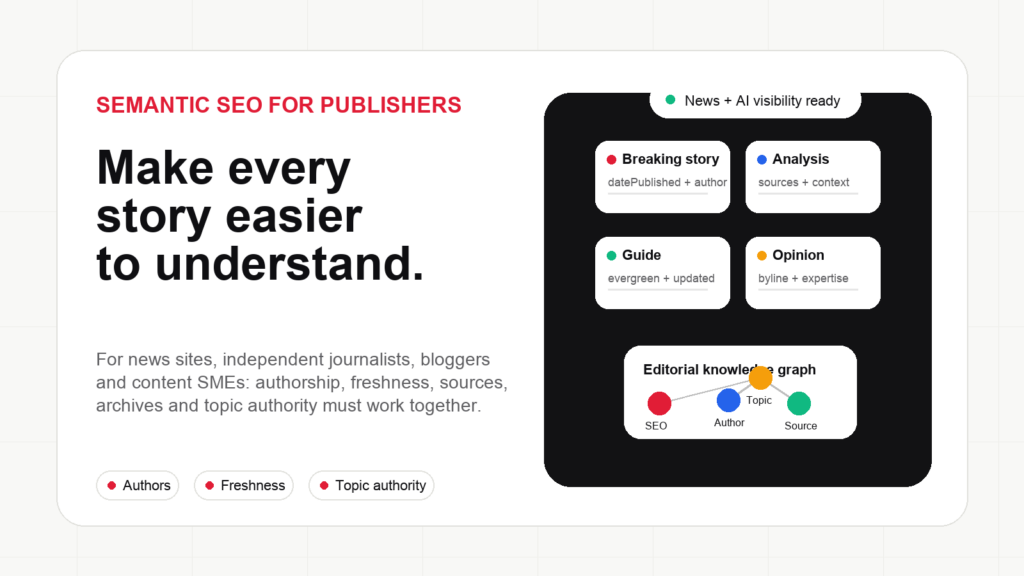
Publishers have a different SEO problem from most businesses.
A local service website may need ten excellent service pages. An ecommerce store may need product, category and buying-guide clarity. A publisher, blogger or independent journalist needs something harder: a constantly growing knowledge system that still remains understandable after hundreds or thousands of articles.
That is why semantic SEO matters so much for media sites and content businesses.
If a reader arrives from Google, Discover, social media, an AI answer, a newsletter or a direct recommendation, the website must help them understand the article quickly. It must also help machines understand the same article: the topic, the author, the source trail, the date, the category, the related context and the broader editorial archive.
This is not only for large publishers. It is ideal for bloggers, niche media, independent journalists, creator-led newsletters and SMEs in the content industry. A small editorial team can compete when its information architecture is cleaner than a larger competitor’s archive.
Why publisher SEO is now semantic SEO
Classic publisher SEO often focused on headlines, speed, schema, tags and news timing. Those still matter, but they are no longer enough.
Modern search systems need to understand meaning and relationships:
- article to topic;
- topic to category;
- category to archive;
- author to expertise;
- source to claim;
- date published to date modified;
- breaking news to evergreen context;
- opinion to evidence;
- review to criteria;
- guide to next step.
Google’s documentation for Article structured data makes this visible at the technical level: headline, author, image, date published and date modified are not decorative details. They help clarify what the article is and who is responsible for it.
But the deeper point is editorial. Structured data should describe a real editorial system, not decorate a weak one.
Stories become connected knowledge
Article-first publishing
Pattern: publish posts, add tags, hope Google understands the archive.
This creates crawl waste, duplicate tags, orphan stories and thin topic clusters.
Knowledge-first publishing
Pattern: connect articles to topics, authors, sources, updates and related context.
The archive becomes easier to crawl, cite, recommend and monetize.
The editorial entities that must be clear
A publisher is not only a collection of posts. It is a network of entities.
The most important entities usually include:
- Authors: the people behind the content, their expertise, their bio and their editorial history.
- Topics: the subjects the publication covers consistently.
- Categories: the editorial shelves that organize content for humans and crawlers.
- Sources: official documents, studies, statements, interviews and data used to support claims.
- Entities mentioned: companies, people, products, places, regulations, events and concepts.
- Formats: news, analysis, opinion, guide, review, interview, case study, explainer.
- Updates: what changed, when it changed and whether the article still reflects reality.
For a media website, semantic SEO means making those entities explicit.
A news article about Google AI Mode should connect to a broader AI Search archive. A guide about Ecommerce SEO should connect to product feeds, Technical SEO, structured data, topical authority and case studies. An opinion article should make clear what is evidence, what is interpretation and who is taking responsibility for the perspective.
This is also useful for AI Retrieval systems. If an AI system cannot identify the author, topic, source context and currentness of a page, the page becomes harder to cite with confidence.
Authors, bylines and trust are part of SEO now
Publisher websites often underestimate author architecture.
An author page should not be an empty archive. It should explain who the author is, what they cover, why they are credible, where else they can be found and which articles best represent their expertise.
This matters because readers evaluate trust quickly. Search systems also evaluate signals around the page, the site and the entity behind the content. Google’s guidance on helpful, reliable, people-first content repeatedly points back to usefulness, trust, expertise and content made for people.
For independent journalists and bloggers, this is an advantage. A small site can be more transparent than a large content farm:
- clear author bio;
- visible editorial focus;
- linked social or professional profiles;
- source notes;
- update notes;
- clear distinction between reporting, analysis and opinion;
- consistent internal links to related work.
In my opinion, this is where many AI-scaled content projects will fail. They may produce volume, but they will struggle to produce accountable editorial trust.
Freshness is not changing the date and pretending it is new
Freshness is often abused.
Changing the date on an article without improving it is not a real update. A useful update might include new data, a changed recommendation, a new official source, a corrected explanation, better examples, improved structure or a stronger answer to the reader’s intent.
For publishers, freshness should be operational:
- Which articles are losing Impressions?
- Which articles rank but no longer answer the query well?
- Which topics changed because of regulation, product updates or market shifts?
- Which evergreen guides need a 2026 review?
- Which news articles should be connected to a larger explainer?
- Which outdated pages should be merged, redirected or deindexed?
Google’s Article documentation supports the technical distinction between date published and date modified. But editorially, the question is simple: did the page become more useful?
For AI Search, freshness also affects citation confidence. If a page discusses a fast-moving topic such as AI Overviews, Google AI Mode, content policies, product feeds or agentic commerce, an outdated article can become misleading quickly.
Archives, tags and internal links can help or hurt
Publisher archives often become messy because publishing systems make it easy to create tags and categories without governance.
Common problems include:
- ten tags for the same topic;
- thin tag pages with one article;
- category archives that duplicate tag archives;
- important articles buried deep in pagination;
- old articles with no links from current content;
- orphan evergreen guides;
- news articles that should point to explainers but do not;
- broken links to old source material;
- outdated internal links after a story evolves.
This is not a cosmetic issue. It affects crawl quality, topical authority and user experience.
A semantic publisher archive should have a deliberate structure:
- strategic categories for major editorial areas;
- curated topic hubs for recurring themes;
- author pages that prove expertise;
- evergreen explainers connected to news coverage;
- clear internal links between related stories;
- noindex for low-value tag pages;
- canonical consistency for pagination and archives;
- sitemaps that include only useful, canonical, indexable URLs.
This is why semantic SEO is not only a content writing issue. It is also information architecture.
Google Discover and AI Search reward clarity, not chaos
Google Discover is especially important for publishers, but it is not a separate trick. Google’s Discover documentation emphasizes useful, engaging content, large high-quality images, clear titles and content that follows Search essentials and policies.
Discover success is not guaranteed, and publishers should be careful with clickbait. But the operational lesson is clear: articles must be understandable, visually strong, trustworthy and aligned with reader interest.
AI Search adds another layer.
An AI system may need to answer questions like:
- What is this article really about?
- Who wrote it?
- Is this reporting, analysis, opinion or a guide?
- What sources support the claims?
- Is the information current?
- What related context should be considered?
- Is this site known for this topic?
Google’s AI features optimization guide points back to the same fundamentals: make content accessible, useful, crawlable and understandable. For publishers, that means clean HTML, meaningful headings, real author context, source links, strong images, structured data and a coherent archive.
The AYSA view: publishers need execution systems, not only editorial calendars
In my opinion, the biggest publisher problem is not a lack of ideas. It is execution debt.
Content teams know they should update old articles, clean tags, improve author pages, add internal links, fix broken sources, optimize schema, refresh explainers, monitor Discover performance and build topic authority. The problem is that the work never ends.
This is where AYSA.ai can help, even though the product is not positioned only for publishers.
For bloggers, independent journalists, niche media and content SMEs, AYSA can monitor the website, detect SEO and AI visibility opportunities, prepare approval-ready actions and execute accepted changes inside the website workflow. That may include:
- finding content decay;
- identifying orphan articles;
- suggesting internal links between related stories;
- flagging weak category or tag archives;
- preparing title and meta improvements;
- detecting schema opportunities;
- mapping topic gaps;
- refreshing evergreen guides;
- monitoring AI Search and answer-engine readiness;
- keeping execution approval-first.
The important difference is that AYSA is not just another dashboard. The agent prepares the work, explains why it matters, asks for approval and can execute accepted changes. For content businesses, that turns SEO from a report into an editorial operating system.
This article continues the semantic SEO series. For the broader foundation, read Semantic SEO In The AI Search Era. For a more local angle, see Semantic SEO For Local Businesses.
Sources and further reading
- Google Search Central: Article structured data
- Google Search Central: Google Discover and your website
- Google Search Central: Creating helpful, reliable, people-first content
- Google Search Central: AI features and your website
- Schema.org: NewsArticle
- Schema.org: BlogPosting
Turn your archive into a search and AI visibility system.
If your content team is tired of endless audits, weak tags, old articles and SEO tasks that never get finished, AYSA can help prepare the work, ask for approval and execute accepted improvements inside your website workflow.
Continue the AI search topic inside AYSA.
Use these pages to connect the article with AI SEO tools, AI visibility monitoring, AI Overviews and approved website execution.
Turn this topic into a website action plan.
Use these AYSA hubs to move from reading to technical fixes, AI visibility monitoring, research, glossary context and approval-first SEO execution.

