
Semantic SEO For Local Businesses: How Salons, Car Washes And Everyday Services Get Found
Semantic SEO for local businesses connects services, location, reviews, photos, prices, opening hours and booking into a clear search and AI visibility system.
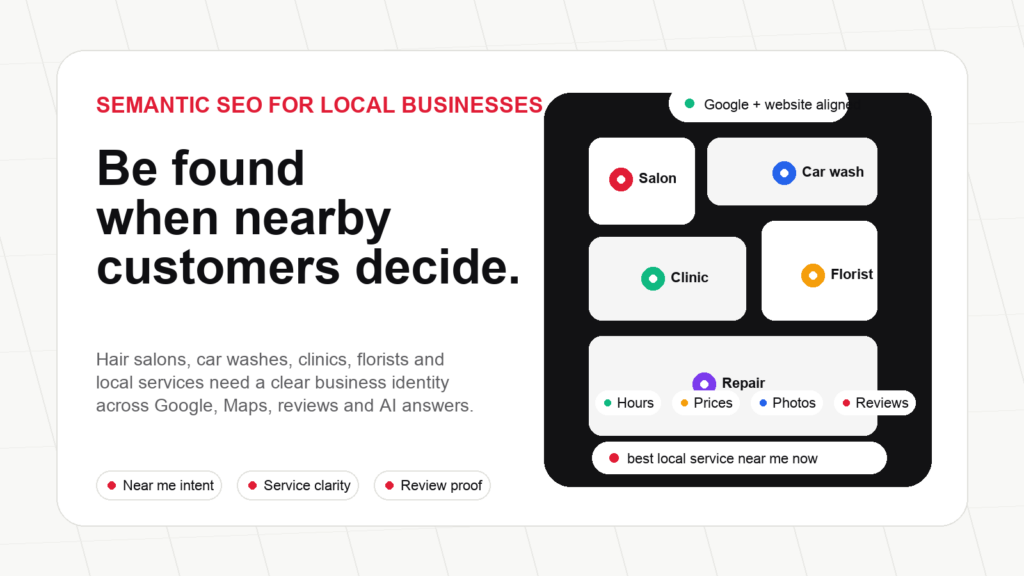
Local business SEO is where theory meets real life.
A person looking for a coafor, barbershop, salon, car wash, florist, private clinic, dry cleaner or repair shop is not doing abstract research. They usually want a nearby solution, a clear service, a price range, a trustworthy business and a simple way to book or call.
That is why semantic SEO for local businesses has to be practical. It is not enough to rank for “coafor Bucuresti” or “spalatorie auto aproape.” The business must become understandable as an entity: what it does, where it does it, who it serves, how appointments work and what makes it trustworthy.
In the AI Search era, this becomes even more important. If a user asks, “I need a good hair salon nearby for color correction today, with reviews and online booking,” an Answer engine needs structured facts. It needs to understand services, location, availability, reviews, photos, pricing and booking options. Generic text will not be enough.
Why local SEO is really semantic SEO
Traditional Local SEO often focuses on citations, Google Business Profile and keywords. Those still matter, but the deeper issue is meaning.
Search systems need to understand relationships:
- business to location;
- service to category;
- service to price or package;
- service to staff member or specialist;
- location to opening hours;
- reviews to trust;
- photos to proof;
- booking method to customer action;
- FAQ to customer objections.
A salon is not only a “salon.” It may offer women’s haircut, men’s haircut, balayage, color correction, keratin treatment, bridal styling and consultations. A car wash is not only a “car wash.” It may offer exterior wash, interior cleaning, detailing, ceramic protection, carpet cleaning and fleet subscriptions.
If the website does not explain those services clearly, Google and AI systems have to infer too much.
Nearby intent plus trust
Generic local SEO
Focus: one homepage, a phone number, a map embed and a few “near me” keywords.
This may be enough for very low competition, but it does not explain services or help customers choose.
Semantic local SEO
Focus: services, location, reviews, photos, prices, staff, opening hours, booking and local proof.
The business becomes easier to compare, cite and recommend.
“Near me” intent is not just proximity
Many business owners think “near me” search is only about distance. Distance matters, but it is not the whole decision.
A nearby customer may still compare:
- opening hours;
- availability today;
- service quality;
- reviews and review freshness;
- photos of real work;
- pricing clarity;
- parking access;
- online booking;
- staff or specialist experience;
- how fast the service can be completed;
- whether the business looks active and trustworthy.
For a hair salon, the user may care about before/after photos, color expertise and appointment availability. For a car wash, the user may care about waiting time, detailing packages and whether the interior cleaning is done properly. For a local clinic, the user may care about doctors, schedule and reviews. For a florist, the user may care about same-day delivery, occasion pages and real product photos.
This is semantic SEO because it translates the real buying criteria into structured website content.
The local business entities that need to be clear
Every local business should make its core entities easy to identify.
These usually include:
- business name;
- business category;
- physical address or service area;
- phone and contact methods;
- opening hours;
- core services;
- service packages or price ranges;
- staff or specialists where relevant;
- booking method;
- review profile;
- photos and proof of work;
- FAQs and customer objections.
Google’s documentation on local business structured data is useful here because it reinforces the importance of clear business identity information. Schema.org includes LocalBusiness, HairSalon and AutoWash, which show how different local business types can be represented as entities.
But Structured data is not a replacement for visible content. If customers cannot understand the services, location and booking process from the page, markup will not save the page.
Service pages should answer real customer questions
Many local business websites have a weak “Services” page with a short list. That is rarely enough.
A strong service page should explain:
- what the service includes;
- who the service is for;
- how long it takes;
- what price range or package exists if the business can publish it;
- what preparation is needed;
- what result the customer can expect;
- what photos or examples prove the work;
- how the customer books;
- which related services may be useful.
For a coafor, “hair coloring” should probably be broken into useful concepts: root touch-up, full color, balayage, highlights, color correction, toner, consultation and aftercare. For a car wash, “detailing” should explain interior detailing, exterior detailing, upholstery cleaning, polish, ceramic protection and time needed.
This does not mean creating thousands of thin pages. It means making the important services clear enough for customers and search systems.
Google’s guidance on helpful, reliable, people-first content applies directly. Helpful local content is not fancy. It answers what customers need before they call, book or visit.
Google Business Profile and website must agree
For local businesses, Google Business Profile is often the first impression. But the website still matters because it gives depth, detail and conversion context.
The two should agree on:
- business name;
- address;
- phone number;
- opening hours;
- main category and services;
- photos and visual proof;
- booking or appointment links;
- service descriptions;
- important policies.
When the profile says one thing and the website says another, trust weakens. When both are aligned, the business becomes easier to understand.
Reviews also need a practical workflow. A salon can ask after the appointment. A car wash can ask after the service is completed. A clinic can use QR codes at reception where appropriate. The important thing is to build a real review habit, not to fake reputation.
AI Search readiness for local businesses
AI Search is likely to favor businesses that are easy to summarize. A local business website should help an answer engine understand exactly when the business is a good recommendation.
Consider these prompts:
- “Find a good hair salon near me for balayage with good reviews and online booking.”
- “Where can I wash my car interior today near the airport?”
- “Which local florist can deliver a bouquet today and has real photos?”
- “I need a clinic nearby with evening hours and clear booking.”
A business that only has a generic homepage is hard to recommend. A business with clear services, location, reviews, photos, hours and booking is easier to include in a useful answer.
Google’s AI optimization guide points back to strong fundamentals: accessible, useful, crawlable content. For local businesses, that means operational information should be visible in HTML, not trapped inside images, social posts or booking widgets only.
The AYSA view: local businesses need SEO execution, not dashboards
In my opinion, local businesses do not fail at SEO because they lack advice. They fail because advice does not become execution.
A business owner running a salon, car wash, florist or local service does not want to live inside SEO tools. They want more relevant customers, fewer confusing dashboards and a website that reflects what the business actually offers.
This is where AYSA.ai fits.
AYSA can monitor the website, discover local SEO and AI visibility opportunities, prepare approval-ready updates and execute accepted changes inside the website workflow. For local businesses, that can mean service page improvements, FAQ updates, Google Business Profile tasks, internal links, content ideas, schema opportunities, review-driven content and technical fixes.
The user still approves important actions. But the manual work of finding, preparing and applying SEO improvements becomes much lighter.
For a small local business, that is the point: less SEO work, more organic growth.
Practical checklist for local business semantic SEO
- Create clear pages or sections for the most important services.
- Explain price ranges, packages or appointment requirements where possible.
- Show real photos, not only generic stock visuals.
- Keep Google Business Profile aligned with the website.
- Make opening hours, address, phone and booking easy to find.
- Build FAQs from real customer questions.
- Link related services together.
- Collect reviews ethically and consistently.
- Use structured data to support visible business information.
- Update content when services, prices or availability change.
Sources and further reading
- Google Search Central: Creating helpful, reliable, people-first content
- Google Search Central: AI optimization guide
- Google Search Central: Local business structured data
- Schema.org: LocalBusiness
- Schema.org: HairSalon
- Schema.org: AutoWash
- AYSA.ai glossary: Google Business Profile
- AYSA.ai glossary: Local SEO
- AYSA.ai: Semantic SEO In The AI Search Era
Turn nearby searches into approved website improvements.
If customers compare you by services, location, reviews, photos, price and booking, AYSA can help monitor the gaps, prepare the work and execute approved updates inside your website workflow.
Continue the AI search topic inside AYSA.
Use these pages to connect the article with AI SEO tools, AI visibility monitoring, AI Overviews and approved website execution.
Turn this topic into a website action plan.
Use these AYSA hubs to move from reading to technical fixes, AI visibility monitoring, research, glossary context and approval-first SEO execution.

