Semantic SEO For Car Rental: How To Make Rental Choices Easier To Trust
Semantic SEO for car rental connects airport pickup, fleet classes, insurance, deposit, total price, return rules, reviews and local intent into one clear search and AI visibility system.
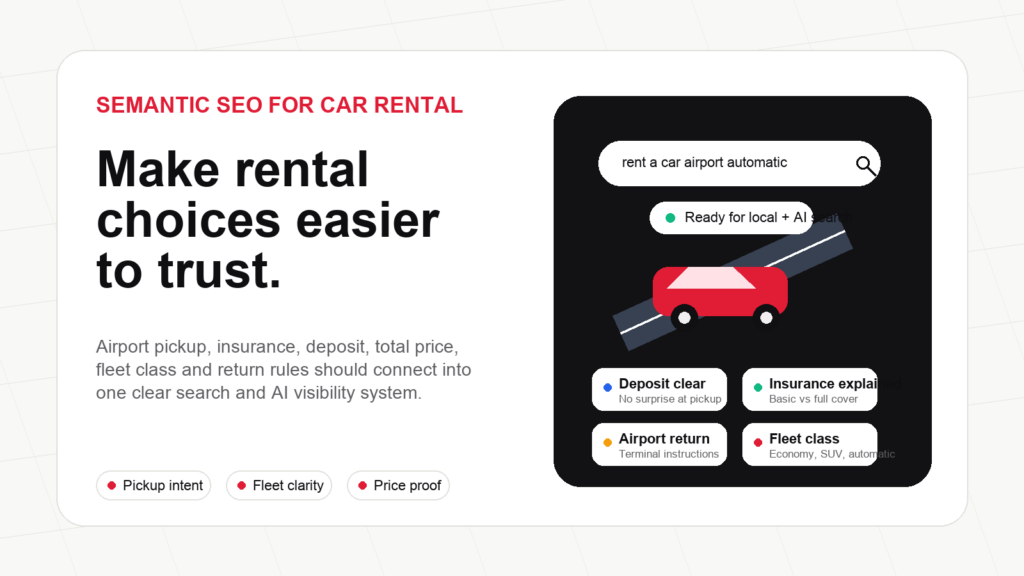
Car rental SEO looks simple from the outside: airport, city, car type, price. In reality, it is one of the most trust-sensitive local commerce categories.
A person searching for car rental is not only choosing a vehicle. They are choosing a promise: that the car will be available, the pickup will work, the price will not change unexpectedly, the deposit will be clear, the insurance will be understandable and the return process will not create trouble.
That is why semantic SEO matters. A generic page that says “cheap car rental near airport” may attract a visitor. A useful semantic page helps the visitor decide.
In AI-assisted search, this becomes even more important. If a user asks, “I land late at the airport and need an automatic rental car with full insurance and no hidden deposit surprises,” the Answer engine needs structured, visible, reliable information to compare providers. If your website does not explain those details, it becomes harder to recommend.
Why car rental SEO is different
Car rental is a high-intent category, but the buyer journey contains friction. Customers compare price, location, car class, insurance, deposit, pickup time, return policy, reviews and support. Many rental decisions fail because the website answers only part of that journey.
The typical renter wants to know:
- where pickup happens: airport terminal, office, shuttle point or hotel delivery;
- whether the vehicle class is guaranteed or only “similar”;
- what the total price includes;
- how large the deposit is;
- which insurance is included and which is optional;
- whether mileage is limited;
- what documents are required;
- whether credit card is mandatory;
- how late-night pickup works;
- what happens if the flight is delayed;
- how return and fuel policy work;
- whether other customers trust the company.
These are semantic SEO signals because they describe the real product. They are also conversion signals because they reduce anxiety.
Trust-sensitive local commerce
Generic rental page
Focus: city Keyword, airport keyword, “best price,” a few car photos and a booking button.
This may get Clicks, but it often leaves the customer unsure about insurance, deposit, pickup and total cost.
Semantic rental page
Focus: pickup, fleet class, price transparency, deposit, insurance, documents, reviews and return rules.
The business becomes easier to compare, trust, cite and recommend.
Renter intent is not one keyword
The phrase “car rental” hides many different jobs-to-be-done. Treating them as the same page creates shallow SEO.
Important intent clusters include:
- Airport intent: “rent a car airport,” “airport car rental late pickup,” “car rental near terminal.”
- Vehicle intent: “automatic car rental,” “SUV rental,” “7 seater car rental,” “economy rental car.”
- Price intent: “cheap car rental,” “car rental no hidden fees,” “weekly car rental price.”
- Deposit intent: “car rental without deposit,” “low deposit car rental,” “credit card required car rental.”
- Insurance intent: “full insurance car rental,” “CDW car rental,” “excess protection rental car.”
- Local intent: “car rental Bucharest,” “car rental Cluj,” “rent a car near me.”
- Use-case intent: “car rental for family holiday,” “business car rental,” “short term car rental.”
A semantic car rental website should map these intents to useful pages and sections. Not every phrase needs a separate page. But every important decision factor should be represented somewhere visible and internally linked.
This is similar to what we explained in semantic SEO for airport parking: the closer the service is to travel logistics, the more practical clarity matters.
The entities a car rental website must make clear
Car rental SEO works better when the website clearly defines the main entities and how they relate to each other.
Those entities usually include:
- rental company brand;
- pickup and return locations;
- airport or city served;
- vehicle classes;
- specific vehicles where available;
- transmission type: automatic or manual;
- fuel policy;
- mileage policy;
- insurance options;
- deposit rules;
- payment methods;
- required documents;
- customer support channels;
- reviews and reputation signals;
- booking, pickup and return workflow.
Google’s documentation for local business structured data is useful for basic business identity signals such as name, address, opening hours and contact details where appropriate. Schema.org also includes entities such as Car and RentalCarReservation, which show how machine-readable descriptions can represent cars and rental reservations conceptually.
But the visible website matters first. Structured data should support information that users can already see, not hide missing details behind markup.
Local and airport search are decision systems
Car rental businesses often depend on local and airport searches. That means the website and Google Business Profile should work together.
A strong local setup should include:
- consistent business name, address, phone and opening hours;
- clear pickup instructions;
- airport page where the business genuinely serves that airport;
- city/location pages where useful and unique;
- vehicle category pages with real differences;
- photos of vehicles, office, pickup point or shuttle if relevant;
- review acquisition handled ethically;
- links between fleet pages, location pages and FAQ pages.
The danger is duplicate local pages. Many rental websites create dozens of city or airport pages with the same text and a changed city name. That is not semantic SEO. It is page multiplication.
A real location page should explain what is different about that location: airport transfer, opening hours, pickup instructions, popular routes, local driving rules, nearby hotels, customer support and available fleet.
Trust and price clarity are SEO assets
Car rental has a trust problem globally because customers often fear hidden fees. Whether or not a specific business has that problem, users bring that anxiety into the search.
This is why clarity is part of semantic SEO.
A good car rental page should explain:
- what the displayed price includes;
- whether taxes or airport fees are included;
- whether insurance is included;
- what the deposit is and how it is blocked or returned;
- whether a credit card is required;
- fuel policy;
- mileage policy;
- late return rules;
- extra driver, child seat or GPS costs;
- cancellation policy.
This content helps users. It also helps search systems understand the offer. A page that clearly explains total cost and rental conditions is more useful than a page that only says “best car rental price.”
Google’s guidance on helpful, people-first content is relevant here. Helpful content in car rental means fewer surprises, more precise answers and a page that actually supports the decision.
AI Search readiness for car rental
AI-assisted search makes comparison queries more common. A user may ask:
“I land at Bucharest airport at midnight and need an automatic rental car for four days, preferably with clear insurance and low deposit. What should I compare?”
To answer that well, an AI system needs structured, visible information. It needs to understand the company, locations, vehicle types, booking rules, insurance options and proof signals.
Google’s AI optimization guide points back to accessible, helpful, crawlable content. For car rental, the practical implication is simple: do not hide the most important rental facts inside scripts, PDFs, images or vague booking flows. Put them on the page.
AI Search readiness for car rental means:
- airport and city relationships are clear;
- fleet classes are explained in plain language;
- insurance and deposit rules are visible;
- pickup and return processes are described;
- reviews and reputation signals are easy to verify;
- FAQs answer real rental objections;
- internal links connect locations, vehicles, policies and booking.
The AYSA view: car rental SEO fails when details stay outdated
In my opinion, car rental is a category where the gap between SEO strategy and execution becomes very visible.
An SEO consultant may correctly recommend better location pages, clearer insurance content, stronger vehicle category pages, FAQ improvements, internal links, schema opportunities and Google Business Profile cleanup. But if nobody updates the website consistently, the recommendation stays theoretical.
Car rental businesses need execution speed because the business changes often: prices, availability, airport instructions, pickup rules, seasonal demand, offers and customer questions. A website that was accurate three months ago may already be unclear today.
This is where AYSA.ai fits.
AYSA can monitor the website, detect SEO and AI visibility opportunities, prepare approval-ready changes, explain why they matter and execute accepted updates inside the website workflow. For car rental, that can mean improving airport pages, vehicle category pages, FAQ sections, internal links, technical SEO, Google Business Profile tasks and content around insurance, deposits and booking.
The point is not to publish blindly. The point is to reduce manual SEO work while keeping the business in control.
Practical checklist for car rental semantic SEO
- Create genuinely useful airport and city pages, not duplicated doorway pages.
- Explain pickup and return clearly for every important location.
- Build vehicle category pages around real renter needs.
- Make deposit, insurance and total price details visible.
- Add FAQ content for documents, credit card, late return, mileage and fuel policy.
- Connect fleet pages, location pages, policy pages and booking CTAs with internal links.
- Keep Google Business Profile accurate and aligned with the website.
- Use structured data to support visible business information.
- Monitor reviews and common customer objections.
- Update pages when fleet, prices, rules or airport instructions change.
Sources and further reading
- Google Search Central: Creating helpful, reliable, people-first content
- Google Search Central: AI optimization guide
- Google Search Central: Local business structured data
- Schema.org: Car
- Schema.org: RentalCarReservation
- AYSA.ai: Semantic SEO In The AI Search Era
- AYSA.ai: Semantic SEO For Airport Parking
- AYSA.ai glossary: Google Business Profile
- AYSA.ai glossary: Local SEO
Turn rental questions into approved website improvements.
If customers compare you by airport pickup, fleet, price, deposit, insurance and trust, AYSA can help monitor the gaps, prepare the work and execute approved updates inside your website workflow.
Continue the AI search topic inside AYSA.
Use these pages to connect the article with AI SEO tools, AI visibility monitoring, AI Overviews and approved website execution.
Turn this topic into a website action plan.
Use these AYSA hubs to move from reading to technical fixes, AI visibility monitoring, research, glossary context and approval-first SEO execution.