
Semantic SEO For Airport Parking: How To Win High-Intent Local Searches
Semantic SEO for airport parking connects distance, shuttle, price, booking, safety, reviews and airport intent into one clear local search and AI visibility system.
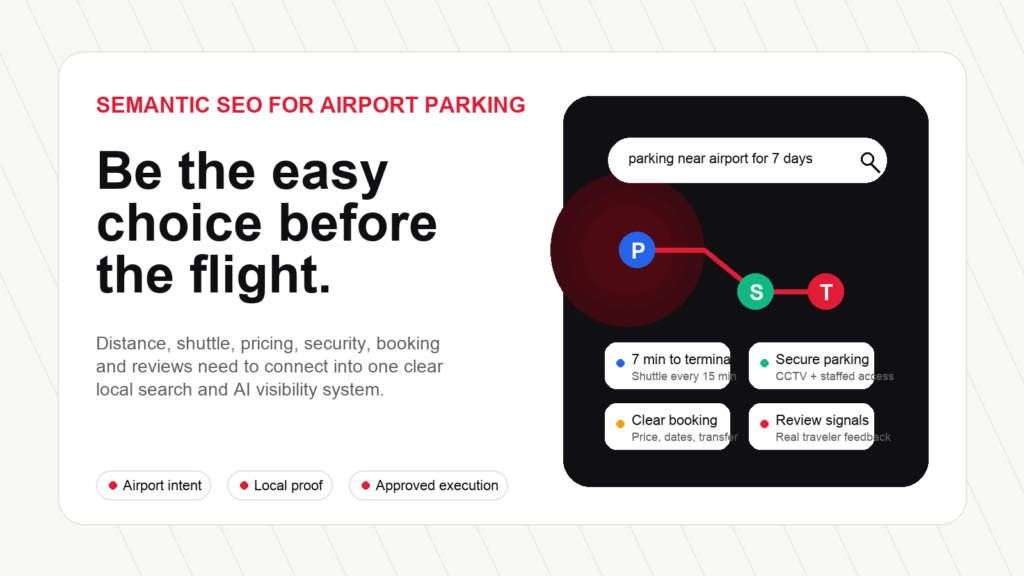
Airport parking is one of those Local SEO categories where the user is not browsing casually. The user is planning a trip, often under time pressure, and the cost of choosing badly feels high.
If someone searches for “parking near airport,” “long term parking Otopeni,” “airport parking with shuttle,” or “secure parking near terminal,” they are not looking for a poetic brand story. They want a decision they can trust before they leave home.
That is why semantic SEO for airport parking has to be practical. It has to answer the real questions behind the query:
- How far is the parking from the airport terminal?
- Is there a shuttle or transfer?
- How often does the shuttle run?
- How much does parking cost for 1 day, 3 days, 7 days or more?
- Is the parking secure, fenced, monitored or staffed?
- Can I reserve online?
- What happens if my flight is delayed?
- Where exactly do I go when I arrive?
- Do other travelers trust this parking?
A classic SEO page might optimize the Title tag and mention the airport name several times. A semantic SEO page connects the entire decision system. That is what helps both people and AI-assisted search understand why the parking option is relevant.
Why airport parking SEO is different
Airport parking is not a normal local service. It sits at the intersection of travel, logistics, trust and urgency.
A traveler searching for a restaurant near the airport may be flexible. A traveler searching for parking before a flight is not. They need to know whether the location is real, whether the transfer is predictable, whether the car will be safe and whether the booking process will work.
This makes airport parking a strong fit for semantic SEO because the important ranking and conversion signals are not only keywords. They are relationships:
- parking facility to airport terminal;
- parking product to duration and price;
- location to shuttle transfer;
- booking process to arrival instructions;
- review profile to trust;
- security features to risk reduction;
- FAQs to traveler objections;
- airport context to local relevance.
Search engines and answer engines need these relationships to understand the business. Travelers need them to make a decision.
High-intent local search
Generic parking page
Focus: “parking near airport,” a few price mentions, a phone number and maybe a map embed.
This can attract visitors, but it does not always reduce traveler anxiety or explain why the business is the safer choice.
Semantic parking page
Focus: airport distance, transfer, timing, price examples, security, booking, directions, reviews and delay policy.
The business becomes easier to compare, cite and recommend.
Traveler intent is layered
The phrase “airport parking” hides multiple intents. A good SEO system separates them instead of forcing all users into one landing page.
Common search intents include:
- Near-me intent: “parking near airport,” “parking near Otopeni airport,” “airport parking nearby.”
- Duration intent: “long term airport parking,” “7 days airport parking,” “cheap weekly airport parking.”
- Transfer intent: “airport parking with shuttle,” “parking with transfer to terminal.”
- Safety intent: “secure airport parking,” “guarded parking near airport.”
- Price intent: “airport parking price,” “airport parking cost per day.”
- Booking intent: “reserve airport parking online,” “book parking near airport.”
- Comparison intent: “best airport parking,” “airport parking reviews.”
These are not just Keyword variants. They are different decision moments.
A traveler leaving tomorrow may care most about availability and instructions. A family leaving for two weeks may care about long-term price, security and shuttle reliability. A business traveler may care about speed and receipt/invoice clarity. A semantic SEO structure should support each of these patterns.
This is the same principle we used in semantic SEO for HoReCa and tourism: local search works when the website reflects the user’s real decision criteria, not only the generic category name.
The entities an airport parking website must make clear
Semantic SEO depends on entities. For airport parking, the key entities are surprisingly concrete.
The website should make it easy to identify:
- the parking facility name;
- the airport served;
- the distance to terminal or transfer point;
- parking types: short-term, long-term, covered, uncovered, valet, shuttle parking;
- reservation options;
- pricing structure;
- opening hours;
- security features;
- shuttle or transfer process;
- payment methods;
- review and reputation signals;
- customer support contact details;
- policies for delays, cancellation or late pickup.
This is where Structured data can help, but structured data is not magic. Google’s documentation on local business structured data explains how businesses can mark up details such as name, address, opening hours and contact information where appropriate. Schema.org also includes ParkingFacility, which can be useful conceptually when describing a parking location.
But the visible page must carry the real value. If the page does not clearly explain transfer, security, booking and price, adding markup will not fix the experience.
Local proof matters more than generic content
Airport parking buyers need proof. A page that says “safe and close to the airport” is weak. A page that explains the exact process is stronger.
Strong local proof may include:
- exact address and map access;
- estimated transfer time to terminal;
- clear shuttle schedule or transfer instructions;
- photos of the entrance, parking area, shuttle and reception;
- review snippets or links handled ethically;
- security explanation: CCTV, lighting, fence, staff, access control;
- invoice or receipt details for business travelers;
- clear phone support for arrival issues;
- instructions for delayed flights or late-night pickup.
Google’s broader guidance on helpful, reliable, people-first content applies well here. The best airport parking content is not long for the sake of being long. It is useful because it removes friction from the traveler’s decision.
For Google Business Profile, consistency is also important. The business name, address, phone number, hours, photos, category, services and website should match the real business. If the parking operator has a physical location where customers arrive, local profile accuracy becomes a commercial asset, not only an SEO checkbox.
AI Search readiness: can the business be summarized correctly?
AI-assisted search changes the problem. A user may not search only “airport parking.” They may ask:
“I have a 6 AM flight and need secure parking near the airport for 5 days with shuttle transfer. What should I compare?”
For an answer engine to recommend or compare a parking option, it needs clear facts. If those facts are buried, missing or inconsistent, the business becomes harder to cite.
Google’s AI optimization guidance points businesses back to solid fundamentals: make content accessible, helpful, crawlable and useful for users. For airport parking, that means the important operational facts should be visible in HTML, not only hidden in images, booking widgets or PDFs.
AI Search readiness for airport parking means:
- the airport served is clearly stated;
- the distance and transfer method are clear;
- pricing examples are easy to understand;
- booking and cancellation steps are visible;
- security features are concrete;
- reviews and reputation signals are easy to verify;
- FAQs answer real traveler objections;
- the page avoids vague claims and uses specific facts.
As we explained in Semantic SEO In The AI Search Era, AI systems do not only look for keywords. They need extractable meaning. An airport parking business that writes clear, structured, specific information is easier to understand than one that relies on generic marketing language.
A strong airport parking page structure
A useful airport parking page should not read like a generic SEO text. It should feel like the traveler can make a decision from it.
A practical structure could include:
- Clear headline: parking near the specific airport, with the main value proposition.
- Fast facts: distance, transfer time, shuttle availability, opening hours, security and booking.
- Pricing section: daily and long-term examples, with a note that final price depends on dates if dynamic pricing applies.
- Transfer section: how customers get from parking to terminal and back.
- Security section: specific safety measures, not vague “safe parking” claims.
- Arrival instructions: what the driver does when arriving at the parking location.
- Return instructions: what happens after landing.
- Reviews and proof: ethical review prompts, real reputation signals and customer support details.
- FAQ: delay policy, cancellation, payment, night transfer, luggage, children, oversized vehicles.
- Booking CTA: reservation button visible without becoming aggressive.
For airport parking, FAQs are not decorative. They are conversion infrastructure. People want to know what happens if their flight is late, if they arrive at night, if the shuttle has space, if the parking is guarded and whether they can pay by card.
These questions are also semantically useful because they clarify the business model.
Common SEO mistakes airport parking businesses make
Many airport parking websites underperform because they treat SEO as a landing page problem, not an operating system problem.
Common mistakes include:
- one generic page for every airport-related query;
- unclear address or inconsistent map information;
- booking widget visible but no explanatory content;
- prices hidden until late in the funnel;
- no explanation of transfer frequency or pickup process;
- thin city/airport pages with duplicated text;
- poor mobile experience even though travelers often book from phones;
- missing FAQ content around delays and returns;
- generic “secure parking” claims without proof;
- outdated opening hours or contact details.
These are not small issues. They affect both ranking and conversion. They also affect whether AI systems can summarize the business accurately.
The AYSA view: airport parking SEO needs continuous execution
In my opinion, airport parking is exactly the kind of business where SEO fails when it stays in reports.
The market changes. Prices change. Shuttle instructions change. Competitors add offers. Reviews move. Travelers ask new questions. Airport procedures can change. A static SEO audit done once every few months is not enough.
An airport parking business needs a workflow that can continuously monitor pages, rankings, visibility, reviews, technical issues, FAQ gaps, booking friction and local proof. More importantly, it needs a way to turn that research into approved website changes.
This is where AYSA.ai fits naturally.
AYSA can monitor the website, prepare SEO and AI visibility actions, explain why they matter, ask for approval and execute accepted changes inside the website workflow. For a parking business, that can mean preparing updated service pages, internal links, FAQs, schema opportunities, Google Business Profile tasks, technical fixes, content improvements and local search monitoring.
The key is not to replace business judgment. The key is to remove the manual SEO work that usually prevents good ideas from becoming published improvements.
Airport parking is high-intent. High-intent pages deserve operational SEO, not generic copy.
Practical checklist for airport parking semantic SEO
- Create a dedicated page for each airport served if the business legitimately serves multiple airports.
- Show distance, transfer time and shuttle process clearly.
- Make pricing examples easy to understand.
- Explain security with specific details.
- Add clear arrival and return instructions.
- Use consistent business data across the website and Google Business Profile.
- Add FAQ content for delays, cancellations, payment and late-night pickup.
- Optimize mobile experience because travelers often book on phones.
- Use structured data only to support visible content.
- Monitor competitors and update the page when the market changes.
Sources and further reading
- Google Search Central: Creating helpful, reliable, people-first content
- Google Search Central: AI optimization guide
- Google Search Central: Local business structured data
- Schema.org: ParkingFacility
- AYSA.ai: Semantic SEO In The AI Search Era
- AYSA.ai: Semantic SEO For HoReCa And Tourism
- AYSA.ai glossary: Google Business Profile
- AYSA.ai glossary: Local SEO
- AYSA.ai glossary: Semantic SEO
Turn traveler intent into approved website improvements.
If people compare your business by distance, price, transfer, trust and reviews, AYSA can help monitor the gaps, prepare the work and execute approved updates inside your website workflow.
Continue the AI search topic inside AYSA.
Use these pages to connect the article with AI SEO tools, AI visibility monitoring, AI Overviews and approved website execution.
Turn this topic into a website action plan.
Use these AYSA hubs to move from reading to technical fixes, AI visibility monitoring, research, glossary context and approval-first SEO execution.

