
Semantic SEO For Pediatric Clinics: How To Help Parents Choose With Confidence
Semantic SEO for pediatric clinics means connecting symptoms, services, doctors, locations, reviews, booking, medical trust and safe content into a clear search and AI visibility system.
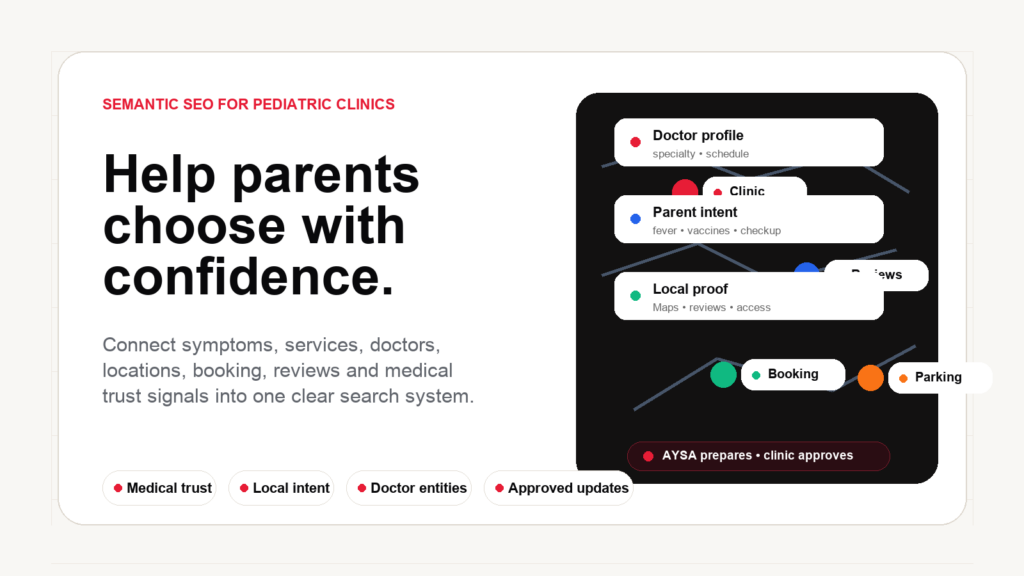
Semantic SEO for pediatric clinics is one of the clearest examples of why SEO has to move beyond keywords.
A parent does not search like a marketer. A parent searches from a situation: a toddler has recurring fever, a child needs a vaccine, a newborn needs a consultation, a parent wants a second opinion, or a family needs a private clinic with online booking, good reviews and easy access.
That kind of search is not only “pediatric clinic Bucharest.” It is a mix of medical concern, urgency, location, trust, logistics and emotional context.
A clinic like Adeomed.ro, as an example of a private pediatric clinic website, does not only need to be discoverable as a clinic. It needs to make clear what services exist, who provides care, how parents can book, where the clinic is located and why the information on the website can be trusted. I am not using Adeomed here to claim rankings or results. I am using it as a familiar example of the kind of clinic where semantic SEO should be practical, local and trust-driven.
As we discussed in our broader article on semantic SEO in the AI Search era, modern search is increasingly about meaning. For pediatric clinics, meaning is not abstract. It is the difference between a parent finding a useful, safe next step and landing on a generic page that says very little.
Why pediatric clinic SEO is different
Pediatric clinic SEO sits close to healthcare and YMYL territory. Google’s documentation around helpful, reliable content emphasizes content created for people, clear value, expertise and trust. In healthcare, the bar is naturally higher because users may make decisions that affect wellbeing.
That does not mean a clinic website should avoid content. It means content should be written and reviewed carefully. A pediatric clinic website should help parents understand services and next steps, not pretend to diagnose a child from a blog post.
A strong pediatric clinic website should clearly communicate:
- what pediatric services are available;
- which doctors or specialties are connected to those services;
- where the clinic is located and how parents can get there;
- how appointments work;
- what situations are appropriate for the clinic and what situations require emergency care;
- whether online booking, phone booking or reception booking is available;
- what trust signals exist: reviews, medical team, credentials, photos, policies and clear contact data;
- when the information was reviewed or updated.
Semantic SEO is the structure that connects all of these signals.
Healthcare-safe
Generic medical SEO
Focus: “pediatric clinic” Keyword, a general service page, a few medical blog posts and a phone number.
This can rank sometimes, but it does not always help a parent compare options or understand the next step.
Semantic pediatric SEO
Focus: symptoms, services, doctors, booking, location, reviews, age groups, safety boundaries and structured trust signals.
The clinic becomes easier to understand, cite and recommend.
Parent intent is not one keyword
The biggest mistake in pediatric clinic SEO is treating all parent searches as the same intent.
Parents may search with very different needs:
- urgent concern: “child fever 39 when to go to doctor”;
- service need: “pediatric consultation Bucharest”;
- specialty need: “pediatric neurologist private clinic”;
- logistics need: “pediatric clinic with online booking and parking”;
- trust need: “best pediatric clinic reviews Bucharest”;
- preventive care: “vaccination schedule consultation child”;
- newborn care: “neonatology consultation private clinic.”
A semantic pediatric website should map these intents to the right pages. A fever information article should not pretend to replace medical advice. A service page should explain what the clinic offers and how parents can book. A doctor profile should show specialty and schedule. A Location page should explain access, parking and appointment flow if those details matter to parents.
This is where many clinic websites underperform. They have services, doctors and blog posts, but they are not connected into a parent journey.
Clinic entities: services, doctors, locations and proof
A pediatric clinic is a collection of entities. Search systems need to understand those entities and their relationships.
The most important entities usually include:
- the clinic brand;
- medical specialties;
- doctors and medical staff;
- services and consultations;
- age groups: newborn, infant, toddler, child, adolescent;
- locations and service areas;
- appointment methods;
- reviews and reputation signals;
- policies, pricing guidance and contact details.
A strong semantic structure links these together. A page about pediatric consultations should link to doctors, relevant symptoms, booking, location and related services. A doctor page should link to specialties and services. A Google Business Profile should match the website’s contact details and business identity. Internal links should not be random; they should express the real care model of the clinic.
This is also why doctor profile pages matter. They are not only “team pages.” They help establish expertise, author/reviewer context and confidence.
Local and Maps visibility matter more than generic traffic
For pediatric clinics, local search and Google Maps are often more important than broad informational traffic. Parents usually need care in a specific city or neighborhood, with practical constraints: distance, schedule, reviews, parking, online booking and phone availability.
A semantic Local SEO structure should connect:
- clinic name, address, phone and opening hours;
- Google Business Profile consistency;
- service area and city pages where useful;
- doctor availability and booking options;
- review signals handled ethically;
- photos of the clinic, reception or facilities where appropriate;
- directions, parking or public transport information if relevant.
For a parent comparing pediatric clinics in Bucharest, “good reviews” and “easy booking” can matter as much as a technical definition of pediatrics. Semantic SEO should reflect that reality.
This connects with the same logic we used in semantic SEO for HoReCa and tourism: local search is not only about city keywords. It is about the decision criteria people actually use.
Medical content should be helpful, safe and reviewed
Pediatric content is valuable when it helps parents understand what to do next. It becomes risky when it sounds like diagnosis, treatment or definitive medical advice without context.
Good pediatric content should:
- use plain language;
- explain common situations carefully;
- state when urgent care may be needed;
- avoid exaggerated claims;
- include medical review where possible;
- link to relevant services and doctor profiles;
- be updated when recommendations or clinic processes change;
- make it easy to book or contact the clinic.
For example, a page about recurring fever in children should not simply chase traffic. It should explain what parents often ask, what information a doctor may need, when to seek urgent care and how to schedule an appropriate consultation. The goal is not to replace the pediatrician. The goal is to help the parent take a safer, clearer next step.
That is the difference between content volume and trust-building content.
AI Search readiness for pediatric clinics
AI Search and answer engines are likely to reward clarity. They need to extract, compare and summarize information. A pediatric clinic website should therefore make important information easy to identify:
- which pediatric services exist;
- which doctors are associated with each service;
- what age groups are served;
- how appointments work;
- where the clinic is located;
- what reviews or reputation signals support trust;
- what content is informational and what requires consultation.
Consider a query like: “I need a pediatric clinic in Bucharest for a toddler with recurring fever, preferably private, good reviews, easy parking and online booking. What should I compare?”
A weak clinic website may only say “pediatrics services.” A strong semantic website can help an AI system identify consultation availability, doctor profiles, location, booking, reviews, parking/access information and safe medical boundaries.
The AYSA view: pediatric SEO needs speed and control
In my opinion, pediatric clinics do not need more SEO confusion. They need a system that can continuously prepare useful improvements and keep medical approval in the loop.
A clinic website may need better service pages, stronger doctor profiles, clearer booking information, local SEO improvements, Google Business Profile consistency, schema opportunities, internal links between symptoms and services, FAQ improvements and AI visibility monitoring. Most clinics do not have time to manually manage all of this every week.
This is where AYSA.ai fits.
AYSA can monitor the website, identify SEO and AI visibility opportunities, prepare approval-ready changes and execute accepted updates inside the website workflow. For healthcare-adjacent websites, the approval layer is not a detail. It is essential. AYSA should help the clinic move faster without giving up responsibility over what gets published.
That is especially important for pediatric clinics. Parents need clarity. Doctors need accuracy. The business needs visibility. Search systems need structure. Semantic SEO connects all four.
Practical checklist for pediatric clinic semantic SEO
- Create clear pages for core pediatric services.
- Connect each service to relevant doctor profiles where appropriate.
- Explain booking, schedule, location and access details clearly.
- Use Google Business Profile consistently with the website.
- Build safe informational content around parent questions.
- Add medical review or author context for sensitive content.
- Use structured data only when it reflects visible content.
- Link related services, symptoms, age groups and appointment pages.
- Keep reviews and reputation signals ethical and accurate.
- Monitor changes in search, AI visibility and local performance continuously.
Sources and further reading
- Google Search Central: Creating helpful, reliable, people-first content
- Google Search Central: AI optimization guide
- Google Search Central: Introduction to structured data
- Schema.org: MedicalClinic
- Google Business Profile Help: Business Profile guidelines
- AYSA: Semantic SEO in the AI Search era
- AYSA: Semantic SEO for law firms
- AYSA Glossary: Google Business Profile
- AYSA Glossary: YMYL
- AYSA Glossary: E-E-A-T
Turn clinic visibility into approved website improvements.
AYSA helps clinics and local service businesses monitor SEO and AI visibility, prepare useful actions, request approval and execute accepted changes inside the website workflow.
Continue the AI search topic inside AYSA.
Use these pages to connect the article with AI SEO tools, AI visibility monitoring, AI Overviews and approved website execution.
Turn this topic into a website action plan.
Use these AYSA hubs to move from reading to technical fixes, AI visibility monitoring, research, glossary context and approval-first SEO execution.

