
Brand Pages vs. Conversion Pages: The SEO Strategy That Stops Internal Fights (and Grows Revenue)
Trying to make every page rank, persuade, and convert is how companies end up with messy site architecture, weaker SEO, and worse conversion rates. Here’s a practical framework for separating page jobs, protecting what must not change, and using an approved execution workflow to scale both authority and revenue—without the CRO-vs-SEO tug-of-war.
By Marius Dosinescu (AYSA.ai)
Most websites don’t have an SEO problem or a conversion problem. They have a page purpose problem.
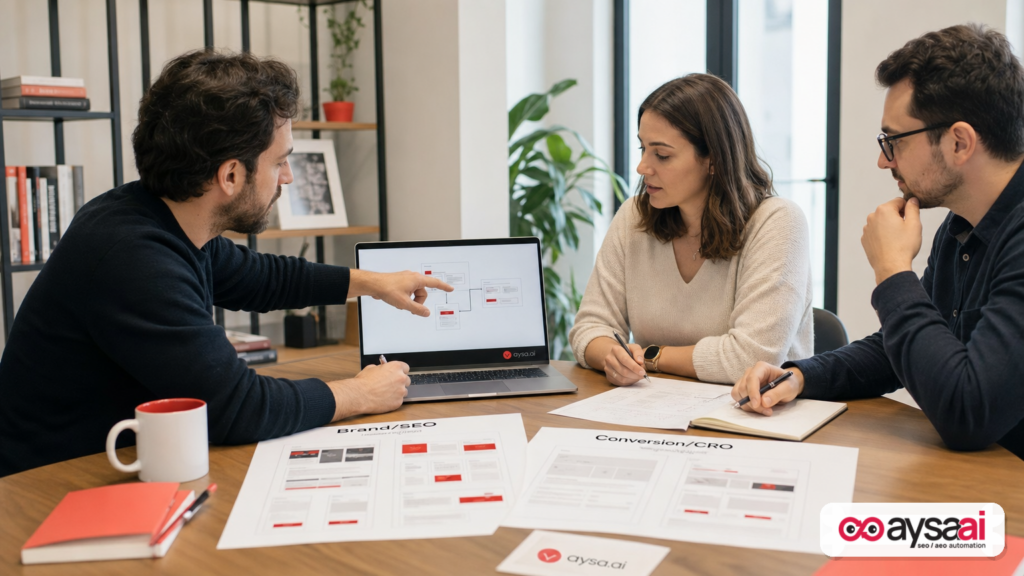
When leaders demand that every page ranks in Google, builds brand authority, and converts like a paid landing page, teams start fighting. SEO wants more context and internal links. CRO wants fewer distractions and fewer words. Brand wants voice, polish, and hero video. Engineering wants fewer changes. The result is predictable: diluted search relevance, messy architecture, fragile experiments, and conversion “wins” that quietly cost you organic growth.
This editorial is inspired by the practical guidance in Search Engine Journal’s Ask An SEO on balancing brand-building pages with converting pages (source). I’m going to take the core idea—different pages have different jobs—and expand it into a full operating system you can run as an SME or agency: taxonomy, guardrails, measurement, and execution workflow (including how AYSA fits when you need changes implemented safely and consistently).
Concise summary
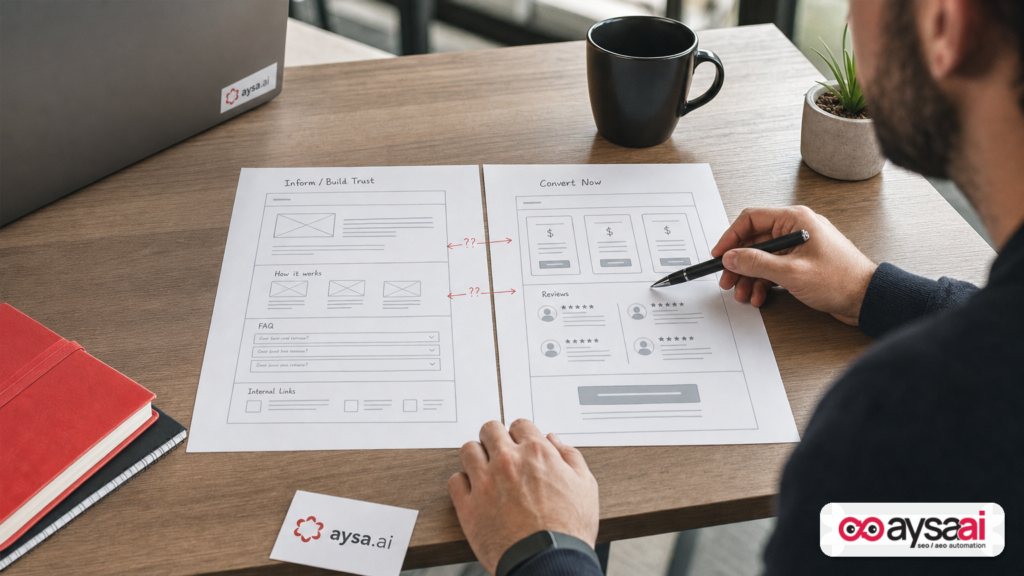
- Stop trying to make one URL do two incompatible jobs. Separate “authority/SEO” pages from “conversion/CRO” pages by design.
- Create a page taxonomy and boundaries (including off-limit folders and must-keep elements) so teams can move fast without breaking organic visibility.
- Measure the right outcomes for each page type. Don’t judge informational content by last-click conversions.
- Use Approved Execution. The highest-performing teams don’t just have strategy—they have a system that monitors, proposes, validates, gets approval, and ships changes without accidental SEO regressions.
Key takeaways (the non-negotiables)
- Page purpose comes first. Define what a page is for before you write, redesign, or test anything.
- SEO and CRO can collaborate—but not by merging tactics blindly. Collaboration is about guardrails, not compromise-by-confusion.
- Protect stable ranking assets. Your category/collection pages, evergreen guides, and citation-worthy resources often carry more durable search value than individual product pages or short-lived campaigns.
- Don’t let experimentation create index bloat. Split tests, temporary pages, and campaign URLs can easily create crawl and duplication issues if unmanaged.
- Execution is the bottleneck. If your team can’t ship changes safely and consistently, the strategy is just a slide deck.
Table of contents
- What changed: why “page purpose” matters more in modern search
- The real problem: when one page is forced to do two incompatible jobs
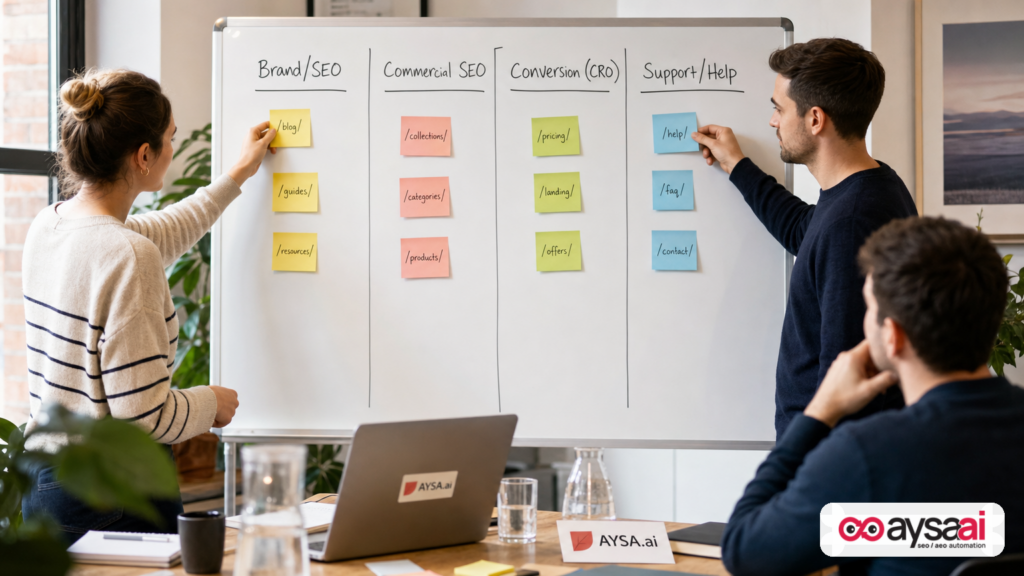
- A practical page taxonomy: four page types every SME should define
- Boundaries that prevent internal fights: folders, templates, and ownership
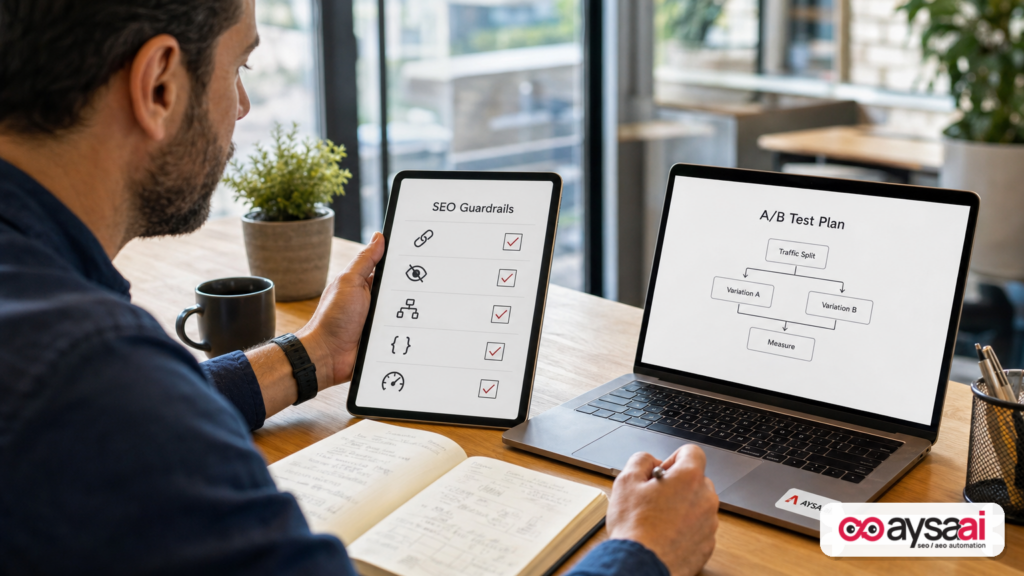
- Guardrails that prevent CRO tests from breaking SEO (without blocking experimentation)
- How to measure success by page job (not by wishful thinking)
- An SME scenario: the ecommerce brand that lost rankings by “optimizing” product pages
- What agencies should rethink: deliverables, approvals, and change control
- Where AI search visibility fits (AEO/GEO): citations, trust, and page intent
- Where AYSA fits: monitoring + approved execution for SEO/CRO alignment
- What to do next: a 30-day action plan you can actually run
- Sources and further reading
What changed: why “page purpose” matters more in modern search
Ten years ago, you could sometimes get away with “one page does it all.” You’d publish a long landing page, stuff it with FAQs, sprinkle internal links, and then slap a call-to-action at the end. It might rank. It might convert. And because the web was less competitive, it might even do both decently.
Today, the conditions are different:
- Search intent is interpreted more aggressively. Google tries to decide what a query “means” and rewards pages that match that intent cleanly (informational vs. commercial vs. navigational).
- Index quality matters. Bloated, duplicative, test-generated URLs can reduce crawl efficiency and muddy topical signals.
- AI-driven experiences raise the bar for clarity. Whether you call it AEO (Answer Engine Optimization) or GEO (Generative Engine Optimization), models tend to cite and summarize content that is structured, authoritative, and unambiguously helpful—not pages that read like a brochure disguised as a guide.
This is the uncomfortable truth: your internal organization is now a ranking factor in practice. Not directly in the algorithm, but in what it produces—consistent templates, stable URLs, clear topical ownership, and fewer accidental regressions.
The Search Engine Journal column we’re using as a research lead makes the core point succinctly: CRO pages and SEO pages do different jobs; define each page’s purpose, set boundaries, and both traffic and revenue can grow (Search Engine Journal).
I agree—and I’ll go one step further: the boundary is not a “best practice,” it’s an operating model.
The real problem: when one page is forced to do two incompatible jobs
Here’s the simplest way to explain the conflict to a non-SEO leader:
- SEO/authority pages are hired to earn attention: rankings, links, citations, shares, brand recall, email signups, and future demand.
- Conversion pages are hired to close: purchases, booked calls, demos, quote requests, checkout completion, or whatever your revenue event is.
Those jobs require different choices.
What SEO pages often need to perform
- Clear topical coverage (not just “brand story”)
- Stable headings that map to real questions
- Internal links that connect related concepts
- Structured markup where appropriate (schema)
- Content that earns trust by being specific, not promotional
What conversion pages often need to perform
- Reduced cognitive load (less choice, fewer exits)
- Message hierarchy: value prop → proof → offer → CTA
- Objection handling (pricing, shipping, risk reversal)
- Fast page experience with minimal render-blocking experiments
When you merge those without discipline, you tend to create a hybrid that satisfies nobody: a guide that reads like an ad, or a landing page that reads like a textbook.
SEJ’s example list of common CRO actions that can harm SEO is worth taking seriously: removing copy, moving key elements, prioritizing brand headers over topical headers, pushing content down for design reasons, launching split tests without checking canonicals or robots directives (SEJ source).
None of those actions are “bad.” They’re just bad when applied to the wrong page type—or applied without technical safeguards.
A practical page taxonomy: four page types every SME should define
If you want fewer internal fights and better outcomes, don’t start with keywords. Start with a taxonomy of page jobs.
For most SMEs (and many mid-market companies), four page types cover 90% of the chaos:
1) Authority / Informational (Brand-building + SEO)
Job: Earn attention and trust.
Examples: blog posts that answer real questions; evergreen guides; comparisons that are honest; industry explainers; “how to” content that solves a problem without pushing a sale in the first paragraph.
Primary KPIs: Impressions, rankings for non-branded queries, engaged sessions, newsletter signups, assisted conversions, backlinks/citations (where applicable).
Common mistake: turning every paragraph into a pitch. Informational content that feels like a brochure tends to underperform and may struggle to be cited or shared.
Commercial SEO (bridging content)
Job: Capture high-intent search without becoming a pure landing page.
Examples: category/collection pages; service pages optimized for “best + category” intent; comparison pages that legitimately help someone choose; “alternatives” pages that address real evaluation behavior.
Primary KPIs: rankings for commercial terms, click-through rate from SERPs, product views/service inquiries, assisted and direct conversions.
Common mistake: thin pages with just product grids or generic service blurbs—no differentiation, no internal linking, no reason to rank.
Conversion / CRO pages (paid + lifecycle)
Job: Convert known demand efficiently.
Examples: paid landing pages; webinar registration pages; partner campaign pages; seasonal promotions; dedicated “demo” pages where you want fewer exits.
Primary KPIs: conversion rate, cost per acquisition (if paid), lead quality, pipeline/revenue per session.
Common mistake: letting these pages get indexed broadly, compete with evergreen SEO assets, and create duplication that dilutes topical authority.
Support / Help / Documentation
Job: Reduce friction after purchase and deflect support volume (and sometimes win long-tail search that matches help intent).
Examples: FAQs, knowledge base articles, shipping policies, troubleshooting, onboarding docs.
Primary KPIs: support tickets reduced, time-to-resolution, customer satisfaction; selectively, long-tail organic visits that match “how do I” help intent.
Common mistake: mixing support docs into the marketing blog without structure, or noindexing everything out of fear—then losing visibility on high-intent “problem” queries.
Once you label the page types, you can make decisions that feel obvious instead of political.
Boundaries that prevent internal fights: folders, templates, and ownership
Strategy fails when it’s enforced by tribal memory (“Don’t touch that page!”) instead of structure.
SEJ recommends creating a simple guide for page types, plus a map of pages/folders that are off-limits for CRO changes, plus a tech SEO guide for common CRO tasks (SEJ source). This is the right direction—especially at enterprise scale—but SMEs can do a smaller version and still win.
Folder strategy (simple, enforceable)
Use URL structure to communicate intent:
/blog/or/guides/for authority/informational/collections/,/categories/, or/services/for commercial SEO/lp/or/campaigns/for conversion pages (often noindex or tightly controlled)/help/or/support/for documentation
The point is not aesthetics—it’s governance. When a CRO specialist sees /lp/, they should assume freedom to test. When they see /guides/, they should assume constraints and review.
Ownership: who decides what on which pages
Define decision rights by page type:
- Authority/SEO pages: SEO/content lead owns structure, headings, internal links, schema decisions.
- Conversion pages: CRO owns layout and testing cadence; SEO owns indexing rules and canonical/robots safeguards.
- Commercial SEO pages: shared ownership, but with a pre-agreed template and “do not break” elements.
- Support docs: support/product owns accuracy; SEO owns discoverability rules and internal linking strategy.
If you skip this step, every discussion becomes subjective. If you define it, discussions become operational.
Off-limits pages (and why “off-limits” doesn’t mean “untouchable”)
Off-limits should mean: “No changes without review,” not “Never change anything.”
Examples of pages that often deserve protection:
- Evergreen guides that consistently rank and attract links
- Category/collection pages that drive a meaningful share of non-branded traffic
- Partner or PR assets used for link acquisition and citations
- Local landing pages that anchor NAP consistency and core service intent
Write down what breaks if someone edits them: internal links removed, headings changed, FAQ blocks deleted, schema removed, canonicals misconfigured. Keep it plain English—SEJ is right that long, complex documents get ignored (SEJ).
Guardrails that prevent CRO tests from breaking SEO (without blocking experimentation)
Conversion teams should test aggressively. But tests must be designed so they don’t create SEO collateral damage.
SEJ highlights several technical pitfalls around split testing: accidental indexing of variants, canonical mistakes, and robots directives overlooked (SEJ). Those are not rare—they’re common in fast-moving teams.
Here are guardrails that work in the real world.
Guardrail 1: Canonical discipline for test variants
If you’re creating multiple URLs for a test, make sure your canonical strategy is explicit.
- One “main” URL that should exist long-term.
- Variant URLs that reference the main URL as canonical.
Important: if you aren’t sure whether your testing tool creates new URLs, modifies DOM, or serves content via scripts, don’t guess. Get clarity from your engineering/dev resources and validate behavior in a controlled way.
Guardrail 2: Indexing rules for campaign pages
Most campaign landing pages should not be competing with evergreen SEO assets. Your choices:
- Noindex, follow if you want the page usable for users and internal linking but not indexed as a competing search result.
- Canonical to a primary evergreen page if the campaign page substantially overlaps the evergreen intent.
- Allow indexing only when the page is intentionally a long-term organic landing page with unique intent and content.
These are strategic decisions, not defaults.
Guardrail 3: Don’t let “brand messaging” steal your headings
One subtle SEO killer is when a brand refresh rewrites headings to be clever instead of clear.
A heading like “Designed for Motion” might look great on a homepage hero. But on a category page for “Running Shoes,” it can remove critical context and reduce relevance for both users and search engines. Put the brand poetry in body copy, not in the structural labels that define what the page is about.
Guardrail 4: Preserve internal links and navigational cues
CRO teams sometimes remove navigation, breadcrumbs, or “related guides” modules to reduce exits. That can be valid on paid landing pages. It’s often harmful on SEO pages and commercial SEO pages.
Internal links aren’t just for SEO. They’re for humans who are still deciding.
Guardrail 5: Validate rendering impact of scripts and tools
SEJ specifically warns that scripts placed in the page head can affect rendering and visibility, and suggests validating pages in Google Search Console to see whether the page renders correctly (SEJ).
Even if you don’t have a deep technical background, your operating rule should be: new scripts are guilty until proven harmless—especially those that manipulate content, inject elements, or change link behavior.
If you need official documentation for your team, start with Google Search Console as the primary tool for site owners (Google’s official product site is here: Google Search Console). For analytics and conversion measurement, Google Analytics is the common baseline (Google Analytics).
How to measure success by page job (not by wishful thinking)
Most leadership arguments happen because teams are judged on the wrong metric for the page type.
Here’s the mental model:
- Authority pages create demand and trust that converts later.
- Commercial SEO pages intercept existing demand.
- Conversion pages monetize traffic efficiently.
KPIs for authority/SEO pages
- Search impressions and clicks over time (trend matters more than spikes)
- Ranking coverage across related queries (not just one “money keyword”)
- Engagement signals you trust internally (time on page, scroll depth, return visits—choose a small set and be consistent)
- Newsletter signups / lead magnets (soft conversions)
- Assisted conversions (in GA4 or your analytics stack)
Notice what’s not on the list: “last click revenue.” That metric belongs to conversion pages and product-led funnels. If you hold a guide to the same standard as a checkout page, you’ll pressure your content into becoming promotional—and then it underperforms at its actual job.
KPIs for commercial SEO pages
- CTR from the SERP (title/meta alignment with intent)
- Click-through to product/service detail pages
- Add-to-cart rate or lead initiation rate
- Revenue per session (not just conversion rate)
KPIs for conversion pages
- Primary conversion rate (purchase, booked call, demo request)
- Form completion quality (sales feedback loop)
- Experiment velocity with quality control (how many tests shipped without regressions)
The bridge metric: assisted conversion paths
If you’re an SME and you want one metric that reduces political fights, it’s this: How often do authority pages appear in the journey before conversion?
You don’t need perfect attribution. You need a directional truth that the business trusts.
An SME scenario: the ecommerce brand that lost rankings by “optimizing” product pages
Let’s make this real.
Imagine a growing ecommerce brand that sells specialty running gear. The CRO team reviews recordings and sees that visitors don’t scroll. They propose a redesign: remove the long product descriptions, move reviews above the fold, and replace technical headings with lifestyle headings to match brand voice.
Conversions on a few paid campaigns improve. Everyone celebrates. Then organic traffic to product-related queries starts slipping.
What happened?
Issue 1: Product pages were doing a job they shouldn’t have been doing
In many ecommerce businesses, the category/collection page is the stable SEO asset, not the product page. Products go out of stock. Variants change. URLs get retired. Collections stay.
SEJ makes this point clearly: product pages often aren’t the priority for ranking, especially when category pages can provide stability (SEJ).
If your product pages were ranking, it might be because your collection pages were thin—or because the site architecture didn’t give Google a better option. The fix isn’t to force product pages to carry SEO forever. The fix is to build strong commercial SEO pages (collections) and let product pages focus on conversion.
Issue 2: The redesign removed topical clarity
When headings and descriptive blocks disappear, you may remove:
- Unique product differentiation (materials, sizing, use case)
- Internal linking context (what this product relates to)
- On-page relevance cues (plain language matters)
Not every page needs more words. But pages that rank usually need enough information to match intent. If you strip too much, the page becomes interchangeable.
Issue 3: Tests created duplication or indexing noise
If test variants were crawlable, you might have created competing URLs or diluted signals. Even if the site “looked fine,” the index could have become messy.
A clean resolution (without killing CRO)
- Rebuild collection pages to own non-branded search intent (commercial SEO job).
- Define product pages as primarily conversion pages.
- Keep a minimal set of SEO-critical elements on product pages (e.g., product name clarity, structured data where appropriate, internal links back to collections).
- Move deep educational content into guides linked from collections (authority/SEO job).
- Run CRO tests in a controlled environment with canonical and indexing safeguards.
This is how you get both: conversion velocity and durable organic growth.
What agencies should rethink: deliverables, approvals, and change control
Agencies often get trapped in a bad contract dynamic:
- They’re hired to “do SEO.”
- They deliver audits, content briefs, and recommendations.
- Then they wait weeks for implementation.
- CRO or brand teams ship changes that undo the recommendations.
That’s not an SEO problem. It’s an execution governance problem.
Shift from “recommendations” to “operating rules”
Instead of only shipping audits, ship:
- A page taxonomy with ownership and boundaries
- Template-level must-keep elements (by page type)
- An experimentation policy: where tests can happen, how variants are handled, and what must be checked
- A change log discipline (what changed, when, and why)
Make approvals part of the work—not an afterthought
Most SEO damage is accidental. People move fast, copy gets deleted, scripts get added, redirects get launched, and nobody connects the dots.
If you want to be a modern agency (or a modern internal team), you need a workflow where changes are:
- proposed,
- validated against rules,
- approved by the right owner,
- and then deployed—consistently.
That’s exactly where “approved execution” becomes a competitive advantage, not just a nice-to-have.
Where AI search visibility fits (AEO/GEO): citations, trust, and page intent
AI-driven discovery rewards clarity and usefulness. Whatever your view of the acronym wars (AEO, GEO, AIO), the behavior is consistent: systems summarize, compress, and cite what appears reliable and directly relevant.
Here’s why page purpose matters even more in this environment:
- Informational pages are more likely to be summarized or cited when they read like instruction and reference, not like a pitch deck.
- Commercial pages need structured clarity (what is this category, who it’s for, what options exist) to be understood.
- Conversion pages can still win, but usually as the end destination once the user has intent—not as the “answer.”
In other words: if you want AI visibility, you need content that is comfortable being extracted and summarized. That’s hard to achieve when every page is written primarily to convert immediately.
If you’re building toward AI search visibility as a capability (not a buzzword), start here: AYSA AI Search Visibility.
Where AYSA fits: monitoring + approved execution for SEO/CRO alignment
Most teams already know what they should do:
- define page types,
- protect key SEO assets,
- test safely,
- and keep a clean index.
The breakdown happens in the middle: execution at scale.
AYSA is built for that middle layer. Practically, here’s how it supports the strategy in this editorial:
1) Monitor what actually changes (before traffic drops)
When teams touch templates, page blocks, internal linking modules, or metadata, the effects can be silent until rankings move weeks later. Monitoring is how you shorten the time-to-diagnosis.
See: AYSA Monitoring.
2) Prepare changes with guardrails
Instead of “someone edited a page in production,” the workflow becomes: propose a change, check it against page-type rules, and flag risks (canonicals, noindex, schema removal, internal links).
3) Ask for approval from the right owner
Authority pages shouldn’t be rewritten by someone optimizing a paid funnel without review. Conversion pages shouldn’t be stuffed with SEO blocks by someone chasing a keyword. Approval routing prevents both mistakes.
4) Execute accepted changes consistently
Once approved, execution shouldn’t depend on a developer being available at the perfect moment. The business needs a reliable system to ship changes cleanly and track what happened.
If you want the tool-level view of how AYSA supports modern SEO operations—including AI search workflows—start here: AYSA AI SEO Tools.
If you’re evaluating whether this model fits your team size and change velocity, pricing and packaging are here: AYSA Pricing.
And if you want more operational playbooks like this, browse: AYSA Blog.
What to do next: a 30-day action plan you can actually run
This is the step-by-step plan I’d run if I walked into a typical SME with organic traffic goals and a CRO roadmap.
Week 1: Inventory and label every revenue-relevant URL
- Export your top pages by organic traffic and by revenue/lead events.
- Label each page as: Authority, Commercial SEO, Conversion, Support.
- Identify “hybrids” where teams disagree—that’s where conflict lives.
Week 2: Define templates and must-keep elements by page type
- Authority page must-haves: heading structure, internal link modules, FAQ placement (if used), schema policy.
- Commercial SEO must-haves: category intro copy policy, filters/navigation, breadcrumbs, internal links to subcategories and guides.
- Conversion page must-haves: indexing rules, canonical policy, experiment policy.
Week 3: Create off-limits list + experiment sandbox rules
- List protected URLs and/or folders that require SEO approval before changes.
- Create a dedicated location/pattern for temporary tests and campaigns.
- Document the minimal technical checklist for A/B tests (canonicals, indexing, rendering sanity check).
Week 4: Fix the biggest mismatch and ship one clean win
- If product pages are ranking because collections are weak: strengthen collections.
- If guides are too salesy: rewrite intros and section headers to match the informational job.
- If landing pages are indexed and competing: apply noindex/canonical strategy.
- Set up monitoring so you know when protected elements change.
What to do next (checklist)
- Pick 10 key URLs and write one sentence for each: “This page exists to ____.” If you can’t write it, you don’t have page purpose.
- Decide which pages are allowed to be ugly-but-clear (SEO) and which must be frictionless (CRO). Don’t pretend they’re the same.
- Create a protected list of URLs/folders that can’t be modified without review.
- Stop indexing test junk. Make a policy for experiments and campaign pages.
- Implement monitoring and approved execution so changes don’t silently erode your search visibility.
Sources and further reading
- Search Engine Journal (Ask An SEO): How Do I Split Pages Between Brand Building & Converting?
- Google Search Console (official): Search Console
- Google Analytics (official): Google Analytics
Note: The SEJ page includes navigational links (e.g., SEO News, Webinars, category hubs). Those are useful for broader learning, but the primary research input for this editorial is the Ask An SEO article linked above.
Related AYSA resources:
Continue the AI search topic inside AYSA.
Use these pages to connect the article with AI SEO tools, AI visibility monitoring, AI Overviews and approved website execution.
Turn this topic into a website action plan.
Use these AYSA hubs to move from reading to technical fixes, AI visibility monitoring, research, glossary context and approval-first SEO execution.

