Google AI Mode + Calendar: The Moment Search Becomes a Scheduled Decision (And What Businesses Must Do Next)
Google is connecting Calendar to Personal Intelligence in AI Mode, letting search answers account for your real schedule and even create events. That sounds convenient for users—but it changes how visibility, rankings, attribution, and conversion will work for every business that depends on search.
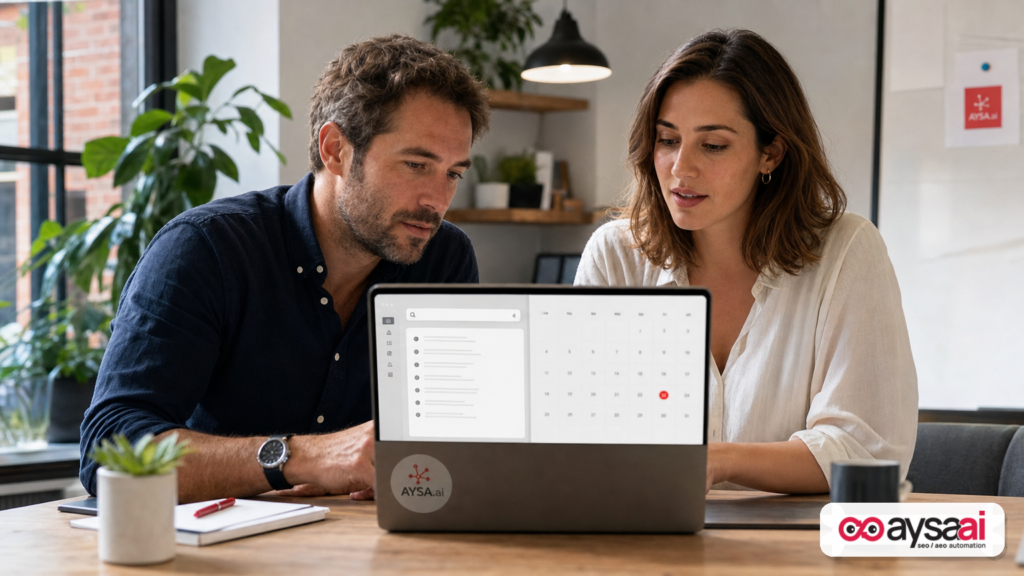
Google just pushed AI Search one step closer to something most businesses aren’t prepared for: a personal assistant that doesn’t simply recommend—it commits. By connecting Google Calendar to “Personal Intelligence” in Google’s AI Mode, answers can now incorporate what’s already on a user’s schedule and (critically) add events directly to Calendar.
For consumers, this looks like convenience. For businesses, it’s a structural change in how demand is routed. When time becomes a first-class ranking signal, visibility shifts from “best result” to “best fit right now.” That affects everyone: local service companies, clinics, hospitality, ecommerce with delivery windows, and B2B teams that live and die by booked meetings.
I’m writing this from the perspective of building and shipping growth systems for SMEs. At AYSA.ai, we focus on the part most teams struggle with: turning strategy into approved, trackable Website Execution—Monitoring what changed, preparing fixes, asking for approval, and deploying accepted updates safely. Calendar-aware AI search raises the bar on operational readiness, not just SEO tactics.
Concise summary

- What changed: Google’s AI Mode can now use Google Calendar as personal context and can create Calendar entries directly (U.S. first). This was reported by Search Engine Journal based on statements from Google Search leadership. Source
- Why it matters: Two people can type the same query and get different answers based on schedule constraints. That makes “one set of rankings” less meaningful and shifts optimization toward eligibility, timeliness, and conversion readiness.
- What businesses must do: Treat AI search as a decision engine. Make your availability, lead time, locations, policies, and booking paths unambiguous—then monitor outcomes as distributions, not single positions.
- Where AYSA fits: This is exactly the kind of shift where you need continuous monitoring and controlled execution: detect visibility changes, generate fixes across content and Technical SEO, route them for approval, and deploy changes quickly.
Key takeaways (for busy operators)

- Schedule-aware answers will change who gets recommended. “Best” becomes “best that fits your time.”
- AI Mode is moving from discovery to action. Calendar is the first announced Personal Intelligence integration that can also write back (create an event), not just read context.
- Local and appointment-based businesses will feel this first. If you sell time slots, you’re now competing in a time-constrained arena.
- Measurement will get harder. You can’t verify one canonical output. You need monitoring that captures variance across contexts.
- Execution speed becomes a moat. When answers are fluid, the businesses that update policies, inventory/availability messaging, and booking flows fastest will win more often.
Table of contents

- What Changed: AI Mode Can Now Use (and Write to) Your Calendar
- Context: Personal Intelligence Is Expanding the Inputs Behind Search
- Why This Is Bigger Than “Personalization”
- The New Ranking Layer: Timeliness, Eligibility, and “Next Available”
- A Concrete SME Scenario: How Calendar-Aware AI Changes Who Gets the Sale
- What Can Go Wrong (and Will)
- The New Measurement Problem: There Isn’t One “Result” to Rank For
- What Agencies Must Rethink: From Rankings to Outcomes
- A Practical Action Plan for SMEs (30/60/90 Days)
- The AYSA Perspective: Monitoring + Approved Execution in an AI-First Search World
- What to do next
- Sources and further reading
What Changed: AI Mode Can Now Use (and Write to) Your Calendar
According to reporting from Search Engine Journal, Google is connecting Google Calendar to “Personal Intelligence” in Google Search’s AI Mode, starting in the U.S. This means:
- AI Mode responses can factor a user’s schedule into recommendations.
- AI Mode can add invites or meetings directly to Google Calendar (a write action).
- Calendar becomes another source of personal context alongside previously mentioned integrations like Gmail and Photos (as described in the source).
This matters because it’s not just “AI knows more about you.” It’s “AI can change your day.” That is a qualitative leap: when the assistant can create events, it becomes an execution layer between user intent and business conversion.
Primary details and timeline context are covered in the SEJ report: Google Brings Calendar To Personal Intelligence In AI Mode (Search Engine Journal).
Context: Personal Intelligence Is Expanding the Inputs Behind Search
Traditional search was built around a shared index and a mostly shared results page. Even with localization and minor personalization, two users searching the same term generally saw similar choices, and marketers could talk about “the SERP” as if it were a single object.
AI search changes that. With AI Mode and AI-generated answers, the output is synthesized, and the synthesis can incorporate more context than a classic ranking list ever could. Google is now adding more “connected inputs” to that synthesis through Personal Intelligence.
From the supplied research context (via the SEJ report), Google previewed a Calendar connection at Google I/O, and Personal Intelligence itself has expanded in availability over time (including expansion to many countries and languages). When AI features are rolled out broadly—especially without subscription requirements—business impact accelerates. It moves from “beta curiosity” to “mainstream channel.”
Even if you don’t use AI Mode today, you should treat this as an early signal of direction: Google Search is becoming an assistant that can access your context and take actions inside Google’s ecosystem.
Why This Is Bigger Than “Personalization”
Marketers often hear “personalization” and think of interests: past purchases, browsing history, language, location, demographics. Calendar changes the personalization vector to something more immediate and operational:
- Time constraints: “I have 45 minutes” is different from “I have tonight free.”
- Hard conflicts: If the user is booked, the AI has to route around it.
- Proximity + schedule: A great option across town is irrelevant if it can’t fit between meetings.
- Coordination preferences: The AI can propose options that align with windows, not just tastes.
This is why calendar-aware AI isn’t just personalization—it’s constraint-based decisioning. In business terms, it’s similar to what happens when a marketplace starts ranking by “can fulfill now” rather than “best overall.” That single change reshapes who wins demand.
And because Calendar is tied to real commitments, it’s a more forceful constraint than “what you seem to like.” It’s “what you can actually do next.”
From search engine to schedule engine
Here’s a practical way to think about it:
- Classic search: retrieve relevant pages.
- AI answers: synthesize a recommendation.
- Calendar-connected AI: commit to a plan.
Once a plan is committed (an event created), the user is less likely to comparison shop. The business that gets selected in that moment benefits from reduced “second-guessing friction.” That is powerful—and it’s why businesses need to care now, even if rollout is currently limited.
The New Ranking Layer: Timeliness, Eligibility, and “Next Available”
Calendar-aware AI search creates a new competitive field: not just “who is most relevant,” but “who is eligible given the user’s constraints.” This is where the old SEO mental model breaks down.
In classic SEO, your job was to rank for a query category. In AI Mode, your job expands to being chosen inside a synthesized answer. With Calendar-aware AI, you also need to be chosen for a specific time window.
Eligibility will beat “brand preference” more often than you think
When users ask questions like:
- “Where should I get dinner near me?”
- “Book a dentist appointment next week.”
- “Find a photographer for Friday afternoon.”
- “Schedule a demo sometime tomorrow.”
…the AI can incorporate schedule conflicts and present options that fit. That doesn’t mean “the best restaurant/dentist/agency always wins.” It means the best option that fits the schedule wins.
From an optimization standpoint, this shifts emphasis to:
- Clear availability signals: not necessarily real-time inventory, but clear “what’s possible.”
- Lead time clarity: “Same-day,” “next-day,” “48-hour turnaround,” etc.
- Booking friction removal: fewer steps between recommendation and confirmation.
- Policy clarity: cancellation windows, minimum notice, travel fees—anything that could invalidate a recommendation.
AEO/GEO becomes scheduling-aware
Many teams are already adapting SEO for AI outputs: Answer Engine Optimization (AEO) and Generative Engine Optimization (GEO). The Calendar connection adds another dimension: your content and structured signals must support AI systems making time-based decisions.
In plain English: AI can’t confidently recommend you for “tomorrow at 2pm” if your site is ambiguous about whether tomorrow at 2pm is even possible.
If you want a practical starting point for how AYSA approaches AI-era visibility, see:
A Concrete SME Scenario: How Calendar-Aware AI Changes Who Gets the Sale
Let’s make this real with a scenario that’s common and high-stakes: a local clinic (but the same logic applies to salons, home services, and boutique hotels).
Scenario: a clinic competing for “urgent but not emergency” demand
A user searches in AI Mode: “Need a dermatologist appointment this week, ideally after work.”
Without Calendar, AI might recommend the best-reviewed clinics nearby, maybe referencing websites and common sources.
With Calendar connected, the AI can also consider:
- The user has meetings until 5:30pm most days.
- The user is traveling on Thursday.
- The user has one open 90-minute slot Tuesday evening.
Now the “best clinic” becomes the clinic that:
- Offers late appointments (and clearly states it).
- Has a booking path that works on mobile, fast.
- Can confirm quickly (or at least set expectations).
- Has policies that don’t create uncertainty (“Call to check availability” is uncertainty).
Two clinics might be equally reputable, but one has better operational clarity and lower booking friction. In a schedule-constrained environment, that clinic becomes the one the AI can recommend with confidence.
What about ecommerce?
Calendar sounds “appointment-only,” but ecommerce is not immune. Consider queries like:
- “Order flowers for delivery Friday afternoon.”
- “What’s a good gift I can get before Saturday?”
- “Best carry-on bag for my trip next week.”
If the AI system can infer time constraints from the user’s schedule, it may bias recommendations toward:
- Clear shipping cutoffs and delivery windows
- Local pickup options
- Product pages that clearly communicate timelines and returns
This is a reminder: the “content” that matters is often not a blog post. It’s the operational truth of your business expressed clearly on your site.
What Can Go Wrong (and Will)
When AI search becomes calendar-aware and action-capable, new failure modes show up. Businesses should expect these—and build mitigations.
1) The AI recommends you for the wrong context
If your site messaging is vague, AI may assume you can do something you can’t (same-day service, after-hours availability, travel radius, etc.). That leads to:
- Wasted leads
- Angry customers
- Higher support load
- Lower conversion rates (which can feed back into future recommendations)
2) Inconsistency between Google surfaces and your website
Many SMEs already struggle with consistency across:
- Website
- Google Business Profile
- Booking platforms
- Social profiles
Calendar-aware AI makes inconsistency more costly because the user’s intent is time-bound. If one surface implies you’re available and another implies you’re not, the AI may avoid recommending you at all to reduce risk.
3) Privacy perception and “creep factor” blowback
Even when features are opt-in, users can feel uneasy when recommendations seem “too aware.” For brands, the risk isn’t that you did something wrong—it’s that the user may distrust the process and back out.
Your role is to reduce friction and increase trust: clear policies, transparent pricing, and easy confirmation paths.
4) Operational bottlenecks get exposed
If AI can route demand into your business faster, your internal bottlenecks become visible:
- Slow response times
- Unclear intake forms
- Manual scheduling constraints
- No capacity planning
In the AI era, “marketing” and “operations” stop being separate conversations. Your website becomes the contract between what the AI promised and what you can deliver.
The New Measurement Problem: There Isn’t One “Result” to Rank For
The SEJ report highlights the core issue: as more apps connect to Personal Intelligence, the same query can yield different answers across people. Calendar adds a variable tied to timing, which is inherently different from interest-based context.
That creates a measurement problem marketers have to face honestly: you can’t open an incognito window and see “the answer.” There are many possible answers depending on:
- Schedule conflicts
- Location and travel time
- Device and context
- Connected apps and permissions
Visibility becomes a distribution
In practice, you’ll need to think in terms of:
- Coverage: How often do we appear across a set of realistic contexts?
- Consistency: Do we appear for the right intents, not just any mention?
- Conversion readiness: When we appear, do users complete the next step?
This is why monitoring needs to evolve. You’re not only tracking keywords; you’re tracking how AI systems represent your business across scenarios.
AYSA’s approach centers on continuous monitoring and then execution, not “one-time audits.” If you want to see how we think about monitoring as a system, start here: AYSA – Monitoring.
New KPIs you should care about (without inventing metrics)
Let’s avoid fake precision. The KPI shift is directional:
- From rank → to being selected/cited in AI answers
- From sessions → to qualified actions (bookings, calls, forms, purchases)
- From one SERP snapshot → to scenario-based testing
If your reporting still assumes a stable, universal results page, you’re going to miss the story.
What Agencies Must Rethink: From Rankings to Outcomes
For agencies and consultants, Calendar-connected AI search challenges a comfortable model: deliver a set of rankings, report improvements, renew retainer. That becomes less defensible when outcomes depend on personal context and time constraints.
Strategy will shift from “content production” to “decision enablement”
Many teams will react by publishing more content. That’s not the right reflex. The higher-leverage move is to make your business easy for AI systems to recommend confidently:
- Clear service definitions
- Transparent geographic coverage
- Explicit hours and exception policies
- Lead-time requirements
- Fast, mobile-first booking/contact flows
The execution gap will widen
Here’s the uncomfortable truth: most SEO “strategies” die in implementation. They sit in Google Docs, waiting on dev cycles, stakeholder approvals, or CMS complexity.
In a world where AI answers can change based on time and context, slow execution is not just inefficient—it’s a competitive disadvantage. If a competitor updates policies, availability messaging, and booking UX today, they may be the “safe” recommendation tomorrow.
This is where an approved execution system matters: the ability to propose changes, route for approval, then deploy reliably.
If you’re an agency, this is also a productization opportunity: sell “AI search readiness + execution,” not just “SEO hours.”
A Practical Action Plan for SMEs (30/60/90 Days)
You don’t need to predict every future integration. You need to make your business legible to AI decisioning systems and resilient to personalization variance.
First 30 days: make the operational truth explicit
- Audit your “time promises” on the site: turnaround, delivery, availability, response times. Make sure they’re explicit and consistent.
- Clarify constraints: service areas, appointment length, minimum notice, blackout dates, rush fees.
- Reduce booking friction: fewer steps, clear calls-to-action, mobile-first forms.
- Standardize key pages: service pages, location pages (if relevant), booking page, policy page, contact page.
If you’re starting from scratch, this is where a system like AYSA can help you move faster without losing control: monitor issues, propose changes, and execute what you approve. Explore capabilities: AI SEO Tools.
Next 60 days: build “eligibility signals” into your content architecture
- Rewrite for decision clarity: “who it’s for,” “when we can do it,” “how fast,” “what it costs (ranges),” “how to book.”
- Add FAQs that remove uncertainty: cancellations, rescheduling, delivery windows, lead times, service boundaries.
- Strengthen internal linking between high-intent pages: services → booking → policies → contact.
- Align local signals (if applicable): hours, service areas, and categories should match across surfaces (site and business listings). (Note: this is a general best practice; verify specifics for your setup.)
90 days: move to scenario-based monitoring and iteration
- Create scenario prompts your customers actually use (e.g., “tomorrow morning,” “after work,” “near the airport,” “between meetings”).
- Monitor variance: do you show up across scenarios, or only in some?
- Iterate site changes quickly when you see gaps—especially around availability messaging and conversion paths.
This is where continuous monitoring matters more than quarterly reporting. See how AYSA treats monitoring as an always-on layer: AYSA Monitoring.
The AYSA Perspective: Monitoring + Approved Execution in an AI-First Search World
When search outputs become personalized and action-capable, the winners won’t be the teams with the most dashboards. They’ll be the teams that can:
- Detect changes early (visibility and representation in AI answers)
- Translate signals into fixes (content, technical, internal linking, UX clarity)
- Ship improvements fast without breaking the site
- Keep humans in control through an approval workflow
That’s the thesis behind AYSA: an execution system for SEO/AEO/GEO that monitors, prepares changes, asks for approval, and deploys accepted improvements. When the ground shifts under you—as it will with AI Mode integrations—you need a mechanism for safe speed.
If you want to understand how we frame AI-era visibility and what it means operationally, start with:
Why “approved execution” matters more now
AI search is moving faster than traditional SEO cycles. But the solution isn’t reckless automation. The solution is controlled automation:
- Prepare changes based on monitoring and best practices
- Give you a clear explanation of what will change and why
- Require approval
- Execute and track outcomes
That’s the kind of model that scales for SMEs who can’t afford a 6-person SEO team—or a never-ending dev backlog.
What to do next
- Identify where you sell time. If your business involves appointments, visits, delivery windows, demos, or deadlines, treat this as urgent.
- Rewrite your “availability story” in plain language. Make lead time, hours, and constraints impossible to misunderstand.
- Strengthen the path from recommendation to confirmation. Booking/contact UX is now part of visibility, not just conversion.
- Stop reporting as if there’s one SERP. Start testing realistic scenarios and tracking variance.
- Adopt an execution system. Monitoring without shipping is theater. Build a loop that detects → proposes → approves → deploys.
Sources and further reading
- Search Engine Journal: Google Brings Calendar To Personal Intelligence In AI Mode (reported by Matt G. Southern; this is the primary research input provided)
- Search Engine Journal: Latest News (additional context stream; used as a research lead)
- Search Engine Journal: SEO (broader SEO context; used as a research lead)
- Search Engine Journal: Webinars (industry education context; research lead)
- Search Engine Journal: For Agencies (agency implications context; research lead)
Note: The supplied source text references announcements and prior previews but does not provide direct links to official Google documentation or the original social posts. Where official primary sources are not present in the provided research context, I’ve avoided claiming exact UI behavior beyond what the report describes.
Continue the AI search topic inside AYSA.
Use these pages to connect the article with AI SEO tools, AI visibility monitoring, AI Overviews and approved website execution.
Turn this topic into a website action plan.
Use these AYSA hubs to move from reading to technical fixes, AI visibility monitoring, research, glossary context and approval-first SEO execution.