
ChatGPT-Driven Phone Calls Qualify Better—So Why Don’t They Close Better? A Practical Playbook For AI Search Leads
New call-tracking benchmarks suggest calls that originate from ChatGPT referrals qualify as leads more often than any other measured channel—but convert at roughly average rates once answered. Here’s what changed, why it matters for SMEs and agencies, and how to operationalize AI Search so “good leads” actually become revenue.

By Marius Dosinescu (AYSA.ai)
AI assistants are not just “where people search.” They’re quickly becoming where people decide—and then they pick up the phone.
That shift is starting to show up in hard business data. A new benchmark report from Invoca—covered by Search Engine Journal—breaks out phone calls that originate from ChatGPT referrals for the first time. The headline finding is provocative: calls that come from ChatGPT referrals qualify as leads more often than calls from any other measured channel. But once a human answers and the lead is “in play,” those calls convert at about an average rate.
That combination should make every founder, marketing leader, and agency partner pause. Because it tells us something important: AI Search may be increasing decision readiness, but the last mile—your website, your routing, your call handling, your offers, your sales scripts, your trust signals—is still where revenue is won or lost.
This editorial is a practical playbook for what to do about it.
Concise summary
- What changed: Call analytics platforms can now isolate at least some AI assistant-driven calls (specifically, calls that follow a ChatGPT referral to a website).
- What the data suggests: ChatGPT-referred calls can produce a higher lead qualification rate, but not a higher on-call Conversion rate.
- What that means: AI Search is likely influencing the top of the funnel (who calls and why) more than the bottom of the funnel (how your business closes).
- What to do next: Treat AI Search as a visibility + operations problem: fix the website journey that precedes the call, fix the call experience that closes the deal, and monitor AI visibility signals continuously.
- Where AYSA fits: AYSA helps you monitor AI Search visibility, recommend changes, request approval, and execute accepted updates—so you can move fast without breaking governance. See AI search visibility and monitoring.
Table of contents
- What changed: AI assistants are now measurable as a call channel (sort of)
- The real story in the Invoca numbers: qualification is up, conversion is not
- Why this is happening now: AI compresses research time
- The attribution trap: what “ChatGPT-referred calls” actually includes (and excludes)
- Lead quality vs. conversion: two different problems with two different fixes
- A concrete SME scenario: the local clinic that suddenly gets “AI-educated” callers
- What SMEs should monitor weekly (even if AI volume is low)
- Website fixes that increase AI-driven call outcomes
- Call-handling fixes that turn better leads into better revenue
- What agencies must rethink: reporting, retainers, and “visibility” deliverables
- Where AYSA fits: monitoring + approved execution for AI Search
- What to do next (action list)
- Sources and further reading
What changed: AI assistants are now measurable as a call channel (sort of)

For years, marketers have been stuck arguing about AI’s influence using soft signals: anecdotal “customers said they found us in ChatGPT,” occasional referral spikes, or screenshots of assistant answers. It’s been hard to quantify because AI assistants often don’t behave like traditional referrers.
The Invoca benchmark—again, covered by Search Engine Journal—matters because it introduces a measurable slice of AI Search Behavior:
- A user engages with ChatGPT.
- The user Clicks through to a business website (a trackable referral visit).
- The user places a phone call from that website journey (a trackable call).
That may sound narrow—and it is. But it’s the beginning of a shift from “AI is changing search” to “AI is changing revenue workflows.”
In other words, the conversation is moving from Impressions and rankings to leads, calls, and close rates.
The real story in the Invoca numbers: qualification is up, conversion is not
Here’s what we can responsibly say from the supplied research context (without inventing data):
- Invoca reported a lead rate (calls that qualify as sales leads) of 49% for ChatGPT-referred calls.
- That lead rate is about 10 percentage points higher than the average of the measured channels, and higher than Google Business Profiles cited in the source context.
- Invoca reported a conversion rate from those leads of 40% for ChatGPT-referred calls compared with an all-channel average around 42%—described as about average.
- Invoca’s dataset spans 70M+ calls and 600M minutes of conversation across 10 industries (as stated in the source context).
The most important interpretation is not “ChatGPT is the best channel.” It’s this:
AI-driven calling may improve who shows up, but it doesn’t automatically improve how you close.
That is a classic operations-and-execution story. It’s the same lesson we’ve learned in every major marketing shift:
- Better targeting doesn’t save a broken checkout.
- More traffic doesn’t fix unclear positioning.
- Higher-intent callers don’t overcome a weak sales process.
Why this is happening now: AI compresses research time
When people use an assistant, they’re not just searching for one page at a time. They’re compressing an entire comparison journey into a single interface:
- “What’s the difference between X and Y?”
- “Which option is best for my budget?”
- “What should I ask before I book?”
- “Who is reputable near me?”
By the time the user clicks out to a website—or calls—they may already have:
- Shortlisted 2–3 options
- Defined a budget range
- Formed expectations about pricing, availability, and outcomes
- Prepared specific questions
That is exactly the profile of a caller who can qualify at a higher rate.
But it also creates a new type of risk: if the assistant’s “pre-research” sets expectations your business can’t meet—pricing, timelines, product availability, service area—then your staff inherits the mismatch. That doesn’t show up as an SEO issue. It shows up as a conversion issue.
The attribution trap: what “ChatGPT-referred calls” actually includes (and excludes)
The Search Engine Journal coverage includes an important limitation: Invoca attributes ChatGPT calls only when the customer journey includes a ChatGPT-to-website referral followed by a call. It does not capture users who:
- Read about you in an assistant and later call from a saved contact
- Search your brand on Google and then call
- Find your Google Business Profile and call
- Call from an email signature, a map app, or another untracked source
This matters because AI influence can be “dark”—it shapes decisions but doesn’t appear as a clean referral. The SEJ story also references prior coverage about Similarweb observations where assistant recommendations may later manifest as branded search rather than direct referrals. I’m not going to expand beyond what’s in the provided context, but the operational point is clear:
If you only look for direct AI referrals, you will undercount AI influence.
So what should a practical business do?
- Track what you can (direct referrals and on-site calls).
- Ask what you can (train staff to log “how did you hear about us?” with an AI option).
- Infer what you must (watch branded demand, call intent, and question patterns shift over time).
This is why monitoring matters more than “one-time optimization.” AI surfaces change. Your competitive set changes. Your product catalog changes. Your reviews change. And the assistant’s summary of your brand can change with all of it.
AYSA is built around that reality: continuous monitoring plus controlled, approved execution—recommendations are prepared, you approve, and then AYSA executes accepted website changes. That’s how you keep up without chaos.
Lead quality vs. conversion: two different problems with two different fixes
Many teams treat “lead quality” and “conversion” like the same KPI. They’re not.
Lead qualification is about relevance
A call qualifies as a lead when the caller is a plausible buyer: right intent, right geography, right service need, right timing, and sometimes right budget. AI assistants can improve relevance because they pre-filter options.
To improve qualification, you focus on:
- Clarity of your services/products
- Local coverage and constraints (service area, hours, availability)
- Authority and trust signals (reputation, expertise, policies)
- Findability in AI answers (AEO/GEO readiness)
Conversion is about friction removal
Conversion during the call is where deals die for very human reasons:
- Long hold times or no answer
- Weak intake scripts and poor discovery
- No next-step offered (no booking ask)
- Mismatch between what the caller expects and what you can deliver
- Lack of trust when the price is finally discussed
The SEJ summary includes a striking operational note from the report: many businesses don’t directly ask callers to buy or schedule. That is not a traffic problem. That is a revenue discipline problem.
AI can send you better-prepared callers. But if your team doesn’t have a consistent “close the next step” motion, you’ll convert like everyone else—or worse.
A concrete SME scenario: the local clinic that suddenly gets “AI-educated” callers
Let’s make this real.
Imagine a two-location wellness clinic (chiropractic, physical therapy, dental, med spa—pick one). Historically, most new patients arrived via:
- Google Business Profile calls
- Word-of-mouth
- Paid search for “near me” queries
Now the clinic notices something subtle:
- New callers ask unusually informed questions: “Do you handle X condition? What’s the difference between treatment A and B? Do you take insurance? What’s the typical number of sessions?”
- They reference comparisons: “I’m choosing between you and another clinic.”
- They want a fast next step: “Can I book this week?”
These are likely assistant-shaped calls. They can qualify very well because the caller already knows what they want.
But conversion can remain average if the front desk:
- Doesn’t have a script to handle comparison questions
- Can’t confidently explain pricing or insurance
- Doesn’t offer a clear next step (“Let’s schedule your evaluation now”)
- Routes calls to voicemail during peak times
In other words: AI brings a more decisive buyer to the door. Your operations decide whether they walk in.
What SMEs should monitor weekly (even if AI volume is low)
If AI-driven call volume is still low (and the source context indicates it is), you might be tempted to ignore it. That’s the wrong move—because the earlier you build the system, the cheaper it is to win later.
Here’s the weekly monitoring stack I’d recommend for SMEs who rely on phone calls.
1) Your “AI visibility baseline”
You don’t need to obsess over daily changes. You do need a baseline answer to: Are assistants aware of my brand, my offers, my locations, and my differentiators?
This is exactly what AYSA’s AI search visibility focus is designed for—monitoring how your business shows up across AI-driven discovery surfaces and turning that into a prioritized execution plan.
2) Brand demand and branded queries
Even when AI influence isn’t directly attributed, assistant-driven consideration can show up as branded search and branded site navigation behavior. Watch for changes in:
- Branded search volume (directional)
- Branded landing pages visited
- Calls initiated from “About,” “Pricing,” “Locations,” “Contact” pages
I’m not attaching numbers here because they’ll be business-specific. The goal is trend detection, not perfection.
3) Call intent patterns
Even without sophisticated tooling, you can categorize calls by intent:
- Pricing and quotes
- Availability and booking
- Compatibility (“Do you do X?”)
- Support / existing customers
If your “compatibility” and “pricing” questions rise, that often signals more comparison-stage callers—exactly what assistants accelerate.
4) Answer rate and speed-to-answer
The source context notes that answer rate is a major step in the funnel. Before you chase a new channel, fix the basics:
- Do you answer calls consistently during business hours?
- Do you route calls to someone trained to convert?
- Do you offer callbacks that actually happen?
AI can raise lead quality. It can’t answer your phone.
Website fixes that increase AI-driven call outcomes
When someone arrives from an assistant, they’re often landing on your site with a specific intent: validate, confirm, and act.
Your website should be designed to help a “ready-to-decide” visitor do three things quickly:
- Confirm you’re the right fit
- Trust you
- Take the next step (call or book)
Here are practical fixes that help, regardless of industry.
1) Make your “fit” constraints explicit
- Service area (especially for local services)
- Minimum order, minimum project size, or pricing range (when appropriate)
- Availability and lead times
- Supported use cases (and unsupported ones)
Clear constraints reduce wasted calls and increase confidence for qualified callers.
2) Build an AI-readable, human-readable services structure
Assistants need structured, consistent content to summarize. Humans need clarity to choose. Most small business sites fail at both by burying services in vague marketing copy.
A better approach:
- One page per core service/category with clear benefits, FAQs, and next steps
- Local landing pages for multi-location businesses (when it’s real and useful, not spammy)
- FAQ sections that mirror real call questions
AYSA can help operationalize this by monitoring what’s missing, preparing recommended content and structural updates, and then executing the approved changes. Start here: AI SEO tools.
3) Strengthen trust signals where decision happens
Decision-ready visitors look for:
- Reviews and testimonials (properly sourced and not exaggerated)
- Policies (returns, cancellations, warranties, insurance)
- Credentials (licenses, certifications, awards—only if legitimate)
- Real photos of team/location/work
Assistants also tend to “reward” brands that look legitimate across the web and on-site. The goal isn’t to manipulate AI; it’s to reduce uncertainty for humans and provide consistent signals for machines.
4) Make calling (or booking) the obvious next step
If a user decides to call, reduce friction:
- Click-to-call buttons on mobile
- Sticky contact options during high-intent pages (pricing, service pages, locations)
- A clear “what happens next” section (so callers know what they’re booking)
Then test whether calls increase from those pages—without assuming every call is good. You want better calls, not just more calls.
Call-handling fixes that turn better leads into better revenue
If AI-referred calls qualify well but don’t convert better than average, your biggest upside is in-call execution. Here are fixes that don’t require enterprise tooling.
1) Create a “fast qualification” script
Decision-ready callers appreciate speed and competence. Train staff to quickly confirm:
- Need/use case
- Location/service area
- Timeline
- Budget sensitivity (if relevant)
This isn’t about being pushy. It’s about respecting the caller’s time and protecting your team’s time.
2) Build a “comparison-ready” set of answers
Assistant-driven callers are often comparing options. Prepare honest, consistent responses to:
- “What makes you different?”
- “Why are you more/less expensive?”
- “How fast can I start?”
- “Do you have experience with my case?”
Consistency matters. If two staff members answer the same question differently, you lose trust.
3) Always ask for a next step
The source context highlights that many businesses don’t ask for the appointment or purchase. This is basic, but it’s where conversion lives.
Examples:
- “Let’s get you scheduled—does Tuesday or Thursday work?”
- “I can send the quote now and reserve a slot—what email should I use?”
- “If you’re ready, I can take the deposit and lock in the delivery date.”
4) Fix missed-call recovery
If your answer rate is weak, AI won’t fix it. Put a system in place:
- Callbacks within 5–15 minutes during business hours
- After-hours: a next-day callback promise that is actually kept
- Voicemail scripts that tell the caller exactly what to leave
If AI is making callers more decisive, a missed call isn’t a “lost opportunity someday.” It’s often a lost deal right now.
What agencies must rethink: reporting, retainers, and “visibility” deliverables
Agencies are walking into a reporting trap in AI Search.
Clients will ask: “Are we getting leads from ChatGPT?” And many agencies will answer with referral traffic charts. That’s not wrong; it’s just incomplete.
Here’s what needs to change.
1) Move from channel vanity to funnel accountability
If AI-referred calls qualify well but convert average, the right question isn’t “How do we get more AI traffic?” It’s:
- What pages are AI-influenced visitors landing on?
- What do they do before they call?
- What questions are they asking on calls?
- Where do we lose them: before answer, during qualification, or during closing?
That demands collaboration with sales/ops—not just SEO tweaks.
2) Package “AI Search readiness” as systems, not one-off tasks
AI Search optimization is not “write 10 blog posts.” It’s a system:
- Monitoring
- Content and entity clarity
- Local and reputation consistency
- Technical hygiene
- Ongoing updates as assistants and competitors shift
That’s why AYSA’s model—monitor, prepare, approve, execute—fits how modern teams need to operate. It reduces the chaos of constant change while still shipping improvements.
3) Redefine KPIs for AI Search
In AI Search, traditional KPIs can be directionally useful, but incomplete. Agencies should add:
- AI visibility presence for key intents (are you being cited/mentioned?)
- High-intent page engagement (pricing, service pages, locations)
- Call answer rate and booking rate
- Lead qualification rate by landing page cluster
The point is not to claim perfect attribution. The point is to manage the business outcome.
Where AYSA fits: monitoring + approved execution for AI Search
Most businesses don’t fail at AI Search because they lack ideas. They fail because they can’t execute consistently:
- Too many pages, too many stakeholders
- No clear approval process
- Changes take weeks (or months)
- Monitoring is scattered across tools nobody checks
AYSA is built to solve that execution gap.
- Monitor: Track your AI Search visibility and site signals continuously. Start at AYSA Monitoring.
- Prepare: AYSA identifies opportunities and prepares recommended fixes—technical, content, and structural—based on what’s changing.
- Approve: You keep control. Changes are proposed and require acceptance before anything is executed.
- Execute: AYSA ships the accepted changes, creating momentum without governance risk.
If you’re trying to turn AI visibility into pipeline, you need that loop—because AI Search is not a one-time campaign. It’s a permanent environment shift.
Explore:
What to do next (action list)
If you rely on calls for revenue, here’s a practical sequence you can run in the next 30 days.
Week 1: Establish your baseline
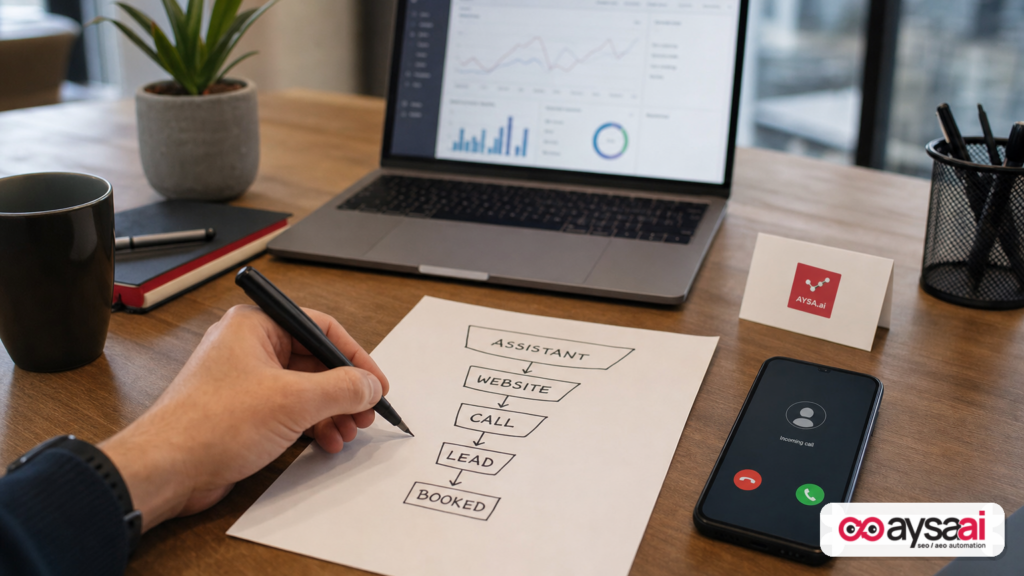
- Document your current call funnel: calls → answered → qualified leads → booked/purchased.
- Add an “AI assistant” option to your “how did you hear about us?” intake (even if it’s manual).
- Review your top 10 landing pages that generate calls and identify which ones should be “decision pages.”
Week 2: Fix the website decision path
- Update service pages with clearer fit constraints, FAQs, and next steps.
- Improve contact UX (click-to-call, booking CTAs, hours, locations).
- Strengthen trust signals (policies, reviews, credentials) where callers decide.
Week 3: Fix call handling
- Create a short qualification + booking script.
- Train staff on the top 10 comparison questions and consistent answers.
- Implement missed-call recovery (callbacks with a real SLA).
Week 4: Monitor and iterate
- Compare lead qualification and booking rate before/after changes.
- Look for changes in caller question patterns.
- Set up ongoing monitoring so AI visibility shifts don’t surprise you.
If you want a system to run this continuously, start with AYSA AI Search Visibility and Monitoring, then map the improvements into approved execution.
Sources and further reading
- Search Engine Journal: ChatGPT Calls Turn Into Leads More Often: Invoca Report (primary research lead for this editorial)
- Search Engine Journal: Latest news (context on ongoing AI search reporting)
Note: The supplied research context references findings from other providers (e.g., Similarweb, Adobe) but does not provide direct links to the underlying reports. I’ve therefore treated those references as context rather than primary sources, and I’m not extending them with additional claims.
Continue the AI search topic inside AYSA.
Use these pages to connect the article with AI SEO tools, AI visibility monitoring, AI Overviews and approved website execution.
Turn this topic into a website action plan.
Use these AYSA hubs to move from reading to technical fixes, AI visibility monitoring, research, glossary context and approval-first SEO execution.

