
Google Business Profile Address Changes: How to Move Without Losing Local Rankings (and What Google Really Anchors)
Changing your Google Business Profile address can quietly break proximity signals and map visibility—especially for service-area businesses with hidden addresses. This operator’s playbook shows how to audit address history, prevent pin anchoring failures, sequence ecosystem updates, and use an approval-first execution workflow to protect revenue during a move.

Local SEO punishes “simple updates.” You change a business address because your company moved, because you expanded, or because you finally want to clean up a messy listing—and suddenly the phone gets quiet. Maps Visibility wobbles. Leads drift to competitors. Internally, everyone asks the same question: “Why would changing our address make us disappear?”
The uncomfortable answer: changing an address in Google Business Profile (GBP) doesn’t always change where Google “thinks” your business is located for ranking purposes—especially for service-area businesses (SABs) that hide their address. That insight was explored in depth by Claudia Tomina in Search Engine Land’s analysis of why GBP address changes can disrupt local rankings (source). I’m using that research as a launchpad, but this article is designed as a standalone, practical operator’s guide for SMEs and agencies.
I’m Marius Dosinescu, and from an execution standpoint, this is how I want you to think about local moves: a GBP address change is not a “task.” It’s an operational deployment that can impact revenue. The right response is controlled sequencing, verification, and Monitoring—not hope.
Concise summary
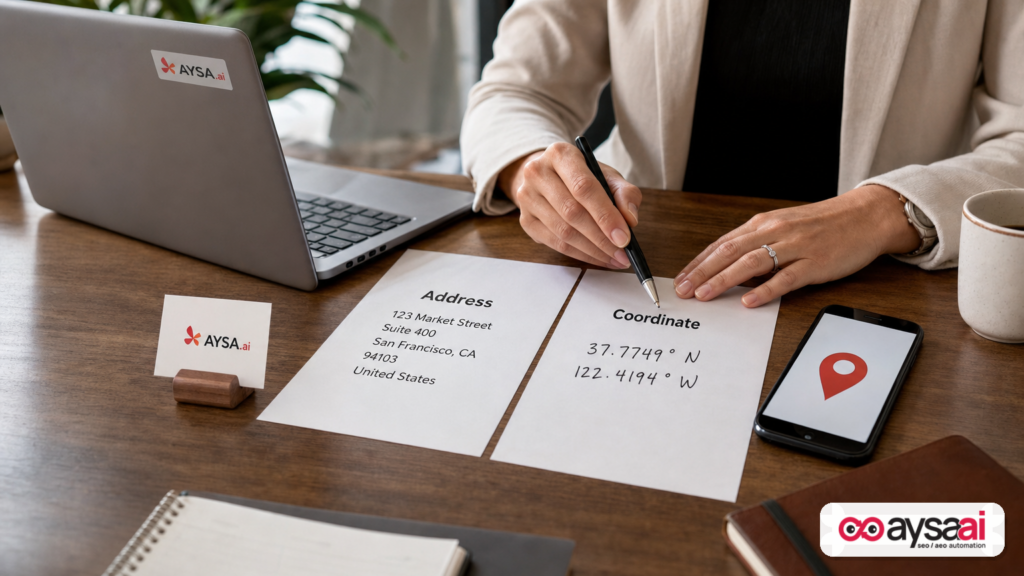
Google local results are heavily influenced by proximity. Proximity is calculated from coordinates (a map pin), not the address text you type. For some listings—especially hidden-address service-area businesses—editing the address may not re-anchor the coordinate that drives rankings. Address history, address formatting, and ecosystem consistency (website + citations) can determine whether a move stabilizes quickly or triggers weeks of volatility. Use a phased plan, isolate changes, and monitor outcomes like an incident response.
Key takeaways (read this before you touch anything)

- Your typed address and your ranking pin are not the same thing. Google geocodes the address into a coordinate and uses that coordinate for proximity-based rankings.
- Address history matters more than most teams realize. The original address used at setup, past edits, and toggles between “shown” and “hidden” can continue influencing performance.
- SABs are the danger zone. Testing cited in Search Engine Land indicates hidden-address SABs can behave as if they’re still anchored to the original address—even after updates and reverification.
- Precision is not optional. Small address formatting issues can reduce geocoding confidence and shift a pin, changing who sees you in Maps.
- Moves should be executed like releases. Update owned assets first, align major citations, then change GBP. Monitor for 30–60 days.
- Execution discipline beats “SEO tricks.” The win is avoiding preventable inconsistencies that undermine trust signals at the exact moment Google is reevaluating your listing.
Table of contents

- Context: why GBP address changes are uniquely risky in 2026
- What changed (and why the industry is still confused)
- The core mechanic: Google ranks a coordinate, not the address string you typed
- Your listing has a memory: why address history can haunt rankings
- The hidden-address SAB problem: why “updating the address” may not move the ranking pin
- Pin failure patterns: centroids, drift, and why “near me” visibility can collapse
- Geocoding precision: small address details with big ranking consequences
- A practical risk model: when an address change is low-risk vs high-risk
- Move scenarios: what to do depending on storefront vs SAB, short move vs long move
- A controlled move plan: the 4-phase checklist (with timing)
- Concrete SME scenario: the clinic move that “shouldn’t have mattered” but did
- What agencies should rethink: address changes as ops, not admin
- Where AYSA fits: monitor → prepare → approve → execute (so local changes don’t become incidents)
- What to do next
- Sources and further reading
Context: why GBP address changes are uniquely risky in 2026
If you’ve managed a Google Business Profile for years, you already know the UI encourages “just update it.” But the stakes have increased:
- Local search is more competitive in most categories because more businesses understand GBP, reviews, and Map pack economics.
- Consumer behavior is compressing. People don’t browse ten blue links—they pick from a small set of map results, call, and book.
- Trust is algorithmic and behavioral. The system compares signals across the web: your site, directories, reviews, and user actions.
So when you change your address, you’re not just editing a field. You’re asking Google to accept a new “truth” about your entity—and to reconcile that truth with everything it already believes about you.
This intersects with broader trends around entities and verification across modern search surfaces. Search Engine Land has also been exploring adjacent themes like entity gaps and schema in AI-driven search (Schema for AI search) and the broader problem of AI systems failing to verify businesses reliably (AI search can’t verify your business). You don’t need to become an “AI SEO” expert to move locations—but you do need to treat your business identity as a connected data object.
What changed (and why the industry is still confused)
There wasn’t a single “GBP update” announcement that suddenly made address changes risky. The risk has always existed. The confusion persists because different business types experience different behaviors:
- Storefronts with visible addresses often see a more intuitive relationship between address edits and pin movement.
- Service-area businesses with hidden addresses can see counterintuitive behavior—where the dashboard address changes but rankings don’t move in the expected direction.
Search Engine Land’s core message is worth restating in plain English: changing an address does not guarantee changing the ranking anchor. If you assume it does, you’ll plan the move incorrectly. And if you plan the move incorrectly, you’ll create a period where Google sees conflicting data, potentially lowering confidence and visibility.
My editorial opinion: the industry should stop discussing “address changes” as if address is the asset. The asset is local demand capture. Your goal isn’t to update a profile. Your goal is to keep showing up and keep the phone ringing while reality changes underneath you.
The core mechanic: Google ranks a coordinate, not the address string you typed
Here is the mental model I want every founder and marketer to adopt:
- Address string = the text you enter (e.g., “123 Main Street, Suite 200”).
- Geocoding = Google interpreting that text and resolving it to a location in its geographic database.
- Coordinate / map pin = the latitude/longitude Google uses as the reference point for proximity.
Proximity-driven ranking isn’t computed from your suite number. It’s computed from where Google places your pin.
Search Engine Land frames this clearly: the address stored in GBP and the map pin used for proximity calculations are separate things (source). That separation explains most “we updated the address but nothing happened” cases.
To make it concrete:
- If you are a florist and you move from one neighborhood to another, you expect to show up near the new shop.
- But if Google’s ranking coordinate doesn’t move—or moves incorrectly—your visibility can remain clustered around the old neighborhood or drift somewhere irrelevant.
That’s not “Google being random.” It’s Google continuing to use a coordinate you didn’t realize was still in play.
Your listing has a memory: why address history can haunt rankings
One of the best points in the Search Engine Land analysis is this: what you don’t know about a listing’s past can damage its future (source). That’s especially true for businesses that have:
- moved multiple times,
- switched between storefront and service-area modes,
- had different agencies/vendors manage the listing,
- or were set up quickly by a founder using “close enough” address formatting.
Before you edit anything, answer (or investigate) three questions:
- What address was used to create and verify the profile originally? (Was it a real rooftop-resolvable address?)
- Has the address ever been shown and then hidden? Toggling visibility can change how the system treats the listing.
- Has the address been updated before? Multiple edits can create conflicting signals or verification friction.
Here’s why this matters in practice: local ranking behavior often reflects the system’s “best guess” based on historical trust and corroboration. If the original anchor is deeply embedded and later signals are weaker or ambiguous, Google may continue to behave as if the original is the “true” one—particularly for SABs.
Operator reality: business owners frequently do not remember the original setup details. That’s not negligence; it’s normal. Your job is to treat “unknown history” as a risk factor and validate with testing and monitoring, not assumptions.
The hidden-address SAB problem: why “updating the address” may not move the ranking pin
If you manage local SEO for service-area businesses—plumbers, landscapers, mobile vets, home cleaners—this is the section that will either save you or at least prevent you from being surprised.
Search Engine Land reports testing indicating that when an SAB hides its address in the GBP dashboard, the map pin can revert to (or remain tied to) the original address used to create the profile (source). The key implication is blunt:
If your address is hidden, updating the address in the dashboard may not re-anchor the coordinates used for ranking.
Even if you:
- unhide the address temporarily,
- enter a new address,
- complete verification,
- and then hide it again,
the functional ranking anchor may still not behave the way you expect.
Why this is so damaging: SABs already rely heavily on proximity (even when they “serve” a wide area). If the proximity anchor is wrong—home address, old address, virtual office—your lead flow can be distorted. You may rank well in the wrong part of town and poorly where you actually want jobs.
My point of view: for SABs, the address field is not a simple lever. It’s part of a bigger trust + geocoding system. Treat any SAB address change as a potentially high-risk operation, especially if you don’t know listing history.
Pin failure patterns: centroids, drift, and why “near me” visibility can collapse
Beyond the “address updated but anchor didn’t move” problem, there’s a second class of failure: the pin ends up somewhere wrong after changes like hiding/clearing an address or adjusting service areas.
Search Engine Land references local SEO community documentation of edge-case behaviors such as:
- pins dropping into unexpected default locations after address fields are cleared,
- pins moving to a centroid-like location when a service area is very broad,
- ranking drops when the pin falls outside the defined service area.
(All discussed within the context of the main article: source.)
I’m not going to turn these into universal laws, because outcomes can vary by market and listing state—and I’m not going to pretend we can verify every anecdote across every country from one source. But I will give you the operational lesson:
When you remove or obscure the address, the system may fall back to a default location model. Defaults are often disastrous for proximity.
What does “disastrous” look like for an SME?
- You used to show up for “emergency plumber” within 3 miles. Now you only show up 12 miles away, sporadically.
- Your calls drop, but your reviews are unchanged and your website traffic looks fine.
- You assume “Google is volatile.” In reality, the coordinate changed and your proximity advantage evaporated.
Local SEO is not just relevance and reviews. It’s geometry. And geometry can break.
Geocoding precision: small address details with big ranking consequences
The most “boring” part of local SEO is also one of the most expensive to get wrong: address formatting.
Search Engine Land provides a strong example showing how tiny differences (like “St.” vs “Rd.”) can change whether Google treats an address as a partial match or a precise rooftop match (source). The takeaway isn’t the specific abbreviations; it’s this:
Geocoding confidence determines pin precision. Pin precision influences proximity performance.
Common mistakes that can reduce geocoding confidence:
- Using a slightly wrong street suffix (Road vs Street vs Avenue)
- Mixing up unit formats (Ste vs Suite vs #)
- Putting suite numbers in the wrong field (especially when platforms expect them separately)
- Using a mailing address rather than a real deliverable physical location
- Typos that still “kind of” match a nearby street
For SMEs, here’s the practical advice: don’t let the office manager “type it how we say it.” Use the exact, canonical address format that matches your official documents and is consistently used across the web. In many businesses, a move includes a new lease, new utility bill, new signage—those documents should match what you publish everywhere.
And here’s the agency-side advice: address normalization is a deliverable. If you charge for local SEO, you should deliver a “canonical NAP” record that everyone uses.
A practical risk model: when an address change is low-risk vs high-risk
Not all address changes are equal. If you want to reduce surprises, classify the move using a risk model. Here’s a practical one you can use in a kickoff call.
Lower-risk changes
- Storefront business with address visible
- Moving within the same neighborhood or city
- Strong consistency across owned assets already (site, social profiles)
- No history of suspensions or verification issues
Medium-risk changes
- Storefront moving across a metro area (meaning proximity zones shift significantly)
- Multiple locations / multi-practitioner complexity
- Old citations widely inconsistent and hard to clean up quickly
Higher-risk changes
- Service-area business with hidden address
- Unknown address history (no one knows what the listing was originally verified with)
- Address was historically a P.O. box or virtual office (compliance and trust risk)
- Moving across state lines (behavioral data + historical association risk)
- Prior suspensions, repeated edits, or ownership disputes
This isn’t about fear. It’s about planning. A high-risk move doesn’t mean “don’t do it.” It means: build a larger buffer, stage more evidence, isolate changes, and commit to monitoring.
Move scenarios: what to do depending on storefront vs SAB, short move vs long move
Search Engine Land outlines scenarios and decision points; I’m going to translate that into an operator’s playbook you can actually run.
Scenario A: SAB, address hidden, ranking well, never touched
Default move: don’t touch it unless you have to.
If an SAB is performing well and there’s no business-critical reason to change the profile, unnecessary edits create risk without upside. The Search Engine Land analysis suggests that changing a hidden SAB address may not move rankings anyway (source).
What to do instead:
- Run baseline checks: where are you visible today?
- Make improvements that don’t involve address edits: services, photos, reviews, content consistency.
Scenario B: SAB, hidden address, inherited listing with unknown history
Default move: investigate before editing.
When you inherit a listing, you inherit hidden risk. Start with an “address history interview”:
- What physical address was used when this listing was created and verified?
- Has the address ever been shown publicly, then hidden?
- Has the business relocated since first verification?
If the owner doesn’t know, assume you’re missing information. That’s normal. It just means you need to validate with observable outcomes (visibility patterns) before you decide on edits.
Scenario C: SAB, hidden address, originally tied to a P.O. box or virtual office
Default move: treat as both a ranking and compliance problem.
The Search Engine Land piece notes that practitioners split on how to handle this scenario—some leave it alone to avoid suspensions, others work to move the business to a compliant physical address and align citations before making GBP edits (source).
My operator bias: decide deliberately, and document the decision. If you choose not to change it immediately, explain the risk to the owner in plain language: “Changing this could trigger re-verification or suspension; we’ll plan it, not gamble.”
Scenario D: Storefront, visible address, moving within the same area
Default move: keep the existing profile and update it.
Preserving reviews and history is usually worth it. Your job is to control the turbulence:
- Update the website first
- Update major citations
- Then update GBP
- Monitor outcomes
Scenario E: Storefront moving across state lines
Default move: align the web before touching GBP.
Search Engine Land specifically advises updating other citations first for major moves and keeping the existing profile to preserve reviews (source). That sequencing is not superstition—it’s a way to reduce “conflicting evidence” during the most sensitive moment.
But there’s a nuance: the same source also notes there are scenarios where starting fresh can be considered when historical navigational/behavioral data conflicts with a far-away new location (again, discussed in the main article).
My position: if you’re considering “start fresh,” treat it like a board-level decision. You are trading:
- review equity and historical trust vs
- potential stability and clarity in the new market.
There’s no universally right answer. There is a universally wrong approach: deciding in the middle of a crisis without a fallback plan.
A controlled move plan: the 4-phase checklist (with timing)
Here’s the process I recommend. It’s intentionally operational. Think of this as a release plan for your local demand capture system.
Phase 0 — Baseline, evidence, and change isolation (2–4 weeks before)
- Document current state: GBP name, categories, address visibility setting, service areas, hours, phone number, website URL.
- Capture current performance: calls, bookings, form leads, and your current visibility footprint (where you rank from different parts of town).
- Collect proof documents: lease, utility bill, signage, insurance documents—whatever exists—because reverification can happen at inconvenient times.
- Define what will change and what won’t: In a move, do not change name, categories, phone number, and website all at once unless there is a business requirement. Isolate variables so you can troubleshoot.
Why this phase matters: if something breaks, you need to know what “normal” looked like. If you didn’t baseline it, you can’t diagnose it.
Phase 1 — Update owned assets first (1–2 weeks before)
Your website is the most authoritative asset you control. Before you ask Google to accept a new address, make your site reflect reality.
- Contact page: update address, phone, embedded map if used.
- Footer/global NAP: ensure templates update everywhere, not just on one page.
- Location pages: if multi-location, update the correct page and internal links to it.
- Structured data consistency: ensure the address appears consistently across markup and page content. (If you’re unsure, don’t guess—be consistent and keep it simple.)
Optional but often useful:
- A short “We moved” announcement page with directions, parking info, and date. This helps customers and creates a stable page for internal linking and customer support. Don’t overcomplicate it—clarity wins.
Phase 2 — Align major citations and platforms (1–2 weeks before)
Search Engine Land explicitly emphasizes updating the broader ecosystem before touching GBP for major moves—website, Facebook, Yelp, Apple Maps, BBB, etc. (source). Whether or not you update every directory, you should update the ones that matter most for trust and customer navigation.
At minimum, make sure these categories are aligned:
- Major consumer platforms your customers use (industry-dependent)
- Maps ecosystems beyond Google where your customers navigate
- Social profiles that display NAP (many do)
- Any appointment/booking platforms tied to your listing
Operator advice: keep a change log. Not a vague note—an actual list with dates. When problems happen, the log becomes your timeline.
Phase 3 — Update GBP and complete reverification (move week)
This is the sensitive step.
- Edit the address carefully (formatting, suite field, postal code).
- If reverification is required, complete it quickly. Delays create a limbo period where customers and Google see mismatched signals.
- Avoid stacking changes: don’t change your business name, primary category, and phone number in the same window unless unavoidable.
If you’re an SAB and you’re dealing with hidden-address behavior, slow down. Your plan should include additional validation steps (see monitoring below) and an explicit risk conversation with the owner.
Phase 4 — Monitor and correct (0–60 days after)
Most teams stop after Phase 3. That’s how incidents become mysteries.
Monitor:
- Lead indicators: calls, bookings, form fills.
- Customer navigation: direction requests, “can’t find you” feedback.
- Geographic visibility pattern: where you rank now vs before. You care about the shape, not just a single ranking.
- Listing stability signals: edits being reverted, verification prompts, duplicates appearing.
And be ready to correct:
- outlier citations still showing the old address,
- website template pages that didn’t update,
- confusing directions or old embedded maps,
- mismatched phone numbers (especially if tracking numbers are involved).
Concrete SME scenario: the clinic move that “shouldn’t have mattered” but did
Let’s make this real with a scenario I’ve seen enough times to consider it a pattern (details generalized to avoid pretending this is a specific client case).
Business
A healthcare clinic with strong reviews and consistent map pack presence for “clinic near me,” “urgent care,” and several service queries. They move about two miles to a better building with more parking and better signage.
What the business expects
“We’re still in the same city. Two miles isn’t a big deal. Our rankings should basically stay the same.”
What the business does (the risky version)
- On move day, someone updates GBP address.
- The website still shows the old address for weeks.
- A few directories update slowly; others never update.
- Staff members start giving patients verbal directions because Maps “seems off.”
What happens
- Local visibility becomes inconsistent: sometimes the old location behaves like the anchor, sometimes the new does.
- Patients complain about directions and confusion.
- Calls drop, not necessarily because the clinic “stopped ranking,” but because trust and navigation friction increased.
What the controlled version looks like
- 2–3 weeks pre-move: update the website, contact page, location page, and keep the canonical NAP consistent. Add a simple “We’re moving” notice with date and new address.
- 1–2 weeks pre-move: update major platforms patients use and any appointment platforms tied to reminders/confirmations.
- Move week: update GBP and complete reverification quickly if required.
- Post-move (first 14 days): check visibility patterns and customer feedback daily. Fix anything still leaking the old address.
Notice what changed: not some clever hack—just sequencing and consistency. Local SEO is often less about “optimizing” and more about reducing contradictions across the entity graph of your business.
What agencies should rethink: address changes as ops, not admin
If you run an agency, this is where I’ll be direct: treating address changes as a quick ticket is a pricing and process mistake. You are underestimating risk.
1) Adopt change management
Every address change should come with:
- Scope definition: address only vs address + phone vs address + rebrand.
- Sequence plan: owned assets → citations → GBP → monitoring.
- Risk disclosure: reverification and potential instability, especially for SABs.
- Rollback thinking: what will you do if the listing gets suspended or the pin behaves unexpectedly?
2) Capture “listing history” on onboarding
Search Engine Land’s point about address history is exactly right (source): you can’t diagnose some local problems without understanding what the profile used to be. Your onboarding should include:
- original verified address (even if hidden now),
- past moves,
- address visibility toggles,
- prior suspensions or verification problems.
3) Report local performance like geography, not just keywords
One reason address problems go unnoticed: teams track a handful of keywords from one location and assume that equals “local visibility.” It doesn’t. Local is location-sensitive by definition. If you don’t measure the geographic footprint, you can’t see when visibility shifts away from the real service area.
4) Set expectations: moves are disruptive even when done right
Founders want certainty. Google doesn’t offer it. Your job is to reduce the downside and shorten the recovery window with better preparation and monitoring.
Where AYSA fits: monitor → prepare → approve → execute (so local changes don’t become incidents)
At AYSA.ai, we approach SEO the way mature teams approach operations: monitor continuously, prepare changes, get explicit approval, and execute cleanly. That mindset is especially valuable for local SEO because the blast radius of a “small” change can be large.
1) Monitor: know your baseline and detect shifts early
You can’t protect revenue if you don’t see changes quickly. AYSA supports ongoing monitoring so you can baseline before a move and detect post-move volatility early: AYSA Monitoring.
2) Prepare: make the website and content ecosystem consistent first
A GBP address edit is one moment in time. But your website is always visible to customers and crawlers. AYSA helps prepare website changes that support the move—contact page updates, location page updates, internal linking, and consistency checks—then packages them for review: AI SEO Tools.
3) Approve: treat changes like deployments with stakeholder sign-off
Local changes should never be surprises. An approval-first workflow ensures the owner understands:
- what will change and when,
- what risks exist (including reverification),
- what success looks like (leads, visibility footprint),
- what you’ll monitor,
- and how you’ll respond if something breaks.
4) Execute: push accepted website changes reliably
The best plan fails if execution is sloppy—half-updated templates, inconsistent NAP, broken location pages. AYSA is built for execution of accepted changes, not just generating recommendations.
5) Visibility beyond Maps: entity clarity across modern search
Moves are also “entity updates.” Modern discovery happens across classic search and AI-influenced surfaces. If you care about how your brand is represented, you need visibility into how your business is understood and surfaced. That’s why we maintain a dedicated focus on AI search visibility: AI Search Visibility.
To be clear: AYSA is not Google support, and no tool can guarantee how Google will treat a specific GBP edit. What we can do is reduce preventable inconsistencies, enforce sequencing, maintain change logs, and make outcomes measurable—so your move is managed, not guessed.
If you want to understand how AYSA fits your team size and workflow, pricing is here: AYSA Pricing. And for ongoing playbooks like this one, see our blog: AYSA Blog.
What to do next
If you’re planning a move—or you suspect a past move broke your local visibility—use this action list.
Immediate actions (today)
- Classify your listing: storefront vs service-area business; address visible vs hidden.
- Document current state: screenshots/notes of GBP settings and current performance.
- Ask the history questions: original verified address, past moves, address toggles.
Before you change GBP
- Normalize your canonical NAP: one correct address format to rule them all.
- Update your website first: contact page, footer, location page(s), and any “find us” or directions pages.
- Update major citations: prioritize platforms your customers use and that commonly appear in branded searches.
During the change window
- Isolate changes: address edits shouldn’t be bundled with rebrands unless required.
- Complete reverification quickly if prompted.
After the change (next 60 days)
- Monitor geographic visibility patterns: look for clustering around the wrong area.
- Monitor leads: calls, forms, bookings.
- Fix inconsistencies fast: any directory still showing the old address extends the “conflict window.”
If you want a controlled workflow that turns these into monitored, approved, executed changes, start here: AYSA Monitoring.
Sources and further reading
- Search Engine Land: Why Google Business Profile address changes can disrupt local rankings (primary research input)
- Search Engine Land: How semantics and topical authority improve local SEO (context on local SEO systems)
- Search Engine Land: Schema for AI search: How to identify and prioritize entity gaps (entity consistency context)
- Search Engine Land: AI search can’t verify your business — here’s how to fix it (verification and entity trust context)
- Search Engine Land: The new SEO rules for bloggers in 2026: Why clarity matters in AI search (clarity as a durable principle)
- AYSA: AI SEO tools
- AYSA: AI search visibility
- AYSA: Monitoring
- AYSA: Pricing
- AYSA: Blog
Continue the AI search topic inside AYSA.
Use these pages to connect the article with AI SEO tools, AI visibility monitoring, AI Overviews and approved website execution.
Turn this topic into a website action plan.
Use these AYSA hubs to move from reading to technical fixes, AI visibility monitoring, research, glossary context and approval-first SEO execution.

