
AI Video After Sora: The New Trust Stack Businesses Need Before They Publish
AI video got cheaper and better—but the real shift is enforcement. Platforms are turning “trust infrastructure” (disclosure, human accountability, and editorial limits) into policy and product. Here’s a practical playbook for SMEs and agencies to publish AI-assisted video without triggering trust, monetization, or brand risks—and how AYSA operationalizes the checks and approvals that scale safely.

AI video is entering its “trust era.” The creative unlock is real: you can generate footage, variations, and formats faster than any team could a year ago. But the most important change isn’t visual quality—it’s enforcement. Platforms and audiences are now treating trust infrastructure (disclosure, editorial restraint, and human accountability) as the baseline for what deserves distribution.
I’m writing this as Marius Dosinescu at AYSA.ai, where we focus on making AI execution safe and measurable: we monitor what matters, prepare changes, ask for approval, and only then execute. That model is suddenly relevant beyond SEO. It’s becoming the operating system for publishing in a world where scale is cheap and trust is expensive.
This editorial was inspired by Greg Jarboe’s analysis on Search Engine Journal about AI video after Sora and the platform shifts around disclosure, scale, and human ownership. I’m not rewriting that piece; I’m building a complete, standalone playbook for businesses and agencies that need to publish AI-assisted video without stepping on policy landmines or creating long-term brand damage. Source for context: Search Engine Journal.
Concise summary
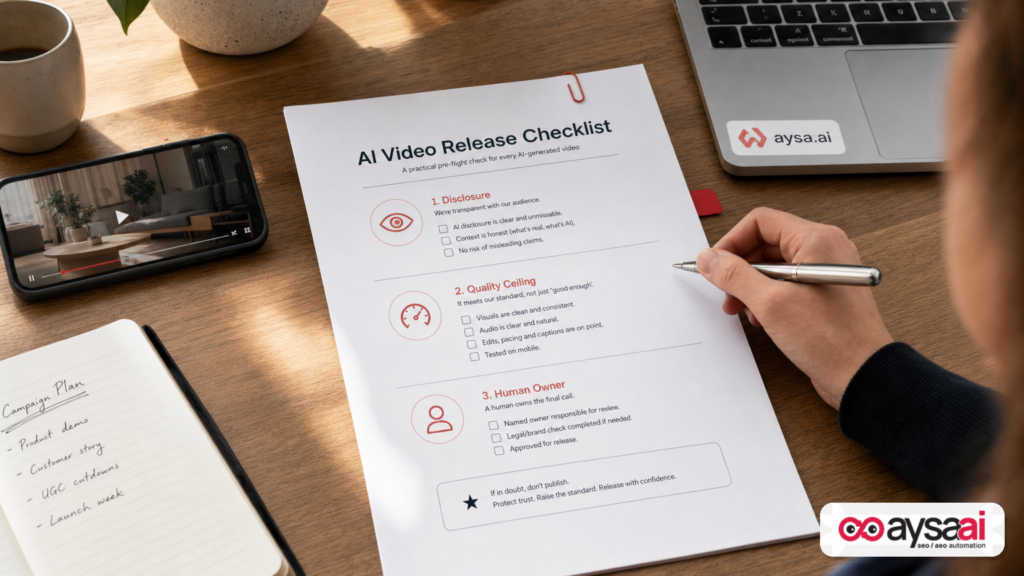
AI video publishing now requires three operational updates:
- Audit disclosure against real platform policy (not your internal comfort level). If you’re wrong, the platform—not you—may label your content.
- Produce below the ceiling. Cheap generation tempts teams into volume that dilutes trust and performance. Decide your output intentionally.
- Name the human decision-maker for every AI-assisted asset. If no one owns the final call, you’re not publishing content—you’re outsourcing responsibility.
Key takeaways

- The AI “slop” problem is not primarily a quality problem. It’s a governance problem: who is accountable, what is disclosed, and what is restrained.
- Platform rules are becoming product features. Disclosure labels and enforcement reduce your control if you treat compliance as optional.
- Trust affects discovery. Even when you’re “doing video,” your real objective is distribution across YouTube, social feeds, Google surfaces, and AI assistants that cite sources.
- Execution is the bottleneck. Great strategy fails when the workflow doesn’t force approvals, documentation, and consistent standards.
Table of contents

- What changed: Sora, platform enforcement, and the collapse of “just ship it”
- The trust stack: what “trust infrastructure” actually means
- The three updates every business should make before publishing AI-assisted video
- Why this matters for SEO/AEO/GEO (even if you “just do video”)
- What can go wrong: the failure modes businesses underestimate
- A concrete SME scenario: the local clinic that wants to “post daily”
- What agencies should rethink now
- What to monitor: signals that show your trust stack is working
- Where AYSA fits: approved execution for AI-era visibility
- A practical 30-day action plan
- What to do next
- Sources and further reading
What changed: Sora, platform enforcement, and the collapse of “just ship it”
In the last wave of marketing tech, the common playbook was simple: tools make production easier, so marketers publish more, test more, and let the algorithm sort it out.
AI breaks that playbook because the limiting factor is no longer production. The limiting factor is trust—and trust is now enforced by a mix of policy, automated detection, and audience skepticism.
In the Search Engine Journal piece that sparked this editorial, the central idea is that AI video didn’t stumble because the outputs were inherently unusable; it stumbled because the ecosystem wasn’t prepared for the speed and realism of the outputs. Platform actions and public backlash aren’t a creative critique. They’re an operational signal: distribution now expects governance.
At the same time, the cost of generating video keeps dropping. Even if you ignore specific vendor announcements, the market trend is clear: generation is becoming cheaper, faster, and more accessible. That combination—cheaper scale plus higher trust expectations—creates a trap for businesses:
- You can publish 10x more than before.
- But if you publish 10x more without human review, you create 10x more risk.
The teams that win will not be the teams with the most AI. They’ll be the teams with the best release discipline.
The trust stack: what “trust infrastructure” actually means
When marketers hear “trust,” they often think of brand campaigns, tone, or “being authentic.” That’s not what I mean here.
Trust infrastructure is the set of operational guarantees you can point to when anyone asks:
- What is this? (Is it AI-assisted? Is it dramatized? Is it altered?)
- Who approved it? (A named person with authority and accountability.)
- What standards did it meet? (Editorial checks, legal/medical/financial constraints, brand rules.)
- What happens if it’s wrong? (Correction process, takedown policy, updates, annotations.)
That sounds heavy, but it’s how mature organizations already operate for finance, HR, and security. AI publishing is simply catching up.
Here’s the point many SMEs miss: you don’t need enterprise bureaucracy. You need a lightweight system that forces the right moments of friction:
- A disclosure decision.
- A quality/volume decision.
- A human owner decision.
The three updates every business should make before publishing AI-assisted video
Let’s turn the “trust stack” into something you can deploy next week.
Update #1: Disclosure that matches policy language
The first update is not “add a disclaimer.” It’s: audit your disclosure practices against the platform’s actual policy language.
Why? Because platforms are increasingly explicit about when they expect creators to disclose AI use—and they may add labels themselves when their systems detect AI-generated or significantly altered content.
In the context provided by the Search Engine Journal article, YouTube’s creator guidance says disclosure is required when AI is used to edit or generate realistic content, and that labels can appear in the player or below the video. The practical implication is blunt: if your internal standard is looser than the platform’s standard, you lose control of the narrative. The platform becomes the one disclosing for you, on its terms.
Start with three questions:
- What exactly triggers disclosure on this platform? Don’t rely on “what we think is reasonable.” Use the platform’s words.
- Where does disclosure appear? In description, in a label, in a tool-driven toggle, or all of the above?
- What’s our consistent language? Not defensive, not vague. Just clear.
Primary reference (as a starting point): YouTube’s creator guidance referenced in the source context, “How Creators Use AI for Content Creation.” If your team publishes on YouTube, read it end-to-end and align your internal checklist to it. (Note: I’m citing the SEJ link above as the provided research context; consult YouTube’s official policy page directly for the most current wording.)
Practical disclosure language (examples, not legal advice):
- “Some scenes were generated or altered using AI tools for illustrative purposes.”
- “AI-assisted editing was used to enhance visuals; the narrative and claims were reviewed by [Name, Title].”
- “This video contains dramatized visuals created with AI; product specs are accurate as of [date].”
Notice what these do: they disclose the method and anchor accountability.
Update #2: Produce below the ceiling (and why it’s hard)
The second update is counterintuitive in a marketing world addicted to output: choose to produce less than the tools allow.
AI video systems make it possible to generate massive variations: different hooks, different backgrounds, different lengths, different aspect ratios, different voiceovers, different CTAs. The temptation is to flood channels with permutations and hope one pops.
That’s a mistake for three reasons:
- Volume dilutes review. If you publish 100 versions, you won’t review 100 versions with equal care. You’ll rubber-stamp.
- Volume trains audiences to ignore you. If your output feels templated, people scroll past it faster. Engagement drops; distribution shrinks.
- Volume creates “inauthenticity risk.” The SEJ context points to enforcement against mass-produced, templated channels. Regardless of the specifics of any one case, the lesson is durable: platforms don’t want automated content mills.
What “below the ceiling” looks like in practice
- You can generate 30 hooks. You publish 3.
- You can generate 10 thumbnails. You publish 2.
- You can generate daily. You publish twice a week—because those two get full review and match your brand.
This isn’t anti-testing. It’s pro-discipline. The goal is to shift from “we can generate it” to “we can stand behind it.”
A simple operational guardrail: set a maximum weekly publish count that your team can fully review. If you can’t do real review at that volume, the ceiling is too high for your current process.
Update #3: Name the human owner (and document decisions)
The third update is the most important: name the human decision-maker for every AI-assisted asset.
Not the editor. Not “the team.” Not the agency. A person.
Why this matters:
- Trust is personal. Customers don’t trust “automation.” They trust accountable organizations.
- Policy enforcement is asymmetric. If a platform flags your content, you need an internal owner who can respond fast, not a committee.
- Quality improves when accountability is explicit. When someone’s name is attached, standards rise.
In the SEJ context, examples of higher-quality AI creative work emphasize deliberate prompting and clear brand codification before generating. That’s another way of saying: a human decides what the brand is, and the tool executes within boundaries.
Operationalize ownership with a “content release card.” For every video, store (in a doc, project tool, or CMS note):
- Asset name + URL
- Disclosure decision (Yes/No + where shown)
- Primary claim(s) made and who verified them
- Tools used (high level)
- Owner: Name, role, date approved
- Rollback plan if flagged
This is how you create institutional memory. It also makes agency-client relationships cleaner: everyone knows who signs off.
Why this matters for SEO/AEO/GEO (even if you “just do video”)
Many business owners still separate “video” from “search.” That separation is outdated.
Today, discovery is blended:
- YouTube is a search engine.
- Google surfaces video results, Shorts, and creator content.
- AI assistants summarize, recommend, and cite sources across the open web.
Whether you call it SEO, AEO (Answer Engine Optimization), or GEO (Generative Engine Optimization), the common requirement is the same: be citable, be credible, and be consistent.
AI video can help—especially for:
- Product demos (ecommerce)
- Service explainers (local services)
- Trust-building education (clinics, legal, finance—careful with claims)
- Customer onboarding (SaaS)
But AI video can also hurt if it introduces:
- Inconsistent brand cues (viewers don’t recognize you)
- Questionable realism (viewers feel manipulated)
- Templated repetition (platforms see “inauthentic content” patterns)
Here’s the strategic link to AI Search visibility: assistants and modern search surfaces reward sources that feel stable, transparent, and human-led. If your video operation looks like a factory, you may still get Impressions, but you lose long-term authority.
If you want a deeper look at how AI search visibility is evolving, see: AYSA AI Search Visibility.
What can go wrong: the failure modes businesses underestimate
Most teams underestimate AI video risk because they picture “deepfakes” as the only threat. In reality, the most common failures are operational and subtle.
1) Policy mismatch (you disclose, but not correctly)
You add a generic disclaimer, but it doesn’t match the platform’s expectations for the type of alteration you made. Or you disclose inconsistently across Shorts vs long-form. Result: inconsistent labeling, confused viewers, higher scrutiny.
2) Repetition patterns (you look like a template mill)
Even if each video is “unique,” the structure is identical: same intro cadence, same stock-style visuals, same voice, same CTA. Platforms and audiences interpret that as inauthentic. This maps to the enforcement context discussed in the SEJ piece about inauthentic/repetitious mass-produced channels.
3) Claims drift (the AI adds certainty you didn’t intend)
AI tools often default to confident phrasing. In regulated categories (health, finance, legal), that’s dangerous. You can end up promising outcomes you don’t control—or implying credentials you don’t have.
4) Brand erosion (you stop looking like you)
When you generate lots of variations, you lose visual continuity. Your brand becomes a set of random aesthetics rather than a recognizable identity. That hurts direct traffic, repeat engagement, and conversions.
5) No owner, no response
If something gets flagged, misinterpreted, or challenged, and nobody is clearly accountable, response time expands. In modern distribution, delays are costly: a short window exists where you can clarify before the narrative sets.
A concrete SME scenario: the local clinic that wants to “post daily”
Let’s make this real.
Scenario: A local dermatology clinic wants to post daily short-form videos to compete with larger practices. They’re considering AI video to generate quick “tips” and “myth vs fact” clips. The owner is busy; the office manager and a part-time marketer will run the channel.
The naive plan:
- Generate 30 scripts a month with AI.
- Generate an AI avatar to narrate.
- Publish daily.
What goes wrong:
- Medical claims drift into advice that should be individualized.
- Disclosure is inconsistent.
- Videos feel templated and “faceless,” hurting trust.
- No single person is accountable for final approval.
A safer, higher-performing plan (below the ceiling):
- Publish 2–3 times per week, not daily.
- Use AI for editing assistance and b-roll generation, but keep the clinic’s real clinician voice (on camera or voiceover) for key claims.
- Create a 10-topic library approved by the lead clinician (e.g., sunscreen basics, acne myths, what “board-certified” means).
- Require a release card: disclosure + claim verification + owner signature before posting.
Result: Fewer videos, but higher trust. More importantly, the clinic can confidently embed these videos on service pages and FAQ pages—supporting SEO/AEO because the content is consistent, accurate, and owned.
This is exactly the kind of workflow discipline AYSA is built to support on the web side: monitored changes, prepared recommendations, approvals, then execution. The same philosophy applies to video publishing.
What agencies should rethink now
Agencies are caught in the middle: clients want more content, faster, cheaper. AI makes that technically possible—but it can also destroy margins and relationships if you become “the content faucet.”
Three agency-level shifts matter:
1) Productize governance, not just production
If you sell “20 videos/month,” you’re selling volume. In AI era, volume is commoditized. What clients actually need is a release system that keeps them safe and credible.
New retainers should include:
- Disclosure standards per platform
- Brand knowledge base inputs (visual + verbal rules)
- Approval workflows and sign-off roles
- Audit logs and accountability
2) Scope for review capacity
AI generation is cheap; human review is not. Your profit depends on how clearly you scope review:
- How many scripts are reviewed by a subject matter expert?
- How many rounds of revisions are included?
- What is the client responsible for approving?
3) Tie video output to discoverability outcomes
Clients don’t ultimately buy “videos.” They buy leads, pipeline, and revenue. Agencies should connect video to:
- On-site content upgrades (pages that convert)
- Search visibility improvements (topics you can win)
- AEO/GEO readiness (content that can be cited and summarized)
AYSA’s approach—monitor, prepare, approve, execute—maps cleanly to this. It gives agencies a way to scale execution without losing control of what actually changes on the site: AYSA AI SEO Tools.
What to monitor: signals that show your trust stack is working
You can’t manage what you don’t measure. But you also don’t need 50 dashboards. You need a small set of signals that reflect trust and distribution.
Platform-level signals
- Disclosure consistency: Are AI labels appearing where you expect them? Are descriptions standardized?
- Content actions: Any removals, limitations, demonetization notices, or sudden reach suppression (even if not explicitly stated)?
- Engagement quality: Watch time and comments that indicate confusion (“Is this real?” “Is this you?”) are trust alarms.
Website-level signals (where SEO/AEO shows up)
- Branded Search lift: More people searching your brand after consuming video is a strong trust proxy.
- Conversion rate on pages embedding video: Do pages with AI-assisted video convert better or worse?
- Topic coverage consistency: Are you building depth around a few topics, or scattering across dozens?
On the AYSA side, the key is operational monitoring: knowing what changed and why. That’s the foundation for accountable growth: AYSA Monitoring.
Where AYSA fits: approved execution for AI-era visibility
AI tools can generate content. They cannot guarantee that your business publishes responsibly, consistently, and in a way that compounds authority.
AYSA’s model is simple and deliberately conservative:
- Monitor your site and visibility surfaces for changes and opportunities.
- Prepare recommended updates (technical, content, structured improvements).
- Ask for approval so a human owner signs off.
- Execute only what you accept—then log it.
That’s “trust infrastructure” applied to SEO and AI search visibility. It reduces the two most common failures I see in SMEs and agencies:
- Random acts of optimization (lots of changes, no strategy, no record).
- Uncontrolled automation (changes go live without a human accountable for outcomes).
If your AI video strategy is meant to drive demand, the site has to be ready to capture it—fast pages, clear service/product architecture, credible FAQs, and consistent entity signals. That’s where execution matters most, and where “approved execution” is a competitive advantage.
Learn more about how we approach AI-era discoverability: AI Search Visibility.
A practical 30-day action plan
If you’re an SME or agency trying to publish AI-assisted video safely, don’t boil the ocean. Run this 30-day sprint.
Week 1: Set standards (one-page governance)
- Choose your platforms (YouTube, TikTok, Instagram, LinkedIn, etc.).
- Write a one-page disclosure standard per platform based on the platform’s own wording (start with YouTube guidance referenced in the SEJ source context).
- Create a release card template with the fields listed above.
- Assign owners: one primary and one backup.
Week 2: Build a “topic truth set”
- Pick 5–10 topics you can own (not 50).
- For each, write “truth constraints”: what you will and won’t claim.
- Collect links to your own canonical pages and any official references you rely on.
Week 3: Pilot below the ceiling
- Generate more than you need, but publish less (e.g., create 12 drafts, publish 4).
- Run full review on each published piece.
- Track audience feedback for trust signals.
Week 4: Connect video to site capture
- Embed best-performing videos on relevant pages.
- Add supporting FAQ content (human-reviewed).
- Use AYSA-style monitoring to track changes and outcomes over time.
If you’re already using AYSA, this is the moment to align web execution with your video strategy. If you’re not, start here: AYSA Pricing and see what level fits your business.
What to do next
- Read your platform’s AI disclosure guidance (don’t rely on assumptions).
- Set a weekly publishing cap based on real review capacity.
- Assign a named owner to every AI-assisted asset.
- Create a release card and require it before posting.
- Audit your site so the traffic you earn can convert (pages, FAQs, speed, clarity).
- Implement monitoring + approved execution so changes are intentional and logged.
For more on how we think about AI-era visibility and execution, browse the AYSA blog: AYSA Blog.
Sources and further reading
- Search Engine Journal: AI Video After Sora: 3 Updates You Should Make Before You Publish (primary research context for this editorial)
- Search Engine Journal: SEO section (for ongoing platform/search changes referenced in the source context)
- Search Engine Journal: Latest marketing/search news (additional monitoring of policy shifts)
- AYSA: AI Search Visibility
- AYSA: Monitoring
- AYSA: AI SEO Tools
- AYSA: Pricing
- AYSA: Blog
Note on sourcing: The provided research context references additional outlets (e.g., the Associated Press, The Hollywood Reporter) and vendor announcements. Because those primary links were not included in the supplied source links, I’ve avoided asserting specific figures or quoting those articles directly. If you want, we can update this editorial with direct primary citations once those URLs are added to the research packet.
Continue the AI search topic inside AYSA.
Use these pages to connect the article with AI SEO tools, AI visibility monitoring, AI Overviews and approved website execution.
Turn this topic into a website action plan.
Use these AYSA hubs to move from reading to technical fixes, AI visibility monitoring, research, glossary context and approval-first SEO execution.

