
Self-Improving AI Content Workflows: 7 Feedback Loops That Turn Edits Into Search Wins (Without Publishing More)
Most teams use AI to write faster—then spend the saved time fixing the same mistakes. Here’s how to build seven practical feedback loops that capture recurring corrections (research gaps, weak angles, tone drift, factual slips, and SEO misses) and turn them into a system that improves every run. With examples for SMEs and an execution path using AYSA’s approved automation model.

AI didn’t break content marketing. It exposed what was already true: most teams don’t have a “content problem,” they have a workflow problem. If your process can’t reliably turn an idea into a publishable, defensible, search-visible page, adding AI just makes you fail faster.
This editorial is my practical playbook for making AI content workflows self-improving—so recurring corrections become system rules, not repeated labor. It’s inspired by (but not copied from) Tania Brown’s excellent framework on feedback loops for AI content workflows published by Search Engine Land.
Concise summary

Self-improving AI content workflows use feedback loops to catch the same mistakes once and prevent them forever. The core idea: every edit (angle change, source correction, tone tweak, structural rewrite, SEO adjustment) is signal. Capture that signal, classify it, and feed it back into earlier steps—briefing, research, drafting, editing, and post-publish iteration—so the next run starts closer to “approved.”
Key takeaways

- Speed isn’t the win. Consistency and correctness are. AI gives you volume; feedback loops give you quality.
- Most failures are upstream. A weak angle or missing evidence will cost you more at the end than at the start.
- Use gates + caps. Add a quality gate and cap revisions; endless rewrites hide structural issues.
- Separate jobs. Don’t make one “editor agent” do everything; fact-checking and editing are different disciplines.
- Post-publish metrics should rewrite the brief. Search performance is training data for planning, not just reporting.
- Execution matters. Insights only help if you can turn them into approved website changes—reliably and safely.
Table of contents
- The new reality: AI made writing cheap—quality became the constraint
- What changed in search: from keywords to answers, and from pages to entities
- Why feedback loops beat “prompt engineering”
- Loop 1: The upstream filter (kill weak angles before you pay the full production cost)
- Loop 2: Retrieval refinement (validate evidence before drafting)
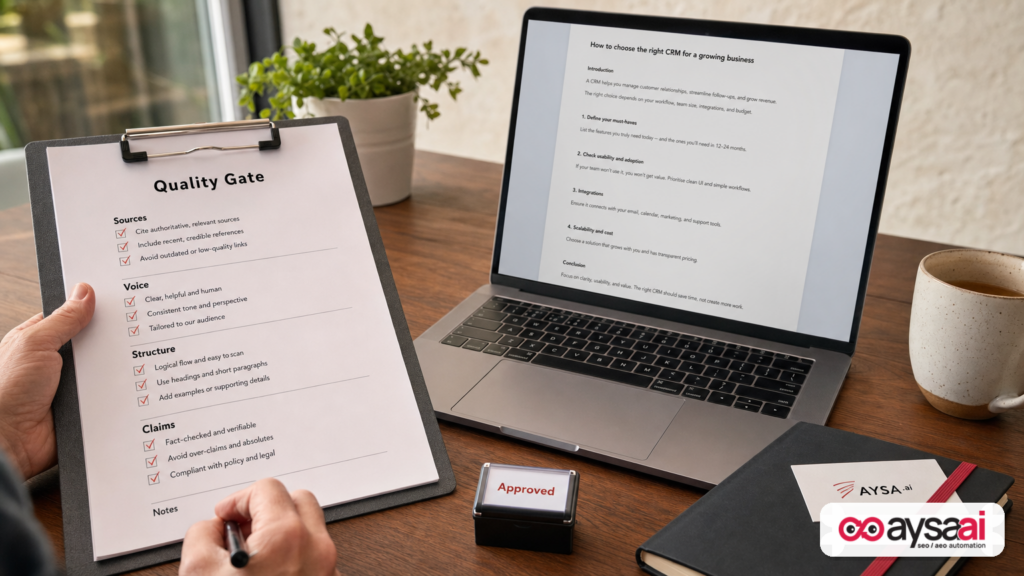
- Loop 3: The quality gate (with a revision cap) that prevents AI slop
- Loop 4: Rubric scoring + ensemble selection (choose the best version on purpose)
- Loop 5: The adversarial challenge (stress-test thought leadership)
- Loop 6: Diff-and-learn (turn human edits into permanent system upgrades)
- Loop 7: Performance feedback (turn rankings and CTR into better briefs)
- A concrete SME scenario: local clinic pages that improve every month
- What can go wrong (and how to keep AI honest)
- Implementation plan: build this in 30–60 days without boiling the ocean
- Where AYSA fits: monitored, approved execution—so loops become outcomes
- What to do next
- Sources and further reading
The new reality: AI made writing cheap—quality became the constraint
Five years ago, “content production” meant writing time. Now it means decision time:
- Which topics are worth publishing?
- What claims are we willing to stand behind?
- What is our real point of view—and do we have proof?
- What should a reader do next (and is that experience good)?
AI can draft. It can’t automatically decide what your business should say, prove it, and ship it in a way that wins in modern search. And that’s why the best teams aren’t “using AI to write.” They’re building AI workflows that learn.
A self-improving workflow is a system where recurring corrections don’t stay trapped in someone’s head or in scattered Google Docs comments. They get turned into:
- a briefing rule (“don’t accept angles without a unique claim”),
- a research requirement (“every ‘benefit’ needs a source or a customer proof point”),
- a drafting guardrail (“avoid hedging language unless the evidence is uncertain”),
- an editing standard (“define terms at first use”),
- or a publishing checklist (“add schema and internal links before it goes live”).
That’s the difference between a content team that constantly “fixes” AI and a team that steadily trains their workflow so fixes become rare.
What changed in search: from keywords to answers, and from pages to entities
This isn’t just an operations story. Search behavior is changing, and the “publish more blog posts” playbook is losing leverage.
Search Engine Land’s broader context across adjacent pieces—like why clarity matters in AI search and content strategy that favors focus—points to the same direction: content needs to be clear, verifiable, and aligned to real user questions. That’s even more important as search results increasingly emphasize summaries, answer-like experiences, and more aggressive query interpretation.
Separately, the industry conversation around entity-first optimization and Structured data continues to reinforce that modern visibility isn’t only about a single Keyword on a single page. It’s about whether machines can confidently understand what your business is, what it offers, and why it’s credible. Search Engine Land has also covered schema and entity gap thinking (e.g., schema for AI search and prioritizing entity gaps), which matters because LLM-driven interfaces reward clear, structured understanding.
So yes: writing matters. But what matters more is the system that repeatedly produces clear, consistent, well-supported pages that match what search engines (and AI answer systems) can parse.
Why feedback loops beat “prompt engineering”
Most teams respond to AI output drift with prompt changes. That’s necessary, but insufficient. Prompt engineering is like giving instructions to a new hire. Feedback loops are what you build when you stop hiring new people and start building a repeatable factory line.
A feedback loop has four parts:
- A checkpoint (a deliberate inspection point in the workflow)
- A standard (criteria, rubric, or threshold)
- A decision (pass/revise/escalate/kill)
- A memory (a place where the decision and its rationale persist)
Without memory, you’re just “reviewing.” With memory, you’re improving the system.
At AYSA, we care about this because the end goal isn’t “generate content.” The goal is: monitor → propose changes → get approval → execute safely. A loop that produces insight but can’t reliably turn into changes is just a nicer report.
Loop 1: The upstream filter (kill weak angles before you pay the full production cost)
The most expensive content mistake is not a typo. It’s a bad angle that survives long enough to become a published page.
An upstream filter is a pre-writing checkpoint that evaluates a topic/brief/angle and returns one of three verdicts:
- Pass: proceed to research and drafting
- Revise: adjust angle, audience, thesis, or required proof
- Kill: don’t write it—because it can’t be made valuable or defensible
Why this matters for SMEs
If you’re a small business, the real cost of a weak angle isn’t just wasted time. It’s:
- publishing content that doesn’t rank (or ranks for the wrong intent),
- training customers to ignore your blog,
- crowding your site with pages you later have to prune or consolidate,
- and confusing search systems about what you’re actually an authority on.
How to implement it
Write down the criteria before you automate anything. Keep it painfully simple:
- Originality test: what will we say that isn’t already in the top results?
- Evidence test: what can we cite or demonstrate?
- Audience test: who is this for, and what action should it drive?
- Fit test: does this topic build topical authority for our business?
Then create a “kill log.” Every killed angle should have a reason captured in a durable place (spreadsheet, database, even a versioned markdown file). Over time, the kill log becomes strategic: it shows which ideas consistently fail and why.
What AYSA would do here
In an AYSA-driven workflow, the upstream filter can be paired with Monitoring and planning so the team isn’t guessing what to write. You can use AYSA Monitoring to watch visibility signals, then propose a shortlist of content opportunities. The filter loop decides which of those opportunities deserve production—and which should be rejected early.
Loop 2: Retrieval refinement (validate evidence before drafting)
AI can generate a confident draft from weak sources. That’s not intelligence; it’s pattern completion.
The retrieval refinement loop adds a checkpoint between research and writing:
- Research retrieves sources for the planned outline.
- A mapping step checks section-by-section: do these sources support the claims we plan to make?
- If a section is weak, the system generates follow-up queries that specifically target what’s missing.
- Only then does writing begin.
Why this matters in AI search and AEO/GEO
Answer engines (and humans) punish vagueness. When sources don’t support the outline, the draft fills space with:
- hedges (“can,” “may,” “often”),
- platitudes,
- generic “best practices” that sound like everyone else.
Validated sources enable specificity. Specificity is what gets cited, linked, and remembered.
Constraints you must respect
This is where teams are tempted to “invent” evidence. Don’t. If you can’t support a claim with a source or your own verifiable data, treat it as:
- a hypothesis (and label it), or
- an opinion (and own it), or
- an idea to remove.
Loop 3: The quality gate (with a revision cap) that prevents AI slop
A quality gate is the simplest feedback loop that actually changes outcomes.
Instead of “generate → publish,” you add:
- a reviewer step that checks the draft against explicit standards,
- a writer revision step to address the feedback,
- a revision cap (e.g., max 2 rounds),
- and an escalation path to a human when the draft can’t pass.
Why the revision cap matters
Without a cap, you can burn hours rephrasing a draft that’s fundamentally broken because:
- the angle is too broad,
- the evidence isn’t there,
- the page is trying to rank for an intent it doesn’t satisfy.
A cap forces you to confront the real issue: you don’t need “better writing,” you need a better brief or better sources.
Split the jobs: editor vs fact-checker
One of the most useful patterns in the Search Engine Land piece is the explicit separation of roles. Editing for clarity and checking factual alignment are different tasks. When you combine them, both get weaker.
A practical setup:
- Editor: structure, clarity, voice, audience fit, redundancy
- Fact-checker: verifies each claim matches cited sources (not merely that the link exists)
Where AYSA fits
AYSA is built around monitored, Approved Execution. A quality gate pairs naturally with that philosophy:
- Drafts and proposed changes are reviewed.
- Only approved changes are executed.
- There’s a record of what changed and why.
That’s the difference between “AI writes content” and “AI helps you ship trustworthy changes.” Learn how we think about visibility systems at AYSA AI Search Visibility.
Loop 4: Rubric scoring + ensemble selection (choose the best version on purpose)
“Pass/fail” is a start, but it doesn’t tell you what to fix or which draft is best when you generate multiple options.
Rubric-based scoring solves this. You define criteria, score each, and diagnose what’s missing. For SMEs, a rubric doesn’t need to be fancy; it needs to be consistent.
A practical rubric for SME content pages
Use a 1–10 score on each item, with a minimum threshold (e.g., 7):
- Intent match: does the page answer the query it targets?
- Specificity: are there concrete steps, examples, or policies?
- Credibility: are claims supported (citations, internal data, named expertise)?
- Clarity: could a non-expert understand this in one read?
- Conversion path: is the next step obvious and helpful?
- Consistency: does it match brand voice and terminology?
Then add the missing ingredient: a required diagnosis. “6/10 on specificity” is useless unless the system says: which sections are vague, what details are missing, and what evidence would make it concrete?
Ensemble selection: generate options, then judge
Rubrics also let you do something teams rarely do well: generate a few competing drafts (different framing, different structure) and pick the best one intentionally.
That’s how you avoid shipping the first draft that “sounds fine.” In competitive SERPs, “fine” is invisible.
Loop 5: The adversarial challenge (stress-test thought leadership)
Some content is meant to inform. Other content is meant to persuade. Thought leadership and opinion pieces live or die on the strength of the argument.
An adversarial challenge loop introduces a deliberate “smart critic” step:
- Attack the thesis.
- Attack the evidence.
- Attack the logic linking evidence to conclusion.
- Surface the best counterarguments a competent peer would make.
Then the writer must respond to each objection by either:
- strengthening the content,
- adding clarification,
- or documenting why the objection doesn’t change the conclusion.
Where this is especially useful
- Founder POV posts on LinkedIn or your blog
- “Our approach vs the industry” pages
- Agency positioning content
- High-stakes pages where a wrong claim is reputational risk
For basic how-to pages, a quality gate is usually enough. Don’t over-engineer what doesn’t need it.
Loop 6: Diff-and-learn (turn human edits into permanent system upgrades)
This is the loop most teams never build—and it’s the one that makes the whole system compound.
Here’s the pattern:
- The workflow produces a “frozen” draft output (never edited).
- A human edits a working copy to final publishable form.
- A diff step compares frozen vs published line-by-line.
- Each change is classified (tone shift, language simplification, structural reorder, factual correction, heading rewrite, etc.).
- When a change type repeats enough times, it becomes a proposed rule update.
- A human approves or rejects the new rule.
Why freezing matters
If you edit the same file the system produced, you erase the evidence of what it did wrong. No evidence, no learning.
Why approval matters
Not every edit should become a rule. A one-off edit might be contextual. Without human approval, the system can “learn” the wrong lesson and degrade future output.
What to track in your diff registry
- Per change: page, section, category, before/after text, reason
- Per category: total counts, number of pages affected, status (watching vs implemented)
This is how you stop paying for the same fix forever.
Loop 7: Performance feedback (turn rankings and CTR into better briefs)
Publishing is not the end of the workflow anymore. It’s the start of measurement.
The performance feedback loop schedules a recurring process (weekly is a practical cadence) to pull signals like:
- Impressions and Clicks,
- click-through rate (CTR),
- average position and query mix,
- page-level trends (winners and losers).
In many orgs, this becomes a monthly slide deck. That’s a waste. The loop should produce a single actionable output:
Given how this page performed, what would we change about the original brief?
Important caution: don’t misread CTR in AI-influenced SERPs
CTR can drop for reasons unrelated to content quality, including changes in how search results present answers. A falling CTR alone is not a verdict; it’s a prompt to investigate.
Use winners, not just losers
The pages that outperform expectations are your goldmine. They often reveal:
- a better framing than you planned,
- an unexpected query cluster,
- an internal linking pattern that worked,
- or an authority signal you accidentally provided (and can repeat intentionally).
Where to look (without inventing tooling claims)
Most teams use Google Search Console as the baseline for this kind of analysis. If you’re not pulling data weekly, start there. (If you need a refresher, Google Search Console is Google’s own product for performance monitoring.) If you’re layering broader competitive monitoring, some teams use third-party platforms; Search Engine Land’s source context mentioned Semrush as an example.
At AYSA, we treat monitoring as foundational. Start with AYSA Monitoring, then connect insights to proposed changes, approvals, and execution so performance feedback doesn’t die in a spreadsheet.
A concrete SME scenario: local clinic pages that improve every month
Let’s make this real with a scenario that doesn’t require an enterprise team.
Business: a local physical therapy clinic with two locations.
Goal: generate more booked evaluations and rank for service-intent local queries (e.g., “sports injury physical therapy” + city).
The old way
- Owner asks for “more blog posts.”
- AI drafts content quickly.
- Team edits manually: tone, medical caution, add local references.
- Pages go live inconsistently, with weak internal linking and unclear CTAs.
- Performance is checked quarterly; changes are made too late.
The loop-driven way
Loop 1 (Upstream filter): The clinic rejects topics like “What is physical therapy?” (too broad, no unique POV) and accepts topics like “What to expect at your first sports injury evaluation in [City]” (high intent, clinic-specific).
Loop 2 (Retrieval refinement): Before drafting, the clinic requires sources for claims about recovery timelines and flags any section that would otherwise drift into generic advice.
Loop 3 (Quality gate + cap): A reviewer checks for: disclaimers, clear next steps, and plain-language definitions. If the draft can’t pass in two rounds, it goes back to brief or research.
Loop 6 (Diff-and-learn): The owner repeatedly edits two patterns: replacing jargon with plain English and adding a “call us if you have red-flag symptoms” safety section. After three repeats, those become permanent rules in the workflow.
Loop 7 (Performance feedback): Weekly review shows one page ranks for “physical therapy evaluation cost” queries. Next month’s brief includes a dedicated FAQ section and clearer pricing guidance (where appropriate), plus internal links from related service pages.
Where AYSA can make this operational
For SMEs, the hard part isn’t knowing what to do. It’s reliably doing it while running the business. AYSA is designed to reduce that gap:
- Monitor visibility and page signals with AYSA Monitoring.
- Turn findings into proposed content and on-page changes.
- Request approval (so the owner stays in control).
- Execute accepted changes consistently.
That’s how you get compounding improvement without hiring a full in-house content ops team.
What can go wrong (and how to keep AI honest)
Feedback loops are powerful, but they can also amplify mistakes if you build them carelessly.
Failure mode 1: encoding one-off edits as universal rules
You delete a statistic because it didn’t fit one article, and the system “learns” to avoid stats forever. Fix: human approval and thresholds (only promote patterns that repeat).
Failure mode 2: optimizing for rubrics instead of outcomes
If your rubric rewards length or “SEO keywords,” you’ll train the system to bloat pages. Fix: align rubrics to intent match, clarity, and conversion usefulness.
Failure mode 3: mixing tasks into one evaluation step
An agent that tries to evaluate voice, facts, SEO, legal risk, and conversion intent at once will do all of them poorly. Fix: separate into specialized checks (and only run the checks you truly need).
Failure mode 4: measuring the wrong thing post-publish
Teams panic about CTR without checking whether impressions grew, queries changed, or SERP layouts shifted. Fix: compare like-for-like pages, look at query mix, and avoid single-metric conclusions.
Failure mode 5: building an insights machine with no execution path
If your workflow produces lots of “recommendations” but no one reliably implements them, you’re just generating backlog. Fix: connect loops to a monitored, approved execution system (that’s where AYSA is designed to help).
Implementation plan: build this in 30–60 days without boiling the ocean
You don’t need seven loops on day one. Most teams should sequence this as a maturity curve.
Phase 1 (Week 1–2): stop the bleeding
- Add Loop 3 (quality gate + cap). This immediately improves publish quality.
- Split editing vs fact-checking if you publish anything regulated or reputationally sensitive.
- Create a minimal “definition of done” checklist: sources, clarity, CTA, internal links.
Phase 2 (Week 3–4): reduce wasted work
- Add Loop 1 (upstream filter) to kill weak angles early.
- Add Loop 2 (retrieval refinement) for any piece that includes claims beyond basic how-tos.
- Create a kill log and a research gap log.
Phase 3 (Week 5–8): start compounding
- Add Loop 6 (diff-and-learn). This is your compounding engine.
- Implement a threshold rule (e.g., “3 repeats across 2+ pieces” triggers a proposed instruction update).
- Start a lightweight rubric (Loop 4) if you produce multiple variants or multiple content types.
Phase 4 (ongoing): close the loop with performance
- Add Loop 7 (performance feedback) with a weekly cadence.
- Require that every flagged page results in one brief-level change, not just “update the article.”
At each phase, keep one principle: if it doesn’t change what you publish next week, it’s not a loop. It’s paperwork.
Where AYSA fits: monitored, approved execution—so loops become outcomes
Feedback loops are a content ops concept, but the real business value shows up when loops change what’s live on your site.
AYSA’s model is built for that translation:
- Monitor your visibility and site signals (Monitoring).
- Prepare proposed changes: content improvements, internal links, clarity updates, and other on-page actions.
- Ask for approval so humans retain control (especially important for SMEs and regulated industries).
- Execute accepted changes consistently, reducing backlog and missed opportunities.
That’s why we talk about AI visibility systems, not “AI content.” If you want to explore how this fits your workflow, start with:
And if you’re an agency, the loops above map cleanly onto your delivery model: brief gates reduce rework, diff-and-learn trains your SOPs, and performance feedback makes strategy measurable. The difference is whether you have a system to implement changes at scale without losing control—approved execution is the missing piece for a lot of agencies trying to operationalize AI.
What to do next
- Pick one break point. Where does your process fail most often—angle, research, drafts, editing, or performance?
- Implement Loop 3 first (quality gate + revision cap). This is the fastest quality lift.
- Add a frozen draft + diff habit (Loop 6) so your edits become learning data.
- Start a weekly performance review (Loop 7) focused on “brief changes,” not “reporting.”
- Build a kill log (Loop 1) so you stop wasting cycles on topics that can’t win.
- Connect insights to execution so the system actually improves what’s live. If you want that monitored, approval-based workflow, explore AYSA Monitoring.
Sources and further reading
- Search Engine Land: 7 feedback loops for self-improving AI content workflows
- Search Engine Land: The new SEO rules for bloggers in 2026: Why clarity matters in AI search
- Search Engine Land: Schema for AI search: How to identify and prioritize entity gaps
- Search Engine Land: How semantics and topical authority improve local SEO
- Search Engine Land: How to audit your AI entity footprint
- AYSA: AI search visibility
- AYSA: AI SEO tools
- AYSA: Monitoring
- AYSA: Pricing
- AYSA Blog
Continue the AI search topic inside AYSA.
Use these pages to connect the article with AI SEO tools, AI visibility monitoring, AI Overviews and approved website execution.
Turn this topic into a website action plan.
Use these AYSA hubs to move from reading to technical fixes, AI visibility monitoring, research, glossary context and approval-first SEO execution.

