AI Automation in Regulated Paid Media: Default Settings That Quietly Break Compliance (And How to Build a Safer System)
Google and Meta’s AI defaults can rewrite copy, swap assets, expand audiences, and change where ads land—often after your creative was “approved.” Here’s a practical framework for regulated advertisers to keep speed without losing control, plus an execution model where AI proposes changes and humans approve them before anything ships.

AI is now baked into paid media platforms by default—especially in Google and Meta. For regulated industries (healthcare, finance, legal, insurance, education, and any business with strict internal review), the problem isn’t simply “using AI.” The real risk is that AI-driven default settings can rewrite copy, remix images, expand audiences, and change destinations after your compliance team approved a specific version.
I’m Marius Dosinescu, and from the AYSA.ai perspective, this is the moment where “marketing” becomes “systems.” If you can’t reliably control what ships, you don’t have a growth engine—you have an incident generator. The fix is not to ban automation. The fix is to redesign your process so AI can propose improvements, humans can approve them, and your tools can document every change.
Primary research reference: Search Engine Journal’s analysis of regulated paid media AI settings and compliance pitfalls is an excellent prompt for this conversation. Read it here: AI In Regulated Paid Media: The Default Settings That Put Compliance At Risk (Search Engine Journal).
Concise summary
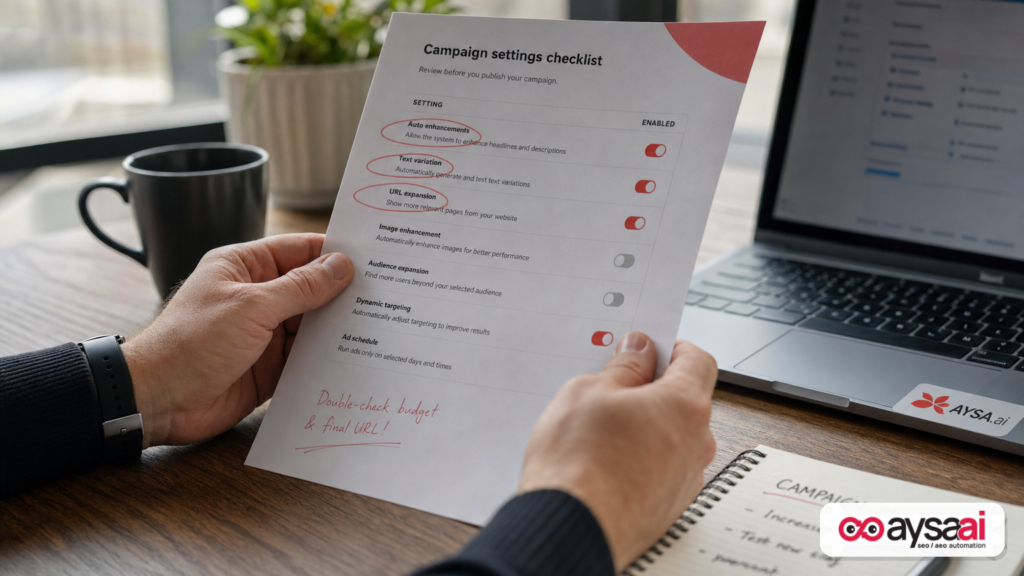
- What changed: “AI assist” in paid platforms is no longer optional; it’s increasingly embedded and turned on by default in settings that affect creative, targeting, and destinations.
- Why it matters: Regulated advertisers approve specific claims, layouts, disclaimers, and landing pages. AI systems can unintentionally break those constraints at scale.
- What to do: Audit every campaign for automation toggles; lock down destinations; define a written AI policy; enforce preview-and-approval workflows; strengthen measurement so you’re optimizing to real outcomes, not proxy metrics.
- Where AYSA fits: AYSA is an execution system that monitors, prepares changes, requests approval, and then executes accepted website updates—reducing the “surprise change” problem across SEO/AEO/GEO and paid landing pages.
Key takeaways (for busy operators)

- Defaults are decisions. If you didn’t explicitly choose a setting, you still own its consequences.
- Compliance risk lives in four layers: Creative, Destination (final URL), Audience/Targeting, and Measurement/Attribution.
- “Approved creative” is not enough. You need “approved behaviors”: what the platform is allowed to change and what it is not allowed to change.
- Fix governance before scaling automation. The more you automate, the more your process must produce auditable logs and repeatable approvals.
Table of contents

- Why this is urgent now (even if your results look fine)
- The new compliance risk isn’t “AI ads”—it’s AI defaults you didn’t notice
- Where things go wrong: the four automation layers that can change approved ads
- Platform hotspots to audit (Google + Meta) without chasing every buzzword
- Layer 1: Creative automation—copy drift, layout drift, disclaimer drift
- Layer 2: Destination automation—URL expansion and “wrong page” risk
- Layer 3: Audience automation—expansion that violates internal policy
- Layer 4: Measurement—when weak tracking makes the algorithm dangerous
- Write an AI policy that actually helps marketers ship safely
- The regulated advertiser’s audit checklist (practical and repeatable)
- An SME scenario: a clinic, a cautious compliance team, and an “approved” ad that changed
- How to build a safer operating system for paid media: controls, logs, and approvals
- The “approved execution” model: how AYSA reduces surprise changes across web + paid
- What to do next (action list)
- Sources and further reading
Why this is urgent now (even if your results look fine)
Many regulated marketers will read about AI settings and think: “We’re fine. We have compliance review. We’re cautious. We’re not generating ads with ChatGPT.”
That mental model is outdated.
The risk isn’t only AI-generated ad copy. It’s:
- AI-assisted variations that pull new text from your site or prior assets
- Automated enhancements that modify layouts, colors, fonts, cropping, or overlays
- Audience expansion that moves you beyond the guardrails you intended
- Destination expansion that sends traffic to a page compliance never reviewed for paid claims
- Opaque optimization that rewards “easy conversions” that don’t align with your risk profile
As Search Engine Journal notes, these concerns are amplified in industries like healthcare, finance, and legal—where precise wording and required disclosures can be the difference between a compliant ad and a problem.
And there’s a second-order effect: AI doesn’t just change ads. It changes how your org evaluates marketing. Compliance, legal, and risk teams increasingly ask for documented controls, not verbal assurances. If you can’t show what settings are on, what changed, and who approved it, budget and trust shrink.
The new compliance risk isn’t “AI ads”—it’s AI defaults you didn’t notice
One of the most consistent failure patterns in regulated paid media is simple: platform defaults get accepted during setup, then forgotten.
Over time, more campaigns get built, more people touch accounts, and “default-on” becomes “always-on.” The account may still pass a spot-check. Performance might even improve. But compliance risk is compounding quietly.
From an operational standpoint, this is a governance problem—not a marketing problem. You need a system that:
- Surfaces what is currently enabled
- Explains how each setting can change outputs
- Assigns ownership for approving exceptions
- Documents the decision and the rationale
That’s the same mental model we bring to AYSA.ai for SEO execution: Monitoring, preparing changes, requesting approval, and executing only what’s accepted. You don’t want “random changes”—you want controlled progress.
Where things go wrong: the four automation layers that can change approved ads
If you want a framework that a founder, marketing lead, and compliance officer can all understand, use this: the Four Layers of Automation Risk.
1) Creative (what the ad says and shows)
AI can rewrite, recombine, crop, overlay, or reformat assets. That can break disclaimers, required footnotes, required risk language, and brand standards.
2) Destination (where the ad lands)
AI can choose or test alternate landing pages. The “best-performing” page may be the least compliant—or simply not reviewed for paid claims.
3) Audience (who sees the ad)
AI can expand targeting beyond what you selected, which can violate internal policy (even if technically allowed by the platform).
4) Measurement (what the algorithm optimizes for)
AI bidding systems are only as safe as the signals you feed them. If your Conversion tracking is incomplete or misaligned, you can “optimize” into risk: low-quality leads, biased delivery patterns, or misleading attribution.
When a regulated marketer says, “AI feels like a black box,” it’s usually because they haven’t separated these layers. Once you do, the problem becomes audit-able and fixable.
Platform hotspots to audit (Google + Meta) without chasing every buzzword
Search Engine Journal highlights several specific areas to watch in Google and Meta settings—particularly features that automatically generate or modify creative, and options that expand targeting or URLs. Rather than listing every product name (which changes frequently), focus on behaviors you can identify in any UI:
- Text variation / text customization: Can the platform generate alternate headlines/descriptions?
- Asset generation / asset optimization: Can it create or remix images/video from your assets?
- Final URL expansion: Can it pick different landing pages than what you entered?
- Audience expansion / optimized targeting: Can it go beyond the audience you selected?
- Creative enhancements: Can it add overlays, music, templates, or “improvements”?
If you’re running regulated accounts, treat each of these as “requires explicit approval,” not “optional optimization.”
Layer 1: Creative automation—copy drift, layout drift, disclaimer drift
In regulated advertising, compliance often approves a specific set of claims and a specific presentation:
- Exact phrasing (including required qualifiers)
- Disclaimers that must be visible and readable
- Brand constraints (color, font, tone)
- Jurisdictional constraints (some regions require disclosures of AI involvement)
The SEJ source points to common concerns:
- AI text features can pull in language that doesn’t match approved messaging.
- Auto-generated creative can run in the wild with layouts that weren’t previewed.
- Meta enhancements can change the visual presentation significantly, and placement formats can cover disclaimers.
What businesses should do (practical controls)
- Define “non-editable” text. Required risk language and disclaimers should be treated as locked components.
- Require placement previews as part of approval. It’s not enough to approve “the feed ad.” If it can run in Stories/Reels-style formats, you need to preview those too.
- Create a compliance-safe asset library. Pre-approved headlines, descriptions, and image templates reduce the temptation to rely on platform-generated variants.
- Document which automations are allowed by campaign type. Treat this like a standard operating procedure (SOP), not a one-off decision.
Important note: The SEJ source mentions that ad platforms may include disclosure options for AI involvement (depending on jurisdiction). If your org operates across multiple states/countries, don’t guess—get a written compliance position on when and how to disclose.
Layer 2: Destination automation—URL expansion and “wrong page” risk
Destination drift is one of the easiest ways to break compliance while believing you’re safe. Why? Because many teams review ads and landing pages separately. Then the platform connects them in ways you didn’t intend.
SEJ specifically flags concerns about final URL expansion and sending users to unwanted pages. In regulated environments, “unwanted” can mean:
- A blog post with an unqualified claim
- A product page missing required disclosures
- A Location page with outdated pricing/availability language
- A general homepage where the message doesn’t match the ad claim
Why destination control is now a growth lever
As platforms automate more, your safest advantage is building better, clearer, more compliant landing pages and then forcing the system to send traffic there. “Let the algorithm figure it out” is not a compliant strategy.
Controls to implement
- Use URL allowlists (where available) or turn off URL expansion. If your compliance process requires page review, don’t let a platform dynamically pick pages.
- Create paid-only landing pages for sensitive offers. Separate pages reduce the chance that organic content changes impact paid compliance.
- Version and log landing page changes. If a disclaimer is edited, you need to know exactly when and why. This is where execution discipline matters.
This is also where SEO execution and paid media compliance collide. If the landing page can change (new testimonials, new wording, new modules), the “approved” ad message can become unapproved by association.
Layer 3: Audience automation—expansion that violates internal policy
Platforms may already restrict certain targeting behaviors for sensitive categories, but SEJ makes the key point: internal rules can be stricter than platform rules.
Examples of internal restrictions that often show up in regulated businesses:
- No age targeting even if the platform allows it
- Limits on list-based targeting (customer match, synced CRM lists)
- No pixel-based retargeting for certain healthcare contexts
- Heightened scrutiny of algorithmic delivery bias (e.g., fair lending concerns)
What “audience expansion” breaks in the real world
Audience expansion features are often positioned as harmless: “We’ll find more people like your converters.” But regulated advertising isn’t only about performance. It’s about defensible intent and non-discrimination principles, plus adherence to internal policy.
Even if the platform is within its own policy boundaries, you may still be outside your company’s acceptable risk envelope.
Controls to implement
- Decide your expansion stance per campaign objective. Brand campaigns, lead gen, and recruitment may each have different rules.
- Maintain a “targeting exception log.” If expansion is enabled, require a written rationale and time-bound review.
- Pressure-test with platform reps for documentation. SEJ suggests working with reps to provide documentation that relieves internal concerns. Don’t treat that as “nice to have”—treat it as part of the approval package.
Layer 4: Measurement—when weak tracking makes the algorithm dangerous
Automation without measurement is not automation—it’s delegation to a system you can’t verify.
SEJ highlights that as platforms move toward AI-driven bidding and looser targeting, accurate conversion tracking becomes even more crucial. I agree, with a stronger statement:
In regulated advertising, accurate measurement is a compliance tool.
Here’s why: if your conversion signal is weak (or overly broad), the platform will optimize for the easiest-to-get “conversions.” That can produce behavior that looks like performance but undermines business value and increases risk:
- Optimizing for low-intent leads (junk form fills)
- Optimizing toward demographics that convert more easily (raising bias concerns)
- Over-allocating spend to placements that inflate conversion counts
Common regulated-world tracking constraints
SEJ notes that internal restrictions can make pixels and offline uploads tedious. In many organizations, marketing needs approvals from security, privacy, legal, and web teams before deploying any tracking changes.
If your org restricts platform pixels, SEJ suggests alternate methods like UTM parameters to associate leads with source. That’s not as powerful as robust server-side and offline conversion connections, but it’s better than flying blind. The main point: you need a measurement plan that your organization will actually approve.
What to monitor (without inventing metrics)
- Are “conversions” aligned to business value? (Applications, booked appointments, qualified calls—not just page views.)
- Are conversions deduplicated and consistent? Multiple tags can inflate success signals.
- Do you have a documented tracking map? What fires where, and who owns it?
- Are UTMs standardized? If you can’t trust your attribution labels, your reporting will mislead stakeholders.
Write an AI policy that actually helps marketers ship safely
“We have an AI policy” often translates to a PDF that marketers never open—until something goes wrong.
A functional AI policy for regulated paid media should answer:
1) What AI is allowed to do (and not do)
- Can AI generate first drafts of copy internally (not in-platform)?
- Can platform AI create variants?
- Can platforms modify creative (enhancements)?
- Can platforms expand audiences or URLs?
2) What data is allowed in AI workflows
SEJ warns about feeding customer data to AI tools and the risk of violating privacy regulations or internal rules. Your policy should explicitly define:
- What counts as sensitive customer data
- What can be uploaded to third-party tools
- What must remain inside secure systems
- What approvals are required
3) What requires compliance preview and sign-off
- New claims or comparative language
- Any change to disclaimers
- New landing pages
- Any enabling of expansion/enhancement settings
4) What gets logged
If you can’t prove it, it didn’t happen (as far as risk teams are concerned). Logging should include:
- Settings enabled per campaign
- Creative versions
- Landing page version/date
- Approver name and timestamp
- Reason for change
The regulated advertiser’s audit checklist (practical and repeatable)
SEJ’s bottom line—audit and document—is the right starting point. Here’s a more structured checklist you can run quarterly (and re-run anytime you launch a new campaign type).
Account-level controls
- Do we have a written internal policy on AI usage in creative, targeting, and analytics?
- Do we have a defined approval workflow with named roles?
- Do we have a change log for creative and landing pages?
Campaign-level controls (Google/Microsoft-style search + automation-heavy campaigns)
- Is any text customization enabled? If yes, what are the guardrails?
- Is final URL expansion enabled? If yes, do we have an allowlist?
- Are any auto-generated assets enabled (text/image/video)?
- Are we confident the algorithm is optimizing to a high-quality conversion?
Ad-level controls (creative behavior)
- Can the platform generate video from assets?
- Can it remix formats that change disclaimer visibility?
- Have we previewed every enabled placement format?
Meta-style controls (enhancements and placements)
- Are creative enhancements enabled?
- Are there any overlay/text/link add-ons turned on by default?
- Do we have placement-specific previews saved as approval artifacts?
Measurement controls
- Is conversion tracking installed and tested end-to-end?
- Do UTMs and lead source capture match the reporting requirements?
- If pixels are restricted, do we have an alternate measurement plan approved?
An SME scenario: a clinic, a cautious compliance team, and an “approved” ad that changed
Let’s make this real with a scenario that mirrors what I see in the market.
Business: A multi-location healthcare clinic (SME), marketing team of two, compliance counsel part-time.
Goal: Drive appointment requests for a regulated service line.
What they do right:
- They write compliant ad copy and get it approved.
- They use a dedicated landing page with required disclaimers.
- They limit targeting to geography and intent keywords.
Where it breaks:
- A new campaign is launched quickly using a “recommended settings” flow.
- A platform setting allows creative variations (text customization) or enhancements.
- The ad starts showing a headline variation that is technically related to the site content but isn’t the approved claim phrasing, and in one placement the disclaimer is partially obscured by formatting.
What happens next:
- Compliance sees a screenshot from the field and pauses paid spend.
- Marketing scrambles to figure out what changed and where it’s controlled.
- No one can confidently say: “Here is the exact setting that caused it, and here’s the log of when it was enabled.”
The fix (a better system):
- They create a campaign launch checklist that explicitly turns off creative enhancements and URL expansion unless an exception is approved.
- They store placement previews (or exported proofs) as part of the approval package.
- They implement a landing page versioning process so any edit triggers a re-approval for paid campaigns.
This is not about being anti-AI. It’s about preventing “approved” from becoming a false sense of control.
How to build a safer operating system for paid media: controls, logs, and approvals
The most effective regulated advertisers don’t win by guessing which platform feature will be renamed next quarter. They win by building an operating system that survives UI changes.
Step 1: Define your “allowed automation matrix”
Create a simple table that maps each campaign type to what’s allowed:
- Creative generation: Allowed / Not allowed
- Creative enhancements: Allowed / Not allowed
- Audience expansion: Allowed / Not allowed
- URL expansion: Allowed / Not allowed
- Required preview artifacts: Yes / No
This removes ambiguity and speeds up launches because marketers don’t need to “ask permission” for every routine decision.
Step 2: Separate “exploration” from “production”
Regulated teams should treat AI-heavy features like a lab environment:
- Exploration campaigns are tightly budgeted, time-bound, and monitored.
- Production campaigns have stricter guardrails and fewer moving parts.
If you blur these environments, you’ll either move too slowly (because everything feels risky) or move too fast (because everything feels normalized).
Step 3: Make compliance a workflow, not a meeting
The biggest bottleneck in regulated marketing is often “we need approval,” which becomes an email thread, a meeting, a Slack message, and then someone forgets what was approved.
The solution is a consistent approval artifact:
- Ad copy and asset versions
- Placement previews
- Landing page URL + version/date
- A list of automation settings (on/off)
- Approver signature or recorded approval
Whether you store it in a ticketing system, a shared drive, or a governance tool, the point is repeatability.
Step 4: Align optimization with real outcomes
SEJ correctly emphasizes conversion tracking as a critical pillar. In regulated teams, I’d add one more step: define the “north star conversion” that compliance and marketing both agree is appropriate to optimize toward.
If you can’t get perfect tracking approved today, still start by standardizing:
- UTM conventions
- Lead source capture in forms/CRM
- Call tracking strategy (where permitted)
The “approved execution” model: how AYSA reduces surprise changes across web + paid
At AYSA.ai, we think the next era of marketing isn’t “more AI.” It’s more controlled execution.
Regulated paid media problems frequently originate on the website side:
- Landing pages drift over time (new modules, new copy, missing disclaimers)
- Teams publish blog content that unintentionally introduces risky claims
- Multiple stakeholders change pages without a unified approval log
AYSA is designed to bring structure to that chaos:
- Monitors your site and visibility signals so changes don’t happen unnoticed: AYSA Monitoring
- Prepares recommended improvements for SEO/AEO/GEO workflows (including content and technical updates) without silently pushing them live: AI SEO Tools
- Asks for approval before executing changes—crucial for regulated teams who need sign-off.
- Executes accepted changes so your team isn’t stuck in “recommendation theater.”
This model matters for paid media because it keeps your destinations stable and auditable. When you run ads to a page, you want high confidence that:
- The page still contains the required disclosures
- The approved wording hasn’t drifted
- Updates are logged and reviewable
And because AI Search is reshaping how people discover brands, regulated companies increasingly need strong visibility beyond ads. AYSA’s focus on AI search visibility supports that broader strategy: AI Search Visibility.
If you’re evaluating whether a governed execution system is right for you, start here: AYSA Pricing. And for ongoing playbooks and operator-level guidance, see our updates: AYSA Blog.
What to do next (action list)
- Run a “defaults audit” this week. Pick your top 5 spend campaigns and document: creative generation/enhancements (on/off), audience expansion (on/off), URL expansion (on/off), and where ads can appear.
- Decide your non-negotiables. Identify which text and disclosures can never be modified by platforms—and lock down the settings accordingly.
- Implement a campaign launch checklist. Make it mandatory for any new campaign, not optional “best practice.”
- Stabilize and version your landing pages. Separate paid landing pages for sensitive offers and ensure changes are logged and re-approved.
- Strengthen conversion tracking within your governance constraints. If pixels are restricted, enforce UTMs + CRM source capture as a minimum baseline.
- Create an “exception process.” If someone wants to enable AI Max-style features, enhancements, or expansions, require a time-boxed test plan and a rollback plan.
- Adopt an approved execution workflow for site changes. Use AYSA to monitor, prepare, and execute only approved website updates so paid + organic don’t drift out of compliance alignment.
Sources and further reading
- Search Engine Journal: AI In Regulated Paid Media: The Default Settings That Put Compliance At Risk
- Search Engine Journal: Paid Media category (context and ongoing coverage)
- Search Engine Journal: AI Search coverage (broader AI/marketing context)
AYSA.ai related:
Note: This editorial focuses on operational controls and governance patterns rather than platform-specific step-by-step screenshots, because platform interfaces change frequently. Use the framework here to drive an internal audit and documentation process that remains valid even as product names evolve.
Continue the AI search topic inside AYSA.
Use these pages to connect the article with AI SEO tools, AI visibility monitoring, AI Overviews and approved website execution.
Turn this topic into a website action plan.
Use these AYSA hubs to move from reading to technical fixes, AI visibility monitoring, research, glossary context and approval-first SEO execution.