AI Won’t Replace Your SEO Team—But It Will Replace Your SEO Workflow
The winning model for modern SEO isn’t “let an agent audit my site.” It’s deterministic checks for facts, AI for interpretation, and humans for judgment—then approved execution that actually ships changes. Here’s how SMEs and agencies should rebuild technical SEO workflows for AI-assisted search.

AI is changing SEO—but not in the simplistic way most headlines suggest. The real shift isn’t “AI replaces SEOs.” It’s that AI forces us to rebuild how SEO work gets done: what we verify with deterministic checks, what we ask models to interpret, what decisions remain human, and (most importantly) how we reliably execute changes without turning the website into a science experiment.
Chris Green at Search Engine Journal frames this split cleanly: use deterministic checks for facts, use a (local) language model to explain those facts, and keep a human responsible for judgment and prioritization. That article is worth reading as a practitioner’s account of where models help and where they still fall short: Search Engine Journal: Using AI To Assist With SEO Work, Not Replace The Worker.
This editorial builds on that foundation and goes further: how SMEs and agencies should redesign their workflows for AI-assisted search, why execution is now the competitive advantage, and where AYSA fits as an approved SEO/AEO/GEO execution system that monitors, prepares changes, asks for approval, and executes accepted updates.
Concise summary
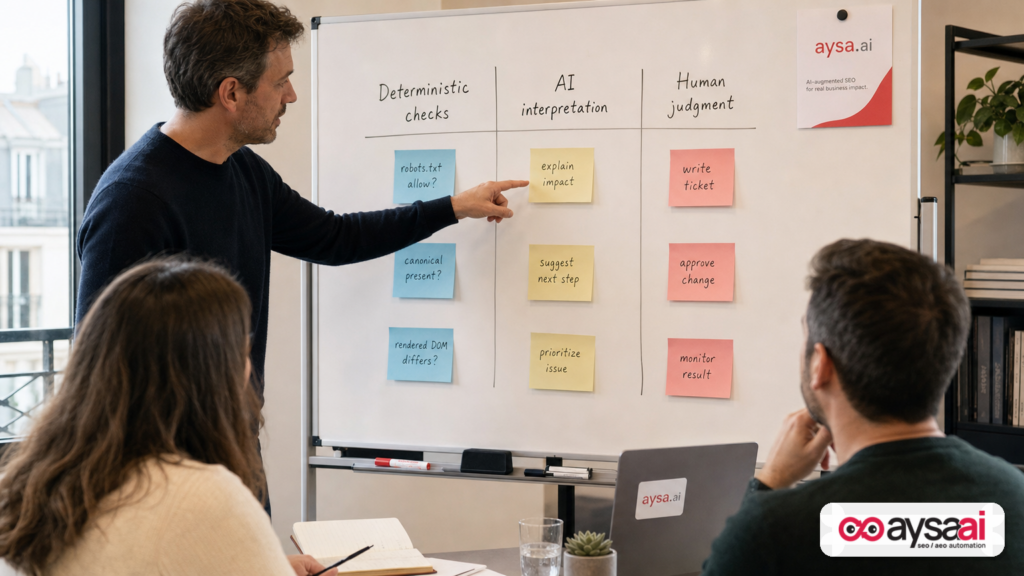
- Deterministic checks should establish facts (Indexability, status codes, canonical tags, robots rules, rendering differences). LLMs shouldn’t be your “truth engine.”
- AI is best used to reduce friction: turning raw evidence into explanations, comparisons, tickets, and stakeholder-ready language.
- Humans should own judgment: prioritization, risk management, tradeoffs, and accountability.
- The bottleneck is execution: most organizations don’t lose because they lack insights—they lose because fixes don’t ship.
- AYSA’s model fits the new reality: monitor continuously, prepare proposed changes, get approval, execute, and log outcomes.
Key takeaways (for owners, marketers, and agencies)
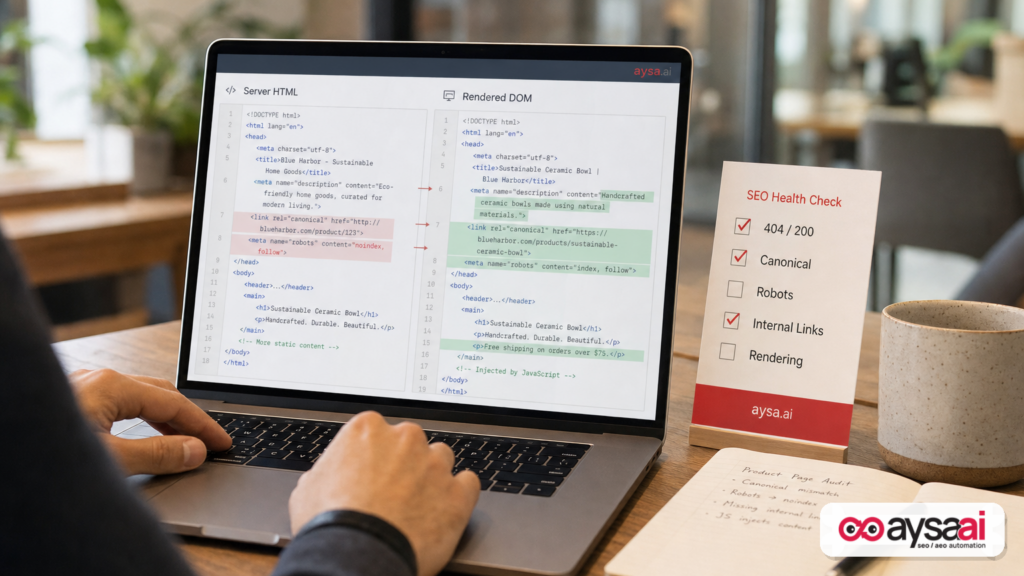
- Stop asking AI “what’s wrong with my site?” Start asking deterministic systems “what is true?” and ask AI to explain what that truth implies.
- Measure SEO productivity by shipped improvements, not by audit pages, slide decks, or tool screenshots.
- Build governance into the workflow: what can be executed automatically, what must be approved, and what requires senior review.
- Prepare for AI Search, AEO, and GEO with the same principle: evidence first, interpretation second, judgment last—then execution.
Table of contents

- What changed: AI is not the new auditor—AI is the new interface to your evidence
- The “facts → interpretation → judgment” model (and why it’s the only one that scales)
- Where deterministic SEO ends—and where AI actually helps
- Why “autonomous SEO audits” are a trap (especially for SMEs)
- What goes wrong when you let AI judge the site
- The new KPI: less friction, faster approvals, more shipped fixes
- A concrete SME scenario: the local clinic that “lost traffic” after a redesign
- What agencies must rethink: deliver changes, not documents
- A practical workflow you can implement this quarter
- Where AYSA fits: from monitoring to approved execution
- What to monitor in 2026–2027: technical truth, AI visibility, and execution drift
- What to do next (action list)
- Sources and further reading
What changed: AI is not the new auditor—AI is the new interface to your evidence
SEO has always been part engineering discipline, part editorial craft, part business strategy. The AI era doesn’t remove those components—it exaggerates them.
Here’s the uncomfortable truth: in most organizations, the limiting factor wasn’t the ability to find issues. It was the ability to:
- Translate raw findings into understandable language,
- Get buy-in and approvals,
- Ship changes safely,
- Validate outcomes and prevent regressions.
LLMs are good at translation and summarization. They are not inherently good at truth. That’s not an insult; it’s simply a description of what these systems are built to do: generate plausible language based on patterns. When you use an LLM as the “auditor,” you are outsourcing verification to a probabilistic system and then acting surprised when it misses edge cases or invents rationale.
Chris Green’s SEJ article highlights the right direction: deterministic checks wherever possible, AI where interpretation helps, and humans for judgment and accountability. This isn’t “anti-AI.” It’s pro-workflow.
The bigger change is that AI becomes the new interface layer between your evidence and your decisions. The companies that win are the ones who treat AI as a friction reducer inside a disciplined system—rather than as a magical replacement for discipline.
The “facts → interpretation → judgment” model (and why it’s the only one that scales)
In my view, the most useful way to think about AI in SEO is a three-part pipeline:
1) Facts (deterministic)
This is where you establish what is true, with repeatable checks. Examples:
- Does a URL return a 200, 301, 404, or 500?
- Is the Canonical tag present, and what does it reference?
- Does
Robots.txtallow Crawling of key paths? - Is a page indexable (meta robots, x-robots-tag, canonical conflicts)?
- Does server-rendered HTML differ from rendered DOM in ways that affect links, content, or metadata?
None of these require an LLM. In fact, using a model to infer them is slower and less reliable than simply checking directly.
2) Interpretation (AI-assisted)
Once you have facts, interpretation is where AI shines—because the friction isn’t “finding,” it’s “understanding quickly at scale.” AI can help:
- Summarize what changed between versions of a template or page output.
- Turn raw evidence into an explanation a non-technical stakeholder can understand.
- Draft a Jira ticket with reproduction steps and acceptance criteria.
- Propose multiple options: low-risk fix now vs structural fix later.
3) Judgment (human-owned)
Judgment is not just “deciding what’s important.” It includes:
- Business context (What makes money? What’s seasonal? What’s legally sensitive?)
- Risk management (Will this change break checkout? Tracking? Compliance?)
- Prioritization (What will produce impact within constraints?)
- Accountability (Who owns the decision if outcomes are negative?)
When the model “judges” the site, it often collapses these layers. You get confident language with questionable reasoning, and the organization starts acting on vibes instead of evidence.
That’s why the facts → interpretation → judgment split is the only model I’ve seen that actually scales across teams, websites, and stakeholder maturity levels.
Where deterministic SEO ends—and where AI actually helps
Let’s make this concrete. Technical SEO includes many binary checks. Borrowing the spirit of the SEJ article, here are examples where deterministic checks should do the heavy lifting:
Deterministic checks: do these first
- HTTP status and redirect chains: confirm if pages resolve correctly and whether redirects are efficient.
- Canonical presence and conflicts: confirm whether canonicals exist and whether they contradict other signals.
- Robots directives: verify whether crawling/indexing is allowed for critical areas.
- Internal link resolution: confirm whether internal links point to indexable, 200-status destinations.
- Server HTML vs rendered DOM differences: detect changes introduced by JavaScript rendering that affect links, headings, body copy, structured data, and metadata.
These checks can be implemented in code and repeated consistently. If you are doing them repeatedly, the “correct” solution is rarely to prompt an LLM every time. It’s to build (or adopt) a system that checks and logs the facts.
AI assistance: use it where it reduces friction
Now the useful part: once you have facts, AI can make the workflow faster and more collaborative.
- Explain why a DOM change matters (e.g., anchor text becomes generic, link destination changes, content moves below the fold).
- Summarize a release: “These template changes likely reduce internal linking context across category pages.”
- Draft implementation notes for developers and content teams.
- Create stakeholder-ready language: the same issue explained for an engineer vs a founder.
- Flag ambiguity: “The canonical points to a parameterized URL; confirm whether faceted pages should be indexable.”
This is exactly the kind of usage Chris Green describes: the model conveys evidence; it doesn’t get to be the judge and jury.
Why “autonomous SEO audits” are a trap (especially for SMEs)
The pitch is seductive: connect your site, run an agent, receive a prioritized list of fixes, ship changes automatically. In reality, SMEs face three constraints that make autonomy risky:
Constraint 1: thin margins for error
If you’re a local clinic, a florist, a law firm, or an ecommerce shop, your website isn’t a playground. A bad change can break lead flow, scheduling, checkout, or analytics. SMEs often don’t have staging environments, QA teams, or release managers. Autonomy without governance is a liability.
Constraint 2: limited context in the data
AI systems can only reason over what you provide. But SEO decisions depend on context that often lives outside the crawl:
- Which services are highest margin?
- Which pages have legal restrictions?
- Which campaigns are currently running?
- What is the dev roadmap?
When that context isn’t present, models fill gaps with assumptions. That’s not “intelligence.” It’s guessing.
Constraint 3: execution isn’t a single step
Even if an “agent” identifies an issue, it still must be translated into a change, approved, implemented, validated, monitored, and rolled back if necessary. Autonomy skips the social and operational reality of businesses: approvals, ownership, and risk.
This is why I prefer a less flashy but far more effective goal: reduce friction, increase throughput, and keep humans accountable.
What goes wrong when you let AI judge the site
When organizations hand over judgment to AI, the failure modes are predictable. You don’t need dramatic “hallucinations” for damage; you just need confident, incomplete reasoning.
1) Confident conclusions from incomplete evidence
Example: the model sees thin content on a category page and recommends adding paragraphs—without knowing that your UX tests show lower conversion when category pages get longer, or that filters drive discovery better than text blocks.
2) Misweighted priorities
AI might prioritize rewriting title tags across 10,000 pages because it’s easy to describe, while ignoring an indexability or canonical issue that quietly removes your most profitable pages from search visibility.
3) Policy and brand risk
In regulated industries (health, finance, legal), “helpful” AI-generated content edits can create compliance issues. SEO is not just rankings; it’s how your brand communicates claims. You need approvals and guardrails.
4) Black-box recommendations you can’t defend
If you can’t explain why a recommendation exists, you won’t get it implemented—or worse, you’ll implement it and not be able to troubleshoot when it backfires.
One of the strongest points in the SEJ piece is practical: if you let AI do everything, what happens when someone asks you a question? The human becomes a messenger, not a practitioner. That’s not a career path—and it’s not a resilient business workflow.
The new KPI: less friction, faster approvals, more shipped fixes
Traditional SEO operations have been optimized around producing outputs: audits, spreadsheets, and decks. In an AI-assisted era, those outputs are cheaper than ever—so their value collapses.
The new KPI is operational:
- Time-to-understanding: how quickly can a non-expert understand the issue and its impact?
- Time-to-approval: how fast can stakeholders confidently approve the change?
- Time-to-execution: how quickly can the change ship without breaking anything?
- Time-to-validation: how quickly can you confirm the fix worked and didn’t regress?
This is also where AI is genuinely transformative: not by “replacing” the SEO, but by reducing the administrative drag that stops good work from becoming shipped work.
If you want a practical metaphor: AI shouldn’t be the pilot. It should be the co-pilot that reads the instruments, explains what’s happening, drafts the checklist, and logs decisions—while a human flies the plane.
A concrete SME scenario: the local clinic that “lost traffic” after a redesign
Let’s use a realistic example that happens every day.
Scenario: a local clinic redesigns its website to look more modern. Two weeks later, calls are down, contact form submissions are down, and branded search traffic seems weaker. The owner asks, “Did Google penalize us?”
Here’s how the facts → interpretation → judgment workflow prevents chaos.
Step 1: establish deterministic facts
- Are core service pages returning 200 status?
- Did URL paths change, and do old paths 301 redirect correctly?
- Did the new templates change indexability (meta robots / canonical)?
- Did internal links to high-value pages decrease?
- Does rendered DOM remove content or links that existed in server HTML (or vice versa)?
This step is not glamorous, but it’s where truth is found. If a top service page accidentally returns 404 or canonicalizes to the wrong URL, you don’t need a model’s opinion—you need a fix.
Step 2: ask AI to interpret and communicate
Once the facts are collected, AI can produce:
- A plain-English summary for the clinic owner: “Your old service pages now redirect to a generic category page, which reduces relevance and may impact rankings.”
- A dev ticket: steps to reproduce, affected URLs, expected behavior, and acceptance criteria.
- A risk note: what changes are safe to ship quickly vs what needs more planning.
Step 3: human judgment and prioritization
A human decides:
- Which pages matter most to revenue (e.g., high-intent services).
- Whether to revert a risky template change.
- Whether to keep the new design but restore internal linking context.
Step 4: execute with approvals
The fastest path back to performance is not another audit deck. It’s shipping fixes—safely.
And this is where most SMEs fail. Not because they can’t find issues. Because they don’t have a reliable system to turn findings into approved, executed changes.
What agencies must rethink: deliver changes, not documents
Agencies are feeling pressure from both sides:
- Clients can generate “an SEO audit” with AI in minutes.
- Clients also expect faster outcomes, not longer reports.
If your agency’s value is a PDF, you’re competing against a prompt. That is not a defensible position.
The defensible position is operational excellence:
- Deterministic measurement and monitoring
- Clear, consistent interpretation
- Pragmatic prioritization tied to business value
- Approved execution pipelines
- Validation, logging, and regression prevention
Agencies that win will look more like “system builders” than “audit writers.” That doesn’t mean you stop doing strategy. It means strategy is expressed through a workflow that reliably produces shipped improvements.
SEJ has a broader SEO and technical SEO context worth following for this reason: workflows are becoming the competitive edge as AI commoditizes surface-level advice. If you want to explore more of their ecosystem, see their SEO section and Technical SEO section.
A practical workflow you can implement this quarter
You don’t need to “build an agent.” You need a workflow that respects the difference between truth, interpretation, and judgment.
Workflow layer 1: monitoring and deterministic checks
Build (or adopt) a monitoring approach that continuously checks:
- Indexability states for key templates and priority pages
- HTTP status changes and redirect drift
- Canonical integrity
- Robots directives that affect crawl paths
- Internal linking changes (especially to money pages)
- Server vs rendered differences for critical pages
This is the “instrument panel.” It should be boring, consistent, and trusted.
For the AYSA view on continuous tracking, start here: AYSA Monitoring.
Workflow layer 2: AI-assisted interpretation outputs
For every detected issue or change, produce standardized outputs:
- One-paragraph explanation in plain English
- Impact hypothesis (“This may reduce topical relevance / internal PageRank flow / crawl efficiency”)
- Implementation note for dev/content team
- Ticket-ready draft with acceptance criteria
Notice what’s missing: “final verdict.” The model isn’t the judge. It’s the translator.
Workflow layer 3: approval gates (governance)
Define what can be executed:
- Automatically (rare; only for low-risk, reversible changes)
- With marketing approval (titles, meta descriptions, internal links, on-page clarifications)
- With engineering approval (templates, rendering, routing, canonical logic)
- With legal/compliance approval (claims in regulated verticals)
SMEs often skip this, then wonder why nothing ships or why changes cause damage. The governance layer is what turns AI speed into business-safe throughput.
Workflow layer 4: execution + validation + logs
Execution needs:
- A clear record of what changed, when, and why
- Post-change validation checks
- Monitoring for regression
Otherwise you end up in a loop of “we changed something, rankings moved, who knows why.” That’s not SEO; that’s superstition.
Where AYSA fits: from monitoring to approved execution
Most SEO platforms are built to report. AYSA is built to operate.
AYSA’s philosophy maps cleanly to the model described above:
- Monitor your site and search presence continuously (technical truth + visibility signals).
- Prepare proposed changes with clear evidence and rationale (AI-assisted interpretation).
- Ask for approval so humans remain accountable.
- Execute accepted website changes reliably.
If you’re evaluating tools, start with these AYSA resources:
This is also where the industry conversation is heading: “agentic” workflows are interesting, but most businesses need something more practical—assistance that reduces friction without removing accountability. In that sense, approved execution isn’t a limitation; it’s the feature that makes AI usable in real companies.
What to monitor in 2026–2027: technical truth, AI visibility, and execution drift
If you’re a business owner or marketing lead, here’s what I’d put on the dashboard—not as vanity metrics, but as operational signals.
1) Technical truth signals
- Key URLs returning wrong status codes
- Unexpected noindex/canonical changes
- Robots changes affecting crawl access
- Template changes that alter internal linking patterns
- Render-based changes that hide or rewrite content/links
2) AI visibility signals (AEO/GEO)
Even without making claims about specific platform performance, the direction is clear: search experiences are incorporating more AI-driven synthesis. That changes what “visibility” means. You should be asking:
- Are we being cited or referenced in AI-driven discovery experiences where relevant?
- Do our pages provide clear, extractable answers (AEO) without sacrificing trust and brand voice?
- Do we have consistent entity signals and topical coverage that support GEO (generative engine optimization) style retrieval?
AYSA’s perspective on this is evolving publicly; the best starting point is: AI Search visibility.
3) Execution drift (the silent killer)
Execution drift is when your site slowly diverges from what you think is live:
- Plugins update and change output.
- Theme edits remove internal links.
- Developers refactor templates and forget SEO requirements.
- Marketing ships landing pages that conflict with canonical strategy.
Most “SEO declines” are not mysterious. They’re operational: things changed, nobody noticed, and nobody shipped the fix fast enough.
What to do next (action list)
- Inventory your “money pages.” Identify the 20–200 URLs that drive most revenue/leads and treat them as production-critical.
- Implement deterministic checks for those pages. Status, canonicals, robots, indexability, internal links, rendering diffs.
- Standardize AI outputs. Require every issue to include a plain-English explanation and a ticket-ready draft—no “AI verdicts.”
- Create approval gates. Decide what changes require marketing approval vs engineering approval vs compliance approval.
- Adopt an execution system. If fixes don’t ship, insights are entertainment. Consider an approved execution approach like AYSA’s workflow: monitor → prepare → approve → execute.
- Log changes and validate. Treat SEO improvements like releases, not like suggestions.
Sources and further reading
- Search Engine Journal (Chris Green): Using AI To Assist With SEO Work, Not Replace The Worker
- Search Engine Journal: SEO
- Search Engine Journal: Technical SEO
- Search Engine Journal: AI Search
- AYSA: AI SEO tools
- AYSA: AI Search visibility
- AYSA: Monitoring
- AYSA: Pricing
- AYSA Blog
Continue the AI search topic inside AYSA.
Use these pages to connect the article with AI SEO tools, AI visibility monitoring, AI Overviews and approved website execution.
Turn this topic into a website action plan.
Use these AYSA hubs to move from reading to technical fixes, AI visibility monitoring, research, glossary context and approval-first SEO execution.