GPT-6 + Intelligent UI: Why Interactive Answers Change SEO (and What SMEs Must Do Next)
OpenAI’s GPT-6 rollout in ChatGPT introduces “Intelligent UI” that can generate interactive tools, charts, and forms inside answers—often starting before the model finishes thinking. That’s a structural shift: users won’t just read answers, they’ll complete tasks without clicking. Here’s what changes, what breaks, and how businesses can win visibility in AI-first journeys—with an execution plan you can actually ship.

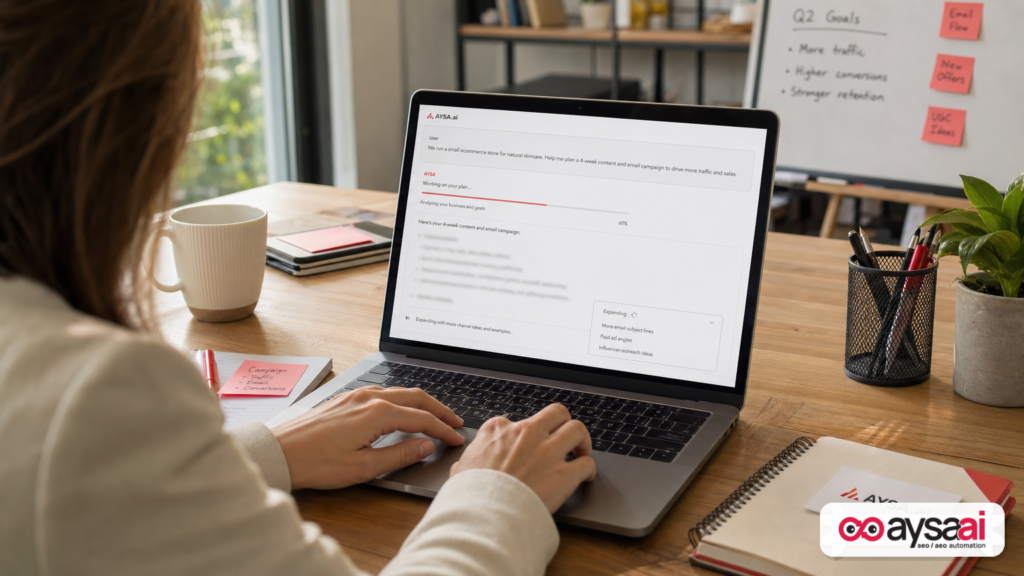
OpenAI is rolling out GPT-6 inside ChatGPT along with what it calls an Intelligent UI: responses that can include charts, buttons, forms, and even small interactive tools—inside the answer itself. That sounds like a product update. It’s bigger than that. It’s a shift in how people consume information and how they complete tasks.
For SEO, the story isn’t “a new model is smarter.” The story is: the interface is becoming the destination. When the UI can generate a bill-splitter, a savings calculator, a comparison table, or a step-by-step workflow inside the chat, the incentive to click out drops—especially for informational and “quick utility” intent.
As Marius Dosinescu at AYSA.ai, I’ll be direct: if your growth plan still assumes the primary goal of SEO is “rank → click → session,” you’re going to feel whiplash. The next phase is visibility inside AI answers, trust signals that survive summarization, and execution systems that can keep up as the SERP and the chat UI evolve weekly.
This editorial explains what changed with GPT-6 + Intelligent UI, why it matters for SMEs and agencies, what can go wrong, and a practical plan to adapt—plus how AYSA fits as an SEO/AEO/GEO execution system that monitors, prepares changes, asks for approval, and executes what you accept.
Concise summary

- GPT-6 in ChatGPT is rolling out across plans, paired with Intelligent UI that dynamically chooses layouts (text, charts, interactive modules) based on the question.
- Answers can start before “thinking” ends, meaning users may act earlier and never reach your site—even when your information helped power the answer.
- Utility pages (basic calculators, converters, simple comparisons) and thin informational content are most exposed; deep expertise, differentiated data, and operational trust become more valuable.
- SMEs should optimize for AI citations, brand recognition in summaries, and task-completion journeys that still create leads.
- Winning in AI Search is an execution game: continuous Monitoring + frequent site updates with governance. That’s the gap AYSA is built to close.
Table of contents
- What OpenAI Actually Shipped: GPT-6 In ChatGPT + Intelligent UI
- Why “Intelligent UI” Matters More Than the Model Name
- The Real Disruption: “Answers Start Before Thinking Ends”
- The New Search Funnel: From “Click to Website” to “Complete the Task Here”
- Who Wins, Who Loses: Content Types Most Affected
- Citations, Sources Buttons, and the New Definition of “Ranking”
- What Can Go Wrong (and How to Reduce Risk)
- A Concrete SME Scenario: Local Clinic vs. Interactive AI Triage
- What Agencies Must Rethink: From Deliverables to Systems
- Measurement: What to Monitor When Clicks Decline
- A Practical 90-Day Action Plan for SMEs
- How AYSA Helps: Monitor, Prepare, Ask for Approval, Execute
- What to do next
- Sources and further reading
What OpenAI Actually Shipped: GPT-6 In ChatGPT + Intelligent UI

The baseline facts we can rely on come from Search Engine Journal’s coverage of OpenAI’s rollout. The reported update includes:
- GPT-6 availability inside ChatGPT across plan tiers, with some plan/model variations.
- Intelligent UI that lets responses include different layouts and interactive components such as charts, forms, and buttons—while still using plain text when appropriate.
- Faster time-to-first-answer for questions that require web search (SEJ reports an OpenAI claim that GPT-6 Instant starts answering sooner than GPT-5.6 Instant, on average, for web search questions).
- Users can toggle off layout/visual settings (with caveats that some visuals may still appear).
- For web search incorporation, answers may provide citations via a “Sources” button when available.
I’m intentionally not repeating model names and tier-specific variants beyond what matters operationally. For business owners and marketers, the lesson isn’t “memorize the lineup.” It’s: the chat answer is no longer a paragraph. It’s potentially a mini product experience.
Why “Intelligent UI” Matters More Than the Model Name
Most of the industry reflexively focuses on the model number: GPT-4, GPT-5, now GPT-6. But the growth and distribution battle is being fought in the interface layer—because that’s where user behavior changes.
Think about the last decade of Google Search evolution:
- Featured snippets answered questions without a click.
- Knowledge panels and local packs reduced the need to visit sites for basic facts.
- Maps, shopping units, and instant answers turned the SERP into a destination.
AI chat is following the same trajectory, but faster and with more flexibility. Intelligent UI isn’t just “pretty formatting.” It’s a mechanism to complete tasks in-session. Every task completed inside the chat is one less session on your site—unless your brand and your offer become part of the default flow.
SEJ’s write-up references OpenAI examples like a savings calculator and a bill splitter—simple, generic “utility” experiences that can be generated on demand. That’s the canary in the coal mine for a large class of websites built around lightweight tools, calculators, and generic informational pages.
And it’s not limited to those examples. Once a system can reliably render:
- a comparison table,
- a step-by-step checklist,
- a decision tree,
- or a small input form with computed outputs,
…the UI becomes a “front desk” for countless industries. The question becomes: what inputs does the model trust, and which sources does it cite?
The Real Disruption: “Answers Start Before Thinking Ends”
One detail in the SEJ coverage should make every marketer pause: GPT-6 can begin answering while it’s still thinking or using tools, and then expand the answer without the user asking again.
Why is that disruptive?
- Early anchoring effect: the first partial answer sets the direction. Users often stop there.
- Lower patience threshold: if users get “good enough” quickly, they won’t browse.
- More in-flow microactions: interactive UI encourages immediate action (enter a number, choose an option, click a button) instead of “open new tab.”
In practice, this changes the competitive set. You’re not only competing with other websites for a click. You’re competing with the AI’s own ability to create a satisfying outcome without you.
So the strategic question shifts from: “How do I rank for this query?” to: “How do I become the trusted substrate the AI draws from, cites, and recommends—and how do I make the next step (contact, buy, book) the obvious completion of the task?”
The New Search Funnel: From “Click to Website” to “Complete the Task Here”
Let’s define the old and new funnels in plain business terms.
The old funnel (still alive, but less dominant)
- User searches on Google.
- User Clicks a result.
- User reads content on your site.
- User converts (lead, purchase, booking).
The emerging funnel (AI-first journeys)
- User asks a question in AI chat (or AI mode inside search).
- AI produces an answer plus an interactive module.
- User iterates inside the UI (adjusts inputs, compares options).
- User either completes the task in-chat—or chooses a recommended next step (visit site, call, book, buy).
That fourth step is where businesses can still win—if they plan for it. If your website is only useful as “a place to read,” your value will be commoditized. If your website is useful as “a place to transact or verify trust,” you remain essential.
From an AYSA perspective, this is where execution matters. It’s not one optimization. It’s dozens: content structure, product feeds, policy clarity, trust signals, local presence, and technical hygiene—shipped continuously as AI interfaces learn what they can safely summarize and what they can’t.
Who Wins, Who Loses: Content Types Most Affected
Not all pages are equal in an Intelligent UI world. Here’s a practical breakdown.
Highest risk: “easy to reproduce” pages
These are pages where the value is mostly calculation, formatting, or restating public information.
- Simple calculators and converters (unit conversion, basic ROI calculators with generic assumptions).
- Template-like how-to posts with no original insight (e.g., “how to split a restaurant bill”).
- Basic comparison pages that simply list specs without context.
- Glossary content with no proprietary examples or standards.
In SEJ’s analysis, the author notes calculators and converter pages may be challenged if ChatGPT can generate the tool in-chat. That’s a reasonable conclusion: if the tool is generic and the math is public, an AI UI can replicate it.
Medium risk: “summarizable expertise” pages
- Service pages that explain what you do but lack differentiation.
- “Best X” listicles with commodity recommendations.
- FAQ pages that are accurate but bland and redundant.
These can still win if you supply clear, verifiable specifics (process, credentials, constraints, pricing ranges, timelines, eligibility, geography, warranties). The AI can summarize you, but it’s more likely to cite you if your content is structured and unambiguous.
Lower risk: “hard to reproduce” assets
- Original research and proprietary datasets.
- First-party product catalogs with real inventory, availability, and unique bundles.
- Deep operational content: implementation guides, compliance constraints, troubleshooting based on real support data.
- Trust-heavy workflows: booking, quoting, verification, aftercare, warranties, local logistics.
The AI can still summarize these, but it often can’t replace the underlying asset. Your goal becomes: make the summary point toward your brand as the source of truth and the next step.
Citations, Sources Buttons, and the New Definition of “Ranking”
SEJ mentions that when ChatGPT uses web search results, it may show citations accessible via a Sources button (when available). That detail matters because citations are emerging as the new “blue link.”
But citations don’t behave like rankings:
- You may be cited without getting a click.
- You may influence the answer without being cited (depending on aggregation and summarization behavior).
- A single citation can be worth more than a #1 ranking if it becomes the recommended vendor, method, or next step.
This is where the practice of AEO (Answer Engine Optimization) and GEO (Generative Engine Optimization) becomes operational, not theoretical. You’re optimizing for:
- extractable clarity (the AI can confidently reuse your wording without misrepresenting it),
- verification (the AI can point to your page as support), and
- actionability (the user’s next step is obvious and safe).
If you want one mental model: in classic SEO, the SERP is a list of doors. In AI search, the answer is the lobby—and citations are the small plaques on the wall that say who built the building.
So you don’t just “rank.” You become reference material.
What Can Go Wrong (and How to Reduce Risk)
Interactive answers are powerful—and risky. As businesses, we need to think beyond traffic. We need to think about misrepresentation and liability.
Risk #1: Stale or incorrect details (pricing, availability, eligibility)
If your site’s pricing, product availability, service area, or policies are unclear—or spread across PDFs and old pages—an AI can summarize the wrong thing confidently.
Mitigation: publish canonical, up-to-date pages for the facts that matter; include “last updated” conventions where appropriate; consolidate duplicates; remove or redirect outdated pages.
Risk #2: The AI generates a tool with assumptions you don’t agree with
A generic estimator might use assumptions that don’t match your business reality (e.g., ROI assumptions, loan rates, medical guidance). If users make decisions based on those assumptions, your brand may still take the blame.
Mitigation: provide your own calculators/estimators with explicit assumptions and disclaimers, then make those pages highly citable and structured. Even if users don’t click, the AI may borrow the assumptions—especially if they’re the clearest and best-supported.
Risk #3: Regulated industries get summarized dangerously
Healthcare, finance, legal, and anything involving safety can be harmed by overconfident summarization. Even non-regulated niches (supplements, childcare, home services) can carry real-world risk.
Mitigation: clear authorship, credentials, editorial policy, and “when to consult a professional” boundaries—written in plain language. Don’t hide important constraints behind collapsible UI or PDFs.
Risk #4: Brand voice and differentiation disappear in summaries
Many businesses look identical when summarized. If your differentiators are vague (“high quality,” “great service”), AI will erase them.
Mitigation: make differentiation concrete: turnaround times, service model, warranties, on-site coverage, certifications, inventory depth, niche specialization, case-proof (without inventing claims), and operational specifics.
A Concrete SME Scenario: Local Clinic vs. Interactive AI Triage
Let’s ground this in a realistic scenario: a local clinic (or dental practice) that relies on organic search for new patient calls.
Before Intelligent UI
- A patient searches: “Is my sore throat strep or just a cold?”
- They click a blog post, read symptoms, then (maybe) book an appointment.
After Intelligent UI
- The patient asks ChatGPT the same question.
- ChatGPT responds with a symptom checklist, a severity slider, and a “seek care now vs monitor” decision guide.
- The patient feels helped. They might never click a clinic blog post.
So how does the clinic win anyway?
How the clinic can still win
- Own the “next step” content: pages like “When to visit urgent care vs primary care,” “What to expect at a strep test visit,” “Pricing for self-pay strep testing,” “Same-day appointment availability,” “Service area,” “Insurance accepted.”
- Be the most citable local authority: clear physician-reviewed content, local relevance, and operational details that generic answers can’t provide.
- Improve conversion from brand exposure: if the AI mentions the clinic, the website must make booking frictionless.
Notice what changed: the blog post about “cold vs strep” becomes less valuable than operational, trust, and conversion pages. That’s the reallocation most SMEs need to make now.
What Agencies Must Rethink: From Deliverables to Systems
Agencies have traditionally sold deliverables: audits, keyword research, content calendars, link-building packages. In an AI interface era, deliverables age quickly. What clients need is a system:
- monitor visibility shifts,
- detect where AI answers are stealing demand,
- prioritize changes that restore business outcomes,
- ship updates safely and repeatedly.
This is why “execution” is becoming the differentiator. The market is full of strategy decks. It’s short on teams that can implement changes across templates, content, internal linking, structured data, and technical SEO—without breaking the site or creating legal risk.
AYSA’s angle is simple: monitoring + preparation + approval + execution. Strategy matters, but strategy without shipping is theater.
Measurement: What to Monitor When Clicks Decline
If AI answers reduce clicks, many teams will panic because their dashboards are click-centric. The fix isn’t denial. The fix is measurement maturity.
Here’s what SMEs and agencies should start tracking more intentionally:
1) Brand search and direct demand
If AI summaries introduce your brand, you may see increases in branded searches or direct traffic even if non-branded clicks fall. That’s not “nice to have.” It’s evidence your brand is being recommended.
2) Lead quality and assisted conversions
AI-assisted users can arrive more educated. Your conversion rate may rise even when traffic drops. If you only watch sessions, you’ll misread the situation.
3) Content performance by intent group
Segment pages into:
- utility (calculators/tools),
- definitions/how-tos,
- comparisons,
- transactional/commercial,
- trust/verification (policies, pricing, service area, credentials),
- support/troubleshooting.
Then watch which groups lose demand first. Intelligent UI will disproportionately hit the first two.
4) AI visibility signals (where possible)
Not all platforms expose the same data. But you can still monitor:
- search console trends for query classes,
- brand mentions across the web,
- landing page shifts (which pages gain/lose entrances),
- and qualitative testing: asking AI assistants the same questions your buyers ask and observing whether your brand is mentioned or cited.
AYSA’s focus on AI search visibility and monitoring is designed for exactly this environment: you need early warning, not a quarterly postmortem.
A Practical 90-Day Action Plan for SMEs
This is the part most editorials skip. Here’s what I’d do if I owned an SME that relies on organic discovery.
Days 1–15: Identify where AI can “absorb” your clicks
- Inventory your pages by intent group (utility, how-to, comparison, transactional, trust).
- Flag the “easy to reproduce” pages: generic calculators, thin definitional content, commodity listicles.
- Decide what role each page plays: brand trust, lead capture, product education, support reduction, or pure traffic.
If a page’s only role is traffic, it’s now a risky asset. Convert it into something the AI can’t replace: original data, clearer differentiation, a strong next step, or a product-led experience.
Days 16–30: Build “citable clarity” into your core pages
- Rewrite key sections to be explicit: pricing ranges, service areas, prerequisites, timelines, what’s included/excluded.
- Add strong FAQ blocks that answer buyer questions with constraints and specifics (not fluff).
- Strengthen about/credibility content: who you are, certifications, standards, editorial policy where relevant.
This is content SEO, but with a different goal: being summarized accurately and cited confidently.
AYSA can help teams operationalize this via AI SEO tools that prepare edits and route them for approval rather than creating a backlog nobody ships.
Days 31–60: Upgrade the pages that AI will recommend next
If AI does your top-of-funnel education, your site becomes a verification and transaction layer. So your “money pages” must be impeccable:
- service/product pages,
- pricing and policy pages,
- booking/checkout flows,
- contact and location pages.
Make it effortless for a user who arrives from an AI recommendation to complete the next step. Speed, clarity, and trust cues matter more than ever.
Days 61–90: Build a continuous execution loop
This is where most SMEs fail: they treat SEO as a project. But AI interfaces evolve continuously. You need a loop:
- Monitor visibility and page group performance weekly.
- Prepare targeted changes (content updates, internal links, technical fixes).
- Approve changes with human governance (especially for regulated or high-stakes content).
- Execute changes quickly and track outcomes.
That loop is the product philosophy behind AYSA—and it’s why we emphasize approved execution over “autopilot SEO.” You can explore that workflow starting from Monitoring and Pricing.
How AYSA Helps: Monitor, Prepare, Ask for Approval, Execute
In an Intelligent UI world, the biggest risk isn’t that you don’t know what to do. It’s that you know—and it sits in a ticketing system for 6 weeks.
AYSA is built as an execution system for SEO/AEO/GEO:
- Monitors your AI search visibility and SEO signals so you can spot shifts early (AI Search Visibility).
- Prepares recommended website changes (content improvements, structure, internal linking, technical hygiene) using AI where helpful (AI SEO Tools).
- Asks for approval before anything goes live, so you keep governance—crucial for brand risk, compliance, and accuracy.
- Executes accepted changes so improvements don’t die in a backlog.
This isn’t about chasing every AI feature. It’s about building a compounding advantage: the faster you can iterate safely, the more likely you are to become the stable, citable reference as AI answers become more interactive.
If you want more practical frameworks like this, we publish them regularly on the AYSA blog.
What to do next
- Audit your “easy to reproduce” pages (calculators, thin how-tos) and decide whether to upgrade them into differentiated assets or deprioritize them.
- Rewrite your core commercial pages for citable clarity: specifics, constraints, service area, pricing logic, warranties, and next-step CTAs.
- Create a “verification hub”: policies, pricing, credentials, process pages—things AI can reference safely.
- Set up continuous monitoring for AI visibility and organic shifts (AYSA Monitoring).
- Implement an approved execution cadence: weekly batches of changes with human approval, not quarterly overhauls.
- Align reporting to outcomes (leads, bookings, revenue) rather than sessions alone.
Sources and further reading
- Search Engine Journal: ChatGPT Gets GPT-6 And Intelligent UI For Interactive Answers
- Search Engine Journal: AI Search coverage
- Search Engine Journal: SEO coverage
- Search Engine Journal: SEO News
- Search Engine Journal: Technical SEO
- Search Engine Journal: Local SEO
- Search Engine Journal: Links & PR
AYSA internal resources:
Continue the AI search topic inside AYSA.
Use these pages to connect the article with AI SEO tools, AI visibility monitoring, AI Overviews and approved website execution.
Turn this topic into a website action plan.
Use these AYSA hubs to move from reading to technical fixes, AI visibility monitoring, research, glossary context and approval-first SEO execution.