
The Dynamic Google Business Profile Playbook For AI Local Search (And How To Actually Execute It)
Google Business Profile isn’t a one-time listing anymore—it’s a living data surface that feeds Maps, the local pack, and AI-driven local answers. Here’s what changed, which engagement signals matter, and a practical operating system (with AYSA-approved execution) to keep your visibility compounding.

By Marius Dosinescu (AYSA.ai)
For years, “Local SEO” meant a one-time task: claim your Google Business Profile, make sure your name/address/phone are consistent, collect a few reviews, and move on.
That era is over.
Google Business Profile (GBP) is no longer just a directory listing. It’s a living engagement surface that feeds Maps, the Local pack, and increasingly, AI-driven local answers. If your profile hasn’t changed in months, Google doesn’t interpret that as “stable.” It reads it as “inactive.” And competitors who run their profile like a channel—not a form—can take visibility you didn’t even realize was up for grabs.
This article is a practical operating playbook for local businesses and the agencies that serve them. It’s built from industry research and Google’s own guidance, but it’s written for execution: what changed, why it matters, what to do weekly, what to measure, and where an “Approved Execution” model like AYSA fits when you need consistency more than heroics.
Primary reference: Search Engine Journal’s roundup, The New Google Business Profile Playbook for AI Local Search.
Concise summary
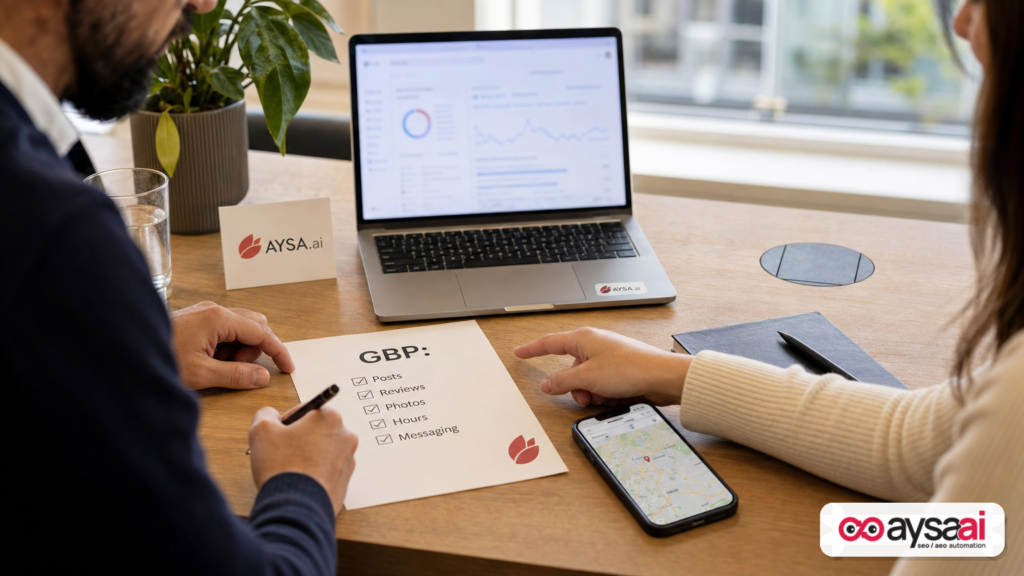
- Static GBP is a liability. “Set it and forget it” works only when Google treats GBP as a database record. It now treats it as a live engagement surface.
- Table stakes still matter (category, proximity, core info), but they don’t differentiate when everyone has them right.
- Engagement + freshness signals (review velocity, owner responses, posts, recent photos, accurate hours, messaging/booking activity) increasingly decide who wins when the basics are equal.
- AI local experiences raise the bar: multi-variable queries require complete, current data—hours, services, attributes, review language, and more.
- Execution beats strategy decks. The winners build a weekly cadence and measurement loop. That’s where AYSA’s monitor → prepare → approve → execute workflow can compound results.
Table of contents
- What changed: Google moved from “listing verification” to “live engagement”
- The new table stakes (and why they’re not enough)
- Why the AI layer makes GBP discipline non-optional
- The signals that actually move the needle (and the traps that waste time)
- Reviews: velocity, responses, and review language
- GBP Posts: the underused freshness signal
- Photos & video: recency is part of quality
- Hours & special hours: the “open now” reality check
- Messaging, booking, and Q&A: close the loop inside Google
- Retail: inventory and products as visibility surfaces
- What to measure (when attribution is messy)
- The compounding effect: how small weekly actions build durable visibility
- Concrete SME scenario: the clinic that stopped “doing local SEO” and started operating it
- What agencies should rethink in 2026
- How AYSA fits: approved execution for local + AI search visibility
- What to do next
- Sources and further reading
What changed: Google moved from “listing verification” to “live engagement”
When GBP (and its predecessors) behaved like a directory, Google’s job was simple: confirm the business exists at a location. If your information was consistent across citations and your category was correct, you could sit still for long stretches and remain competitive.
But user behavior shifted. People don’t “browse” local options the way they used to. Many searches are immediate intent:
- “Dentist open now near me”
- “Emergency plumber who can come today”
- “Best tacos within 10 minutes”
- “Hotel with EV charging and late check-in”
Those are not research questions. They’re decision requests.
So Google adapted GBP into a surface where people can act—call, message, request directions, book, and (in some verticals) shop. That activity creates signals. And in modern local search, those signals help decide who gets shown.
This is not a conspiracy or a “Google made it harder” complaint. It’s product logic. Google wants to provide the fastest path from query → confident decision. Active profiles supply the data to do that.
The new table stakes (and why they’re not enough)
Let’s be clear: fundamentals still matter. You still need a complete profile, correct categories, accurate NAP, and a website that matches the entity. If you’re missing the basics, you’re trying to win a game you haven’t entered.
Industry experts continue to emphasize the importance of core ranking factors—especially your primary category and proximity—via surveys like Whitespark’s Local Search Ranking Factors.
But “table stakes” are exactly that: the entry fee.
Once your competitors have the same basics dialed in, the differentiators become operational signals that show Google (and customers) that you are:
- active,
- trusted,
- responsive, and
- accurate right now.
In other words: local visibility is becoming less about what you say you are, and more about what your customers and your ongoing activity prove you are.
Why the AI layer makes GBP discipline non-optional
GBP used to be “for Maps.” Today it’s also “for answers.”
Google is pushing more conversational, multi-condition experiences in Maps—like Ask Maps—that aim to help users ask detailed, real-world questions and get a personalized response. Search Engine Journal has covered what Ask Maps means for marketers and how it changes what business data needs to support (coverage here).
Multi-variable questions are the point. They require more than a title and a star rating. Examples:
- “A 24-hour locksmith who can unlock a car right now”
- “A lit tennis court available tonight”
- “A family restaurant with outdoor seating that’s open late”
Each condition leans on different data layers: hours, attributes, services, review content, photos, and sometimes third-party integrations. If your profile is incomplete or stale, you’re less eligible for these answers—regardless of how good you are offline.
Google’s own guidance is consistent on the principle: businesses that keep information accurate and up to date are more likely to be matched to relevant searches (Google’s local ranking guidance).
The practical takeaway: AI-driven local discovery isn’t just “another channel.” It raises the minimum standard for data quality and recency.
The signals that actually move the needle (and the traps that waste time)
Most SMB local programs fail for one simple reason: they confuse setup with operations.
Setup is: categories, NAP, description, services, photos, verification.
Operations is: the ongoing cadence that keeps the profile alive—reviews, posts, photos, responses, and interaction features.
The trap is focusing on what’s easy to do once (like filling every field) instead of what’s hard to sustain (like responding to reviews within 48 hours, every week, for a year).
From the Search Engine Journal roundup and supporting research it references, the patterns are consistent:
- Fresh signals matter: reviews, posts, photos.
- Engagement matters: Clicks, calls, messages, bookings, direction requests.
- Accuracy matters in real time: hours and special hours, services, attributes.
Notice what’s missing: “one-time optimization.”
Reviews: velocity, responses, and review language
Most businesses understand reviews as reputation. Google also treats them as data.
Two practical ideas matter more than most owners realize:
1) Review velocity beats review volume (in competitive markets)
A profile with 300 reviews—but the last one was 9 months ago—doesn’t communicate the same reality as a profile getting a steady stream of recent feedback.
That doesn’t mean you should “chase reviews” in a spammy way. It means the review request should be an operational step triggered by real customer outcomes:
- After a completed appointment
- After delivery confirmation
- After an issue is resolved
When you ask matters. Ask while the experience is fresh. That’s a human truth, not an algorithm hack.
2) Owner responses are not optional
Responding to reviews is customer service, but it’s also a visible sign of responsiveness. It tells future customers (and plausibly Google) that the business is active and accountable.
Operational rule that works for most SMEs:
- Respond to every review (positive and negative).
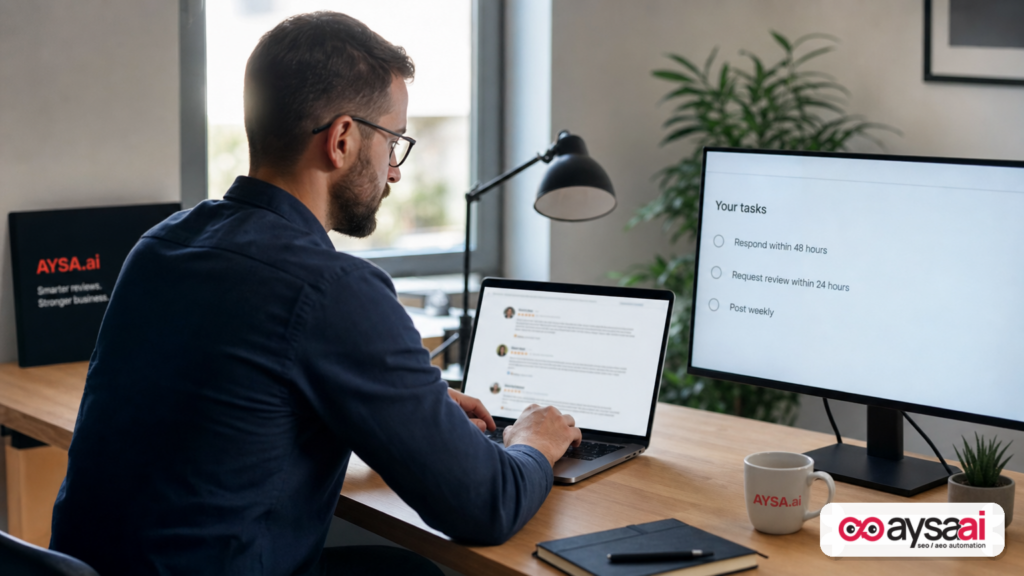
- Do it fast—aim for 48 hours.
- Don’t use generic copy/paste lines.
3) Review content can shape relevance
One of the most overlooked angles: what customers say in reviews can help Google understand what you’re known for.
Search Engine Journal points to research about review signals growing in influence in top local rankings (Review Signals Gain Influence In Top Google Local Rankings), and discusses how proximity may get you seen, while reviews help you win the top spots when competition is tight.
What you can do ethically: when requesting a review, prompt customers with a question that naturally elicits specificity. For example:
- “What service did we help you with today?”
- “What problem did we solve?”
- “What product did you buy and where did you use it?”
What you should not do: script keywords or incentivize reviews. Keep it real. Keep it compliant.
GBP Posts: the underused freshness signal
GBP Posts are one of the simplest ways to show recency, yet many businesses never use them. Others post once, then stop.
Here’s the mindset shift: Posts are not “social content.” They’re an operational update layer for your local entity.
A cadence that’s realistic
- Minimum: 1 post per week
- Better: 2–3 posts per week in competitive categories (food, beauty, home services)
If that feels like a lot, you’re probably thinking like a marketer (big campaigns) instead of an operator (small consistent updates). Weekly posts can be simple:
- Before/after project photos (service business)
- Seasonal product spotlight (retail)
- New team member or credential (professional services)
- Schedule reminder (clinic)
- Local event participation (any category)
Use the right post type
Where available, use Offer and Event types when they fit. Time-bounded content communicates freshness by definition.
Common mistake: posting generic evergreen “Welcome to our business!” updates repeatedly. That’s noise, not momentum.
Photos & video: recency is part of quality
Most businesses treat photos as a one-time upload: a logo, the front door, maybe 10 interior shots. Then nothing for years.
But local customers (and algorithms) respond to what’s current. A steady flow of authentic images signals operational reality: a real team, real work, real place.
Search Engine Journal’s roundup references Birdeye’s report on GBP, which notes that profiles with photos tend to see higher engagement, and that recent photos/video correlate with better interactions (Birdeye’s State of Google Business Profile 2025 report).
A simple photo rhythm for SMEs
- Twice per month: upload new photos (minimum)
- Weekly: if you’re in a highly competitive area/category
What to photograph (without hiring a production crew)
- Recent work (job site, finished installation, plated dishes)
- Real staff (new hires, training, community involvement)
- Updated space (renovations, signage, new equipment)
- Seasonal inventory or seasonal service setups
What to avoid: obvious stock photos. They can reduce trust, and they don’t reflect the “live” state of your business.
Hours & special hours: the “open now” reality check
In local search, “open now” is not a detail. It’s the difference between getting the call and losing it.
Search Engine Journal’s roundup references findings that “being open at the time of search” has become increasingly important, noting commentary attributed to Joy Hawkins and a BrightLocal study on the relationship between opening hours and rankings (BrightLocal study of opening hours and local rankings).
I’m careful with hard claims here because local ranking systems are multi-factor and noisy. But from a business perspective, accurate hours are non-negotiable regardless of their exact ranking weight. Incorrect hours produce:
- missed revenue,
- negative reviews (“it said you were open”),
- customer frustration,
- and reduced trust signals.
A process that prevents “hours drift”
- Quarterly audit your regular hours.
- Set special hours for holidays and local events ahead of time.
- Align across systems: GBP, website, social profiles, and any booking system.
This is boring work. It’s also exactly the kind of boring work that wins local search over time.
Messaging, booking, and Q&A: close the loop inside Google
Google increasingly wants the entire journey—discovery to conversion—to happen within its ecosystem. You can either fight that (and lose attention) or make it easy for customers to act.
Messaging and booking
If your business type supports it, enable features that reduce friction:
- Messaging (with a real response process)
- Appointment/booking links
- Menus/services where applicable
Even without claiming “ranking boosts,” this matters because it affects conversions. And conversion-like interactions (clicks, calls, direction requests, bookings) are the heartbeat of local performance Monitoring.
Q&A: don’t let strangers define your business
The Q&A section is a weird corner of GBP because anyone can answer questions. If you ignore it, you’re delegating your public FAQ to random users.
Practical move: seed 3–5 real questions customers ask every week, then answer them clearly. Examples:
- “Do you take walk-ins?”
- “Do you accept [insurance/payment type]?”
- “What’s the turnaround time?”
- “Is there parking?”
This is not about stuffing keywords. It’s about reducing uncertainty so customers choose you faster.
Retail: inventory and products as visibility surfaces
If you sell products, you have an extra lever that many service businesses don’t: product availability.
Google has been pushing richer shopping experiences in local contexts for years, and Search Engine Journal’s roundup highlights the integration logic: accurate inventory and product data can surface directly in Google experiences, not just on your site.
Two grounded, operational ideas:
Start with your top products, not your whole catalog
Most SMEs break their own program by trying to do everything at once. If you carry 2,000 SKUs, don’t start with 2,000 SKUs. Start with your “top 50” high-intent products—items people actually search for and buy quickly.
Align your website’s entity and location data
Your website is still the canonical source for your business information and services/products. When it’s inconsistent with your GBP, you create doubt.
Schema can help clarify location and entity information. If you need a starting point, Search Engine Journal has a practical guide: How to use schema for local SEO.
(If you’re not technical: the takeaway is not “learn schema.” It’s “make sure your business details and offerings are unambiguous to machines.”)
What to measure (when attribution is messy)
If you can’t measure it, you can’t improve it. But local + AI discovery has an uncomfortable truth: Attribution is imperfect.
Someone might:
- see you in Maps,
- read reviews,
- search your name later,
- and call from your website.
Was that “GBP”? Was it “SEO”? It was the system.
Core GBP KPIs (track weekly/monthly)
- Calls
- Direction requests
- Website clicks
- Bookings/message interactions (where enabled)
Operational KPIs (the leading indicators)
- Review velocity: new reviews per month
- Response time: average time to respond to reviews/Q&A
- Posting cadence: posts per week
- Photo cadence: uploads per month
AI visibility: use proxies, not fantasies
It’s tempting to claim you can “track AI traffic perfectly.” You can’t—at least not with the information provided in the sources we’re using here.
What you can do is use proxies and trend lines:
- brand search growth (often a downstream effect of AI/Maps discovery)
- calls and direction requests over time
- increases in “discovery” style queries in GBP insights (where available)
For deeper thinking on AI search measurement, Search Engine Journal also ties AI search to call attribution and visibility tracking as a practical need (CallRail reference in the roundup). I’m not endorsing any single tool here; the point is: as AI surfaces increase, you need better instrumentation for outcomes (calls, bookings), not just clicks.
The compounding effect: how small weekly actions build durable visibility
Local visibility compounds when your actions create a feedback loop:
- More frequent posts/photos/reviews → profile looks current
- Profile looks current → more clicks/calls/directions
- More engagement → stronger competitive position (especially when basics are equal)
- Stronger position → more customers
- More customers → more reviews and real-world signals
Static profiles do the opposite: they slowly decay. Not because your business got worse, but because your data stopped proving that you’re active and relevant now.
This is also why local SEO has become less like “campaign marketing” and more like “operations.”
Concrete SME scenario: the clinic that stopped “doing local SEO” and started operating it
Let’s make this real with a scenario that mirrors what I see constantly in the market.
Scenario
A multi-provider dental clinic in a mid-sized U.S. city. Good reputation. Strong in-person referrals. Website is fine. GBP was claimed years ago, has decent photos (from the original buildout), and a respectable rating—but review flow is inconsistent, posts are rare, and holiday hours are updated after patients complain.
What’s actually happening
- Competitors are publishing weekly updates (“Invisalign consults this month,” “New hygienist,” “Whitening slots”).
- Competitors are getting new reviews every week, and responding quickly.
- When a user searches “dentist open Saturday” or asks a multi-condition question, the competitor looks more current and more reliable.
The clinic doesn’t feel the loss immediately. They still get referrals. But over 6–12 months, their share of discovery-based calls erodes.
The fix: a lightweight weekly operating system
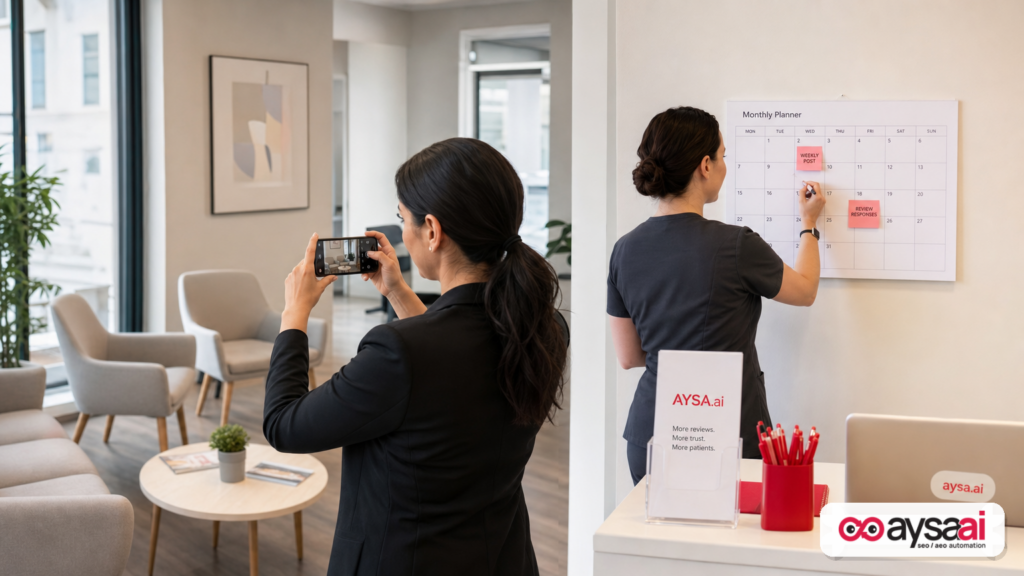
- Monday: publish 1 post (availability, seasonal service, patient education, community activity)
- Daily: respond to reviews (or at least every other day)
- Twice/month: upload 3–5 new real photos
- Weekly: request reviews from completed appointments with a simple prompt (“What treatment did we help you with?”)
- Quarterly: audit hours + special hours for upcoming holidays
Why it works (without magical claims)
This system doesn’t rely on a secret trick. It aligns with what Google says it wants—accurate, up-to-date information (Google local ranking guidance)—and it creates the kind of steady activity that’s hard for a less disciplined competitor to match long-term.
Most importantly: it’s sustainable for a real clinic with real constraints.
What agencies should rethink in 2026
If you’re an agency, here’s the uncomfortable truth: you can’t “audit your way” to ongoing local wins.
Audits matter, and a comprehensive local SEO audit checklist is useful (Search Engine Journal’s local SEO audit checklist). But the biggest agency failure mode in local is delivering strategy while neglecting the operational cadence that creates freshness and engagement signals.
The shift agencies must make
- From: quarterly deliverables and rank reports
- To: weekly operating rhythms and measurable actions
That means your retainer should include:
- a review generation workflow (client operations + agency support),
- weekly posts and photo requests,
- response SLAs (or shared responsibility),
- and measurement tied to interactions, not vanity rankings.
Competitor analysis should include operations, not just metadata
Most competitor “GBP analysis” is shallow: categories, title, review count. You also need to analyze cadence:
- How often do they get reviews?
- Do they respond?
- How often do they post?
- Are their photos recent?
Search Engine Journal has discussed competitor GBP analysis as a research area (competitor analysis for local SEO). The practical agency lesson is to benchmark activity, not just fields.
How AYSA fits: approved execution for local + AI search visibility
Most businesses don’t lose local visibility because they don’t know what to do. They lose because they can’t execute consistently without breaking something, forgetting something, or relying on a single person’s memory.
This is where AYSA is designed to help—without pretending it “replaces strategy” or “automates trust.”
AYSA’s model is simple:
- Monitor for what changed (performance, visibility, content gaps, technical issues)
- Prepare recommended improvements (on-site updates that support local relevance, clarity, and conversion)
- Ask for approval so humans stay in control
- Execute accepted website changes consistently and safely
That “approved execution” piece matters because local search isn’t just GBP. Your website is still the foundation for:
- service clarity (what you actually do),
- location/entity consistency,
- conversion paths (call, book, directions),
- and structured data (where appropriate).
If you want to explore how we think about local + AI visibility as a system, start here:
- AI Search Visibility (how we frame visibility across AI surfaces)
- Monitoring (what we track and why consistency beats sporadic effort)
- AI SEO Tools (execution support for modern SEO workflows)
- Pricing (for teams deciding between tools vs. operations)
- Blog (ongoing playbooks and updates)
Important note: AYSA doesn’t claim to control Google’s local rankings. No one does. What AYSA can do is help you run the parts you do control—site clarity, on-site content updates, technical hygiene, and repeatable execution—so your GBP activity is backed by a strong, consistent entity footprint.
What to do next
If you want a practical next step, don’t start with a “big optimization project.” Start with a cadence and a checklist.
Action list (30–60 minutes to set up)
- Audit your GBP basics (category, address, phone, website link, services, attributes). If you need a refresher on setup, Search Engine Journal provides an overview: set up your Google Business Profile.
- Fix hours + add special hours for upcoming holidays and known closures.
- Create a weekly posting calendar (4 post themes you can rotate).
- Install a review request workflow: who asks, when they ask, and how you ensure it happens within 24 hours.
- Set a response SLA: reviews and Q&A responded to within 48 hours.
- Schedule photo uploads: twice monthly minimum.
- Define 6 KPIs: calls, directions, website clicks, reviews/month, response time, posts/week.
If you want AYSA involved
- Start with Monitoring so you have a baseline and can catch drift.
- Use AYSA to prepare on-site changes that support local clarity (service pages, location copy, schema where appropriate), then approve what you want executed.
- Keep GBP operations on a weekly rhythm; align the website so the entity story is consistent everywhere.
Sources and further reading
- Search Engine Journal roundup (primary reference): The New Google Business Profile Playbook for AI Local Search
- Google: Local ranking guidance
- Whitespark: Local Search Ranking Factors
- BrightLocal: Study on opening hours and local rankings
- Search Engine Journal: Review Signals Gain Influence In Top Google Local Rankings
- Birdeye: State of Google Business Profile 2025
- Google blog: Ask Maps
- Search Engine Journal: What Ask Maps means for marketers
- Search Engine Journal: Schema for local SEO guide
- Search Engine Journal: Local SEO audit checklist
Note on claims: Local ranking systems are complex. Where sources discuss correlation-based studies or expert surveys, treat them as directional guidance, not guarantees. The operational advice here focuses on what improves customer experience and data quality—two things that remain valuable regardless of algorithm details.
Continue the AI search topic inside AYSA.
Use these pages to connect the article with AI SEO tools, AI visibility monitoring, AI Overviews and approved website execution.
Turn this topic into a website action plan.
Use these AYSA hubs to move from reading to technical fixes, AI visibility monitoring, research, glossary context and approval-first SEO execution.

