
Semantic SEO For Law Firms: How Lawyers Can Build Trust In Search And AI
Semantic SEO for law firms means making practice areas, attorneys, jurisdictions, proof, service pages and helpful legal explanations easy to understand without turning legal content into generic advice.
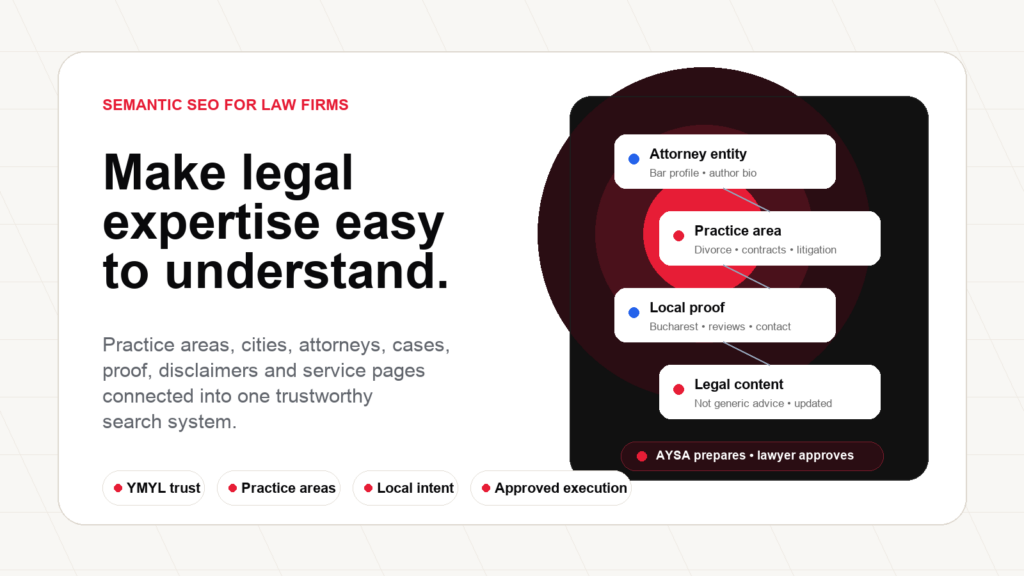
Semantic SEO for law firms is a very different problem from semantic SEO for ecommerce, tourism or general business websites.
A law firm website does not only need to rank. It needs to be trusted. It must explain expertise without pretending to replace legal advice. It must help potential clients understand whether their problem fits the firm’s practice area, jurisdiction, experience and process. It must do all of this in a way that is useful for people and understandable for search engines and AI systems.
That is why semantic SEO matters so much for lawyers.
A search engine or Answer engine does not simply need to see the phrase “lawyer in Bucharest” repeated across a page. It needs to understand what kind of lawyer, which legal problem, which jurisdiction, which city, which procedure, which level of urgency and which professional signals support the recommendation.
As we explained in the broader article on semantic SEO in the AI Search era, modern search is moving toward meaning, entities and usefulness. For law firms, that shift raises the bar. Thin practice pages and generic legal blogs are less convincing when AI systems try to decide which source is reliable enough to cite.
Why legal SEO is different
Legal SEO is sensitive because legal topics can affect people’s finances, rights, businesses, families and life decisions. Google’s quality systems and human quality rater guidelines discuss YMYL topics: pages that can significantly affect health, financial stability, safety, welfare or society. Legal content often belongs near that category because poor information can lead to serious consequences.
This does not mean law firms should avoid content. It means legal content needs stronger discipline.
A useful law firm page should make clear:
- what legal issue the page discusses;
- which jurisdiction or country the information relates to;
- whether the page is general information or legal advice;
- who wrote or reviewed the content;
- what experience or professional role supports the content;
- what next step a potential client should take;
- when the information was reviewed or updated.
Semantic SEO for law firms therefore begins with trust architecture, not Keyword density.
YMYL-aware
Generic law SEO
Focus: city Keyword, legal service keyword, a long generic article and a contact form.
This can look optimized, but it may not communicate expertise, jurisdiction, process or trust.
Semantic law firm SEO
Focus: practice area, attorney entity, jurisdiction, client situation, proof, process, author review and internal links.
The website becomes easier to evaluate, cite and recommend.
Trust architecture: the foundation of law firm visibility
For a law firm, trust should not be hidden on an “About” page. It should be part of the whole website structure.
A strong legal trust architecture usually includes:
- clear attorney profile pages;
- bar membership or professional qualification information where appropriate;
- practice area pages connected to the lawyers who handle those matters;
- office location pages with accurate contact information;
- case-type explanations written in plain language;
- updated legal resources with visible dates;
- client-oriented process explanations;
- review and testimonial handling that respects professional rules;
- disclaimers that distinguish general information from legal advice.
This is semantic SEO because it helps search systems understand the relationship between the firm, the attorneys, the legal services, the jurisdictions and the user needs.
It is also good business. A potential client rarely wants a “content hub.” They want to know whether the firm can help with a divorce, contract dispute, criminal matter, debt recovery, business incorporation, labor issue, real estate transaction or compliance problem.
Practice area pages should be decision pages, not keyword pages
Many law firm websites create practice area pages that are too thin. They define the legal service, list a few bullet points and end with “contact us.” That is not enough.
A semantic practice area page should answer practical questions:
- What situations does this practice area cover?
- Who typically needs this service?
- What documents or facts are usually required?
- What risks should the client understand?
- What does the process look like?
- What can and cannot be estimated before consultation?
- Which lawyer or team handles these matters?
- What related legal issues should the user consider?
For example, a page about commercial contract disputes should not only say “we handle contract disputes.” It should explain breach of contract, negotiation, evidence, deadlines, litigation risk, settlement options and related services such as debt recovery or corporate legal advice.
A page about divorce should not read like a copied legal dictionary. It should help the person understand procedure, children, property, urgency, documents, mediation and when to speak with a lawyer.
This is where semantic SEO becomes useful for humans. The page is not optimized because it is longer. It is optimized because it organizes the legal problem clearly.
Local legal intent: city, jurisdiction and practical access
Legal SEO often has a strong local component. People search for lawyers near them, but local intent in legal services is more complex than “near me.”
A useful local law firm page should connect:
- the office location;
- the courts or local institutions relevant to the practice;
- the jurisdiction where the firm can assist;
- consultation format: in office, online, phone, emergency availability;
- language availability;
- parking, access or appointment logistics where useful;
- local reviews or reputation signals where ethically allowed.
For Local SEO, semantic clarity matters because “lawyer Bucharest” is not a single intent. It can mean urgent criminal defense, family law, employment advice, business contracts, real estate documents, debt recovery or immigration support. A law firm website should not make Google guess which of these it actually covers.
This is similar to the logic we used in semantic SEO for HoReCa and tourism: local visibility improves when the business connects services, location, user intent and practical decision criteria.
Legal content should educate without pretending to replace counsel
Legal content is valuable when it helps users understand a problem well enough to take the right next step. It becomes risky when it pretends to solve every situation with generic advice.
Good legal content usually has these characteristics:
- plain language explanations;
- jurisdiction-specific context;
- clear boundaries and disclaimers;
- examples without exposing confidential client details;
- updated information when laws or procedures change;
- links to related practice pages;
- author or reviewer Attribution;
- clear next steps for consultation.
The mistake is publishing hundreds of generic articles such as “What is contract law?” or “What is divorce?” without connecting them to real services, attorney expertise or local context. That creates content volume, not topical authority.
Semantic legal content should form clusters:
- practice area page: family law;
- supporting guide: divorce procedure;
- supporting guide: child custody questions;
- supporting guide: property division;
- attorney profile: lawyer handling family law;
- local page: family lawyer in the relevant city;
- FAQ: consultation, documents, timelines and limitations.
This kind of structure helps users, Google and AI systems understand the firm’s expertise more confidently.
Schema, entities and structured data for law firms
Structured data can support semantic SEO, but it should not be used to exaggerate claims.
For law firms, structured data may help clarify entities such as the organization, local business, legal service, person, article, breadcrumb and FAQ content where the visible page supports it. Schema.org includes vocabulary such as LegalService, and Google’s structured data documentation explains the broader principle: markup should reflect visible page content and follow eligibility rules for the specific feature.
The key is consistency. The firm name, address, phone, attorney names, practice areas, author details and page purpose should align across:
- visible page content;
- structured data;
- Google Business Profile;
- directories or professional profiles;
- internal links;
- title and meta description;
- author and reviewer information.
Schema cannot compensate for weak content or unclear expertise. It can only help machines interpret a strong page more accurately.
AI Search readiness for lawyers
AI Search changes how law firms should think about discoverability. People increasingly ask long, situational questions:
- “I received a contract termination notice. What kind of lawyer should I contact?”
- “How do I compare divorce lawyers in Bucharest?”
- “What documents do I need before speaking with an employment lawyer?”
- “Can a small business recover unpaid invoices without going to court?”
- “What should I ask a real estate lawyer before signing a purchase contract?”
These queries are not just keywords. They are problem descriptions. A law firm that wants visibility in AI-assisted search needs content that maps legal problems to practice areas, attorneys, jurisdictions, evidence and next steps.
The best AI-ready law firm content is not aggressive. It is clear, careful and useful. It helps a user understand the shape of the problem without pretending that a web page can replace legal counsel.
The AYSA view: law firms need controlled execution
In my opinion, legal SEO is one of the clearest examples of why AI alone is not enough.
A general chat model can draft a legal article, but that does not mean the article is strategically correct, jurisdictionally careful, connected to the firm’s services or safe to publish. A law firm needs a system that monitors the website, detects gaps, prepares improvements, explains the reasoning and keeps approval in the hands of the business.
That is the AYSA model.
AYSA.ai can help prepare SEO and AI visibility work for a law firm website: practice area improvements, internal linking, content briefs, schema opportunities, title and meta improvements, FAQ opportunities, local SEO improvements and monitoring. But the important part is approval. AYSA is built around approved execution, not blind autopilot.
For law firms, that matters. The website should move faster, but not carelessly. The firm should not wait months for every small SEO task, but it should also not publish unreviewed legal claims at scale.
Semantic SEO for law firms is therefore not “write more content.” It is build a trustworthy legal knowledge structure and keep improving it with human approval.
Practical checklist for law firm semantic SEO
- Create clear attorney profile pages with professional context.
- Build practice area pages around client problems, not only legal terms.
- Connect practice pages to supporting guides and relevant attorney profiles.
- Use local pages carefully, with real jurisdiction and office context.
- Add visible disclaimers where content is informational and not legal advice.
- Keep legal guides reviewed and updated.
- Use structured data only when it reflects visible content.
- Avoid mass generic legal articles with no connection to services.
- Monitor internal links so important practice pages are not isolated.
- Use approval workflows before publishing sensitive legal content or claims.
Sources and further reading
- Google Search Central: Creating helpful, reliable, people-first content
- Google Search Central: AI optimization guide
- Google Search Central: Introduction to structured data
- Schema.org: LegalService
- Search Engine Land: What is semantic SEO?
- AYSA: Semantic SEO in the AI Search era
- AYSA: Semantic SEO for WordPress
- AYSA Glossary: Local SEO
- AYSA Glossary: YMYL
- AYSA Glossary: E-E-A-T
Move faster without giving up editorial control.
AYSA helps service businesses prepare SEO and AI visibility improvements, explain what matters, request approval and execute accepted changes inside the website workflow.
Continue the AI search topic inside AYSA.
Use these pages to connect the article with AI SEO tools, AI visibility monitoring, AI Overviews and approved website execution.
Turn this topic into a website action plan.
Use these AYSA hubs to move from reading to technical fixes, AI visibility monitoring, research, glossary context and approval-first SEO execution.

