
Semantic SEO For Ecommerce: How To Make Products Understandable To Search And AI
Semantic SEO for ecommerce means turning products, categories, variants, reviews, availability, shipping and internal links into a clear meaning system for Google, AI Search and shopping agents.
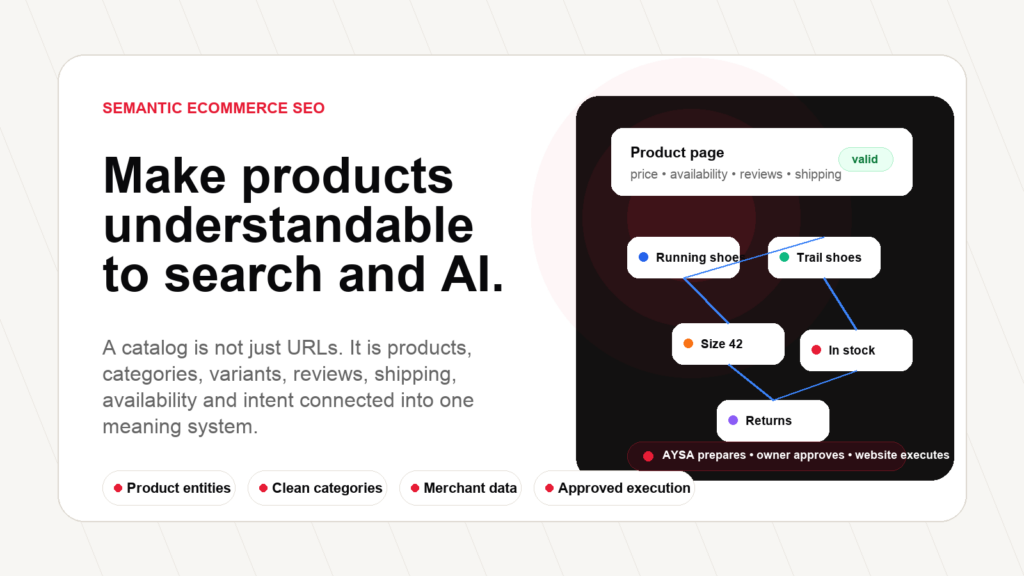
Semantic SEO for ecommerce is not a decorative layer on top of a shop. It is the work of making the store understandable.
A modern ecommerce website is not only a set of URLs. It is a catalog of products, categories, brands, attributes, prices, availability states, shipping promises, return policies, reviews, comparisons, guides and business rules. Search engines and AI systems need to understand how these pieces connect before they can confidently rank, cite, recommend or summarize the store.
This is why ecommerce SEO is becoming more operational. It is no longer enough to write a category description and add meta titles. The real question is: can Google, AI Mode, ChatGPT-style systems and shopping agents understand what the business sells, who the products are for, what makes them different, when they are available, how they can be delivered and why a buyer should trust the recommendation?
As we argued in our broader article on semantic SEO in the AI Search era, search is moving from Keyword matching toward meaning, entities and usefulness. Ecommerce feels this shift first because buying decisions are highly structured. A user rarely wants “a product page.” They want the right product for a situation, budget, location, urgency and preference.
Why ecommerce needs semantic SEO now
Traditional ecommerce SEO often focused on three surfaces: category pages, product pages and backlinks. Those still matter, but they are not enough for the search environment that is forming around AI-assisted discovery.
Google’s own documentation around product structured data and Merchant Center shows how much structured product understanding matters: price, availability, reviews, shipping, return information, merchant listings and product identifiers all help search systems understand what is being offered. The same direction is visible in Google’s guidance for AI features: create unique, helpful, accessible content; make sure Google can crawl it; use structured data that matches visible content; and avoid creating pages only for machines.
For ecommerce, that means semantic SEO must answer several questions at once:
- What product or product family is this?
- What category does it belong to?
- Which attributes matter for buyers?
- Which variants are meaningful and which are just technical duplicates?
- Is the product available now?
- How much does it cost and what affects the price?
- Where can it be delivered or picked up?
- What proof exists: reviews, ratings, brand trust, expert guidance, real photos?
- Which questions does a buyer ask before purchasing?
- Which related products, alternatives or accessories should be connected?
That is semantic SEO. It is not only “put the keyword in the title.” It is product meaning, buyer context and technical clarity working together.
Old ecommerce SEO
Focus: category keyword, product title, Meta description, backlinks and occasional blog content.
This can still bring traffic, but it often creates thin categories, duplicate filters and weak product understanding.
Semantic ecommerce SEO
Focus: product entities, category intent, attributes, availability, reviews, structured data, internal links and buyer questions.
The store becomes easier to crawl, classify, cite and recommend.
The ecommerce catalog as a meaning system
The first semantic SEO mistake in ecommerce is treating the catalog as a database instead of a meaning system.
A database stores products. A meaning system explains them.
For example, a flower shop may sell roses, preserved roses, wedding bouquets, funeral arrangements, birthday flowers and subscription flower delivery. A simple product database may list SKUs, prices and images. A semantic ecommerce system explains relationships:
- roses are appropriate for romantic occasions, anniversaries and some formal gifts;
- wedding bouquets connect to wedding services, florist expertise and seasonal availability;
- funeral arrangements need different language, delivery reliability and local trust;
- subscription flowers are a recurring purchase, not a one-time gift;
- delivery pages connect products to cities, timing and logistics.
This matters because search and AI systems increasingly answer questions, not just match product names. If a user asks, “What flowers should I send for a formal business thank-you in Bucharest?” the winning store is not necessarily the one with the most products. It is the store whose catalog, content and internal links make the answer obvious.
The same applies to fashion, electronics, cosmetics, furniture, supplements, pet products, auto parts and B2B ecommerce. A product is rarely just a product. It belongs to a use case, a buyer problem, a comparison set and a trust context.
Category pages should explain intent, not just list products
Category pages are often the strongest SEO assets in ecommerce. They also become some of the weakest pages when they are treated as product grids with a paragraph added at the bottom.
A semantic Category page should help the user and the machine understand:
- what the category includes;
- who it is for;
- which attributes matter;
- how to choose between subcategories;
- which products are best for which situations;
- what delivery, availability or compatibility constraints exist;
- what related guides or comparison pages support the decision.
That does not mean every category page needs a long essay. It means the page needs useful context. A category for “trail running shoes” should explain terrain, grip, waterproofing, foot support and distance. A category for “pediatric clinics” should explain location, services, appointment flow, emergency limits, reviews and trust signals. A category for “airport parking” should explain distance to terminal, transfer time, security, booking, cancellation and pricing.
In ecommerce, the best semantic category pages do three jobs at once: they help users choose, they help Google classify the page and they help AI systems extract a useful answer.
Product pages need entity clarity and buyer proof
Product pages are where semantic SEO becomes very concrete. A product page should not only say what the product is called. It should make the product understandable.
Strong product pages usually include:
- a clear product name;
- brand or manufacturer information;
- use cases and buyer intent;
- important attributes and specifications;
- price and availability;
- delivery or pickup details;
- returns and warranty information where relevant;
- reviews, ratings or expert notes;
- high-quality images with useful alt text;
- links to related products, accessories, alternatives and guides.
This is where many shops lose semantic clarity. They import manufacturer descriptions, duplicate the same text across variants, hide important details in tabs, omit product identifiers or fail to connect products to helpful buying guides.
Google’s product structured data documentation makes clear that product information should be accurate and match what is visible to users. Structured data is not a place to invent claims. It is a way to help machines understand the visible content already present on the page.
Filters, variants and faceted navigation can either help or poison the catalog
Ecommerce sites often generate thousands of URLs from filters: color, size, brand, price, material, rating, availability, location, compatibility and sorting options. Some of these pages are useful. Many are crawl traps.
Semantic SEO does not mean “index every filter.” It means deciding which filtered combinations represent real demand and meaning.
For example, “red running shoes for women” may be a useful landing page if the store has enough products and demand exists. But “red running shoes for women sorted by newest with price under 73” is usually not a page that should compete in search.
The same applies to product variants. A color variant may deserve its own URL if users search for it and the page has unique content, images and availability. A minor technical variation may be better handled through canonicalization or a single parent product page.
This is one of the most important ecommerce SEO governance decisions: what should be indexable, what should be canonicalized, what should be noindexed and what should simply remain a user filter.
Structured data and product feeds are semantic infrastructure
For ecommerce, structured data and product feeds are not optional technical details. They are part of the semantic infrastructure of the store.
Product structured data can help Google understand product details such as name, image, description, price, availability, review ratings, shipping information and return policy where eligible. Merchant Center product data adds another layer of product information used across Google surfaces.
The important principle is consistency. Product data should agree across:
- visible product page content;
- Product structured data;
- Merchant Center feed;
- canonical URL;
- availability and price updates;
- shipping and return information;
- category and internal link structure.
If the page says one price, the feed says another, the structured data says in stock and the page says out of stock, the semantic system is broken. That is not just an SEO issue. It is a trust issue.
This is also why ecommerce SEO cannot be fully separated from operations. Inventory, pricing, merchandising, CMS templates, feed rules and SEO all affect the same visibility layer.
AI Search changes what ecommerce visibility means
AI Search is not replacing ecommerce SEO with magic. It is increasing the importance of clarity.
When an AI system summarizes options, compares products or recommends stores, it needs extractable evidence. It needs to know what the product is, who it is for, why it is different and whether the business can fulfill the need.
This is especially important for list-style and comparison queries:
- “best running shoes for flat feet under 100 euros”;
- “which online florist delivers same day in Bucharest?”;
- “best airport parking near Otopeni with shuttle and online booking”;
- “which laptop is better for a student who edits video?”;
- “safe skincare products for sensitive skin.”
These are not simple keyword queries. They are multi-constraint decisions. Semantic ecommerce SEO prepares the website for that reality by making product and business information easier to retrieve, compare and cite.
In our article on agentic commerce and ecommerce SEO, we argued that the next buyer may not be only a person browsing a category page. It may be an agent helping the person filter options. That does not eliminate SEO. It raises the standard: product information must be legible to machines and useful to humans.
The AYSA view: ecommerce needs approved execution, not another dashboard
In my opinion, the biggest ecommerce SEO problem is not lack of reports. Most stores already have more reports than they can act on: Search Console, Analytics, Merchant Center, rank tracking, crawlers, speed tools, CMS reports, product feed errors and agency recommendations.
The real problem is execution.
A semantic ecommerce SEO system needs continuous work:
- detect categories that should become stronger landing pages;
- find product pages with weak descriptions or missing attributes;
- identify internal linking gaps between categories, products and guides;
- spot structured data inconsistencies;
- detect indexable filter pages that waste crawl budget;
- prepare better titles, meta descriptions and content blocks;
- connect products to comparison content and buying guides;
- monitor ranking, AI visibility and market changes;
- turn approved recommendations into website changes.
This is where AYSA.ai fits naturally. AYSA is not built to be another ecommerce dashboard that tells a business owner to “improve category content.” It is built to monitor the website, prepare approval-ready SEO and AI visibility actions, ask for human approval and execute accepted changes inside the website workflow.
For ecommerce teams and SMEs, that distinction matters. A tool that only identifies issues still leaves work on the table. A system that prepares and executes approved actions can keep up with the pace of catalog changes, search changes and AI discovery.
Practical semantic ecommerce checklist
If you run an ecommerce website, start with this checklist:
- Map every strategic category to a clear buyer intent.
- Decide which filters deserve indexable landing pages and which should stay non-indexable.
- Ensure product structured data matches visible product information.
- Keep price, availability, shipping and returns consistent across page, feed and schema.
- Add useful buying guidance to category pages where users need help choosing.
- Connect blog guides to category and product pages, not only to other blog posts.
- Use internal links to connect alternatives, accessories, use cases and related entities.
- Remove or consolidate thin product, tag and filter pages.
- Monitor Search Console, Merchant Center and AI visibility signals together.
- Turn recommendations into approved website execution, not a backlog that nobody touches.
Semantic SEO for ecommerce is not about making the store sound more technical. It is about making the store easier to understand, compare, trust and recommend.
Sources and further reading
- Google Search Central: Product structured data
- Google Search Central: Introduction to structured data
- Google Search Central: AI optimization guide
- Google Merchant Center: Product data specification
- Search Engine Land: What is semantic SEO?
- AYSA: Semantic SEO in the AI Search era
- AYSA: Semantic SEO for WordPress
- AYSA: Agentic commerce and ecommerce SEO
Tired of SEO recommendations that never reach the website?
AYSA helps ecommerce websites monitor search and AI visibility, prepare semantic SEO improvements, request approval and execute accepted changes inside the website workflow.
Continue the AI search topic inside AYSA.
Use these pages to connect the article with AI SEO tools, AI visibility monitoring, AI Overviews and approved website execution.
Turn this topic into a website action plan.
Use these AYSA hubs to move from reading to technical fixes, AI visibility monitoring, research, glossary context and approval-first SEO execution.

