2027 Marketing Budgets For AI Search: Stop Funding Channels. Fund Visibility, Trust, Distribution, Oversight, And Measurement.
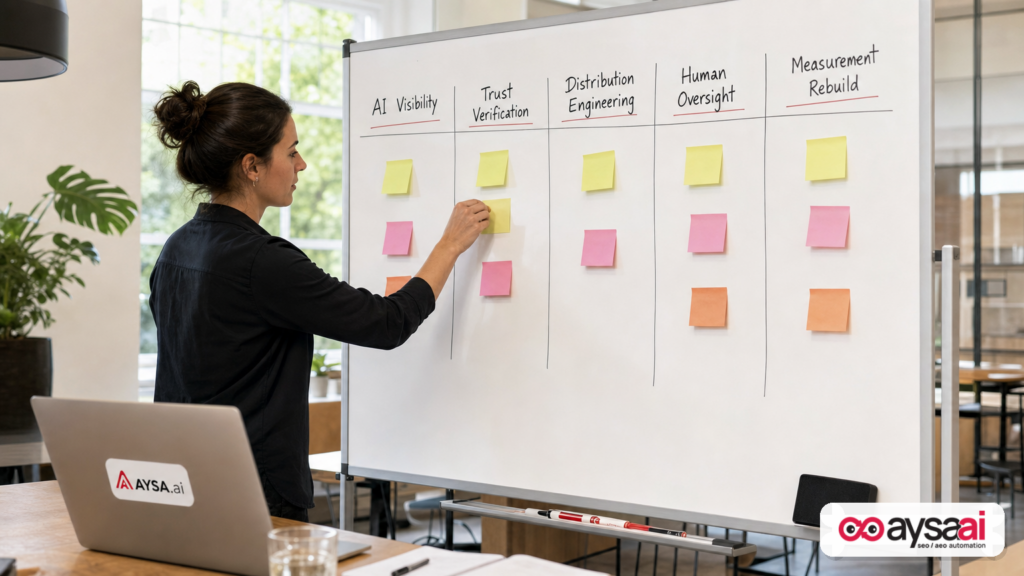
AI is changing how customers discover and decide—often without clicking. For 2027, the most resilient marketing budgets won’t be bigger “AI” line items inside old channel buckets. They’ll be reorganized around five functions: AI visibility, trust verification, distribution engineering, human oversight, and measurement rebuild—so teams can win citations, reduce misinformation risk, and prove impact beyond last-click.

Marketing budgets are about to get audited by a new judge: not Google’s 10 blue links, not a social feed, and not a neatly attributable last-click report. The judge is the answer layer—AI Overviews, AI Mode, chatbots, and recommendation systems that summarize, compare, and suggest without sending as many visits to your site.
That’s why I agree with the core premise behind Greg Jarboe’s argument in Search Engine Journal: it’s not enough to add a bigger “AI” line item inside the same old channel buckets. If you fund “SEO,” “paid social,” “email,” and “PR” the same way you did five years ago—then sprinkle in some generative AI tooling—you’re budgeting for a customer journey that’s already dissolving.
But here’s the part I want to push further, from the perspective of building and operating AYSA.ai: the winners in 2027 won’t be the teams with the biggest AI spend. They’ll be the teams with the fastest, safest execution loop—the ability to monitor visibility, prepare site changes, request approval, and ship improvements continuously. AI Search is volatile; the only durable advantage is being operationally ready.
Concise summary

For 2027, reorganize your marketing budget away from channels and toward five functions that match how AI-driven discovery works:
- AI visibility & citation management (earning inclusion in answers, not just rankings)
- Trust verification (making your claims, people, and policies easy to validate)
- Distribution engineering (designing content to travel across owned, earned, and AI-crawled surfaces)
- Human judgment & editorial oversight (preventing brand-damaging errors and thin content)
- Measurement rebuild (moving beyond last-click to track influence and visibility)
This editorial explains what changed, why it matters to SMEs and agencies, what can go wrong, what to monitor, and how to build an Execution Plan. I’ll also show where AYSA fits as an AI SEO/AEO/GEO execution system that monitors, prepares, asks for approval, and executes accepted website changes.
Key takeaways (read this before your next budget meeting)
- Channels aren’t strategies. They’re delivery mechanisms. AI is changing the delivery rules.
- Visibility is shifting from “ranking” to “being cited.” If your brand isn’t referenced in AI answers, you’re losing top-of-funnel influence even if traffic looks stable.
- Trust is now a budget line. If AI systems can’t verify you, you’ll be excluded—or misrepresented.
- Distribution is an engineering problem. Content has to be structured, syndicated, and maintained like a system, not a campaign.
- Editorial oversight is not optional. AI-era mistakes are faster, cheaper, and more scalable—which makes them more dangerous.
- Measurement must adapt. Last-click misses “no-click influence” where decisions happen inside answers.
- Execution speed with governance wins. The best plan is useless if your site changes take 6–12 weeks of approvals and dev backlog.
Table of contents

- What changed: the customer journey is fragmenting (and “search” isn’t one place anymore)
- Why legacy channel buckets fail under AI discovery
- The 5 functional budget lines that beat “bigger AI” inside old buckets
- 1) AI visibility & citation management
- 2) Trust verification
- 3) Distribution engineering
- 4) Human judgment & editorial oversight
- 5) Measurement rebuild
- A concrete SME scenario: a local clinic competing in AI answers without blowing the budget
- What agencies should rethink before 2027 renewals
- What can go wrong (and how to de-risk it)
- A 6-week action plan before you submit the 2027 budget
- Where AYSA.ai fits: monitoring, preparation, approvals, and execution
- What to do next
- Sources and further reading
What changed: the customer journey is fragmenting (and “search” isn’t one place anymore)
Not long ago, the simplified story of discovery looked like this:
- A customer searches on Google.
- They click a website.
- They convert—or they don’t.
- Analytics assigns credit.
Even when that story was incomplete, it was directionally useful. It justified channel-based budgeting: “SEO drives Clicks,” “paid drives demand,” “social builds awareness,” “email retains.”
Now the journey increasingly looks like this:
- A customer asks an AI assistant for recommendations.
- They receive a shortlist, a comparison, or a summary—sometimes without links, sometimes with links they never open.
- They sanity-check with reviews, Maps, Reddit-like communities, or a colleague.
- They may land on your site late (or not at all) to confirm pricing, availability, or policy details.
- They convert through a call, booking, marketplace, or in-app flow that has weak attribution.
In other words: visibility and influence are moving upstream into AI-generated answers and multi-surface recommendation environments. Your website still matters, but its role is shifting from “the place that captures the click” to “the canonical source that validates the answer.”
When the rules of discovery change, budgets that mirror the old rules become a liability. And the easy mistake is to respond with a vague line item: “AI tools.” That’s not a strategy; it’s an expense category.
Why legacy channel buckets fail under AI discovery
Channel-based budgets are attractive because they feel concrete:
- SEO has rankings, traffic, and “free” clicks.
- PPC has spend and conversions.
- Social has impressions and engagement.
- Email has opens and revenue.
But those are measurements for a world where channels are the primary unit of control. AI pushes the control point elsewhere:
- From placement to eligibility: Are you eligible to be cited, referenced, or summarized correctly?
- From clicks to outcomes: Can customers act without visiting your site, and do you still win the decision?
- From campaigns to systems: Are your facts, entities, policies, and product/service details consistently available across the web?
That’s why Jarboe’s functional framing is a better budgeting primitive than “put more money into AI.” It forces you to fund the work that actually changes results.
It also addresses a common budget pathology I see in SMEs and mid-market teams: spending grows in whichever channel provides the cleanest reporting, not the cleanest business impact. If your analytics stack can’t see AI influence, AI influence doesn’t exist on the spreadsheet—so it doesn’t get funded.
The 5 functional budget lines that beat “bigger AI” inside old buckets
Let’s translate the five functions into plain business language: what you’re buying, why it matters, and how it connects to execution.
1) AI visibility & citation management (be included in the answer)
What you’re buying: the ability for AI systems to confidently reference your brand, products, services, and expertise when users ask questions you should own.
Why it matters: in AI search environments, being “#1” for a keyword is less meaningful if the user never sees your listing. The “new SERP” is the answer itself. Your goal becomes: appear as a cited source, a recommended option, or a referenced entity.
What this includes:
- Topic and query mapping for AI-style questions (comparisons, “best for,” “near me,” “pros and cons,” “what should I choose”).
- Content designed for extractability: clear definitions, structured sections, succinct answers, and supporting proof.
- Entity clarity: making it unambiguous who you are, what you offer, where you operate, and what your differentiators are.
- Technical accessibility: pages that can be crawled, parsed, and rendered reliably.
Important nuance: this doesn’t replace SEO. It reshapes it. Classic SEO still matters for discovery, crawling, and authority. But “ranking pages” is no longer the only objective; it’s part of earning inclusion in AI outputs.
How AYSA fits: AI visibility is not a one-time project. You need ongoing monitoring and controlled execution. AYSA is built to monitor site signals and visibility-related issues, prepare changes, request approvals, and execute accepted updates—so improvements don’t die in tickets and meetings. See: AI search visibility.
2) Trust verification (make your claims easy to validate)
What you’re buying: proof infrastructure.
AI systems are great at summarizing; they are less great at “knowing” what’s true in a way humans consider reliable. Even in traditional search, Google has long emphasized concepts like expertise and trustworthiness (commonly discussed in the context of Google’s Search Quality Rater Guidelines and E-E-A-T). In an AI answer world, verification becomes even more central: your brand can be omitted or misrepresented if systems can’t validate your facts.
Trust verification work looks like:
- Identity and accountability: clear company details, leadership, author/editor bios where appropriate, and contact paths.
- Policy clarity: shipping/returns for ecommerce, cancellation for services, privacy and data handling, warranties, guarantees, medical/legal disclaimers when relevant.
- Evidence: references to standards, certifications, memberships, case studies (without exaggeration), third-party reviews, and verifiable testimonials.
- Consistency across surfaces: your site, listings, review platforms, and authoritative profiles should align.
What this is not: “sprinkle schema on it.” Structured data can help, but trust is a system of signals: content, policies, reviews, identity, and external corroboration.
Why it’s a budget line now: trust work is cross-functional. It touches legal, compliance, product, customer support, listings, and comms. If it’s not funded explicitly, it becomes everyone’s “nice-to-have” and nobody’s deliverable.
Relevant primary source lead: Google provides extensive documentation on how it handles structured data and search features, and while structured data is not a guarantee, it’s part of making information machine-readable. See Google Search Central documentation: developers.google.com/search.
3) Distribution engineering (build content to travel)
What you’re buying: a repeatable system that publishes once and propagates everywhere that matters—owned properties, earned mentions, partner surfaces, and AI-crawled pages.
Historically, distribution was often treated like channel ops: “We made the blog post, now social schedules it, email sends it, PR pitches it.” In AI discovery, distribution isn’t just promotion—it’s availability.
AI systems learn from and reference what they can access, parse, and corroborate across the open web. That means your distribution strategy should answer:
- Where do customers actually research decisions in your category?
- Where do AI systems typically find corroborating sources?
- Which surfaces are durable (and not dependent on a single algorithmic feed)?
Distribution engineering includes:
- Creating canonical “source of truth” pages on your site that are easy to cite (e.g., pricing explainer, comparison pages, service details, FAQs, methodology pages).
- Repurposing into multiple formats that preserve meaning: short explainers, Q&A, guides, checklists.
- Aligning PR/digital PR with “citation goals,” not vanity press goals.
- Maintaining an update cadence: AI answers can drift as the web changes.
Where SMEs get stuck: they treat distribution as an add-on. But if content isn’t engineered to be reused and referenced, you end up paying for the same thinking multiple times—once per channel—without accumulating durable visibility.
4) Human judgment & editorial oversight (prevent scalable mistakes)
What you’re buying: quality control, risk management, and brand protection.
Generative AI makes it easy to produce a lot of content quickly. That’s precisely why editorial oversight matters more, not less.
In 2027, the biggest content risk is not “we didn’t publish enough.” It’s:
- We published incorrect claims at scale.
- We created thin, repetitive pages that dilute authority.
- We accidentally contradict ourselves across pages and platforms.
- We misstate policies, pricing, or availability.
- We create compliance issues (health, finance, legal, employment, safety).
AI-era oversight also includes making judgment calls that models can’t reliably make:
- What should we be willing to claim?
- What do we have proof for?
- What’s the brand voice boundary?
- What’s the reputational downside if an AI answer paraphrases us?
Human oversight is not anti-AI. It’s pro-outcomes. It’s how you use AI to accelerate drafts and operations without delegating accountability.
5) Measurement rebuild (see influence when there’s no click)
What you’re buying: a measurement approach that reflects how decisions are made in AI-assisted journeys.
Last-click attribution has been stressed for years, but AI increases the gap dramatically. If the customer gets their shortlist from an AI answer, then later types your brand name directly, your measurement will typically over-credit brand/direct and under-credit the content and authority that earned the recommendation.
Jarboe points to the need for new GEO-oriented measurement thinking and references AMEC’s work on GEO principles. That’s a credible measurement lead: AMEC is a long-standing industry body for communications measurement and evaluation. If you’re rebuilding measurement, look for frameworks that emphasize outcomes, transparency, and validity. (If you plan to adopt a standard, use AMEC’s official resources rather than secondhand summaries.)
Practical measurement rebuild for SMEs can include:
- Tracking branded vs non-branded demand trends in Search Console and paid search query reports (directional, not perfect).
- Monitoring how your pages are being crawled and whether key pages remain indexable and up-to-date.
- Capturing “AI visibility” proxies: mentions, citations, and referral patterns when present (methodologies vary; be explicit about what you’re measuring).
- Using GA4 thoughtfully for what it can measure well (on-site behavior and conversions), and not pretending it measures the entire journey.
Primary source lead for analytics: Google Analytics 4 documentation is the best baseline for understanding what GA4 can and cannot measure. Start here: support.google.com/analytics. For search performance, use Google Search Console: search.google.com/search-console.
A concrete SME scenario: a local clinic competing in AI answers without blowing the budget
Let’s make this real with a scenario that mirrors what we see every day in SME marketing.
Business: a multi-location physical therapy clinic in a mid-sized U.S. metro.
Problem: referrals are slowing, PPC costs are rising, and organic traffic is flat. The owner asks, “Should we just spend more on AI tools and content?”
In a legacy budget, you might increase:
- SEO content production
- Paid search
- Paid social awareness
But a functional 2027 budget reframes the work:
AI visibility & citation management (clinic edition)
- Create a set of canonical pages that answer high-intent questions: “PT for lower back pain,” “how long does PT take,” “PT vs chiropractor,” “what to expect first visit,” “does insurance cover PT,” “dry needling benefits and risks.”
- Structure content so it can be extracted: short summaries, bullet lists, clear headings, and clinician-reviewed guidance.
- Ensure each location page is complete, consistent, and easy to parse (services, hours, parking, phone, booking, accessibility).
Trust verification (clinic edition)
- Publish clinician credentials and review process: who writes content, who reviews it, and how often it’s updated.
- Make policies explicit: cancellations, insurance verification, pricing ranges, and referrals.
- Strengthen third-party trust signals: accurate listings, review responses, and consistent NAP data across directories.
Distribution engineering (clinic edition)
- Repurpose clinician answers into short Q&A snippets for multiple surfaces (site FAQ, appointment confirmation emails, printed handouts, community partnerships).
- Pitch local media or partner blogs with evidence-based content (not promotional fluff) so external references exist beyond the clinic’s own site.
Human oversight (clinic edition)
- Require clinical review for any health-related claims.
- Maintain an “approved phrases” library to keep messaging consistent and compliant.
Measurement rebuild (clinic edition)
- Track call and booking trends by service line and location alongside search demand trends.
- Watch branded demand lift after publishing trust-heavy content updates (directional indicator).
- Use Search Console to monitor growth in queries that match AI-style questions, even if click volume doesn’t spike.
The budget outcome: the clinic doesn’t necessarily spend more. It spends differently—less on “more content,” more on making a smaller set of pages verifiable, distributable, and maintainable. That’s the shift: from volume to function.
What agencies should rethink before 2027 renewals
If you run an agency, 2027 budgets are a forcing function. Your clients are going to ask uncomfortable questions:
- “If AI answers reduce clicks, what exactly are we paying for?”
- “Why did we publish 40 blog posts and still not show up in AI recommendations?”
- “Why do we need three separate teams for SEO, content, and PR when the outcome is ‘being cited’?”
Channel-based retainers will struggle if they can’t translate into functional outcomes. The strongest agencies will:
- Sell systems, not deliverables: a visibility/trust/distribution loop, not “X articles per month.”
- Adopt editorial governance: formal review standards, update policies, and proof requirements.
- Integrate measurement consulting: help clients rebuild reporting and expectations.
- Own implementation: not just recommendations. Execution is the moat.
This is where SEO automation has to mature. Automation that only produces recommendations is a half-solution. The gap is implementation capacity: changes stuck in a backlog don’t create business value.
AYSA is designed for this new agency reality: monitor and prepare changes continuously, ask clients for approval, and execute the accepted fixes—so the agency can scale outcomes without turning every improvement into a Jira saga. Start with AYSA’s AI SEO tools and monitoring.
What can go wrong (and how to de-risk it)
Reorganizing budgets is hard. Reorganizing budgets under AI turbulence is harder. Here are the most common failure modes—and what to do about them.
Risk #1: You fund “AI content” and call it a strategy
Symptom: you produce more pages, more posts, more variants. Results don’t compound.
Fix: fund the five functions explicitly, especially trust verification and measurement rebuild. Volume is not a substitute for verifiability.
Risk #2: You chase tools instead of workflows
Symptom: the team has subscriptions, but nothing ships faster. The CMS is still the bottleneck.
Fix: build an execution loop: monitor → prepare → approve → publish. If you can’t describe your loop in one sentence, you don’t have one.
Risk #3: You optimize for the wrong KPI because it’s the easiest to report
Symptom: budgets move toward PPC and away from long-term authority because PPC has neat dashboards.
Fix: rebuild measurement so CFOs can see leading indicators (visibility/citation/brand demand lift) alongside lagging indicators (revenue).
Risk #4: You ship unreviewed AI-generated claims
Symptom: misinformation, compliance issues, reputational damage, or public corrections.
Fix: allocate budget to editorial oversight. Implement human review gates, especially for YMYL-like topics (health, finance, safety, legal).
Risk #5: You fragment ownership across teams
Symptom: SEO owns “visibility,” PR owns “authority,” product owns “policies,” legal owns “disclaimers,” and nobody owns “trust verification.”
Fix: budget categories create ownership. Assign a DRI (directly responsible individual) per function and require quarterly reporting.
A 6-week action plan before you submit the 2027 budget
Most organizations start budget planning in a rush. You don’t need a 12-month transformation program to improve your 2027 plan—you need a disciplined sprint that produces a re-org proposal, a measurement story, and an execution plan.
Week 1: Re-tag last year’s spend into the five functions
Pull the last 12 months of marketing expenses and map every major line into:
- AI visibility & citation management
- Trust verification
- Distribution engineering
- Human oversight
- Measurement rebuild
This does two things immediately:
- It reveals “hidden spend” (work you’re already doing but not naming).
- It exposes neglected functions (usually trust and measurement).
Week 2: Identify your top 20 AI-era questions (not just keywords)
Build a list of the questions that actually drive decisions in your market:
- “Best X for Y”
- “X vs Y”
- “Is X worth it?”
- “How much does X cost?”
- “What are the risks of X?”
- “Which provider should I choose?”
Then map each question to:
- Which page on your site should be the canonical answer
- What proof is required
- Which distribution surfaces matter
Week 3: Audit trust and consistency (site + listings + reviews)
Do a fast, high-impact audit:
- Are your policies easy to find and consistent?
- Are your authors/experts clearly identified where it matters?
- Do listings match your site (hours, phone, services)?
- Are reviews actively managed and responded to?
Even without new tools, you can spot trust gaps quickly. The key is to fund fixing them—not just documenting them.
Week 4: Build your distribution map and update cadence
Create a “where this content lives” map:
- Your site (canonical pages)
- Partner placements (earned)
- Listings/review platforms
- Email sequences (owned)
- Sales enablement assets (internal distribution)
Then define an update cadence: what changes monthly, quarterly, and annually. AI answers drift; your content maintenance must be planned.
Week 5: Propose a measurement rebuild with clear caveats
Bring your CFO a measurement model that:
- Separates what you can measure precisely (on-site conversions) from what you can measure directionally (influence).
- Uses trend lines rather than false precision.
- Explains what “good” looks like over 90 days and 180 days.
Anchor it in primary tools you already use: GA4 and Search Console, plus any credible third-party measurement standards you decide to adopt.
Week 6: Lock the execution plan (who ships what, how fast, with what approvals)
This is the step most teams skip—and it’s why strategies don’t materialize.
Answer these questions:
- What changes can be executed without engineering (CMS edits, templates, internal linking, page structure improvements)?
- What changes require development (schema templates, rendering, site performance, faceted navigation fixes)?
- What is your approval workflow (marketing, legal, compliance, leadership)?
- What is your SLA for publishing improvements?
If you can’t ship changes quickly, your 2027 budget will underperform regardless of how smart the plan is.
Where AYSA.ai fits: monitoring, preparation, approvals, and execution
At AYSA.ai, we operate with a simple belief: SEO, AEO, and GEO don’t fail because teams lack ideas. They fail because teams can’t execute safely and continuously.
AI-era search increases the need for iteration:
- Answers change.
- Competitors update pages.
- Policies shift.
- Products and services evolve.
AYSA is positioned as an execution system for this reality:
- Monitors key site and visibility signals: AYSA Monitoring
- Prepares recommended updates (content/technical/on-page) aligned with AI visibility and trust needs
- Requests approval so changes are governed and auditable (no risky auto-publishing)
- Executes accepted website changes so improvements don’t stall
If you’re reorganizing your 2027 budget around the five functions, AYSA maps naturally to the operational backbone:
- AI visibility: ongoing optimization cycles that improve clarity, structure, and relevance
- Trust verification: maintaining consistent, verifiable pages and policies
- Distribution engineering: keeping canonical pages updated and reference-ready
- Human oversight: approvals as a built-in control point
- Measurement rebuild: continuous monitoring and change logs to connect actions to outcomes
If you want to explore what this looks like in practice, start with AI search visibility, review the AI SEO tools, and check pricing. For ongoing guidance, see the AYSA blog.
What to do next (action list)
- Stop asking “Which channel gets more?” Ask “Which function is underfunded relative to AI-era reality?”
- Re-tag last year’s spend into the five functions and identify the gaps.
- Pick 10–20 decision questions that matter most to your revenue and build canonical, verifiable pages for them.
- Fund trust like a product, not like a content project: policies, credentials, reviews, consistency.
- Engineer distribution so each core asset has multiple durable placements and update cycles.
- Install editorial oversight gates for AI-assisted content and high-risk categories.
- Rebuild measurement with honest caveats and trend-based reporting beyond last-click.
- Fix execution speed: implement a monitor → prepare → approve → execute loop (with AYSA or your internal workflow).
Sources and further reading
- Greg Jarboe (Search Engine Journal): 2027 Marketing Budgets: Why New Categories Beat Bigger AI Line Items
- Google Search Central (primary documentation): Google Search developer documentation
- Google Search Console (primary tool): Search Console
- Google Analytics help (primary documentation): GA4 documentation
- Search Engine Journal sections (context and research leads): SEO, SEO News, Google Algorithm Updates
AYSA internal resources:
Continue the AI search topic inside AYSA.
Use these pages to connect the article with AI SEO tools, AI visibility monitoring, AI Overviews and approved website execution.
Turn this topic into a website action plan.
Use these AYSA hubs to move from reading to technical fixes, AI visibility monitoring, research, glossary context and approval-first SEO execution.