AI Cited Your Brand. Now What? A Practical Playbook For Fixing AI Visibility Gaps (Without Chasing Vanity Mentions)
An AI answer mentioning your business isn’t a strategy—it’s a symptom. Here’s how to diagnose the real AI visibility gap (accuracy, coverage, authority, or access), pick the right fix, and operationalize it with an approved execution workflow using AYSA.

AI cited your brand. You screenshot it, share it in Slack, and for a moment it feels like you’ve “made it.” Then reality hits: the answer is outdated, your competitor is recommended more often, or the AI cites a random third-party page you’ve never heard of.
That moment—when you realize an AI mention doesn’t tell you what to do next—is where most teams either freeze or waste budget. They publish another blog post, run generic PR, or start “optimizing for AI” without a diagnosis.
This editorial is a practical playbook for turning AI mentions into decisions. It’s inspired by Constance Tan’s framework shared via Search Engine Journal (SEJ) and expands it into an operational system you can run as an SME, an in-house team, or an agency—without treating every citation like a business win.
Concise summary
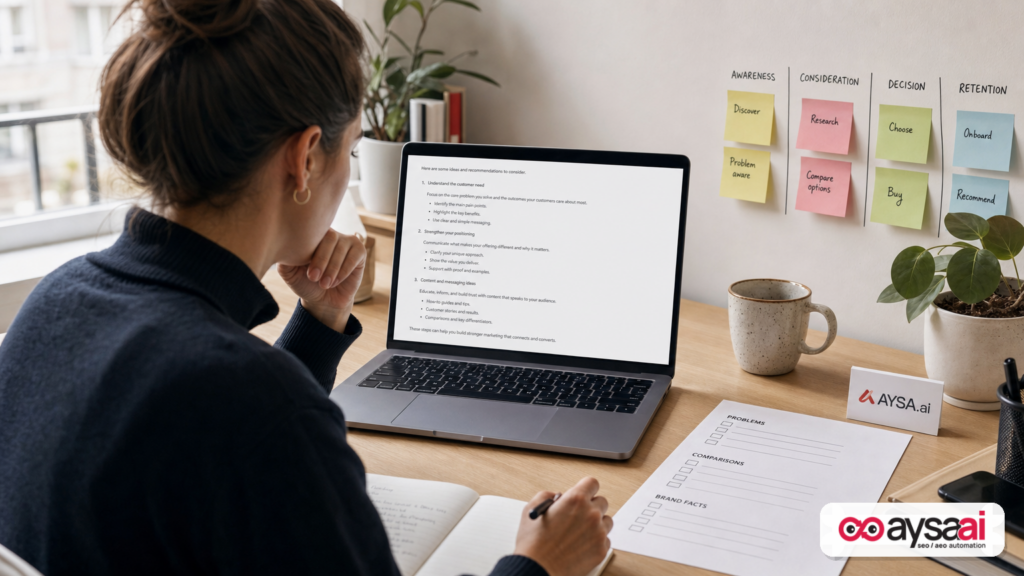
AI visibility problems usually fall into four buckets: (1) inaccurate information, (2) not enough credible mentions, (3) content coverage gaps, or (4) bot access/retrieval failures. The fix is different for each. Your job is to identify recurring patterns across the customer journey, trace answers back to their sources, correct what you control first, then choose between Outreach, new content, or technical remediation. AYSA fits as the execution system: monitor what AI surfaces, prepare changes, ask for approval, and execute accepted updates—fast, safely, and auditable.
Key takeaways
- An AI mention is not a KPI. It’s a signal—sometimes a good one, often a warning.
- Don’t monitor random prompts. Build a stable set based on customer problems, comparisons, and brand facts.
- Diagnose the gap before acting. The right fix might be a pricing page update, not a new article.
- Trace citations to sources. If competitors dominate, find which pages, formats, and narratives drive it.
- Check access before rewriting. If bots can’t fetch or render your pages, content work won’t matter.
- Operationalize execution. Speed + governance wins; Approved Execution beats “SEO theater.”
Table of contents

- What changed: from ranking pages to influencing answers
- The new reality: AI mentions are easy to see, hard to act on
- What to monitor: prompts that map to how customers choose
- A diagnostic framework: four AI visibility gaps and the right fix for each
- How to trace competitor mentions back to sources (and why formats matter)
- Fix inaccurate information where you have control
- Earn useful mentions (without spamming communities)
- Close content coverage gaps: build “sources of truth,” not filler
- Don’t assume it’s content: check bot access, rendering, and reliability
- Measurement: visibility is a leading indicator, not revenue
- Scenario: a local clinic that’s “mentioned” but losing patients
- How AYSA turns diagnosis into approved execution (without SEO theater)
- What to do next: a 30-day action plan
- Sources and further reading
What changed: from ranking pages to influencing answers
For two decades, the dominant mental model in SEO was: rank pages, earn Clicks. Even when SERPs became more complex—featured snippets, knowledge panels, local packs—the workflow stayed familiar: optimize pages, build authority, measure traffic.
Now, customers increasingly show up with a different behavior:
- They ask an AI to shortlist options.
- They ask for pros/cons and “best for X.”
- They verify brand facts (“Is this covered?” “Does it integrate?” “What’s the pricing?”) without visiting your site first.
In that world, your website is still critical—but it’s not the only interface between you and the customer. AI systems summarize, recommend, and cite sources (sometimes). That creates a new layer of search visibility: answer visibility.
The risk is not that SEO is dead. The risk is that companies will keep doing SEO like it’s 2018: publish content, buy links, celebrate Impressions—while the market shifts toward AI-mediated decisions.
That’s why the most valuable question today isn’t “How do we get cited?” It’s: What problem is the AI answer revealing, and what is the most efficient fix?
The new reality: AI mentions are easy to see, hard to act on
SEJ’s webinar recap highlights a simple but uncomfortable truth: an AI answer mentioning your brand does not tell you what to do next. One prompt can be misleading, and one citation can be accidental.
What matters is patterns—especially patterns that align with the customer journey. Constance Tan’s approach (as summarized by SEJ) focuses on repeated claims across prompts, repeated sources, and repeated gaps. That orientation is what separates a real strategy from a screenshot-driven panic.
Here’s why “AI mentions” are hard to operationalize:
- They’re ambiguous. A mention could be positive, negative, outdated, or irrelevant.
- They don’t map to a tactic. If an AI answer is wrong, do you update your site, contact the citing author, or publish new content?
- They don’t equal demand. You can be cited and still be ignored; you can be uncited and still win via brand + referrals.
The correct response is not “optimize for AI.” The correct response is diagnose the AI Visibility Gap.
What to monitor: prompts that map to how customers choose
If your monitoring is just a giant spreadsheet of random prompts, you’ll drown in noise. The SEJ recap describes three prompt categories that are genuinely useful because they align with how buyers move:
- Problems customers need to solve (discovery stage).
- Positioning and comparisons (shortlisting stage).
- Facts about your business (validation stage).
This is the core shift: from “keyword lists” to “decision language.”
Where to get prompt language (without guessing)
Most businesses already have the best prompt research sitting in other departments:
- Sales calls and demos: what prospects ask when they’re almost ready to buy.
- Support tickets: where customers get stuck (and what they call it).
- Internal search and site search: the language of active intent.
- Reviews and community threads: how the market describes pain, not how you describe features.
- Search queries: your existing SEO research is still useful; it just needs to be reframed as questions.
SEJ’s recap also includes a caution worth repeating: don’t assume the same forums matter in every market. “Reddit and Quora are not the answer everywhere.” The right inputs depend on your category, region, and buyer behavior.
Build a “stable prompt set,” not a prompt storm
Operationally, you want a list you can run consistently over time. Think of it like a panel survey: fewer questions, asked repeatedly, produces trends you can act on.
A practical starting point for most SMEs:
- 5–10 problem prompts (category + pain + context)
- 5–10 comparison prompts (“best for…”, “alternative to…”, “X vs Y”)
- 5–10 factual prompts (pricing, availability, integrations, guarantees, policies)
Then lock it for a month. If you change the questions every week, you can’t see movement—only chaos.
If you want a workflow to support this, AYSA’s monitoring layer is designed for exactly that: consistent tracking of visibility signals over time, not one-off curiosity checks. See: AYSA Monitoring and AI search visibility.
A diagnostic framework: four AI visibility gaps and the right fix for each
Most “AI optimization” advice collapses into one tactic: create content. That’s often wrong.
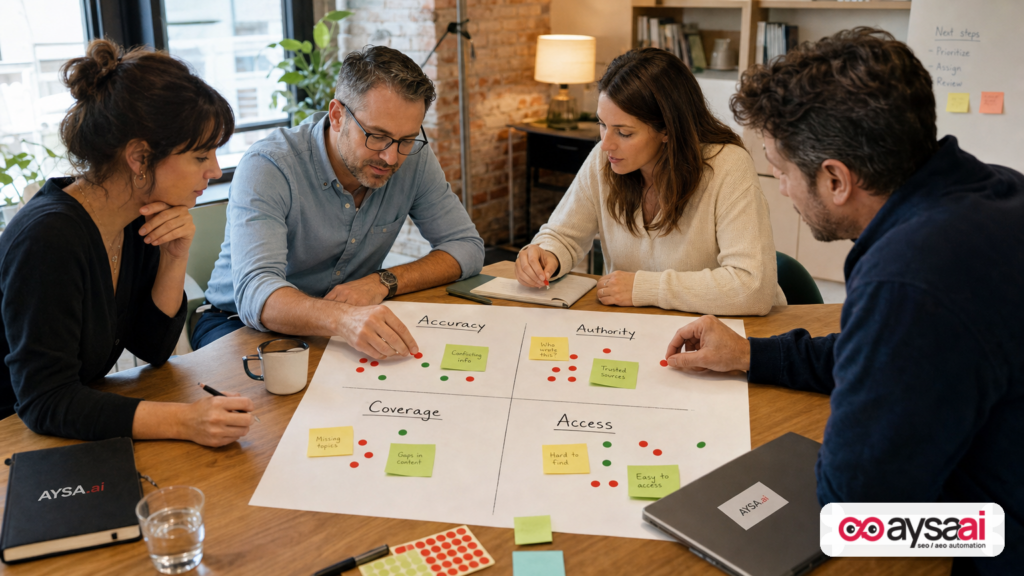
In practice, AI visibility failures tend to cluster into four buckets. Your first job is to label the problem correctly.
Gap #1: Accuracy (the AI says the wrong thing)
Symptoms:
- AI describes an old pricing tier, discontinued feature, or outdated policy.
- AI confuses your product category or target audience.
- AI repeats a misconception about your brand.
Likely causes:
- Conflicting information across your own pages (old blog posts vs new landing pages).
- Stale third-party articles ranking/circulating with outdated details.
- Incomplete “source of truth” content on your site.
Primary fixes:
- Correct owned pages first (pricing, product, FAQ, policies).
- Then pursue third-party corrections where reachable and high-impact.
Gap #2: Authority/Mentions (competitors are cited and recommended more)
Symptoms:
- Competitors show up repeatedly for “best for…” prompts.
- You’re present in organic search but absent in AI shortlists.
- AI cites industry lists, reviews, or community threads that don’t include you.
Likely causes:
- Not enough credible third-party coverage in the formats AI pulls from (reviews, comparisons, discussions, videos).
- Your positioning is unclear, so sources don’t describe you in “recommendable” terms.
- Competitors have stronger narrative distribution, not necessarily better products.
Primary fixes:
- Earn mentions where the market already cites sources (PR, partnerships, reviews, community expertise).
- Strengthen positioning content that third parties can reference.
Gap #3: Coverage/Content (AI can’t find a good page to cite for your angle)
Symptoms:
- AI answers the question but never cites you, even when you’re a strong fit.
- Your content is broad but lacks specific “use case + constraints” pages.
- AI cites low-quality sources because better sources don’t exist.
Likely causes:
- You don’t have a clear, current “source of truth” for key topics.
- Your content is marketing-heavy and light on specifics.
- You have content, but it doesn’t match how customers ask the question.
Primary fixes:
- Create or upgrade pages that answer the question better than existing sources.
- Build content around real decision criteria, not generic definitions.
Gap #4: Access/Technical (bots can’t retrieve or render your best content)
Symptoms:
- Your best page is never cited, even though it’s clearly relevant.
- AI cites a weaker version of your page (cached, scraped, or third-party summary).
- Pages rely heavily on JavaScript for key content, or load unreliably.
Likely causes:
- Firewall restrictions, bot blocks, or aggressive rate limiting.
- Broken URLs, redirect chains, timeouts, or rendering issues.
- Content hidden behind scripts that a bot may not execute reliably.
Primary fixes:
- Technical audit focused on bot access and content retrievability.
- Make critical information available in fast, crawlable HTML.
A simple decision tree you can actually use
- If the AI answer is wrong → start with Accuracy.
- If competitors dominate recommendations → start with Authority/Mentions and source tracing.
- If no one covers your niche well → start with Coverage/Content.
- If your content is good but never cited → start with Access/Technical.
How to trace competitor mentions back to sources (and why formats matter)
When a competitor appears more often, the temptation is to assume they have “better SEO.” Sometimes they do. Often they simply have better distribution in the formats AI is pulling from.
SEJ’s recap emphasizes a key move: follow competitor mentions back to their sources. Not just “who is mentioned,” but why they’re being recommended and which sources are feeding that narrative.
Step 1: Identify repeated prompts where you lose
Look for themes, not single losses:
- “Best software for X”
- “Best clinic for Y”
- “Alternative to Z for small teams”
If the same competitor shows up across 10 related prompts, you have a positioning distribution gap worth fixing.
Step 2: Collect citations and classify them by format
Don’t treat all sources equally. A review directory, a YouTube walkthrough, a Reddit thread, and a high-authority editorial piece play different roles:
- Editorial articles help define categories and criteria.
- Reviews influence shortlists.
- Community discussions shape trust and real-world objections.
- Videos often drive “how it works” understanding.
This matters because your fix changes by format. You can update your own content faster than you can change a directory listing. You can participate in a community thread differently than you pitch an editor.
Step 3: Prioritize reachable sources that are repeatedly cited
SEJ shares a pragmatic outreach point: prioritize sources you can realistically influence. Domain metrics can add context, but the best target is often the source that is both frequently cited and reachable.
In other words: don’t waste a month begging an unresponsive publisher for a correction if you could publish a definitive source-of-truth page in a week.
Fix inaccurate information where you have control
If you take only one operational lesson from the SEJ recap, make it this: correct your own house before you complain about the neighborhood.
AI systems absorb and remix information from across the web. If your own site has conflicting details, you’re feeding the confusion.
Start with “money pages” and factual anchors
For most businesses, the highest-impact accuracy fixes are unglamorous:
- Pricing pages
- Plan comparison tables
- Feature descriptions
- Integrations
- Shipping/returns (ecommerce)
- Hours/locations (local)
- Policies and eligibility (health/finance especially)
These are the pages AI answers tend to summarize—and the pages customers rely on to decide.
Then decide: outreach correction vs. new source
SEJ’s recap includes an outreach example from Ahrefs: they contacted multiple authors, some replied, and a few updated content. The exact outcomes aren’t the point; the point is the economics of outreach:
- It’s slow.
- It’s uncertain.
- It works best when the source is both important and reachable.
Sometimes, the better move is to create a newer, clearer, more comprehensive source on your own site—something the ecosystem can cite going forward.
What “accuracy” looks like in execution
Accuracy is not only “edit the text.” It can include:
- Consolidating duplicate pages that contradict each other
- Updating old posts that rank/circulate but are no longer true
- Adding explicit “last updated” context where it’s meaningful
- Publishing a canonical source-of-truth page and linking to it internally
AYSA’s model is useful here because most accuracy work is high frequency, low drama—but it has risk. A wrong pricing edit is worse than no edit. Approved execution (prepare → approve → execute) is how you move fast without breaking trust. Start here: AYSA AI SEO tools.
Earn useful mentions (without spamming communities)
Let’s get blunt: the internet does not need more founders parachuting into threads to drop links.
SEJ’s recap highlights a healthier approach to “earning mentions”: contribute like a real participant. That means:
- Answer technical questions
- Correct factual mistakes (with evidence)
- Offer guidance that stands on its own, even if the reader never buys from you
If you do this consistently, the byproduct is brand mentions that AI systems can pick up as part of the category conversation.
Mentions that matter are tied to decision criteria
Not all mentions are equal. A useful mention looks like:
- “We switched to X because it supports Y use case.”
- “For small teams that need Z, X is the best fit.”
- “X integrates with A and B; here’s how.”
Those mentions align with how AI answers comparisons.
Turn community signals into product and onboarding fixes
A point I strongly agree with from the SEJ recap: recurring complaints aren’t just “PR problems.” They’re product and onboarding feedback.
In an AI-mediated world, friction becomes visible at scale. If dozens of users complain about setup or confusing pricing, AI systems will reflect that narrative. Your best AI visibility tactic might be making the product easier—not publishing content about how easy it is.
Close content coverage gaps: build “sources of truth,” not filler
When you need new content, don’t default to “another blog post.” Build a page that can serve as a reference.
SEJ’s recap frames this as creating “new sources of information” when outreach isn’t practical or coverage is weak. That’s the right mindset.
What makes a page cite-worthy in practice
AI systems and humans cite pages that do at least one of these well:
- Explain tradeoffs clearly
- Define criteria (how to choose, not just what something is)
- Answer specific scenarios (not vague categories)
- Provide step-by-step guidance
- Stay current and consistent
Content patterns that often win AI citations
Without claiming a magic formula, here are content types that tend to become ecosystem references:
- “How to choose” guides (with constraints and decision trees)
- Integration and compatibility pages (what works with what)
- Use-case landing pages (“for dentists,” “for Shopify stores,” “for 10-person agencies”)
- Comparisons written honestly (when appropriate and defensible)
- Explainers tied to objections (security, compliance, returns, warranties)
Notice what’s missing: “What is X?” content written for keywords alone. That era is ending—not because it won’t rank, but because it’s rarely the decisive reference.
Where AYSA fits in content execution
Most teams struggle with content because execution is fragmented: one tool for research, one for writing, another for CMS updates, and then a long QA chain.
AYSA is built to compress that cycle responsibly: monitor → prepare recommendations → request approval → execute accepted website changes. If you’re serious about AEO/GEO, that “approved execution” loop is the difference between ideas and impact.
Start here: AI Search Visibility and AYSA pricing.
Don’t assume it’s content: check bot access, rendering, and reliability
This is the most overlooked part of the conversation, and it’s where teams burn the most money.
SEJ’s recap calls it out clearly: missing citations can be caused by bots being unable to retrieve your content—firewall restrictions, broken URLs, timeouts, or heavy JavaScript.
Why access issues are increasing
As AI crawlers proliferate, many sites respond by tightening security. That’s rational. But the side effect is accidental invisibility—even to systems you want to reach your content.
Also, modern web stacks increasingly rely on client-side rendering. Humans see the page; bots may see a skeleton.
Common access failures to investigate (even for non-technical teams)
- Robots and bot management rules that block important user agents
- WAF/firewall settings that challenge or throttle crawlers
- Slow page speed or timeouts on content-heavy pages
- Broken internal links to key pages
- JavaScript-dependent content where core information isn’t in HTML
You don’t need to become a crawler expert. You need a checklist and accountability: “Can the right bots fetch the right information reliably?”
Technical SEO is now AEO infrastructure
For years, some teams treated technical SEO as a one-time cleanup. In AI search, technical reliability is ongoing infrastructure. If your “source of truth” page is fragile, the market will cite someone else.
If you need a place to start, AYSA’s positioning is exactly here: connect monitoring to executable changes so technical fixes don’t sit in tickets for six months. See monitoring and the broader toolset at AI SEO tools.
Measurement: visibility is a leading indicator, not revenue
Executives will ask: “How much revenue did we get from AI citations?” Most teams can’t answer—and pretending you can is how bad strategy happens.
SEJ’s recap makes the right point: discuss visibility alongside conversions and customer feedback, not as a substitute for them. That’s exactly right.
What you can measure responsibly
Even if AI platforms don’t provide clean analytics, you can still track meaningful indicators:
- Share of voice in your stable prompt set (how often you appear vs competitors)
- Accuracy score (how often key facts are correct)
- Citation sources (which domains or formats show up repeatedly)
- On-site behavior (conversion rate trends on “source of truth” pages)
- Self-reported attribution (sales/support: “Where did you hear about us?”)
To be clear: self-reported attribution is imperfect, but it’s better than pretending you have a perfect model.
What not to do
- Don’t declare victory because you got cited once.
- Don’t kill SEO because AI answers reduced clicks in some queries; your brand still needs demand capture.
- Don’t chase an “AI mention count” as your north star.
Visibility reporting needs business context
The right reporting cadence is simple:
- Monthly: prompt set visibility, accuracy issues, competitor sources
- Quarterly: content roadmap adjustments, technical reliability, conversion and pipeline correlation
Keep it grounded: “What did we learn? What did we change? What outcomes moved?”
Scenario: A local clinic that’s “mentioned” but losing patients
Let’s make this real with a scenario I see constantly in SMEs: local services where facts matter more than thought leadership.
The situation
A multi-location physical therapy clinic notices it’s being mentioned in AI answers for “best physical therapy near me.” The team celebrates—until the front desk reports fewer calls, and new patients say they “weren’t sure” about insurance coverage and appointment availability.
When the clinic tests prompts, the AI answer includes:
- Old office hours
- Outdated insurance carriers
- A claim about a service the clinic stopped offering last year
Worse, the AI cites a third-party directory profile that hasn’t been updated in months.
Diagnosis: Accuracy + Authority + Access
This is not a “write more blogs” problem. It’s a layered visibility gap:
- Accuracy gap: wrong facts create friction and mistrust.
- Authority/mentions gap: directory profiles dominate the citations.
- Possible access gap: the clinic’s own pages may be slow or hard to parse, so third parties win citations by default.
The fix sequence (the order matters)
- Correct owned facts first: location pages, insurance FAQ, hours, appointment policy.
- Create a clear source-of-truth page: “Insurance accepted + how to verify” plus per-location details.
- Update key third-party profiles: focus on the ones that show up as citations.
- Check technical accessibility: ensure location info is in crawlable HTML, fast, and not hidden behind scripts.
- Re-test the stable prompt set monthly: confirm accuracy improves and citations shift.
Why this wins
You’re not “optimizing for AI.” You’re reducing customer uncertainty at the exact moment AI is shaping decisions. That shows up as more calls, better conversion rates, and fewer wasted front-desk conversations.
How AYSA turns diagnosis into approved execution (without SEO theater)
Most AI visibility guidance fails at the most important step: execution. Businesses don’t lose because they lack ideas; they lose because ideas get stuck in:
- backlogs,
- endless revisions,
- unclear ownership,
- or fear of making changes.
AYSA exists to close that gap with a simple, enterprise-grade principle: approved execution.
The AYSA loop
- Monitor what’s being said (and what’s missing) across your prompt set and key topics.
- Prepare recommended fixes: content updates, new pages, internal links, technical changes—mapped to the diagnosed gap.
- Ask for approval from the human owner (you, your team, your client).
- Execute the accepted website changes cleanly and consistently.
- Measure outcomes and feed learning into the next cycle.
This model matters because AI search is moving fast. If your cycle time is 90 days from insight to publish, you will always be reacting.
Where to explore AYSA (internal links)
What to do next: a 30-day action plan
If you want momentum without chaos, run this as a 30-day sprint. The goal is not perfection—it’s building a repeatable machine.
Week 1: Build your stable monitoring set
- Create 15–30 prompts split across: problems, comparisons, brand facts.
- Use language from sales/support/search queries (not just your marketing copy).
- Document the prompts and keep them stable for the month.
Week 2: Diagnose patterns and trace sources
- Run the prompt set and record recurring claims and recurring citations.
- Identify where competitors dominate and what sources feed those recommendations.
- Classify gaps into: Accuracy, Authority/Mentions, Coverage/Content, Access/Technical.
Week 3: Fix what you control first
- Update money pages and factual anchors.
- Remove or revise outdated posts that conflict with current offers.
- Create one “source of truth” page for a high-value topic where you see confusion.
Week 4: Choose one external push + one technical check
- External: pick 5–10 reachable sources for outreach or profile updates based on repeated citations.
- Technical: validate bot access, page reliability, and rendering on the pages you want cited.
- Re-run the prompt set and compare results month-over-month.
What to do next (action list)
- Stop treating AI mentions as a win. Treat them as a diagnostic entry point.
- Build a stable prompt set tied to how customers decide.
- Track recurring claims and sources—not one-off answers.
- Fix owned factual pages before writing net-new content.
- When competitors dominate, trace sources and target the repeat citers.
- Before you rewrite, check if bots can reliably fetch and render your content.
- Operationalize execution with approval gates so you can move fast without breaking trust.
Sources and further reading
- Search Engine Journal: AI Cites Your Brand: How to Choose Your Next Move (primary source for the framework discussed)
- Search Engine Journal: AI Search coverage (context and ongoing reporting)
- Search Engine Journal: Technical SEO (for access, crawling, and rendering considerations)
- Search Engine Journal: SEO (broader SEO strategy context)
Note: The SEJ recap references practical bot-access checks (firewalls, timeouts, JavaScript rendering), competitive source analysis, and outreach tradeoffs. Where teams need official platform-specific crawling policies, consult the relevant platform documentation directly; it was not included in the supplied research context, so it’s not cited here.
Continue the AI search topic inside AYSA.
Use these pages to connect the article with AI SEO tools, AI visibility monitoring, AI Overviews and approved website execution.
Turn this topic into a website action plan.
Use these AYSA hubs to move from reading to technical fixes, AI visibility monitoring, research, glossary context and approval-first SEO execution.