
Is Google’s AI Search Guide a Begging Letter? A Practical Reading for SMEs
A practical AYSA analysis of Google’s AI Search guidance, Andrew Holland’s critique, and what SMEs should actually do for SEO, AEO, GEO and AI Mode.
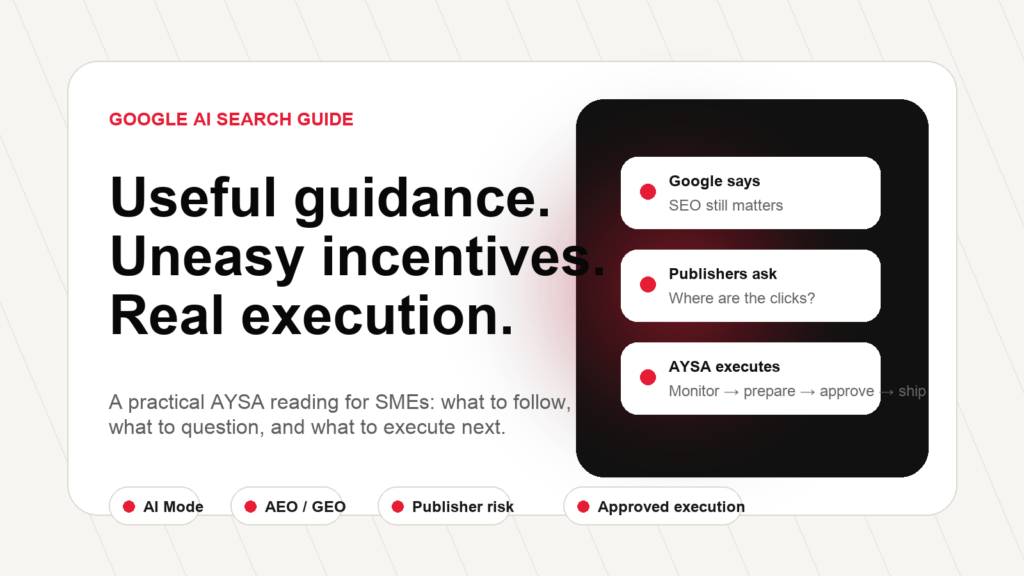
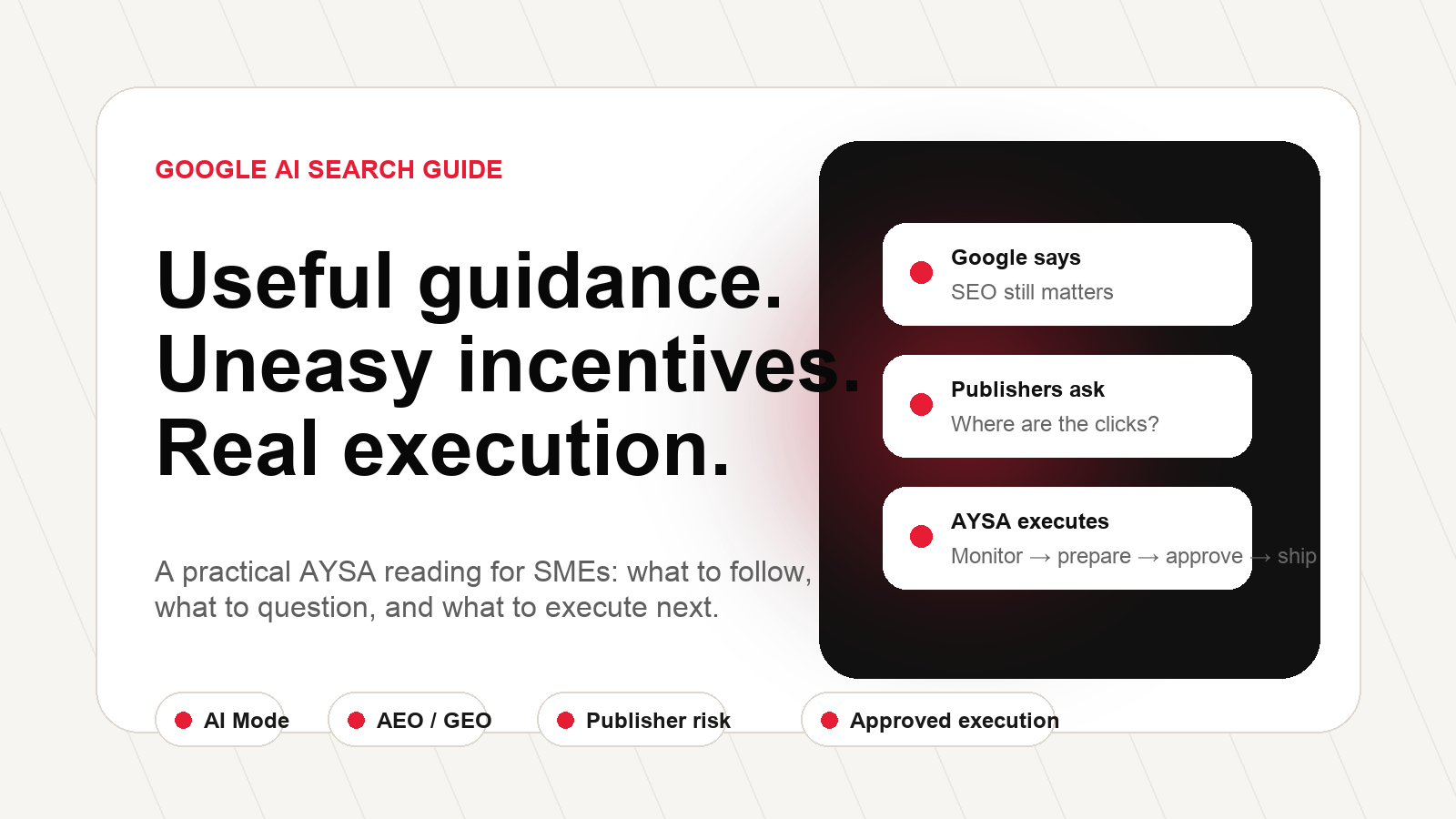
Executive summary: Google’s official guide for AI features is technically useful, but it also exposes the new tension in search. Google tells publishers and businesses to keep creating accessible, useful, crawlable content, while AI answers can reduce the number of traditional Clicks those same businesses receive. Andrew Holland’s LinkedIn critique calls this a “begging letter dressed up as a guide.” I think the criticism is emotionally understandable, but the practical answer for SMEs is not to rage against the guide. It is to treat it as a negotiation document: follow the parts that improve discoverability, question the incentives, and build an operating system that turns SEO and AI visibility work into Approved Execution.
For AYSA, the lesson is simple: the future is not “SEO is dead.” The future is that SEO, AEO, GEO, technical quality, authority, structured content and brand clarity must be monitored continuously and executed faster. Small and medium businesses cannot win this by reading more guides alone. They need the work prepared, explained, approved and shipped.
Why this matters
Google’s AI search guidance arrived in a strange moment. Businesses are being told to optimize for AI features, but many are also watching search results become more answer-heavy, more synthetic and less predictable. The traditional contract was understandable: create useful pages, get indexed, rank, earn clicks. That contract was never perfect, but it was legible.
AI search changes the psychology of that contract. A page can contribute to an answer, shape a recommendation or support a citation without receiving the same volume of visits it might have received from classic blue links. A brand can become more visible in an answer environment while its analytics still show unclear Attribution. A helpful article can train user trust and still not produce a clean last-click conversion.
This is why Andrew Holland’s critique resonates. His LinkedIn article frames Google’s AI Search guide as a kind of “begging letter” because Google still needs high-quality publisher and business content to make AI answers useful, while those same answers can reduce the traffic incentives that funded that content. Whether you agree with the wording or not, the tension is real.
But there is a danger in turning the critique into paralysis. SMEs do not have the luxury of waiting for the old search model to come back. They still need customers. They still need to be understood by Google, answer engines, AI assistants and potential buyers. They still need pages that are technically accessible, commercially useful, trustworthy and easy to cite. The question is not whether Google’s incentives are perfectly aligned with publishers. They are not. The question is: what do you do on Monday morning?
What Google actually says in the AI Search guide
The official Google Search Central AI features optimization guide does not reveal a secret AI ranking formula. Its core message is much more grounded: keep following search fundamentals, make sure Google can access your content, create helpful and reliable content for people, use structured data where it matches visible content, keep snippets and previews controllable, and measure beyond clicks.
That sounds boring, but boring does not mean unimportant. In AI-assisted search, the basics become more critical because content is no longer evaluated only as a destination page. It may also become a source passage, entity reference, product explanation, local proof point, policy clarification, comparison signal or answer ingredient.
Google’s guidance points businesses back to several practical areas:
- Crawlability and indexability: if Google cannot access or understand the page, it is unlikely to use it well in classic or AI-enhanced search.
- Helpful content: pages need to answer real user needs, not just target keywords.
- Structured data: schema should match visible page content and help systems understand entities, products, reviews, FAQs, organizations and actions.
- Multimodal readiness: images, videos and other assets should be clear, relevant and accessible.
- Measurement evolution: businesses should look beyond simple click counts and understand visibility, engagement and conversion quality.
From a technical perspective, this is sensible. Google is not wrong to say that AI search still depends on accessible, useful, well-structured web content. The problem is not the advice itself. The problem is the incentive environment around the advice.
Why the critique lands
The critique lands because Google is asking the open web to keep feeding the system while the system changes how value returns to creators. This is not only a publisher problem. It affects ecommerce stores, local businesses, clinics, hotels, SaaS companies, agencies and service businesses.
Imagine a private clinic that invests in a detailed page about pediatric fever, emergency warning signs, appointment options and how to choose between urgent care and scheduled care. In a classic search world, the page might rank, earn clicks and convert some visitors into bookings. In an AI answer world, the page may help the assistant summarize what a parent should compare, but the clinic may receive fewer visits unless it is cited, recommended or selected as part of the next step.
Or take an ecommerce store that builds excellent category guidance around product fit, sizing, returns, delivery and use cases. AI systems may use those signals to answer comparison questions. But if the answer satisfies the user before the click, the store needs a broader strategy: product feeds, reviews, entity clarity, citations, pricing clarity, availability, structured data and authority signals.
This is why “just make great content” is no longer enough as a business instruction. Great content is still necessary, but it needs to be connected to technical discoverability, entity consistency, structured data, brand authority, conversion paths and measurable execution.
Andrew Holland’s framing is sharp because it says the quiet part out loud: Google still needs the web, but the web needs a reason to keep investing. That reason may no longer be only traffic. It may become visibility, citation, assisted conversion, brand trust, local discovery, product eligibility and agent-ready transactions. That is a much harder model for SMEs to understand and manage.
The publisher bargain changed, and SMEs feel it too
For years, SEO was sold as a relatively linear process: find keywords, create pages, build authority, improve rankings, get traffic. That model was always simplified, but it worked well enough for many businesses. Now the search environment is more layered. A business can appear in classic organic results, AI Overviews, AI Mode, local packs, product grids, merchant listings, video results, Reddit-style discussions, social citations and AI assistant summaries.
That means the work is no longer only “rank this page.” The work becomes: make the business understandable across surfaces. This includes:
- clear service and product pages;
- strong category and comparison content;
- structured data aligned with visible content;
- credible author, brand and organization signals;
- reviews and third-party references;
- technical crawl and indexation control;
- internal links that explain topical relationships;
- product feed and local profile consistency;
- content that answers the real next question, not only the keyword.
This is why I do not read Google’s guide as a simple instruction manual. I read it as a sign of the new bargain. Google is saying: keep making the web understandable to us, because AI features still need sources. Publishers and businesses are saying: fine, but where is the measurable return?
The answer for SMEs will not come from ideology. It will come from operations. If a business can monitor where it is visible, identify missing signals, prepare improvements, approve the right changes and execute quickly, it has a chance to adapt. If it waits for a quarterly SEO report and a developer backlog, it will be too slow.
What SMEs should do instead of panic-reading the guide
First, fix the basics that make the website readable. This means clean HTML, indexable pages, fast mobile performance, correct canonical tags, structured data that matches visible content, complete product or service information, and internal links between related pages. AI search does not reward a messy website with magical understanding.
Second, write for decision moments, not generic keyword coverage. A page about “best pediatric clinic in Bucharest” should help a parent compare safety, availability, reviews, specialties, booking, parking, emergency criteria and trust signals. A page about “technical SEO audit” should explain what is checked, what can go wrong, how fixes are prioritized and what happens after the audit. This is the quality bar for answer-ready content.
Third, build entity clarity. Google and AI systems need to understand who you are, what you sell, where you operate, who you help, what makes you credible and how your website connects to external proof. This matters for local businesses, ecommerce stores, SaaS companies and professional services.
Fourth, treat reviews, mentions and authority as part of discoverability. Not every answer engine will rely only on your own website. Third-party references, publisher mentions, business profiles, product reviews and credible citations can influence how the brand is understood. This is where authority building should become controlled, relevant and measurable, not messy link buying.
Fifth, measure visibility in layers. Clicks still matter, but they are no longer the only signal. Track classic organic traffic, non-brand impressions, AI referrals, branded demand, local profile actions, assisted conversions, citations, mentions, rankings, product feed performance and revenue. Do not pretend every AI mention is money. But do not ignore early visibility signals either.
Sixth, stop treating SEO as a pile of recommendations. Recommendations that are not implemented do not improve the business. The key question is not “what did the audit find?” It is “what changed on the website because of the audit?”
Old workflow
Read Google guide. Audit website. Create report. Wait for developer. Lose momentum.
Execution workflow
Monitor signals. Prepare actions. Explain impact. Ask for approval. Execute accepted changes.
The AYSA view: Google’s guide is useful, but execution is the missing layer
AYSA fits into this debate because the main problem for SMEs is not lack of advice. The internet is full of advice. Google publishes advice. SEO experts publish advice. Tools produce dashboards. Agencies produce audits. The missing layer is approved execution.
An SME owner does not want to spend the next year learning the difference between AEO, GEO, AI Mode, structured data, canonicalization, entity optimization, internal linking and content pruning. They want to know what matters for their business, what should be changed, why it matters, what the risk is and whether the change can be applied safely.
This is what AYSA is being built to do: learn the business context, monitor search and AI visibility signals, prepare technical, content, authority and AI-readiness actions, ask for approval and execute accepted changes inside the website workflow. The user stays in control. The work does not stay trapped in a report.
So yes, Google’s AI Search guide is worth reading. And yes, Andrew Holland’s criticism is worth taking seriously. But the practical answer is not to choose between obedience and outrage. The practical answer is to build a system that makes your business easier to understand, cite, recommend and choose, while keeping control over what gets changed.
In my opinion, the winners in this next phase will not be the businesses that chase every AI search acronym. They will be the businesses that build faster feedback loops: detect, understand, approve, execute, measure and improve. That is the real difference between a website that reads Google’s guide and a website that benefits from it.
AI search advice is everywhere. Execution is still rare.
If Google’s AI guidance leaves you asking “what should I actually change?”, try AYSA.
AYSA monitors SEO, AEO and AI visibility signals, prepares the website actions that matter, explains them in plain language, asks for approval and executes accepted changes inside your workflow.
Sources and further reading
This analysis references Andrew Holland’s LinkedIn article, “Why Google’s AI Search Guide is a Begging Letter Dressed Up…”, Google’s official AI features optimization guide, Google Search Central documentation on creating helpful content, and Google’s documentation on structured data for search. The AYSA sections are our editorial and product perspective. We do not claim guaranteed rankings, guaranteed AI Overview inclusion, guaranteed citations or guaranteed traffic recovery.
Continue the AI search topic inside AYSA.
Use these pages to connect the article with AI SEO tools, AI visibility monitoring, AI Overviews and approved website execution.
Turn this topic into a website action plan.
Use these AYSA hubs to move from reading to technical fixes, AI visibility monitoring, research, glossary context and approval-first SEO execution.

