
Google Freshness Algorithm: What It Really Means for SEO, AEO and Content Refresh
A practical AYSA guide to Google’s Freshness Algorithm, query deserves freshness, content decay, AI search recency and approved content refresh execution.
Executive summary: Google’s Freshness Algorithm is often misunderstood. It does not mean every old page is bad, every new page is better or every article should be updated just to change the date. It means Google tries to understand when a query deserves fresh, recent or changing information. News, events, recurring updates, product availability, reviews, prices, legal changes, medical guidance, algorithm updates and fast-moving technology topics are more freshness-sensitive than stable definitions or evergreen educational pages.
For SMEs, the practical lesson is simple: do not chase fake freshness. Build a refresh system. Find pages where recency matters, detect Content decay, update facts and examples, improve answer readiness, add internal links, validate Structured data and execute approved changes. AYSA fits here because freshness is not a one-time content trick. It is a Monitoring and execution workflow.
What Google’s Freshness Algorithm really is
Google’s Freshness Algorithm is not a single button that rewards newly published pages. It is part of Google’s broader effort to return results that match the time sensitivity of the query. Some searches need a current answer. Others need the best answer, even if the best answer was written years ago and remains accurate.
If someone searches for “Google March core update 2026,” freshness clearly matters. A page from 2021 is unlikely to satisfy the query. If someone searches for “what is a Canonical tag,” the page does not need to be published yesterday. It needs to be correct, clear and useful. If someone searches for “best pediatric clinic in Bucharest,” freshness may matter because reviews, doctors, booking options, location details and availability change. If someone searches for “how to tie a tie,” the answer is mostly evergreen.
This distinction is the heart of freshness SEO. The goal is not to make every page look new. The goal is to understand whether the user expects current information and whether your page still reflects reality.
A short history of freshness in Google Search
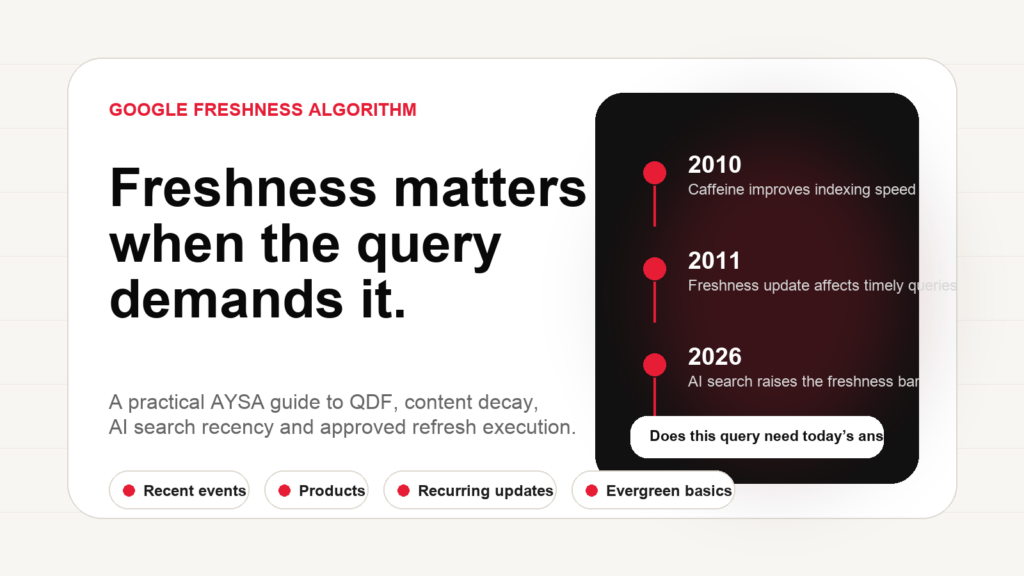
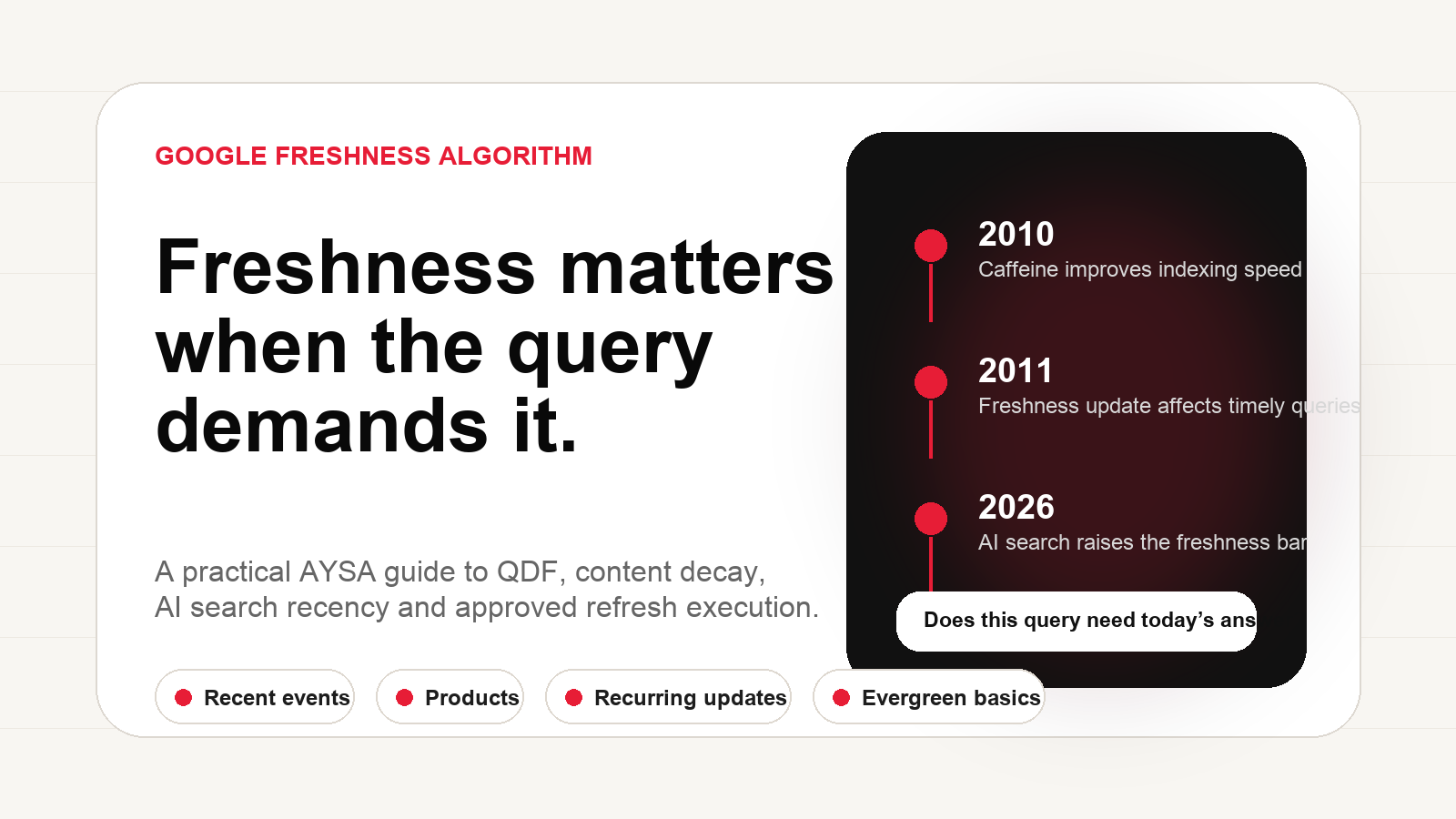
Google’s public freshness story has several milestones. In 2010, Google announced Caffeine, an Indexing system designed to help Google discover and index fresher web content faster. In 2011, Google announced a freshness update that it said would affect searches where more recent results were expected, including recent events, hot topics, recurring events and frequently updated information.
That history matters because freshness was never only about blog timestamps. It was about searcher satisfaction. Google wanted to better handle queries where time changes the correct answer. A result about an old election, an expired product deal, an outdated software interface or a previous algorithm update may be technically “content,” but it may not be useful for the current query.
In 2026, freshness has become even more important because AI-assisted search increases the value of current, structured and verifiable information. AI answers, AI Overviews, AI Mode and answer engines need content that is not only accessible, but also reliable enough to summarize. Outdated information can become a bad source. Missing context can become a weak citation. Unmaintained pages can be ignored.
Query deserves freshness: the idea business owners should understand
SEO people often use the phrase “query deserves freshness” to describe searches where recency changes user satisfaction. You do not need to memorize the acronym. You only need to ask: would a user be disappointed if this answer did not reflect the current moment?
Queries that often deserve freshness include:
- news, current events and breaking developments;
- recurring annual topics such as “best SEO tools 2026” or “Black Friday delivery deadlines”;
- technology and AI search topics that change quickly;
- prices, availability, shipping, offers and product comparisons;
- local recommendations where reviews, opening hours and services change;
- medical, legal or financial guidance where accuracy and recency are critical;
- Google algorithm updates, policy changes and platform documentation;
- event calendars, conferences and seasonal service pages.
Queries that are often more evergreen include basic definitions, historical explanations, stable tutorials and foundational concepts. These still need maintenance, but not because the date is old. They need maintenance when the explanation is wrong, incomplete, weak, poorly structured or no longer the best answer.
What not to do: fake freshness and content noise
The biggest mistake is treating freshness as a superficial signal. Changing the date without improving the page is not a strategy. Adding generic paragraphs to old content is not a strategy. Republishing the same article every year with “2026” in the title is not a strategy if the information does not change meaningfully.
Fake freshness creates several risks. It can disappoint users who expected current facts. It can create duplicate content if each year gets its own weak version. It can dilute internal links. It can waste crawl resources. It can make the brand look careless when screenshots, prices, policies or examples are obviously outdated.
Another mistake is over-updating evergreen pages. If a glossary definition is correct, concise and useful, you do not need to rewrite it every month. You may improve examples, add related terms, update internal links or add a better CTA, but the goal is quality, not cosmetic novelty.
Freshness should be earned by usefulness. A refreshed page should answer the user better than it did before.
Freshness for SEO, AEO, GEO and AI search
Freshness matters beyond classic organic rankings. In AEO and GEO, the content may be used as a source for direct answers, AI summaries, brand recommendations or comparison responses. That raises the bar for accuracy and clarity.
A stale page can fail in several ways. It may contain old screenshots. It may mention outdated tools. It may ignore new user questions. It may lack current examples. It may have broken external links. It may fail to reflect changes in Google documentation, product feeds, pricing, local availability or AI search behavior.
AI systems are not magic editors. They depend on accessible, structured and trustworthy information. If your page is outdated, vague or contradictory, it becomes harder to use as a reliable source. If your page is clear, current and well-linked, it becomes easier to extract, cite and recommend.
This is why content refresh in the AI era should include more than rewriting text. It should include entity clarity, structured data, internal links, examples, citations, author information, conversion paths and business context.
A practical freshness framework for SMEs
Here is a simple framework that business owners and marketing teams can actually use.
1. Classify the page by freshness sensitivity. Is it evergreen, seasonal, recurring, fast-changing, product-related, local, legal/medical/financial, or news-like?
2. Check performance signals. Look at Search Console impressions, clicks, CTR, average position, query changes, rankings and conversions. A page with declining CTR but stable impressions may need a title and meta refresh. A page with ranking loss may need deeper content and authority work.
3. Compare the current search result. Has the SERP changed? Are competitors using fresher examples, better tools, video, comparison tables, FAQs, local proof, product data or stronger expert commentary?
4. Update the answer, not only the date. Replace outdated facts, add current examples, improve structure, update screenshots, remove dead links, add internal links and strengthen the next step.
5. Improve answer readiness. Add concise definitions, comparison criteria, examples, summaries and clear sections that can be understood by both people and AI systems.
6. Approve and execute safely. Not every suggestion should be published blindly. Sensitive pages, commercial claims, medical content, pricing and technical changes need approval.
7. Monitor after publication. Track whether clicks, impressions, CTR, rankings, conversions and AI visibility signals improve. A refresh is a test, not a guarantee.
Bad freshness
Change the year, keep old facts, add filler, publish and hope Google rewards the timestamp.
Useful freshness
Identify freshness-sensitive queries, update the answer, improve proof and execute approved changes.
The AYSA view: freshness should be monitored and executed continuously
From the AYSA perspective, freshness is an execution problem. Most SMEs do not have a process for finding stale pages, deciding what matters, rewriting content, updating metadata, checking internal links, validating schema and monitoring results. They know content should be maintained, but the work falls between marketing, SEO, development and business operations.
AYSA can help by monitoring pages, search signals and AI visibility, identifying content decay and freshness opportunities, preparing updates, explaining the reason, asking for approval and executing accepted changes inside the website workflow.
This matters because freshness is not the same for every business. A florist needs seasonal pages, local delivery updates and event-based content. A clinic needs current doctors, services, appointment information and trust signals. An ecommerce store needs product feed consistency, category updates, comparison content and availability accuracy. A SaaS company needs updated feature pages, documentation, AI search explainers and competitive positioning.
In my opinion, the Freshness Algorithm teaches a larger lesson: Google rewards relevance to the current user need. Sometimes that requires recent content. Sometimes it requires timeless clarity. The job is to know the difference and execute accordingly.
Freshness is not a calendar task. It is an execution loop.
If your pages are getting old, AYSA can help decide what actually deserves an update.
AYSA monitors content decay, SEO and AI visibility signals, prepares refresh actions, asks for approval and executes accepted changes inside your website workflow.
Sources and further reading
This article was inspired by SEOpressor’s article on the Google Freshness Algorithm and cross-checked with Google’s historical announcements on Caffeine and Google Search Central: Google Discover and freshness signals, Google Search Central guidance on helpful content, and Google’s AI features optimization guide. The AYSA sections are our editorial and product perspective. We do not claim guaranteed rankings, guaranteed AI citations or guaranteed traffic recovery.
Continue the AI search topic inside AYSA.
Use these pages to connect the article with AI SEO tools, AI visibility monitoring, AI Overviews and approved website execution.
Turn this topic into a website action plan.
Use these AYSA hubs to move from reading to technical fixes, AI visibility monitoring, research, glossary context and approval-first SEO execution.

