
Google Says LLMs.txt Is “Fine.” Here’s What That Really Means For AI Search—and What Businesses Should Do Next
Google now says it’s “completely fine” to publish llms.txt and other AI-readable formats—even though Google ignores them. That small wording change is your cue to stop arguing about a file and start building an AI search operating system: clear canonical facts, content that’s easy to cite, technical structure that reduces ambiguity, and a workflow that actually ships improvements.

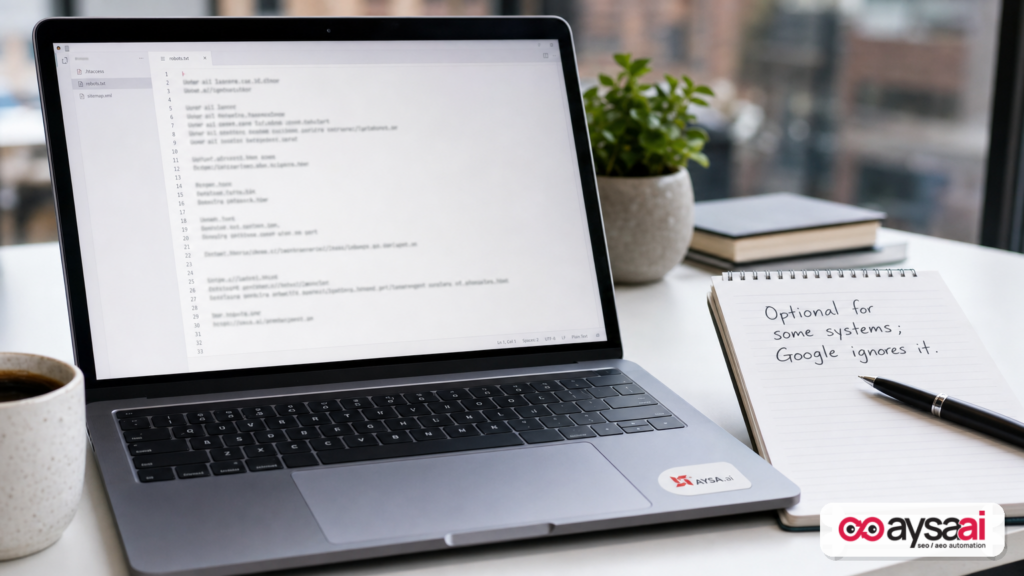
Google recently updated its public guidance to strike a more balanced tone about llms.txt, special markup, and markdown-style formatting for AI SEO. The core message, as covered by Search Engine Journal, is simple: Google Search ignores llms.txt—so it won’t help or hurt your Google visibility—but it’s “completely fine” to maintain these files for other systems that use them.
That’s a small edit that answers a big question I hear from business owners every week: “If we optimize for AI, will Google punish us?” Google’s updated wording is essentially: No. Not for this.
But if you stop there, you’ll miss the real story.
The real story is that AI Search isn’t one product and one set of rules. It’s a growing stack of discovery surfaces—some inside Google, some outside—where customers form opinions, compare options, and make decisions. Your job isn’t to win a debate about a text file. Your job is to build an AI search operating system for your business: canonical facts, citable content, technical clarity, and—most importantly—an execution workflow that ships improvements weekly, not quarterly.
I’m writing from the operator seat as Marius Dosinescu at AYSA.ai. Here’s my bias upfront: strategy is cheap. Execution is rare. In AI search, execution becomes the strategy.
Concise summary
- What changed: Google’s guidance now explicitly says it’s “fine” to maintain llms.txt (and similar files) for other AI services—even though Google ignores them.
- What didn’t change: llms.txt does not influence Google rankings or visibility because Google Search doesn’t use it.
- Why it matters: Google’s wording acknowledges multi-surface optimization: you may want to optimize for AI systems beyond Google, and that won’t inherently conflict with Google SEO.
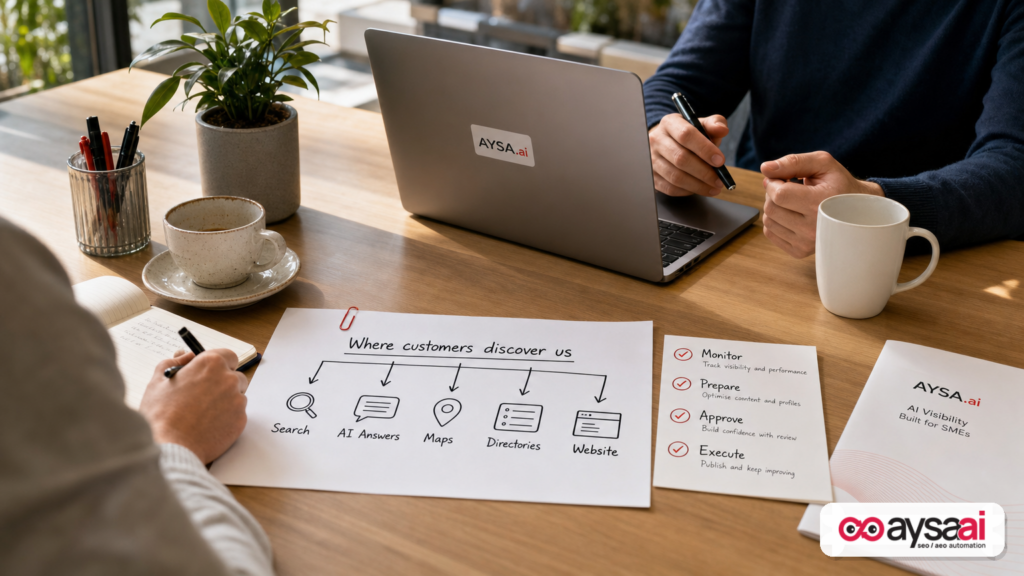
- What to do: Don’t start with a file. Start by fixing your “truth layer,” improving answerability, and building a monitor → approve → execute cadence.
- Where AYSA fits: AYSA monitors AI search visibility, prepares website changes, asks for approval, and executes accepted changes—closing the gap between recommendations and reality.
Table of contents
- What changed: Google’s updated stance on llms.txt (in plain English)
- Why this wording change matters more than it looks
- What llms.txt is—and what it is not
- AI search is multi-surface now (and your customers don’t care what we call it)
- How to think about Google’s generative AI features vs. “AI SEO” broadly
- Durable inputs that improve both SEO and AI visibility
- The “truth layer”: the real foundation of AI visibility
- Technical SEO for AI answerability (without gimmicks)
- Content SEO for AI answerability (what to publish, how to structure it)
- Local and multi-location: why AI gets your hours, insurance, and services wrong
- The execution gap: why most AI search “strategies” fail in the real world
- SME scenario: a multi-location clinic gets the “wrong answer” problem
- SME scenario: an ecommerce brand fights “AI comparison” leakage
- What agencies should rethink: deliverables vs. outcomes in AI search
- A practical 30/60/90-day action plan
- Where AYSA fits: monitoring + approved execution at AI speed
- What to do next (action list)
- Sources and further reading
What changed: Google’s updated stance on llms.txt (in plain English)

Google’s guidance used to read more discouragingly about llms.txt and other “special markup” approaches. The update clarifies scope and tone. The most important clarifications, as reported by SEJ, are:
- Scope clarification: Guidance about not needing special markup is specifically about Google Search (including its generative AI capabilities), not a universal statement about every AI product.
- Permission to support other systems: Google states it’s completely fine to create and maintain llms.txt (or similar files) for other services—while reiterating it will not affect Google Search because Google ignores them.
This matters because broad guidance gets turned into internal policy. One person quotes it to shut down any AI Optimization initiative; another quotes the opposite to justify busywork. Google tightened the language to reduce that “quote-out-of-context” damage.
My read: Google isn’t endorsing llms.txt as a ranking lever. Google is acknowledging reality: businesses operate in an ecosystem, not inside one product.
Why this wording change matters more than it looks
In isolation, “it’s fine” sounds like a shrug. In context, it’s an important signal for decision-makers.
1) It lowers the fear tax
SMEs and enterprises both carry a fear tax when Google guidance is ambiguous: “If we do X for AI, could it hurt us in Google?” A lot of teams default to paralysis because Google is still the largest source of demand for many categories. This update reduces that fear tax for llms.txt specifically.
2) It validates multi-surface optimization as a legitimate business activity
Google’s older, broader phrasing could be interpreted as “don’t bother with special files anywhere.” The new phrasing keeps Google’s position intact (Google ignores it) while acknowledging other surfaces exist and may be worth serving.
3) It forces a more grown-up conversation: “What are we optimizing for?”
AI search conversations often start with tactics (“Should we do llms.txt?”). That’s backward. The strategic question is: Where do our customers ask questions before they buy? Your optimization plan should follow that.
If your customers are heavy users of AI assistants, marketplaces, or discovery interfaces outside of classic search, then yes—serving those systems may be good business. But the “serve those systems” plan rarely begins and ends with a single file.
What llms.txt is—and what it is not
Let’s put llms.txt into the right category so you don’t over-invest or under-invest.
What it is (conceptually)
llms.txt is commonly discussed as a standardized, predictable file that can provide hints to large language model (LLM) systems about:
- which pages are most important,
- preferred canonical sources,
- how information is organized,
- and how to interpret or prioritize content.
Think of it like a “machine hint note” for certain AI systems—similar in spirit to how publishers used sitemaps to help crawlers discover URLs. But don’t confuse “discovering pages” with “choosing you as the answer.” Those are different problems.
What it is not (per Google)
Per the SEJ report, Google says Google Search ignores llms.txt. So it is not:
- a ranking factor for Google,
- a visibility boost for AI features within Google Search,
- or a penalty risk (Google says it won’t help or harm).
The temptation: “We need something we can ship this week”
In every major platform shift, teams reach for the fastest artifact they can ship:
- 2010s: “We need more pages.”
- Late 2010s: “We need schema everywhere.”
- Early 2020s: “We need Core Web Vitals fixes.”
- Now: “We need llms.txt.”
Artifacts can be useful. But artifacts become harmful when they substitute for fundamentals: consistent facts, clear page intent, strong internal structure, and content that answers real questions.
Here’s the decision rule I use with SMEs: If you can’t confidently say which customer questions you’re failing to answer today, don’t start by shipping a file. Start by understanding the gap.
AI search is multi-surface now (and your customers don’t care what we call it)
When marketers say “AI search,” they tend to mean one of three things:
- AI inside classic search engines (generative summaries, assistant-like features).
- AI assistants that answer directly without the classic 10 blue links mindset.
- AI-enhanced discovery across maps, apps, browsers, and vertical platforms.
Your customer does not care about these categories. They care about getting the right answer fast.
That’s why the real takeaway from Google’s update is not “do llms.txt.” The takeaway is: you’re optimizing across multiple surfaces, and you need a coherent operating approach.
At AYSA we frame this as AI visibility: what different systems say about your business, which sources they rely on, and how often they get key facts right or wrong. If you want the broader concept, start here: AI Search Visibility.
How to think about Google’s generative AI features vs. “AI SEO” broadly
Google’s updated guidance is explicitly about optimizing for generative AI features on Google Search, not about optimizing for every AI product. That distinction is crucial.
Here’s how I’d translate it for a business owner:
- “Google AI” optimization still relies on the same fundamentals: crawlable pages, clear intent, strong content, and technical hygiene.
- “Other AI systems” may adopt additional conventions (like llms.txt or markdown preferences). Serving those may be valuable—especially if those systems drive demand in your category.
The operational mistake is building two separate strategies that fight each other. The smarter move is building a single “truth layer” and content system that is useful everywhere—and then layering optional surface-specific artifacts only when they are:
- low cost to maintain,
- unlikely to create contradictions,
- and tied to a real distribution channel you care about.
Durable inputs that improve both SEO and AI visibility
If llms.txt doesn’t affect Google, what does? The same things that have always mattered—just with higher stakes for clarity and consistency.
Here are the durable inputs I’d prioritize for SMEs and mid-market brands because they compound across surfaces.
1) A website that reads like a source of truth, not a brochure
A lot of business websites are good at describing aspirations (“We’re the best.”) and weak at stating facts (“Here’s exactly what we do, for whom, where, and how.”). AI systems can’t cite vibes. They cite facts and definitions.
Make sure your site clearly answers:
- What services/products you offer (in plain language).
- What you don’t offer (reduces wrong leads and wrong AI summaries).
- Where you operate (addresses or service areas).
- Hours, response times, shipping times.
- Pricing ranges and what changes price (where possible).
- Policies: returns, cancellations, warranties, refunds.
- How to contact you and what to expect.
2) Content built around questions and decisions—not just keywords
Keyword research still matters. But AI answer systems emphasize resolution: the ability to confidently answer a question with minimal ambiguity.
So your content should include:
- “How it works” explanations.
- Comparisons (“X vs Y”).
- Eligibility and requirements (“Do I qualify?” “Is it covered?”).
- Constraints and caveats (“This is not recommended if…”).
- Step-by-step processes with clear sequencing.
3) Strong internal linking that teaches relationships
Internal links are not just navigation; they’re a map of meaning. If you want AI systems to understand what is primary vs. supporting, your Site architecture should reflect it.
Examples:
- Every Location page should link to the canonical “Insurance & Billing” policy page (if relevant).
- Every product category should link to sizing guides, care instructions, and shipping/returns pages.
- Every service page should link to pricing ranges, process explanations, and FAQs.
4) Pages designed for citation (citable blocks)
AI systems frequently summarize content in short “blocks”: definitions, steps, lists of criteria. You increase the odds of accurate citation when your content naturally contains those blocks.
Practical patterns that work for SMEs:
- Definition block: “A [service] is…”
- Process block: “Here’s what happens in a typical appointment/order…”
- Decision block: “Choose [option A] if…, choose [option B] if…”
- Policy block: “Refunds: … / Exchanges: … / Warranty: …”
5) Freshness as operations, not as marketing
Outdated information is now more dangerous because it can be amplified through AI summaries. Freshness isn’t “publish more blog posts.” It’s maintaining accuracy on the pages that matter.
Operationally, that means:
- assign page owners,
- set review cycles (monthly/quarterly depending on volatility),
- maintain a change log,
- and implement quick approvals for factual updates.
The “truth layer”: the real foundation of AI visibility
If you take one concept from this editorial, take this: AI visibility is a truth-layer problem before it’s a traffic problem.
The truth layer is the set of facts your business depends on for customers to choose you. For most SMEs, it includes:
- name/brand,
- locations and service areas,
- hours and holiday exceptions,
- phone numbers and contact methods,
- pricing anchors (even ranges),
- availability, turnaround times, shipping times,
- policies (returns, cancellations, eligibility),
- credentials and trust signals (licenses, guarantees, certifications—stated carefully and accurately).
When these facts are inconsistent across your website (or between your site and third-party directories), AI systems can produce incorrect summaries with high confidence.
And here’s the uncomfortable truth: you can’t out-optimize a contradiction. If one page says you’re open Saturdays and another says you’re closed, the AI may pick either. If one page includes an old phone number, that’s the number that will get cited. If your return policy exists only in a PDF, the AI may pull a less accurate summary from somewhere else.
This is why Google’s “it’s fine” matters less than the operational next step: get your truth layer tight. Then anything you do for other AI surfaces becomes safer and more effective.
Technical SEO for AI answerability (without gimmicks)
Let’s talk about what “technical” actually means in this era. Not “secret files.” Not “magic tags.” The basics that make your site easy to parse and hard to misunderstand.
1) Make key facts machine-readable (text, not images)
If your hours, pricing, insurance list, or product specifications are in images, sliders, or non-indexable widgets, you’re making extraction harder. Put critical facts in HTML text.
2) Keep one canonical version of policies
Businesses often duplicate policy content across:
- a footer “Returns” page,
- a help center article,
- a PDF,
- and an FAQ page.
That creates drift. Create one canonical page for each major policy and link to it everywhere. If you need versions for different audiences, make relationships explicit (for example, “Consumer returns” vs. “Wholesale returns”).
3) Strong information architecture beats “special formats”
AI systems and search engines both benefit when your pages are organized predictably:
- clear H2/H3 sections,
- consistent templates for locations/products/services,
- breadcrumbs and internal links that explain hierarchy,
- clean canonical URLs (avoid duplicates).
4) Use structured data where it clarifies meaning (don’t spam it)
The SEJ coverage mentions “special markup” broadly. The best practice is not “more markup.” It’s “markup that reflects reality.” If you add structured data, make sure it matches what’s visible on the page and what your business actually does.
Note: The supplied research context does not include Google’s official structured data documentation URLs, so I’m not linking them here to avoid guessing. If you add the exact Search Central links in WordPress, this section should cite them as primary sources.
5) Don’t break humans while trying to help machines
I’ve seen teams ruin conversion by rewriting pages into robotic “AI-friendly” blocks with no brand voice and no persuasion. Your site must still sell. The right approach is layering clarity into persuasive copy—tight definitions, clear steps, explicit policies—without removing human nuance.
Content SEO for AI answerability (what to publish, how to structure it)
Content is where most businesses either win or waste money in AI search.
The mistake: treating AI as a content factory
Many teams responded to AI by publishing more content faster. That created:
- redundant articles that compete with each other,
- thin pages that don’t resolve questions,
- inconsistent claims across posts,
- and a maintenance burden that grows every month.
If you publish 100 AI-generated posts, you haven’t built authority—you’ve built 100 things you now need to keep accurate.
The better approach: publish “decision content” tied to revenue
For SMEs, the best AI visibility gains come from content that maps to purchase decisions. Examples:
- Service business: “How much does [service] cost in [city]?” “How long does it take?” “What to expect?”
- Ecommerce: “Which model is best for [use case]?” “Sizing guide.” “Care instructions.” “Shipping to [region].”
- SaaS: “Pricing breakdown.” “Security overview.” “Implementation steps.” “Integrations.”
Structure your pages so AI can’t miss the answer
Here’s a structure I like for SME “money pages” (service/product/category pages). It’s simple, and it works:
- What it is (1–2 paragraph definition)
- Who it’s for (use cases, customer types)
- How it works (steps)
- What it costs (ranges, drivers)
- What’s included / not included (boundaries)
- FAQs (real questions from sales/support)
- Proof (process guarantees, credentials, testimonials—only if you can substantiate)
- Next step (CTA)
This doesn’t just help AI. It helps humans convert.
Local and multi-location: why AI gets your hours, insurance, and services wrong
Local businesses and multi-location brands are uniquely exposed to AI misinformation because they have more moving parts:
- multiple addresses,
- location-specific hours,
- different service menus by location,
- different staff/credentials,
- and sometimes different eligibility (insurance accepted, appointment types, etc.).
In classic SEO, the failure mode was “we don’t rank for ‘near me.’” In AI search, the failure mode becomes “we rank—but the AI answer says we’re closed” or “it says we don’t offer that service.” That’s worse than invisibility because it actively pushes customers away.
So for local/multi-location, prioritize:
- standardized location page templates with consistent fields,
- one canonical policy page for system-wide policies (and clearly marked location exceptions),
- location-specific FAQs (parking, access, appointment rules),
- clear service lists per location.
If you want to make this operational, you need monitoring. AYSA’s monitoring is designed for visibility and consistency workflows: AYSA Monitoring.
The execution gap: why most AI search “strategies” fail in the real world
Here’s the hard truth: most businesses don’t lose because they didn’t know what to do. They lose because they didn’t ship it.
AI search makes this worse because the feedback loop feels less direct. If your traffic dips, you might blame seasonality. If your leads drop, you might blame the economy. Meanwhile, AI summaries can quietly change how your business is represented.
The execution gap usually looks like this:
- Someone runs an audit and produces a list of recommendations.
- The list gets turned into tickets.
- Tickets get stuck in “needs approval” (brand, legal, ops, compliance).
- Dev backlog pushes changes out by months.
- By the time changes ship, the situation has changed.
That’s why I’m bullish on the “approved execution” model: changes get prepared, routed for approval, then shipped—fast. If you’re evaluating tools, evaluate the workflow, not the buzzwords. AYSA is built around that workflow. Start with the overview: AI SEO Tools.
SME scenario: a multi-location clinic gets the “wrong answer” problem
Let’s make this painfully practical.
Business: A regional clinic with 6 locations (physical therapy, urgent care, dental—take your pick). They’ve grown through acquisition, so each location has slightly different web pages and policies.
What customers ask AI:
- “Do they take my insurance?”
- “Are they open Saturday?”
- “Do I need an appointment?”
- “How much does a visit cost?”
What happens: One location page lists Saturday hours; another doesn’t. One location has a newer insurance list; another references a PDF from last year. The AI system summarizes: “They are closed on Saturdays” or “They don’t accept [insurance].” Now your phones don’t ring.
The wrong response: “We need llms.txt so the AI reads our site correctly.”
The right response: Treat it like an operations issue:
- Standardize location templates (required fields: hours, phone, address, services, appointment rules, insurance guidance).
- Move critical facts into crawlable text (not images/PDFs).
- Create a canonical “Insurance & Billing” page with per-location exceptions listed clearly.
- Ensure internal links connect every location to the canonical policy page.
- Set monitoring to detect when AI representations drift from the truth layer.
This is boring work. It also produces money. Because it reduces friction at the exact moment of decision.
SME scenario: an ecommerce brand fights “AI comparison” leakage
Now an ecommerce example, because this is where “AI answers with no click” becomes very real.
Business: A DTC brand selling premium skincare or supplements (regulated claims matter here, so accuracy is non-negotiable). They rely on category pages, product pages, and a few high-performing guides.
What customers ask AI:
- “What’s the best vitamin C serum for sensitive skin?”
- “Is [ingredient] safe during pregnancy?”
- “What’s the difference between [product A] and [product B]?”
- “What are the side effects?”
What goes wrong:
- Your product page is beautiful but light on plain-language explanation.
- Key details are buried under accordions or in images.
- You have five blog posts that each half-answer the same question.
- Return policy is clear to humans but not to machines (scattered across pages).
Outcome: AI answers cite a competitor that has a clearer comparison chart, a better “who it’s for” section, and a straightforward FAQ. You didn’t lose because they had more backlinks. You lost because they were easier to summarize accurately.
Fix: Build citable blocks on your product and category pages:
- “Best for” section (skin type/use case).
- “Not recommended for” section (with careful wording).
- Clear ingredient explanation and usage instructions.
- Comparison tables where appropriate (kept accurate and updated).
- Canonical policy pages (shipping/returns) linked prominently.
Again: not a file. A system.
What agencies should rethink: deliverables vs. outcomes in AI search
If you’re an agency—or you hire one—AI search changes what “good work” looks like.
Deliverables are easy to sell, hard to justify
In the AI era, the market is flooding with deliverables:
- “We’ll implement llms.txt.”
- “We’ll generate 200 AI articles.”
- “We’ll add schema to every page.”
- “We’ll do a GEO audit.”
Deliverables are tempting because they’re concrete. But the business doesn’t buy deliverables. The business buys outcomes: accurate representation, more qualified leads, more bookings, higher conversion, fewer wrong inquiries.
Outcomes require operational alignment
To deliver outcomes across AI surfaces, agencies have to integrate with execution:
- Who owns the truth layer?
- Who approves policy changes?
- Who updates templates across 200 location pages?
- Who ensures the new page doesn’t contradict an old PDF?
This is why I believe the next generation of SEO/AEO/GEO services will look like execution systems, not slide decks. AYSA’s approach—monitor, prepare, approve, execute—is built for this reality. If you want to see how we frame it, start at AYSA Blog.
A practical 30/60/90-day action plan
If you’re an SME or a marketing leader and you want to respond to Google’s updated guidance like an adult business, here’s the plan I’d run.
Days 1–30: Baseline + truth layer triage
- Inventory AI-critical pages: homepage, top service/product pages, location pages, pricing, shipping/returns, contact, policies.
- Find contradictions: hours, phone numbers, addresses, service lists, pricing claims, policy text.
- Choose your priority surfaces: Google Search generative features + the 1–2 other AI surfaces that matter most to your customers.
- Set monitoring: not only rankings—monitor how your brand and offerings are represented.
AYSA can support the monitoring and workflow foundation here: AYSA Monitoring.
Days 31–60: Build answerability into money pages
- Add citable blocks: definitions, steps, comparisons, and decision criteria.
- Publish FAQs that match real questions: sourced from sales calls, support tickets, and reviews.
- Make policies canonical: one returns page, one cancellations page, one warranty page—linked everywhere.
- Improve internal linking: ensure relationships are obvious (service → pricing → FAQ → contact).
For a broader view of how we think about AI visibility, see: AI Search Visibility.
Days 61–90: Turn it into a repeatable execution cadence
- Implement approvals: define who approves what (brand, legal, clinical, compliance, ops).
- Ship weekly: small changes compound; big projects stall.
- Create a maintenance map: which pages must be reviewed monthly, quarterly, and annually.
- Close the loop: monitoring insights should automatically create prepared change sets for approval.
This is where an execution system matters. AYSA is built to prepare changes and execute what you approve: AI SEO Tools.
Where (and when) llms.txt fits into this plan
Once your truth layer is consistent and your key pages are answerable, then—and only then—consider llms.txt as an optional artifact if:
- you have a specific non-Google surface that benefits from it,
- you can maintain it (ownership and update cadence),
- and it won’t become a second, conflicting source of truth.
Remember: per Google’s guidance reported by SEJ, llms.txt won’t change your Google visibility. Treat it as a compatibility file for other systems, not as “the new SEO.”
Where AYSA fits: monitoring + approved execution at AI speed
AI search changes the game in one key way: being wrong is worse than being invisible. The businesses that win won’t be the ones with the fanciest experiments. They’ll be the ones that maintain accurate, citable, up-to-date digital truth—and can ship improvements fast.
AYSA is built to operationalize that:
- Monitor: track AI search visibility and representation issues (not just classic rankings). Learn more about Monitoring.
- Prepare: turn insights into concrete website changes—content and technical—ready to review.
- Approve: you stay in control; this matters for regulated industries, brand voice, and pricing/policy accuracy.
- Execute: accepted changes get implemented so you don’t die in backlog.
If you want to evaluate whether this fits your organization, here are the practical entry points:
- AI Search Visibility (framework and outcomes)
- AI SEO Tools (what the system does)
- Pricing (how to get started)
- Blog (ongoing guidance and playbooks)
The point isn’t to “do AI SEO.” The point is to build an execution engine that keeps your business legible across every place customers ask questions.
What to do next (action list)
- Stop asking “Should we do llms.txt?” and ask “Where are we misrepresented today?” If you can’t answer that, your next step is baseline monitoring and truth-layer audit.
- Identify your AI-critical pages (usually 10–50 pages, not your whole site) and make them your first maintenance priority.
- Fix contradictions first (hours, pricing anchors, policies, service lists, eligibility). Contradictions create wrong answers.
- Add citable blocks to money pages (definitions, steps, comparisons, FAQs). Make it easy to summarize you accurately.
- Create one canonical version of each policy and link it everywhere. Don’t let your site drift into five versions of the truth.
- Build a weekly shipping cadence with approvals built in. AI search rewards teams that can update fast without losing control.
- If you still want llms.txt, treat it as an optional compatibility layer for non-Google systems after fundamentals are in place.
Sources and further reading
- Search Engine Journal: Google’s Updated Guidance Now Says It’s “Fine” To Use LLMs.txt For AI SEO
- Search Engine Journal: Latest News
- Search Engine Journal: SEO
- Search Engine Journal: On-Page SEO
- Search Engine Journal: Local SEO
Editorial note for AYSA publishing: The SEJ coverage references Google’s updated Search Central guidance. The official Google Search Central URL was not included in the supplied research context. To avoid guessing and accidentally linking the wrong primary source, I did not include a direct Google link here. If you add the exact URL in WordPress, it should be included as the primary citation in this section.
Final perspective: Google saying llms.txt is “fine” doesn’t mean it matters. It means you’re allowed to think bigger than Google without fear. The businesses that win won’t be the ones that ship the most AI artifacts. They’ll be the ones that keep their digital truth tight—and can execute improvements faster than the market shifts.
Continue the AI search topic inside AYSA.
Use these pages to connect the article with AI SEO tools, AI visibility monitoring, AI Overviews and approved website execution.
Turn this topic into a website action plan.
Use these AYSA hubs to move from reading to technical fixes, AI visibility monitoring, research, glossary context and approval-first SEO execution.

