
Google Spam Policies Now Apply to AI Answers: What SEO, AEO and SMEs Need to Understand
Google clarified that its spam policies apply to generative AI responses too. Here is what that means for SEO, AEO, AI visibility and safe website execution.
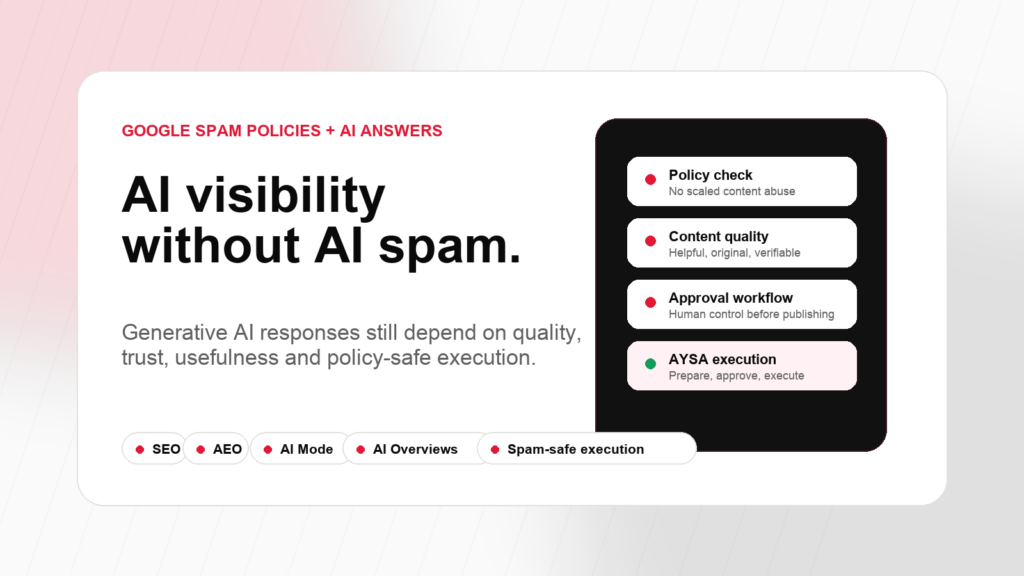
Short version: Google has clarified that its Search spam policies apply not only to classic blue-link search results, but also to generative AI experiences such as AI Overviews and AI Mode. That matters because many businesses are now trying to optimize for AI answers without understanding where useful optimization ends and spam begins.
In my opinion, this is one of the clearest signals that the future of SEO is not “publish more AI content faster.” The future belongs to websites that can prove expertise, answer real questions, keep technical foundations clean, and execute improvements continuously without turning the web into a machine-written landfill.
What changed
Search Engine Land reported that Google updated its wording around Search spam policies to make something explicit: those policies also apply to generative AI responses. In plain English, Google is saying that the rules used to protect Search quality do not stop at traditional listings. If a website tries to manipulate visibility in AI-generated search experiences with spammy tactics, those tactics can still be evaluated through Google’s spam framework.
This is an important clarification because AI search has created a new wave of tactical advice. Some of it is useful: make pages easier to understand, cite sources, answer questions clearly, improve technical accessibility, and build authority. But some of it is just the old spam playbook with an AI label: mass-generated pages, fabricated expertise, doorway content, parasite pages, fake reviews, misleading entities, synthetic citations, and scaled content that exists only to capture long-tail queries.
Google’s official Search spam policies already cover areas such as Cloaking, doorway abuse, hacked content, hidden text and links, Keyword Stuffing, Link Spam, scaled content abuse, scraping, sneaky redirects, site reputation abuse and thin affiliate pages. The AI clarification matters because it removes a convenient excuse: “we were optimizing for AI answers, not Google Search.” If the tactic is spammy, calling it AI Optimization does not make it safe.
Why this matters for SEO, AEO and AI visibility
For years, SEO was mostly discussed around rankings, clicks and pages. Then AI Overviews, AI Mode, answer engines and Generative search changed the interface. Users increasingly ask longer questions, compare options, request recommendations, and expect synthesized answers. The search experience is no longer only a list of links. But the underlying quality challenge is still very familiar: can a system trust, understand and use your website?
That is why the policy update matters. It tells serious businesses to stop treating AI visibility as a loophole. AI search does not remove the need for quality. It raises the cost of low-quality shortcuts. A page that wants to be useful in generative search has to be clear enough to retrieve, specific enough to cite, structured enough to parse, and trustworthy enough to recommend. That is not achieved by producing thousands of generic AI pages.
AEO and GEO are useful concepts when they describe better answers, clearer structure, stronger entity signals and better retrieval readiness. They become dangerous when they are used as camouflage for spam. The same page can be optimized for classic SEO, answer engines and AI search if it is genuinely useful. A page can also be spam in all three environments if it is created at scale with no real value.
The AI spam risk: old shortcuts with new packaging
The biggest risk I see is not that small businesses will use AI. AI is a tool. The real risk is that businesses will use AI to multiply weak decisions. If a company had poor SEO judgement before, AI can help it publish poor judgement faster.
Here are the patterns that worry me most:
- Mass pages with no real differentiation. Hundreds of near-identical city, service or comparison pages that change only a keyword, location or product name.
- AI-written expertise without real expertise. Medical, financial, legal or technical content that sounds confident but does not show real knowledge, review, context or accountability.
- Fake citation and source padding. Pages that mention sources or “research” but do not actually support the claim.
- Entity stuffing. Adding brand names, authors, locations and schema vocabulary without visible content that supports those entities.
- Programmatic content without editorial control. Automation that publishes before anyone checks whether the page is useful, accurate or safe.
- Link and authority shortcuts. Attempts to manufacture trust through irrelevant placements, hidden links, low-quality networks or misleading advertorials.
The irony is that many of these tactics are not new. AI only makes them cheaper and faster. Google’s clarification is a reminder that speed is not a defense. Scale is not a defense. Automation is not a defense. The question remains: does the page help users, and does it comply with Search quality expectations?
What safe AI visibility actually looks like
Safe AI visibility is not about tricking AI systems into mentioning you. It is about making your website a better source of truth. That includes classic SEO work, but it also includes answer-ready content, entity clarity and operational discipline.
A safe approach usually starts with the basics:
- Clear topical coverage: pages should answer the actual questions customers ask, not only target a keyword.
- Visible expertise: author information, business context, experience, examples, review process and source references should be clear where relevant.
- Technical accessibility: important content should be crawlable, indexable, fast and available in clean HTML.
- Structured information: headings, lists, tables, FAQs, definitions, schema and internal links should help both users and systems understand the page.
- Authority signals: legitimate mentions, useful references, consistent brand information and relevant publisher coverage matter more than generic link volume.
- Ongoing monitoring: AI visibility is not a one-time setup. Search interfaces, query patterns and competitor content change continuously.
Google’s own documentation about AI features and your website points website owners back to fundamentals: make content eligible for Google Search, use normal search controls, and follow Search Essentials. Google’s guidance on optimizing for generative AI experiences also reinforces that website owners should focus on useful, accessible, high-quality content rather than a separate trick-based system.
What this means for SMEs and non-SEO teams
For small and medium-sized businesses, this update should be seen as good news. It reduces the temptation to chase every new AI-search hack. Most SMEs do not need a complicated theory of “AI prompt visibility.” They need a reliable process that improves the website in ways that are useful for humans and understandable for search systems.
A private clinic, for example, does not need 500 AI-generated pages about every symptom in every city. It needs clear service pages, doctor information, appointment details, location data, pricing or process information where appropriate, review signals, patient-friendly explanations, medical review where needed, and content that helps people decide what to do next.
An ecommerce business does not need generic AI category text copied across hundreds of pages. It needs product clarity, useful category guidance, comparison information, internal links, schema, stock and delivery details, helpful reviews, return policy clarity, and content that answers objections before purchase.
A local service business does not need doorway pages for every possible neighborhood if those pages are thin and interchangeable. It needs real service-area information, proof, examples, reviews, photos, process clarity, Google Business Profile consistency and content that reflects actual operations.
The practical lesson is simple: AI visibility should be a byproduct of better website usefulness, not a separate spam layer.
Where AYSA fits: approved execution, not AI spam
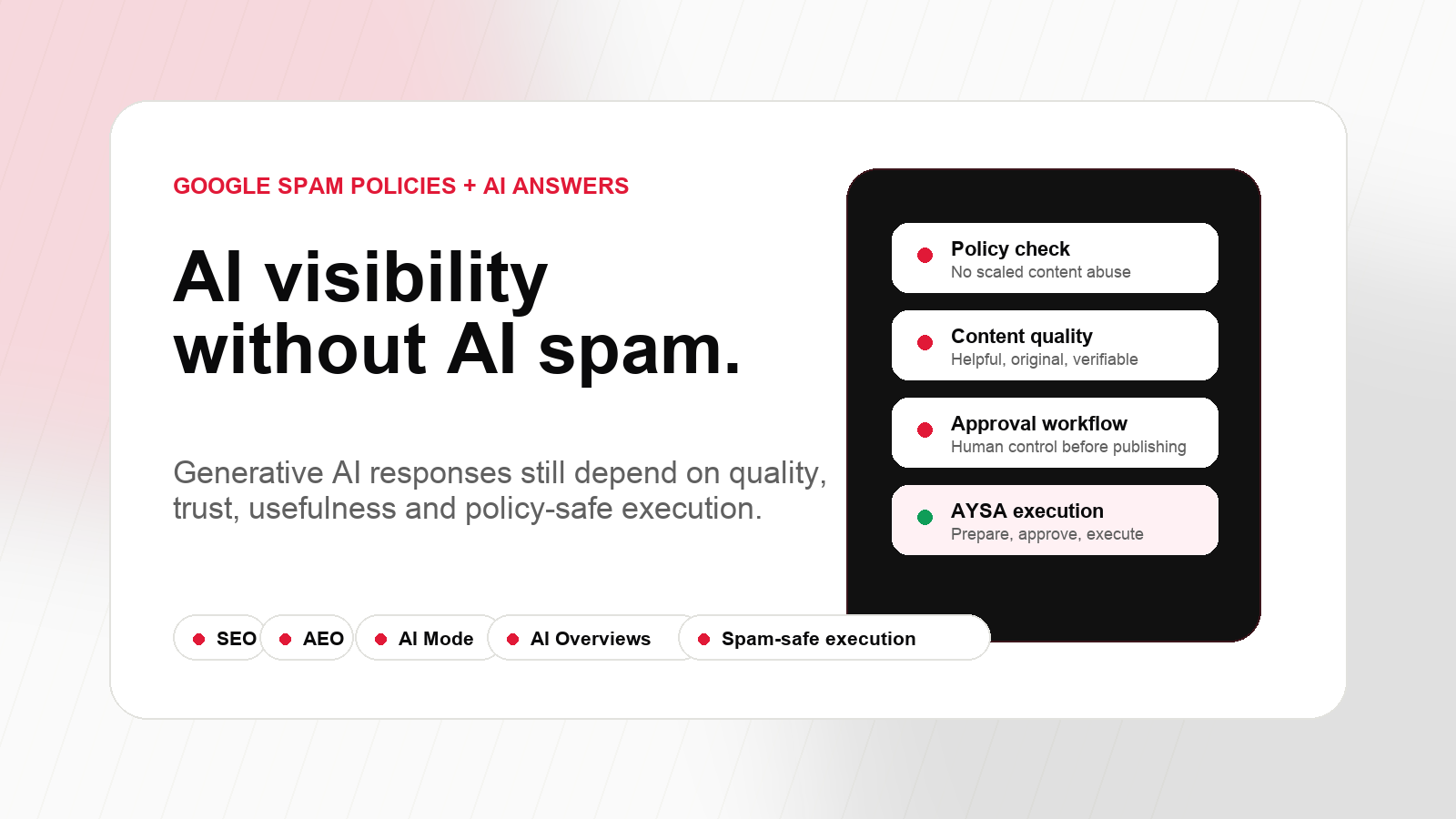
AYSA was built around a different idea from “generate more pages.” The core product principle is approved execution. AYSA monitors the website, understands business context, prepares SEO, AEO and AI visibility actions, asks for approval, and then executes accepted work inside the website workflow where integration is available.
That model matters because many SEO failures happen between diagnosis and implementation. A tool can show that a site has weak internal links, missing schema, duplicate titles, thin pages, crawl issues, weak category content or AI visibility gaps. But someone still has to decide what matters, prepare the right changes, review them and publish them safely.
In the context of Google’s AI spam clarification, the approval layer becomes even more important. Automation should not mean blind publishing. Automation should mean faster research, faster preparation, clearer recommendations, safer approvals and more consistent execution.
In my opinion, this is where the market is going: not from manual SEO to uncontrolled AI publishing, but from manual SEO to controlled AI operations. The winning systems will not be the ones that produce the most content. They will be the ones that improve the right pages, with the right context, under the right controls, at the right speed.
A practical checklist for policy-safe AI search work
If you are trying to prepare your website for AI Overviews, AI Mode, ChatGPT-style search, Perplexity, Gemini or other answer engines, start with this checklist:
- Do your important pages answer real customer questions better than generic competitors?
- Can a user quickly understand who the business is, what it offers, where it operates and why it should be trusted?
- Are important claims supported by visible evidence, sources, examples or experience?
- Are you avoiding mass-produced pages with near-identical content?
- Are generated drafts reviewed before publication?
- Does each page have a clear purpose, not just a keyword target?
- Are internal links helping users and crawlers understand topic relationships?
- Are schema and structured data consistent with visible content?
- Are you monitoring impressions, clicks, rankings, AI visibility signals and content decay over time?
- Do you have a process for approving changes before they go live?
The strongest SEO systems in 2026 will not ignore AI. But they will also not confuse AI with permission to spam. The right path is more disciplined: useful content, clean technical foundations, entity clarity, authority building, monitoring and approved execution.
AYSA perspective: Google’s update is a reminder that AI search does not remove the need for quality governance. It makes governance more important. If your SEO process cannot tell the difference between useful automation and spammy scaling, AI will amplify the problem.
Turn AI visibility work into approved website execution.
AYSA helps SMEs monitor SEO, AEO and AI visibility, prepare useful website actions, request approval and execute accepted changes without turning SEO into manual busywork.
Sources and further reading
- Search Engine Land: Google updates Search spam policies to clarify it applies to generative AI responses
- Google Search Central: Spam policies for Google web search
- Google Search Central: AI features and your website
- Google Search Central: Optimizing for generative AI experiences
- Google Search Central: Creating helpful, reliable, people-first content
Continue the AI search topic inside AYSA.
Use these pages to connect the article with AI SEO tools, AI visibility monitoring, AI Overviews and approved website execution.
Turn this topic into a website action plan.
Use these AYSA hubs to move from reading to technical fixes, AI visibility monitoring, research, glossary context and approval-first SEO execution.

