
FAQ Rich Results Are Gone. Do Questions, Schema and AEO Still Matter for AI Search?
FAQ rich results are gone, but customer questions, visible answers and answer-ready content still matter for SEO, AEO and AI search visibility.
What the new data suggests
Why questions still matter
The SME playbook
Where AYSA fits
A new Search Engine Journal article reported on fresh data around FAQ schema, AI search visibility and Google’s decision to remove FAQ rich results from Search. The headline is uncomfortable for many SEO teams: FAQ schema is no longer the easy SERP enhancement it once was, and early data does not prove that adding FAQ schema creates a reliable AI citation advantage.
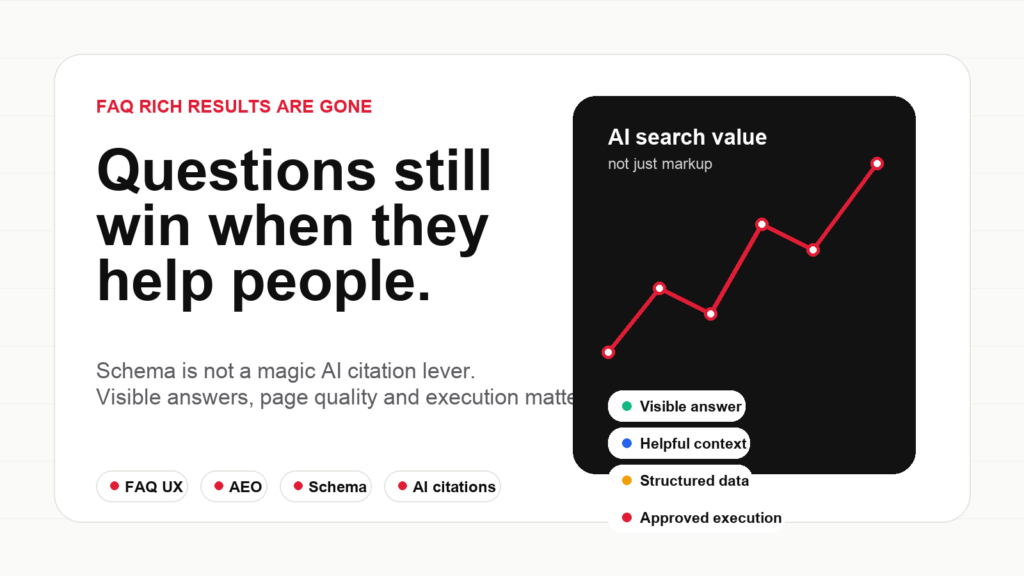
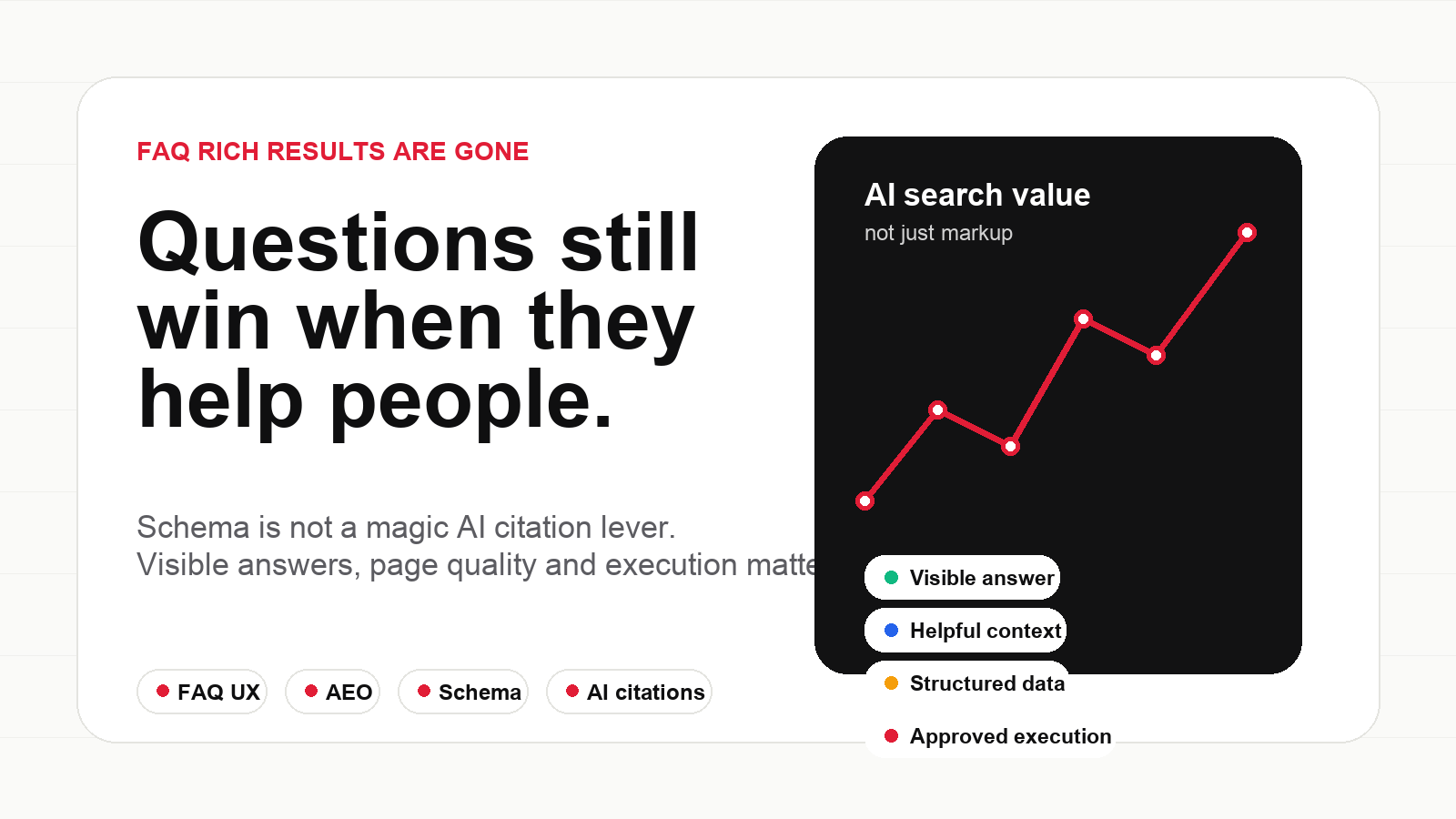
That sounds dramatic, but the practical conclusion is more useful than “FAQ is dead.” The better conclusion is this: questions and answers still matter, but they need to be part of visible, helpful, specific content. Markup should support the page. It should not be the page.
What happened
Google’s documentation now includes a warning that FAQ rich results are being removed from Google Search. That follows a longer trend: in 2023 Google already reduced FAQ rich results to a smaller set of authoritative health and government websites, and by 2026 the feature is being removed from the normal Search experience.
The official FAQ structured data documentation is therefore important reading. It does not mean every FAQ block on a website must disappear. It means site owners should stop treating FAQ markup as a guaranteed visibility tactic.
Search Engine Journal also cited new analysis that tested whether FAQ schema appears to influence AI search citations. The reported finding is cautious: schema alone did not show a clear, consistent citation lift. That is not surprising. AI-assisted search systems need useful, retrievable, trustworthy information. A JSON-LD block cannot turn a weak page into a valuable source.
What the new data suggests
The new conversation matters because many businesses have been told that AI search visibility can be solved with schema. Add FAQ schema. Add HowTo schema. Add entities. Add a file. Add some AI-friendly snippets. Wait for citations.
That is too simplistic. Schema can help search engines understand a page, but it is not a replacement for content quality, technical access, authority, brand clarity or topical coverage. Google’s broader guidance on optimizing for generative AI experiences points back to the same fundamentals: useful content, crawlability, snippets, structured data where relevant and Search policy compliance.
In other words, structured data is part of the signal stack, not the whole strategy. For AI search, the most important question is not “does this page have FAQ schema?” It is: does this page answer a real question better than competing sources, in a format that can be understood, trusted and cited?
Why questions still matter
Questions are still one of the most useful SEO assets because they reveal intent. A business owner may think in services and products. Customers think in problems, fears, comparisons, prices, timelines, risks and next steps.
A pediatric clinic does not only need a page saying “pediatric services Bucharest.” Parents ask different questions: When should recurring fever be urgent? Can I book online? Is parking easy? Is the clinic private? Are doctors child-friendly? Are reviews recent? What documents do I need? What happens after the consultation?
An ecommerce store does not only need category pages. Buyers ask: Which product is right for my situation? What is the difference between two options? What delivery time is realistic? Can I return it? What should I avoid? What accessories do I need? What happens if I choose the cheaper version?
These questions are valuable even without FAQ rich results. They improve the page for humans. They create natural sections. They support internal linking. They help sales. They make content more answer-ready. And yes, they can also make a page easier for AI-assisted systems to understand.
FAQ schema versus visible FAQ content
There is a big difference between visible FAQ content and FAQ schema. Visible FAQ content helps the user. FAQ schema helps machines interpret that content when it is eligible and supported. If the visible content is weak, duplicated or generic, the schema does not fix the core problem.
For most SMEs, the right sequence is:
- collect real customer questions;
- answer them in plain language;
- place the answers on the most relevant page;
- connect the answers to products, services, locations and next actions;
- use structured data only when it accurately represents visible content;
- monitor whether the page improves impressions, clicks, conversions and AI visibility.
This is especially important for AEO and GEO. Answer Engine Optimization is not “put a question mark in every heading.” It is the discipline of making answers clear, complete and useful. Generative Engine Optimization is not “write for robots.” It is making content easier to retrieve, synthesize and cite because it is specific, structured and credible.
The SME playbook after FAQ rich results
Small and medium-sized businesses should not remove all FAQ sections just because Google no longer shows FAQ rich results. That would be the wrong reaction. Instead, they should audit whether each FAQ actually helps the buyer.
Keep FAQs that answer real objections, clarify decisions, reduce support friction, improve trust or help the user choose. Remove FAQ blocks that exist only because an SEO checklist said “add FAQs.” Merge duplicate questions. Move important answers into the main body of the page when they are central to the decision. Add internal links where the answer naturally points to a deeper page.
For local businesses, FAQs can answer location, booking, pricing, parking, service area and trust questions. For ecommerce, they can answer product comparison, delivery, returns, sizing, compatibility and availability questions. For B2B services, they can answer onboarding, timeline, process, approval, reporting, support and pricing model questions.
The best FAQ content feels like a useful sales assistant, not like a schema plugin output.
What should happen to FAQPage markup?
Do not use FAQPage markup as a reflex. If Google no longer supports FAQ rich results in normal Search, the ROI of maintaining FAQ markup changes. But structured data still matters across other types: Organization, Article, BreadcrumbList, Product, LocalBusiness, Review where appropriate, and service-specific markup when aligned with visible content and policy.
For FAQPage specifically, the practical rule is simple: use it only when there is a real, visible FAQ section that helps users and when the implementation is clean. Do not add fake questions. Do not mark up content that users cannot see. Do not expect the markup to compensate for thin content.
Why AI search makes this more important, not less
AI-assisted search experiences can summarize information from multiple sources. That makes clarity more valuable. A page with clear questions, concise answers, supporting explanation, examples and proof is easier to interpret than a page that hides everything in marketing language.
However, AI search also raises the quality bar. If everyone can generate a generic FAQ, generic FAQs become less useful. The winning content will be specific to the business, market and customer journey.
That means the best question is not “how many FAQs should we add?” The best question is: “What would make this page the most useful answer for a real person making a decision?”
Where AYSA fits
AYSA is built for the work that happens after the report. It can help identify pages with weak answer coverage, missing customer questions, thin FAQ sections, schema opportunities, internal linking gaps and AI visibility issues. More importantly, AYSA can prepare improvements and ask for approval before execution.
For example, AYSA can detect that a service page receives impressions but does not answer buyer objections. It can prepare new visible FAQ sections, rewrite weak answers, connect the page to glossary terms, suggest schema only where appropriate and queue the approved changes for website execution.
That is the difference between “add FAQ schema” and “build an answer-ready page.” One is a markup tactic. The other is an operating system for better search visibility.
Practical checklist
- Do not delete useful FAQ content just because FAQ rich results are gone.
- Remove generic questions that do not help the user decide.
- Write answers from real customer questions, not from keyword tools alone.
- Put the most important answers in the main body of the page.
- Use FAQPage markup only when the FAQ is visible, useful and accurate.
- Connect FAQs to service pages, product pages, glossary terms and articles.
- Monitor Search Console data before and after content changes.
- Track AI visibility separately from classic rankings.
- Keep improving answers as customer behavior changes.
Final thought
FAQ rich results were useful while they lasted, but they were never the real asset. The real asset is understanding what customers ask before they trust, buy, book or contact you. That asset is still valuable in classic search, in AI Overviews, in AI Mode and in answer engines.
The businesses that win will not be the ones that keep chasing every markup trick. They will be the ones that turn real questions into useful pages, then keep those pages technically clean, semantically connected and continuously improved.
Turn real customer questions into approved website improvements.
AYSA monitors your website, prepares SEO, AEO and AI visibility actions, asks for approval and executes accepted changes inside your website workflow.
Sources and further reading
- Search Engine Journal: SERP FAQ removal and schema data
- Google Search Central: FAQPage structured data
- Google Search Central: Changes to HowTo and FAQ rich results
- Google Search Central: Guide to optimizing for generative AI experiences
- Google Search Central: Creating helpful, reliable, people-first content
Continue the AI search topic inside AYSA.
Use these pages to connect the article with AI SEO tools, AI visibility monitoring, AI Overviews and approved website execution.
Turn this topic into a website action plan.
Use these AYSA hubs to move from reading to technical fixes, AI visibility monitoring, research, glossary context and approval-first SEO execution.

