How to Measure AI Search Visibility: The KPIs That Matter When Clicks Disappear
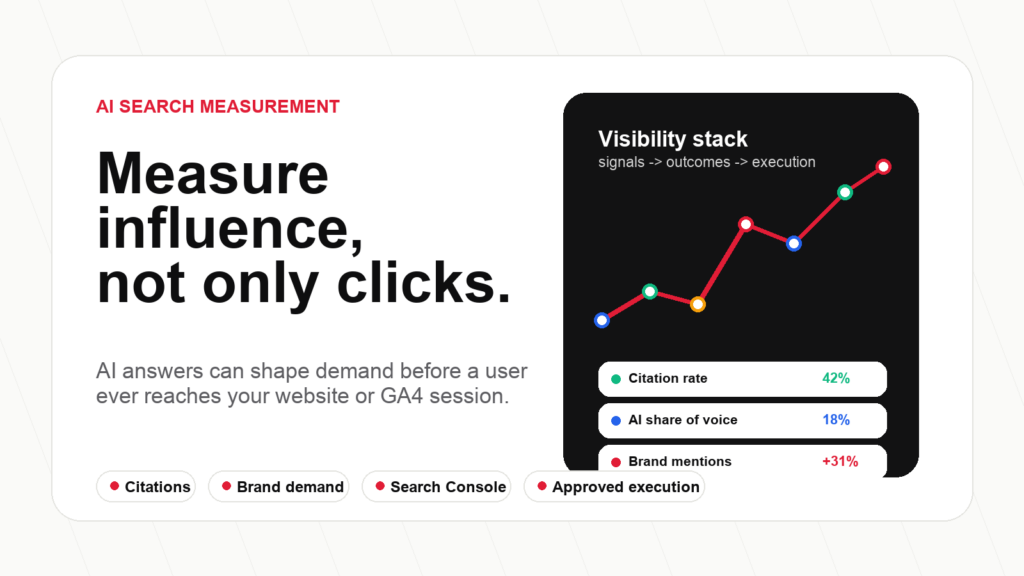
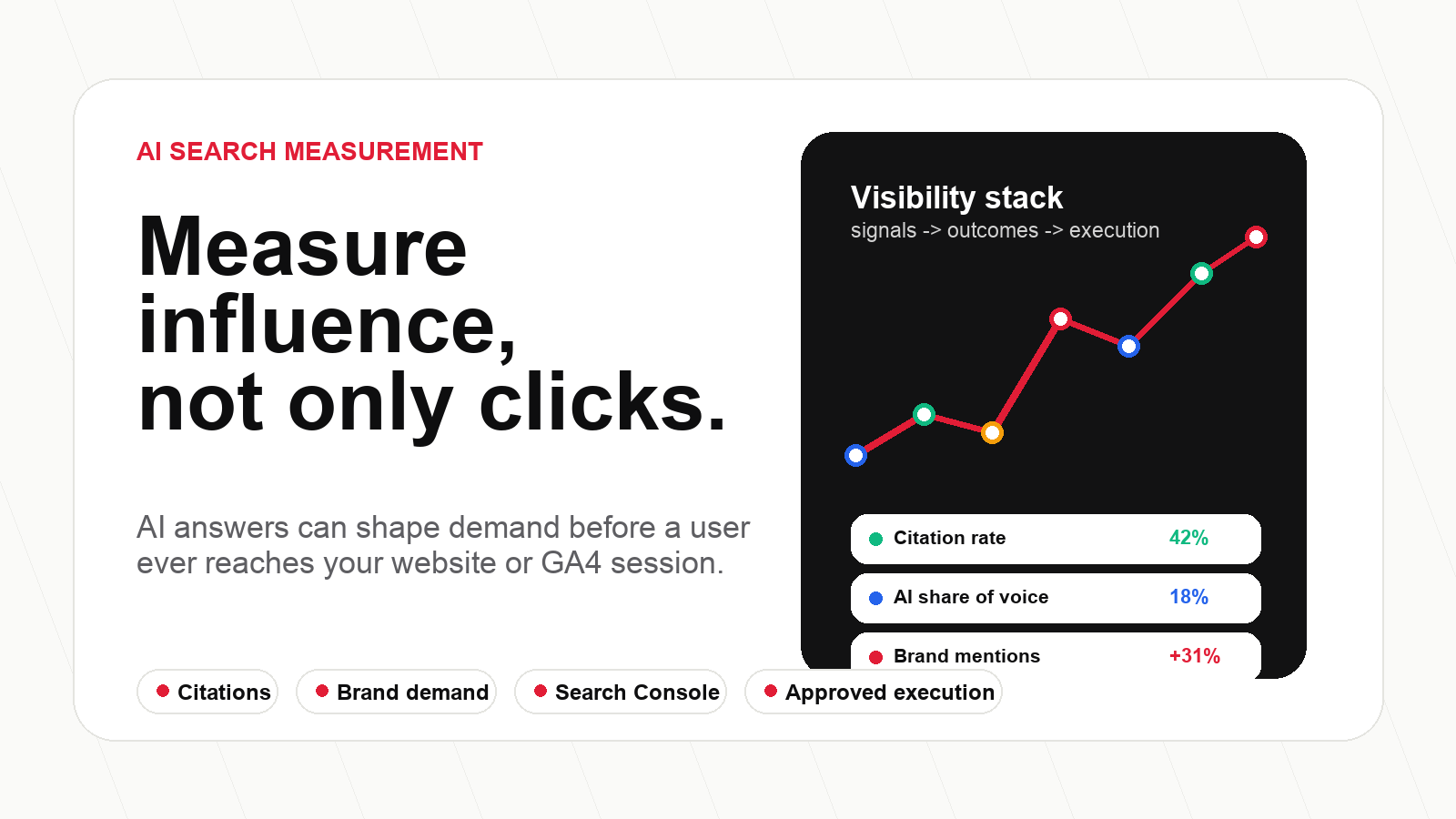
AI search measurement is not about replacing SEO KPIs. It is about adding an influence layer for citations, brand mentions, AI share of voice and approved execution.
Classic KPIs still matter
AI search KPIs
Business outcomes
Where AYSA fits
Search Engine Journal published a useful piece on how to measure AI search and the KPIs marketers need to know. The article lands on a problem every serious SEO team is now facing: AI search can influence decisions without producing the clean click path that analytics tools were built to measure.
A brand can be mentioned inside an AI answer. A product can be recommended. A clinic, SaaS product, ecommerce store or local business can be compared before the user ever visits the website. That influence may later appear as a Branded Search, direct visit, phone call, CRM lead, review, referral or sales conversation. In Google Analytics, it may look like nothing happened.
This does not mean classic SEO measurement is dead. It means classic SEO measurement is incomplete.
Why AI search breaks old attribution thinking
For years, SEO measurement was built around a relatively simple chain: the user searches, sees a result, clicks, lands on a website, and analytics records the session. That chain was never perfect, but it was usable. Search Console showed queries, impressions, clicks and Average position. Analytics showed sessions, engagement and conversions. Rank trackers filled in the rest.
AI-assisted search introduces a new layer. Google AI Overviews, AI Mode, ChatGPT Search, Perplexity, Gemini and other answer engines can summarize, compare and recommend without sending every user to the source immediately. Sometimes the user clicks. Sometimes the AI answer satisfies the need. Sometimes it creates brand awareness that converts later through another channel.
Google’s own documentation around AI features and websites reinforces that AI experiences are now part of how content may appear in Search. Google’s generative AI optimization guide also points site owners back to fundamentals: useful content, technical accessibility, snippets, structured data and Search policies.
The measurement implication is clear: if AI experiences influence discovery, comparison and trust, then measuring only last-click organic traffic will miss part of the value.
Classic SEO KPIs still matter
Before building an AI visibility dashboard, do not throw away the old foundation. Classic SEO KPIs still tell you whether your website is being crawled, indexed, shown, clicked and converted.
Search Console remains the primary source for Google Search performance. Important metrics include impressions, clicks, click-through rate and average position. These numbers are not perfect, but they are still the cleanest first-party view of how Google Search exposes your website.
Google Analytics remains useful for sessions, engagement, conversions and attribution modeling. Google’s documentation on attribution in Analytics is worth reading because AI search makes attribution even less linear. If a user discovers a brand through an AI answer and converts later through branded search, direct traffic or paid search, last-click reporting may undervalue the original visibility event.
The classic KPI layer should include:
- organic impressions by page and query;
- organic clicks and CTR;
- average position for important query groups;
- branded versus non-branded search demand;
- landing page engagement;
- organic conversions and assisted conversions;
- technical indexation and crawl health;
- content decay and pages losing impressions.
If these are broken, AI search measurement becomes a vanity exercise. You cannot interpret AI visibility properly if your canonical URLs are messy, your content is thin, or important pages are not indexable.
The AI search KPIs that matter
The new KPI layer should measure whether the brand, content and website are visible inside answer-style search experiences. The challenge is that the tooling is young and each AI platform behaves differently. That means the measurement model should be directional, repeatable and honest, not overclaimed.
1. AI mention frequency
This measures how often your brand appears in AI-generated answers for relevant prompts or query sets. For example, a pediatric clinic may want to know whether it appears in responses for “best private pediatric clinic in Bucharest with online booking.” A SaaS product may monitor “SEO automation software for WordPress” or “AI SEO execution agent.”
The important part is not only whether the brand appears. It is the context. Is the brand recommended, merely listed, compared, criticized, or absent?
2. Citation rate
Citation rate measures how often AI systems cite your website or pages as sources. This matters because a citation is stronger than a casual mention. It suggests the system found something useful enough to reference.
However, citation rate should not be treated as a guaranteed revenue proxy. A citation can be useful, irrelevant, neutral or even attached to the wrong context. The metric needs qualitative review.
3. AI share of voice
AI share of voice compares your visibility against competitors across a defined set of prompts. This is similar in spirit to SERP share of voice, but the unit is the answer surface rather than the ranking page.
For SMEs, this can be very revealing. A local business might rank decently in classic search but never appear in AI recommendations because its pages lack practical comparison data, service details, reviews, authority mentions or clear entity signals.
4. Source diversity
AI systems may use your own website, third-party articles, reviews, listings, publisher mentions, forums and business profiles. If the only source mentioning your business is your own homepage, your visibility may be fragile. If your brand is consistently described across your site, Google Business Profile, local citations, trusted articles and relevant publisher mentions, the entity picture becomes stronger.
5. Answer sentiment and accuracy
Visibility is not enough if the answer is wrong. AI answers may mention outdated prices, wrong service areas, old product details or incomplete positioning. Measuring AI search should include accuracy checks: what does the answer say about you, and is it correct?
6. Prompt coverage by customer journey
Do not track only one prompt. Track prompt sets by intent. Awareness prompts are different from comparison prompts. Local decision prompts are different from technical troubleshooting prompts. A business should monitor visibility across stages:
- problem discovery;
- education;
- comparison;
- local or service selection;
- purchase or booking intent;
- post-purchase support.
Zero-click influence KPIs
The hardest part of AI search measurement is the influence that happens without a click. This is where marketers need to look at adjacent signals instead of pretending everything can be directly attributed.
Useful proxy metrics include branded search growth, direct traffic changes, returning users, CRM source notes, sales call language, demo request quality, assisted conversions, newsletter signups, social mentions, review velocity and increases in branded plus category queries.
For example, if a business starts appearing more often in AI answers for comparison prompts, it may later see an increase in searches for “[brand] pricing,” “[brand] reviews,” “[brand] alternative,” or direct visits to important product pages. That is not perfect proof, but it is useful evidence when combined with other signals.
Connecting AI visibility to business outcomes
AI visibility metrics become meaningful only when connected to business outcomes. A dashboard saying “we were mentioned 43 times” is not enough. The better question is: did the visibility improve demand, trust, leads, sales, bookings, qualified pipeline or customer acquisition efficiency?
For larger companies, this may involve media mix modeling, incrementality testing and more advanced attribution. For SMEs, the model can be simpler but still disciplined:
- define the query or prompt clusters that matter;
- monitor AI visibility for those clusters;
- track branded search, direct traffic and conversion changes;
- record customer self-reported source data;
- compare changes before and after content or authority improvements;
- separate directional insight from hard financial proof.
The key is honesty. AI search measurement is not yet as clean as paid search conversion tracking. It should be treated as an influence layer, not as a perfect attribution system.
What not to measure as a vanity metric
Some AI search metrics can become misleading if used badly. Do not celebrate every mention. Do not optimize for prompts nobody would use. Do not chase citations on irrelevant topics. Do not count appearances where the brand is mentioned negatively or inaccurately. Do not build reporting that looks impressive but does not lead to action.
The best KPI is the one that changes what you do next.
Where AYSA fits
AYSA is not only a reporting layer. The product direction is an execution system for SEO, AEO, GEO and AI visibility. That matters because AI search measurement creates a new operational problem: once you know where visibility is weak, who does the work?
AYSA can monitor website performance, Search Console signals, technical health, content gaps, AI visibility opportunities and authority-building needs. Then it can prepare concrete actions: rewrite weak sections, add answer-ready content, improve internal links, propose schema where appropriate, identify missing topic coverage, surface authority opportunities and explain why each action matters.
The user stays in control. AYSA asks for approval before important changes. After approval, the system can execute accepted improvements inside the website workflow instead of leaving the business owner with a dashboard and a to-do list.
A practical KPI model for SMEs
For a small or medium-sized business, I would start with a compact model instead of trying to measure everything at once.
Visibility layer
- AI mention frequency for priority prompts;
- citation rate for important pages;
- AI share of voice against 3 to 5 competitors;
- accuracy and sentiment of answers;
- topic coverage gaps.
Search demand layer
- branded search impressions;
- non-branded impressions by topic;
- CTR changes on pages affected by AI answers;
- queries where impressions rise but clicks fall;
- pages losing visibility after SERP or AI feature changes.
Business layer
- qualified leads;
- bookings or demos;
- direct traffic to high-intent pages;
- CRM source notes;
- conversion rate by landing page;
- revenue or pipeline where measurable.
Execution layer
- opportunities detected;
- actions prepared;
- actions approved;
- actions executed;
- pages improved;
- impact after execution.
This last layer is missing from many AI visibility conversations. Businesses do not grow because a report exists. They grow because the right work gets done.
Final thought
AI search measurement is still evolving. Some numbers will be directional. Some platforms will change. Some tools will overclaim. But the direction is obvious: search visibility is no longer only a ranking page. It is a mix of classic search, AI answers, citations, brand mentions, entity signals and off-site proof.
The companies that win will not be the ones that obsess over one shiny AI metric. They will be the ones that connect measurement to execution. Monitor the signals, understand the gaps, prepare the work, approve the right changes and keep improving.
Turn AI search visibility into approved website action.
AYSA monitors SEO, AEO and AI visibility, prepares improvements, asks for approval and executes accepted changes inside your website workflow.
Sources and further reading
- Search Engine Journal: How to measure AI search
- Google Search Central: AI features and your website
- Google Search Central: Guide to optimizing for generative AI experiences
- Google Search Console Help: Performance report
- Google Analytics Help: Attribution
Continue the AI search topic inside AYSA.
Use these pages to connect the article with AI SEO tools, AI visibility monitoring, AI Overviews and approved website execution.
Turn this topic into a website action plan.
Use these AYSA hubs to move from reading to technical fixes, AI visibility monitoring, research, glossary context and approval-first SEO execution.