GA4 Now Tracks AI Assistant Traffic. FAQ Results Are Gone. What This Means for SEO Measurement
GA4 is starting to surface AI Assistant traffic while FAQ rich results disappear. Here is what this means for SEO measurement, AI visibility and approved execution.
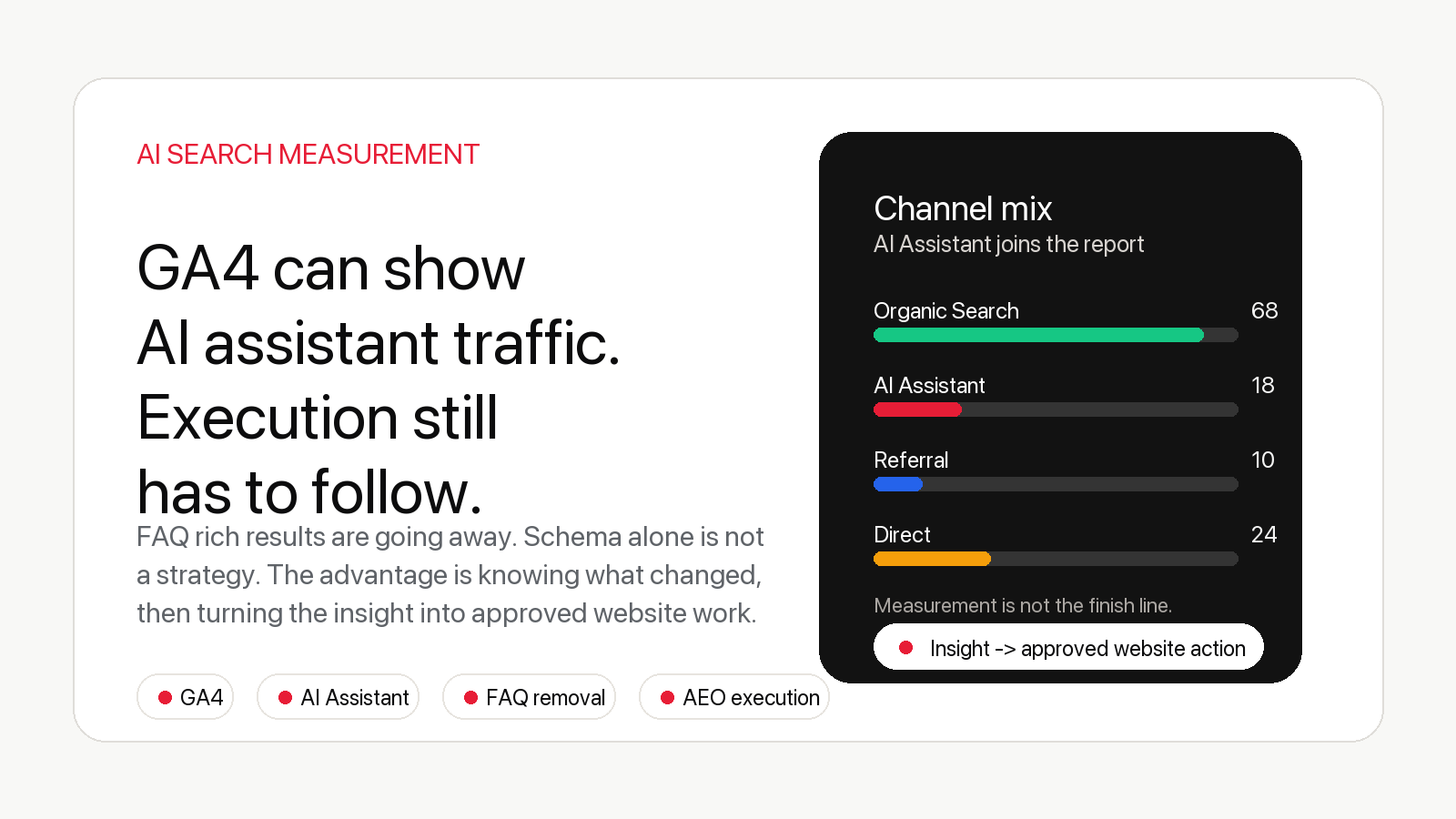
Executive summary: The latest SEO Pulse from Search Engine Journal connects three signals that should matter to every marketer and business owner: Google Analytics 4 is beginning to separate AI Assistant traffic, Google is removing FAQ Rich results from Search, and new data suggests that schema alone is not a reliable shortcut to AI citations.
My view is simple: measurement is catching up, but execution is still the hard part. Seeing AI assistant visits in GA4 is useful. Losing FAQ rich results is important. Understanding schema limits is necessary. But none of those changes grow a business unless the website team can decide what to improve, approve the work and publish better pages. This is where AYSA’s operating model matters: monitor, prepare, approve, execute.

What changed
Search Engine Journal’s latest SEO Pulse is interesting because it is not about one isolated update. It brings together a set of changes that point in the same direction: search is becoming more conversational, AI-influenced journeys are becoming easier to measure, and old SERP tactics are losing value.
The article highlights that Google Analytics 4 is adding AI Assistant as a default channel group, that FAQ rich results are no longer appearing in Google Search, and that Schema markup should not be treated as a guaranteed way to win AI citations. Those three ideas belong in the same conversation because they describe a shift from decorative SEO to operational SEO.
For years, many SEO conversations were built around visibility objects: rankings, snippets, FAQ rich results, star ratings, blue links, impressions and click-through rate. Those still matter, but they no longer tell the whole story. Users can discover a brand through classic search, AI Overviews, AI Mode, ChatGPT, Perplexity, Gemini, social posts, YouTube, comparison pages, Google Business Profile, Reddit, newsletters and direct recommendations. The measurement layer has to catch up with that reality.
But measurement is not the finish line. A dashboard can tell you that a new source of traffic exists. It cannot automatically fix a weak page, clarify a service, improve internal links, update content, add missing comparison criteria, repair technical SEO or prepare an authority-building action. That gap between visibility and execution is where most SMEs lose time.
GA4 and AI Assistant traffic: useful, but not complete
Search Engine Journal reported separately that Google Analytics 4 is adding AI Assistant as a default channel group. For marketers, this is a meaningful change because it gives AI-assisted visits a clearer place in reporting instead of burying everything under broad referral or unassigned categories.
This should help teams answer a practical question: are people arriving from AI assistants, and how does that traffic behave compared with organic search, referral, direct, paid and social? If the channel is visible, teams can look at engaged sessions, conversions, landing pages, assisted journeys and content that attracts AI-influenced visitors.
However, this does not mean AI search measurement is solved. A large part of AI influence may still be invisible in analytics. Some users read an answer and do not click. Some discover the brand in an AI answer and later search the brand directly. Some compare vendors in an AI assistant and then arrive through paid search, organic search or direct. Some AI platforms may not pass referral information consistently. Some traffic can still be unattributed or misclassified depending on browser, app and privacy behavior.
Google’s own Analytics documentation is useful here because it reminds us that channel grouping and attribution are models. They help organize traffic, but they do not capture every causal influence. The practical implication is that SEO teams should not replace one simplistic KPI with another. “AI Assistant sessions” will be useful, but it should sit beside Search Console data, brand search movement, conversion paths, content performance, AI visibility monitoring, referral analysis and business outcomes.
For SMEs, this is especially important. A business owner should not be forced to understand every attribution nuance. The business needs a simpler answer: are we becoming easier to find, understand, trust and choose? If the answer is no, the next step is not another report. The next step is website work.
FAQ rich results are gone, but useful questions are not dead
The second signal is the removal of FAQ rich results from Google Search. Google’s FAQPage structured data documentation now includes a prominent deprecation notice explaining that FAQ rich results are no longer appearing in Google Search, with broader support removal planned. That is a big moment because many websites treated FAQ schema as a visibility lever.
The wrong conclusion would be: “FAQs do not matter anymore.” The better conclusion is: “FAQs should stop being a SERP decoration tactic and return to being a user usefulness tactic.”
A good FAQ block can still help users make decisions. It can clarify pricing, delivery, booking, service scope, returns, medical preparation, product compatibility, shipping, cancellation rules, support response time or implementation process. It can reduce friction. It can improve conversion. It can make content easier to scan. It can help answer engines understand the page. It can support internal linking. It can strengthen a page’s topical coverage.
What disappears is the easy reward of occupying more SERP space through FAQ rich result expansion. That matters because some sites created thin FAQ sections mostly for rich result eligibility. If the visible reward is gone, the content has to justify itself on the page.
This is a healthy direction. Search should not reward markup that adds little value to the user. In the AI search era, answer-ready content matters, but it needs to be visible, accurate and genuinely useful. A page about a private pediatric clinic should answer the parent’s real questions: when to call, what symptoms are urgent, how appointments work, how parking works, what documents are needed, which doctors are available, whether online booking exists and what the clinic can realistically handle. A generic FAQ block is not enough.
Schema is support, not magic
The third signal is the growing evidence that schema markup alone does not create AI visibility. This should not surprise technical SEOs, but it is worth repeating because the market often wants easy answers. Schema can help search engines understand page information when it matches visible content and follows guidelines. It can support eligibility for certain rich results where those results still exist. It can make entities, products, organizations, breadcrumbs, articles and local business information clearer.
But schema is not a substitute for a useful page. It is not a guarantee of rankings. It is not a guarantee of citations in AI Overviews, AI Mode or third-party answer engines. It is not a way to make weak content authoritative.
Google’s generative AI optimization guide points back to fundamentals: helpful content, crawlability, indexability, page experience, semantic clarity, accessible pages, images and videos where useful, accurate business information, and alignment with Search policies. Structured data is part of the toolkit, not the whole strategy.
For a business owner, the practical rule is this: if the information is important enough to mark up, it should probably be visible and useful to humans too. Do not hide the value in JSON-LD and expect machines to save the page. Put the value on the page. Then use structured data to support clarity where appropriate.
What changed
AI Assistant traffic becomes more visible, FAQ rich results fade, and schema stops being treated as a shortcut.
What should happen next
The new measurement model: not one dashboard, but a visibility system
The measurement model for SEO is changing. It is no longer enough to ask: “Where do we rank for this keyword?” That question still matters, but it is only one layer. Teams now need to ask several connected questions.
Are our important pages being discovered? Search Console remains essential for impressions, clicks, average position, queries and landing pages. It tells us how Google Search exposes the website across classic results and many Search features.
Are AI-assisted visits appearing in analytics? GA4’s AI Assistant channel can help teams detect visits that arrive from AI assistants, compare quality and watch for conversion patterns.
Are users getting answers without clicking? This is harder. Zero-click influence, AI answers and brand discovery may affect branded search, direct visits, assisted conversions and offline behavior before analytics records a session.
Are our pages strong enough to be used as sources? This is where content quality, entity clarity, page experience, authority, internal links, structured information and topic coverage matter.
Are insights becoming website improvements? This is the operational question. If the answer is no, measurement becomes theater. You can know that AI traffic exists and still fail to improve the website.
The best SEO reporting in 2026 will combine data and action. It will not only show charts. It will answer: what changed, what does it mean, what should we do, what needs approval, what can be executed, and what happened after publishing?
What SMEs and non-SEO teams should do now
For small and medium-sized businesses, the temptation is to chase every new SEO headline. That usually creates confusion. A more practical path is to build a simple operating loop.
First, tag and measure properly. Make sure GA4, Search Console and conversion tracking are correctly configured. If AI Assistant traffic becomes visible in GA4, track it, but do not treat it as the only AI visibility KPI.
Second, review important landing pages. Look at pages that get impressions, clicks, conversions, AI-influenced visits or brand demand. Ask whether they answer the real user need better than competitors.
Third, stop using FAQs as decoration. Keep FAQs where they help users. Remove thin questions that exist only for old rich result tactics. Turn real customer objections into useful answers.
Fourth, use schema responsibly. Keep structured data accurate, guideline-compliant and aligned with visible content. Do not expect markup to compensate for weak pages.
Fifth, connect measurement to execution. Every insight should have a next step: improve content, add missing information, fix internal links, update schema, repair a technical issue, strengthen topical coverage or clarify a commercial page.
This last step is where many SMEs struggle. They do not lack dashboards. They lack time, prioritization and implementation capacity.
Where AYSA fits: from AI measurement to approved website work
AYSA is designed around the idea that SEO should not stop at reporting. When AI Assistant traffic appears in GA4, AYSA can help a business understand what pages are involved and what actions might improve them. When FAQ rich results disappear, AYSA can help decide which question blocks still serve users and which should be rewritten or removed. When schema is present, AYSA can help check whether it matches visible content and whether the page itself is useful enough.
The important part is the execution model. AYSA monitors the website, prepares SEO, AEO and AI visibility actions, explains why they matter, asks for approval and executes accepted changes inside the website workflow. That is different from giving a business owner another spreadsheet.
For non-SEO users, this is the real value. They do not need to become experts in channel grouping, FAQ deprecation, JSON-LD, AI citations, Search Console filters and conversion attribution. They need the system to translate signals into clear actions and let them approve the important changes.
My opinion is that AI search will punish passive SEO teams. Not because every old tactic disappears overnight, but because the volume of signals, surfaces and required updates is too high for manual dashboard-watching. The companies that win will build an operating system for visibility: monitor, decide, approve, execute, measure and repeat.
That is the promise behind AYSA: less SEO work for the business owner, more consistent organic growth work happening inside the website.
Less SEO work. More organic growth.
Turn AI search measurement into approved website execution.
AYSA helps SMEs monitor SEO, AEO and AI visibility signals, prepare useful website actions, request approval and execute accepted changes without turning SEO into manual busywork.
Sources and further reading
- Search Engine Journal: SEO Pulse covering GA4 AI Assistant traffic and FAQ results
- Search Engine Journal: Google Analytics adds AI Assistant as a default channel group
- Google Analytics Help: attribution and channel grouping
- Google Search Console Help: Performance report
- Google Search Central: FAQPage structured data documentation
- Google Search Central: optimizing for generative AI features
- Google Search Central: AI features and your website
Continue the AI search topic inside AYSA.
Use these pages to connect the article with AI SEO tools, AI visibility monitoring, AI Overviews and approved website execution.
Turn this topic into a website action plan.
Use these AYSA hubs to move from reading to technical fixes, AI visibility monitoring, research, glossary context and approval-first SEO execution.