
Google’s Generative AI Optimization Guide: What It Means for SEO, AEO, GEO and SMEs
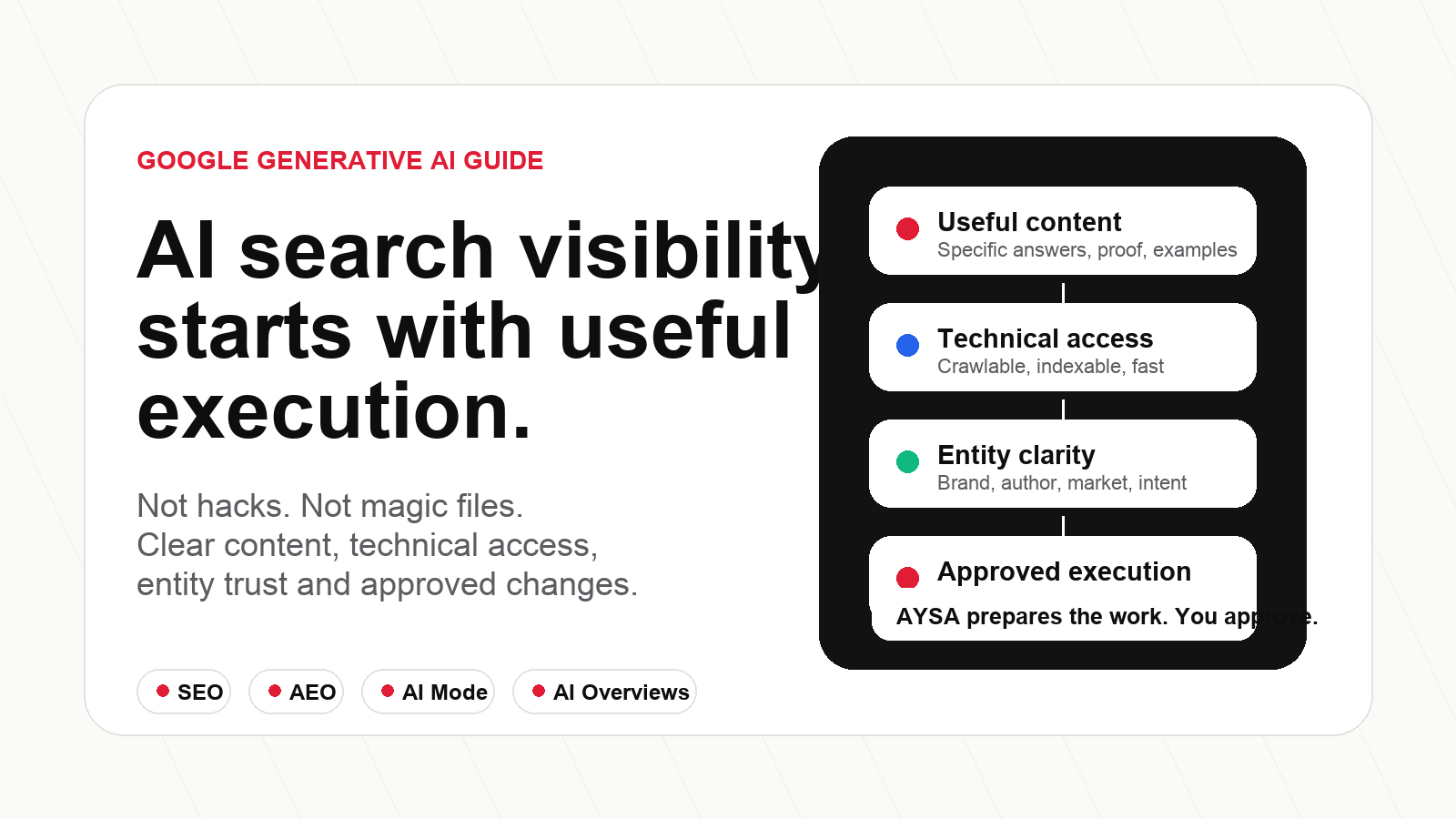
Google’s official generative AI optimization guide confirms that AI search visibility starts with useful content, technical access, entity clarity and safe execution.
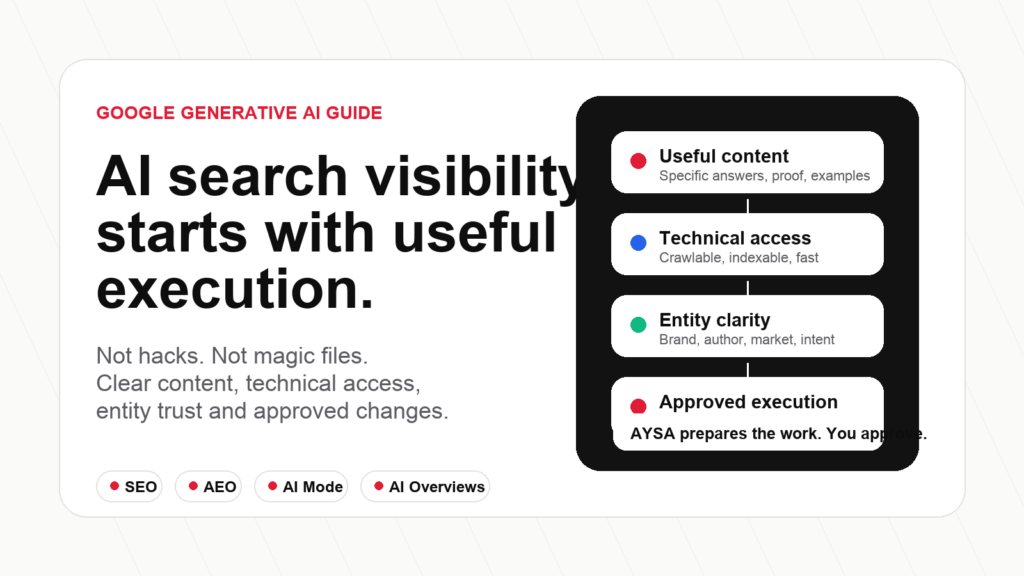
Google published a guide to optimizing for generative AI experiences, and it is one of the clearest documents so far for businesses trying to understand SEO in the age of AI Overviews, AI Mode and answer-style search.
The most important message is not dramatic. Google is not saying that every business needs to abandon classic SEO and start gaming language models. The guide says the opposite: the same fundamentals that make a website useful and accessible to Google Search also matter for generative AI experiences. The difference is that AI surfaces make weak content, unclear entities and technical mess easier to expose.
In my opinion, this is good news for small and medium-sized businesses. It means the path forward is not “learn 50 new acronyms and chase every AI hack.” The path is to build a cleaner, more useful, better structured website, monitor how search behavior changes, and execute improvements consistently. That is hard work, but it is not mystical work.
What Google actually says
The official Google guide explains how site owners can make their content eligible and useful for generative AI experiences in Search. It references the same foundations that have mattered for years: Crawlability, Indexability, helpful content, snippets, Structured data and Search Console measurement.
That matters because many businesses have been sold a fantasy version of AI Search Optimization. The fantasy says that there is a new isolated channel called AEO or GEO that can be solved with a file, a prompt, a trick, a schema shortcut or a few “LLM-friendly” paragraphs. Google’s guidance is much calmer. Your website still needs to be accessible, technically sound and genuinely helpful.
The guide also connects generative AI visibility to Google’s broader documentation on AI features and your website, creating helpful, reliable, people-first content and Google Search spam policies. That combination is important: eligibility, usefulness and policy safety now belong in the same conversation.
What changed in AI search
Classic search usually returns a list of results. AI-assisted search can summarize, compare, synthesize and cite. That changes the way a business should think about content. It is no longer enough to publish a page that technically contains the keyword. The page needs to answer the query clearly, support the answer with real context, and make the business easy to understand.
For example, a page about a pediatric clinic should not be a thin service page with “best pediatric clinic” repeated five times. It should help a parent understand available services, booking options, parking, emergency boundaries, doctor credentials, opening hours, location, reviews, prices where possible and what to do next. A page about a technical SEO audit should not only define the term. It should explain what is checked, why it matters, what risks exist, which fixes can be automated, and what requires human approval.
This is where SEO, AEO and GEO start to overlap. SEO still covers rankings, crawling, links, content and technical health. AEO focuses on answer readiness: clear questions, direct answers, structured explanations and entity clarity. GEO focuses on whether content can be retrieved, synthesized and cited by generative systems. AI visibility monitoring asks whether the brand appears, is mentioned correctly and is easy to recommend.
The acronym is less important than the operating model. A serious website needs to identify opportunities, improve content, clean technical barriers, strengthen authority and keep adapting as search behavior changes.
What businesses should not do
The Google guide is useful because it pushes against a lot of noise. Businesses should be careful with advice that sounds too easy, especially if it claims to “optimize for AI” without improving the website itself.
Do not create generic AI content at scale and hope that volume alone will win. Do not add invisible text, fake reviews, misleading claims or mass-produced pages that do not help users. Do not treat schema markup as a way to say things that are not visible on the page. Do not build doorway pages for every city, service and keyword combination if the pages do not provide distinct value.
Also, do not assume that a single technical file or “LLM optimization” badge replaces real work. AI systems need retrievable, understandable and trustworthy information. Google’s own documentation keeps pointing back to the fundamentals: helpful content, technical access, search policies and visible page quality.
The SME playbook for generative AI search
For small and medium-sized businesses, the practical playbook is clearer than the industry noise suggests.
First, make sure Google can access the important pages. That means clean internal links, indexable pages, correct canonicals, no accidental noindex directives, valid robots rules and sitemaps that contain only useful canonical URLs.
Second, make pages genuinely useful. A service page should answer the real questions a buyer has before contacting you. A product category page should explain choices, comparisons, use cases and buying criteria. A local business page should make location, service area, booking process and trust signals obvious.
Third, build entity clarity. The website should consistently explain who the business is, what it does, where it operates, who is behind it, what proof exists and which services or products matter most. This helps classic search, local search and AI-assisted retrieval.
Fourth, improve content structure. Use logical headings, concise definitions, visible FAQs where they are genuinely useful, comparison tables, examples, short summaries and internal links to related concepts. This is not only for Google. It helps users scan, decide and trust.
Fifth, monitor the website continuously. Search is not static. Queries shift, competitors update pages, Google changes presentation, AI Overviews appear and disappear, and some pages lose impressions even when rankings look stable. A business cannot treat SEO as a yearly audit anymore.
Technical foundations still matter
Generative AI search does not remove technical SEO. It raises the cost of ignoring it. If a page cannot be crawled, rendered, indexed or understood, it has a visibility problem before content quality is even evaluated.
Useful technical checks include indexability, crawl paths, canonical consistency, sitemap hygiene, redirect chains, broken internal links, Core Web Vitals, structured data validation, mobile rendering and duplicate content control. For WordPress websites, the most common problems are often plugin bloat, heavy page builders, image delivery, duplicated meta, thin tags, archive sprawl and accidental crawl waste.
In AI search, technical clarity also supports extraction. Clean HTML, semantic headings, stable URLs and visible content make it easier for systems to understand what a page is about. That does not guarantee AI Overview inclusion, but it removes avoidable barriers.
Content needs to be specific, not merely optimized
The weakest SEO content problem in 2026 is not “missing keywords.” It is generic content. Many pages say roughly the same thing as every competitor, with no local detail, no original examples, no operational proof and no useful decision support.
Google’s helpful content documentation is still one of the best references here. A useful page should demonstrate first-hand value, answer the actual query, avoid exaggeration and leave the reader feeling that they got what they came for. For AI-assisted search, that same usefulness also helps a page become a better candidate for summarization or citation.
For SMEs, this is where business knowledge matters. The business owner often has the best answers: what customers ask, what mistakes people make, what pricing depends on, what service boundaries exist, what location constraints matter, what proof builds trust. The challenge is turning that knowledge into well-structured website content at scale.
Authority and trust are not optional
AI search does not make authority disappear. If anything, it makes trustworthy references and brand consistency more important. A business should care about how it is mentioned across the web, whether local listings are accurate, whether reviews reflect real experience, whether authorship is clear, and whether important pages are supported by internal and external signals.
For AYSA, this is why authority building is part of the execution system. Not every website needs aggressive outreach. But many businesses do need relevant publisher opportunities, local mentions, better internal linking and a controlled way to approve authority actions without spreadsheets, cold outreach chaos or blind purchasing.
Measurement is changing too
Search Console remains essential, but the way teams interpret data must evolve. A page can receive impressions, lose clicks, appear in different SERP features, be summarized by AI systems or be affected by competitor updates. Traditional rank tracking alone is no longer enough.
Useful monitoring should combine rankings, impressions, click-through rate, pages with declining visibility, AI visibility signals, brand mentions, technical drift and content opportunities. The important question is not only “what happened?” It is “what should we do next, and can we safely execute it?”
Where AYSA fits
AYSA is built around the idea that SEO should move from research to approved execution. Google’s generative AI guidance reinforces that approach. A business does not need more dashboards that require a specialist to interpret every signal. It needs a system that understands the website, monitors opportunities, prepares the work, explains why it matters, asks for approval and executes accepted changes.
For example, AYSA can help identify pages that receive impressions but do not answer the query well, missing topics that weaken topical authority, internal linking gaps, schema opportunities, technical crawl issues, pages that need better entity clarity and authority-building actions that require approval before spending.
The key is control. AYSA should not publish blindly. The user reviews important actions first. Once approved, AYSA can move the work into the website workflow so the business does not get stuck in manual SEO busywork.
A practical checklist
- Make important pages crawlable and indexable.
- Use self-referencing canonicals for canonical pages.
- Remove low-value pages from the index instead of flooding Google with thin content.
- Write pages that answer real buyer questions, not only keywords.
- Use visible FAQs only when they help the user.
- Keep schema aligned with visible page content.
- Build internal links between related topics and services.
- Make business, author, location and service entities clear.
- Monitor AI visibility and Search Console trends together.
- Prepare improvements continuously, but execute important changes only after approval.
Final thought
Google’s generative AI optimization guide is not a shortcut manual. It is a reminder that websites win when they are useful, accessible, structured, trustworthy and maintained. AI search changes the interface, but it does not remove the need for real work.
For SMEs, that is both a challenge and an opportunity. The challenge is that manual SEO can be slow, expensive and hard to manage without specialists. The opportunity is that an execution agent can turn the process into something more operational: monitor, prepare, approve, execute and improve again.
AYSA helps prepare SEO, AEO and AI visibility actions, asks for approval and executes accepted changes inside your website workflow.
Sources and further reading
- Google Search Central: Guide to optimizing for generative AI experiences
- Google Search Central: AI features and your website
- Google Search Central: Creating helpful, reliable, people-first content
- Google Search Central: Spam policies for Google web search
Continue the AI search topic inside AYSA.
Use these pages to connect the article with AI SEO tools, AI visibility monitoring, AI Overviews and approved website execution.
Turn this topic into a website action plan.
Use these AYSA hubs to move from reading to technical fixes, AI visibility monitoring, research, glossary context and approval-first SEO execution.

