How to Ask for Google Reviews: A Practical Local SEO Guide for Better Review Workflows
Google reviews are not just a rating widget. This guide explains how to ask customers for reviews in a policy-safe way, with practical examples from Parkado and Adeomed.
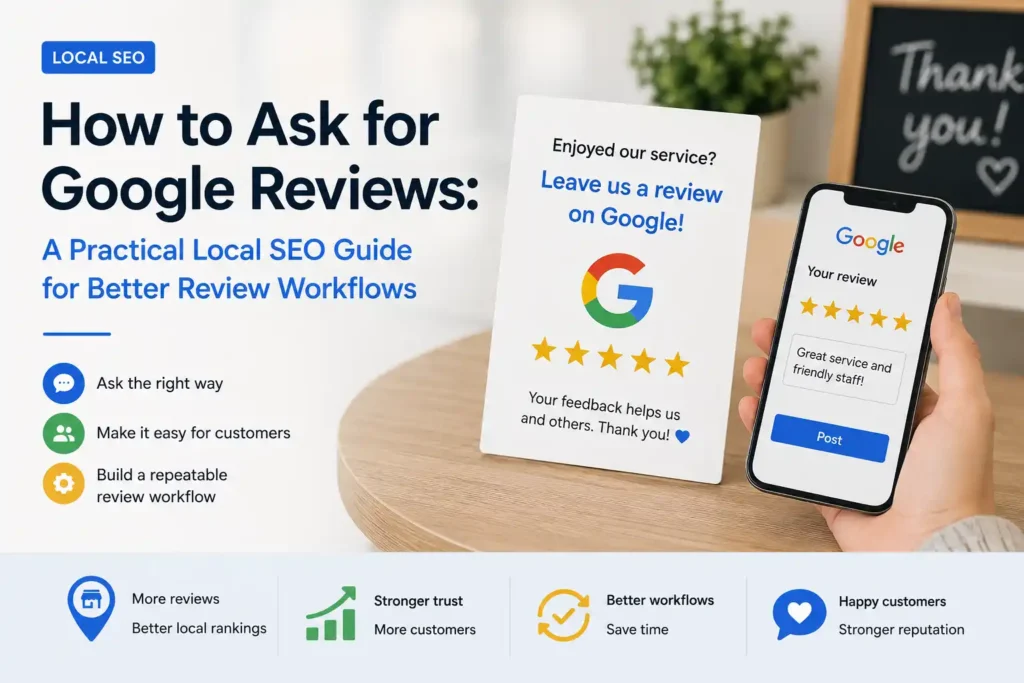
Google reviews are one of the most visible trust signals a local business has. They appear close to the moment of decision, often before a person visits the website, calls the business or asks for directions. For restaurants, medical clinics, parking services, salons, lawyers, repair companies, ecommerce pickup points and local service brands, reviews are not a decorative layer. They are part of the customer acquisition system.
The challenge is that many businesses either do not ask for reviews at all, ask at the wrong moment, or ask in a way that creates risk. Some ask only when they know the customer is happy. Some offer incentives without understanding platform rules. Some send robotic messages that feel disconnected from the actual experience. Some put a QR code on the desk but never explain why the customer should use it. Others respond to reviews for two weeks and then forget.
This guide explains how to ask for Google reviews in a way that is practical, policy-aware and useful for Local SEO. It uses the Semrush article on asking for Google reviews as a structural starting point, but goes deeper into workflow design, timing, examples, review safety, response systems and how review data should feed SEO execution. I will also include two real-world operating examples from AYSA client contexts: Parkado.ro, where a post-service follow-up can ask for feedback one day after the customer used the service, and Adeomed, where a QR code at reception can make the review action easy after a visit.
The goal is not to manipulate reviews. The goal is to make it easy for real customers to describe real experiences, then use that feedback to improve trust, local visibility and the website itself.
Why Google reviews matter for local SEO
Google reviews matter because they influence trust at the exact point where people compare local options. A customer searching for a clinic, parking service, florist, hotel, restaurant or repair company is rarely evaluating only the website. They see a Google Business Profile, a star rating, review count, review snippets, photos, opening hours, directions and competing local results. That is a very compressed decision environment.
Reviews also contain language that traditional Keyword tools often miss. Customers mention what they cared about: “easy booking,” “clear instructions,” “friendly reception,” “fast parking transfer,” “doctor explained everything,” “clean location,” “good communication,” “close to the airport,” “short waiting time,” “helpful staff,” “transparent price.” These phrases are not just reputation signals. They are business intelligence.
From an SEO perspective, reviews can support several layers of local visibility:
- Trust before the click: a strong review profile can make a searcher more likely to choose the business.
- Local relevance: review language can reinforce services, locations, use cases and customer intent.
- Conversion rate: reviews reduce uncertainty and can increase calls, directions, bookings and contact form submissions.
- Content strategy: recurring review themes can become FAQ sections, service page improvements and local content ideas.
- Operational feedback: repeated complaints can reveal service issues that SEO alone cannot fix.
Google’s own Business Profile help encourages businesses to remind customers to leave reviews and share a review link, while also making clear that reviews should be honest and that businesses should not offer incentives in exchange for reviews. Google’s Maps contributed content policy also treats fake engagement and content that does not represent a genuine experience as problematic. That means the right strategy is not “get as many reviews as possible by any means.” The right strategy is: ask real customers, use neutral language, avoid gating, avoid fake engagement, and respond professionally.
The first principle: ask everyone fairly, not only happy customers
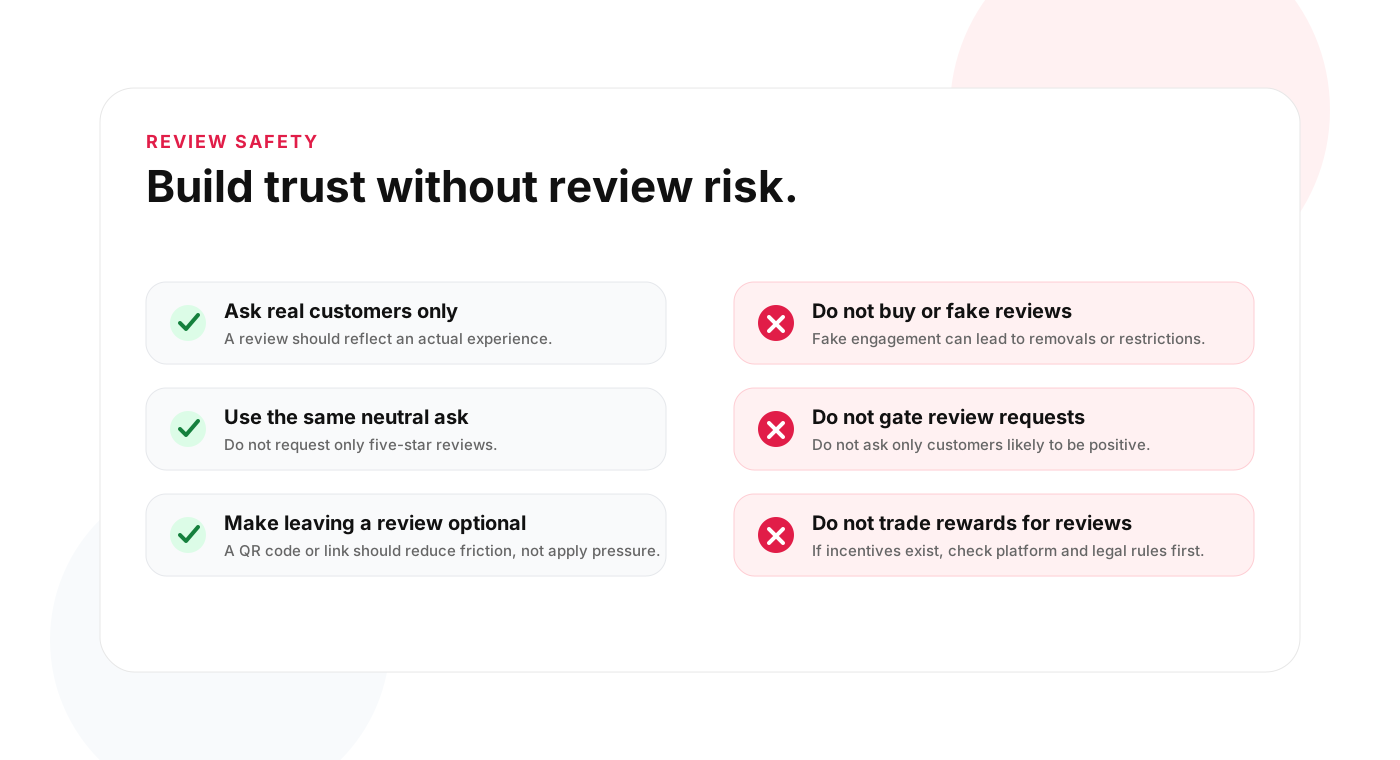
The most important rule is simple: do not build a review system that only routes happy customers to Google. That is review gating. It may feel tempting because it protects the rating in the short term, but it damages the integrity of the review profile and can create compliance problems.
A safe review workflow should not ask “Were you happy? If yes, review us on Google. If no, send us private feedback.” You can collect private feedback for service improvement, but you should not use that private feedback step to decide who gets the public review request. A better approach is to make the public review request neutral and optional for all eligible customers after a real interaction.
That does not mean you should ignore unhappy customers. It means you should handle them properly. If a customer had a problem, support should try to solve it. If they still want to leave a review, that is their right. The review system should not be built to hide negative feedback. It should be built to learn from it and respond.
The second principle: timing beats pressure
Businesses often underperform with reviews because the timing is wrong. They ask too early, before the customer has experienced the service. Or they ask too late, after the emotional memory has faded. Or they ask in a place where the customer is distracted.
Good timing depends on the business model:
- Medical clinic: after the appointment, check-out or follow-up, when the patient has completed the experience.
- Parking service: after the customer has returned, collected the car and knows whether the service was smooth.
- Ecommerce: after delivery, once the customer has received and used the product.
- Restaurant: near the end of the visit, but without pressure from the staff.
- Professional service: after the client receives a result, report, resolution or milestone.
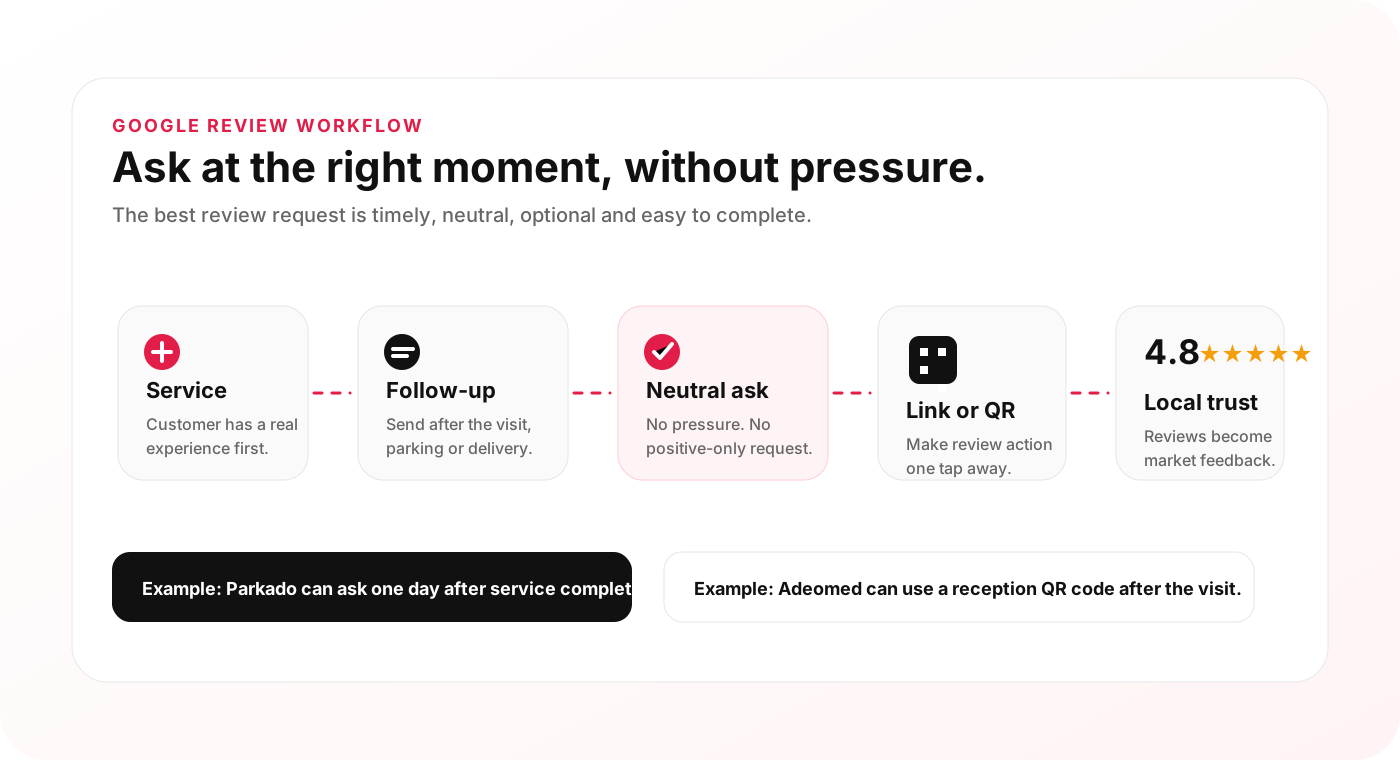
For Parkado.ro, the practical moment is not before the customer parks and not while they are rushing to the airport. The useful moment is after the customer has benefited from the service. A follow-up one day later can work well because the customer has completed the experience, remembers whether the service was clear and can leave a more accurate review.
For Adeomed, the practical moment can be at reception after the visit. A QR code can reduce friction because the patient or parent does not need to search for the clinic manually. The important part is that the request should remain optional, neutral and respectful. In a healthcare context especially, sensitivity matters. The message should not pressure the patient, and staff should never suggest that only positive reviews are welcome.
The third principle: incentives are dangerous unless handled carefully
Many businesses ask whether they can offer a voucher, discount or gift in exchange for a review. This is where the risk increases. Google says businesses should not offer incentives in exchange for reviews. The FTC also pays attention to endorsements, incentives and consumer reviews, especially when compensation or benefits can influence the review or are not disclosed.
That does not mean a business can never have a customer care workflow that includes a voucher, loyalty benefit or follow-up offer. But the review request should not be framed as “leave a review and get a voucher,” and it should never be framed as “leave a positive review and get a reward.” If a voucher exists as part of a broader customer retention or post-service flow, the review request should remain separate, optional and neutral. The customer should not feel that a review is required to receive the benefit, and the business should review its legal and platform obligations.
For Parkado.ro, this distinction matters. A post-service communication can thank the customer, provide any relevant voucher or loyalty information, and also invite the customer to share honest feedback. But the language should not create the impression that the voucher is payment for a Google review. The safer wording is:
Thank you for choosing Parkado. We hope your parking experience was smooth. If you have a minute, you can share an honest review on Google here. Your feedback helps other drivers understand what to expect and helps us improve our service.
If a voucher is part of the message, it should be described as a customer benefit or return incentive, not a reward for reviewing. For example:
As a thank-you for choosing Parkado, here is your return customer voucher. Separately, if you would like to share your honest experience on Google, you can do that here.
This is not legal advice. It is a practical risk-control principle: do not buy reviews, do not condition rewards on reviews, do not request only positive reviews, and do not make the customer feel pressured.
The fourth principle: QR codes work when the context is right
QR codes are useful because they remove friction. A customer does not need to search for the business, identify the right profile and find the review button. They scan, land on the correct review flow and decide whether to write.
But a QR code alone is not a strategy. It needs context. A small sign at reception should explain why the review matters and what kind of feedback is welcome. For Adeomed, a strong reception message might say:
Your feedback helps families choose medical care with more confidence. If you would like to share your experience, scan the QR code and leave an honest Google review.
This language does three things well. It explains the purpose, it asks for an honest review, and it leaves the choice to the customer. It does not ask for five stars. It does not mention rewards. It does not pressure patients. It also connects the review to a real benefit: helping other families.
For clinics, reception QR codes can be paired with staff training. The staff should not say, “Please give us five stars.” They can say, “If you would like to share feedback about your visit, the QR code is available here.” That difference may sound small, but it changes the tone from pressure to invitation.
How to create a Google review link
Google Business Profile allows businesses to share a link that customers can use to leave reviews. The exact interface can change over time, but the principle is consistent: the business owner or manager can access the profile, find the review request/share review form option, and distribute the link through appropriate customer communication channels.
Once you have the link, you can use it in several places:
- Post-service email follow-ups.
- SMS follow-ups where legally permitted.
- WhatsApp follow-ups where the customer relationship supports it.
- Printed cards or receipts.
- Reception desk QR codes.
- Post-purchase thank-you pages.
- Customer support closing messages.
The key is to avoid spam. Do not send repeated review requests every few days. Do not message people who did not actually use the service. Do not ask employees or friends to review the business as if they were customers. Do not ask a marketing agency to generate reviews. Do not use fake accounts.
Review request templates you can adapt
Templates are useful, but they should sound human. A review request should be short, specific and honest. It should mention the real interaction when possible. It should not over-explain local SEO. Customers do not care that you want better rankings. They care that their feedback helps other customers and helps the business improve.
Email template after a service
Hi [Name], thank you for choosing [Business]. We hope everything went smoothly. If you have a minute, we would appreciate an honest Google review about your experience. It helps other customers know what to expect and helps us improve. You can leave a review here: [Review link]
SMS template after a completed service
Thank you for choosing [Business]. If you would like to share your honest experience on Google, you can leave a review here: [Short review link]. Your feedback helps other customers and helps us improve.
Parkado-style post-service template
Thank you for using Parkado. We hope your parking and return experience were smooth. If you would like to help other drivers choose with confidence, you can share an honest Google review here: [Review link].
If there is a voucher or loyalty offer in the same customer care flow, keep it separate from the review request:
As a thank-you for using Parkado, here is your return customer voucher: [Voucher]. Separately, if you want to share your honest experience on Google, you can do that here: [Review link].
Adeomed-style reception QR text
Your feedback helps other families choose medical care with confidence. If you would like to share your experience, scan this QR code and leave an honest Google review.
Customer support closing message
I am glad we could help. If you would like to share your experience with our team, you can leave an honest Google review here: [Review link]. Thank you for your time.
Notice the pattern. The ask is neutral. It does not mention five stars. It does not suggest what to write. It does not create pressure. It does not promise a reward for reviewing.
How to respond to Google reviews
Asking for reviews is only half the system. Responding matters too. Google recommends replying to reviews to show that the business values feedback. Responses also help future customers understand how the business behaves after the sale, visit or service.
A good Review response should be short, specific and professional. Avoid generic copy-paste if possible. Mention the service naturally, but do not stuff keywords. Do not reveal private information, especially for healthcare, legal, financial or sensitive services. For medical businesses, responses should be especially careful. Even confirming that someone was a patient can create privacy concerns depending on jurisdiction and context.
Positive review response template
Thank you for your review. We are glad the experience was helpful and clear. We appreciate you taking the time to share feedback with other customers.
Detailed positive review response template
Thank you for sharing this. We are happy to hear that the booking process and communication were clear. Feedback like this helps our team keep improving the customer experience.
Negative review response template
Thank you for the feedback. We are sorry the experience did not meet expectations. We would like to understand what happened and see how we can improve. Please contact us at [support contact] so our team can review the situation.
Do not argue. Do not reveal internal details. Do not blame the customer. Do not write a defensive essay. A review response is public customer service.

How reviews should influence your website
Most businesses treat reviews as a reputation asset only. That is too narrow. Reviews can also reveal what the website fails to explain. If customers repeatedly praise “easy airport transfer,” the service page should probably explain the transfer process clearly. If patients repeatedly mention “clear explanations,” a clinic may want a page section about the consultation process. If customers ask about parking, payment methods, waiting time or documentation, those questions should appear in the website content where appropriate.
Here are review patterns that should trigger SEO actions:
- Repeated service language: customers use words that are missing from your service pages.
- Repeated objections: people mention confusion about price, timing, location, access or process.
- Repeated compliments: the business has strengths that are not clearly communicated on the website.
- Repeated complaints: the website promises something the operation does not consistently deliver.
- Location language: customers mention neighborhoods, cities, airports, landmarks or areas that may support local content.
- Audience language: customers describe themselves or their situation in ways that can inform use-case pages.
This is where reviews become more than “social proof.” They become raw material for better local SEO, AEO and AI Search visibility. AI systems and search engines need clear, trustworthy, specific information. Customer language can help you understand what clarity means in the real world.
How to build a review workflow for local businesses
A review workflow should be designed like an operational system, not like a random marketing task. The business should know who gets asked, when they get asked, what message they receive, where the review link points, how responses are handled, and how insights are turned into actions.
Step 1: define eligible customer moments
Start by mapping the moments where a real experience has occurred. For Parkado, that is after the customer used the parking service. For Adeomed, that is after a visit or interaction at reception. For ecommerce, it may be after delivery. For agencies, it may be after a completed milestone.
Step 2: create the review link and QR code
Use the Google Business Profile review link for the correct business location. If the business has multiple locations, make sure each QR code points to the right profile. A clinic with several locations should not send all reviews to the wrong branch.
Step 3: write neutral request copy
Use one short request that asks for an honest review. Avoid “five-star” language. Avoid “positive review” language. Avoid “help us rank” language. The message should be about helping other customers and improving the service.
Step 4: decide the channel
Email works well for longer contexts. SMS works well for quick follow-ups, but only when compliant with consent and communication rules. QR codes work well in physical locations. WhatsApp can work in markets where customers expect that channel, but it should still be respectful and permission-aware.
Step 5: respond and categorize
Every review should be read. Many should be answered. Some should be categorized by theme: service quality, waiting time, communication, price, staff, location, product quality, process clarity. Over time, those categories reveal what content and operations need attention.
Step 6: turn patterns into approved actions
This is the part most businesses miss. A review system should produce SEO and operational actions. If reviews show confusion about parking instructions, update the instructions page. If patients praise a specific service but the service page is thin, improve it. If customers repeatedly mention local access, add clearer location information. If complaints expose a real issue, fix the process before writing more content.
How AYSA fits into review-driven local SEO
AYSA’s point of view is that SEO should move from information to approved execution. Reviews are a perfect example. A traditional workflow might export reviews, read them manually, write notes, create tasks, rewrite pages, update Google Business Profile content and hope someone follows through. That is a lot of manual work.
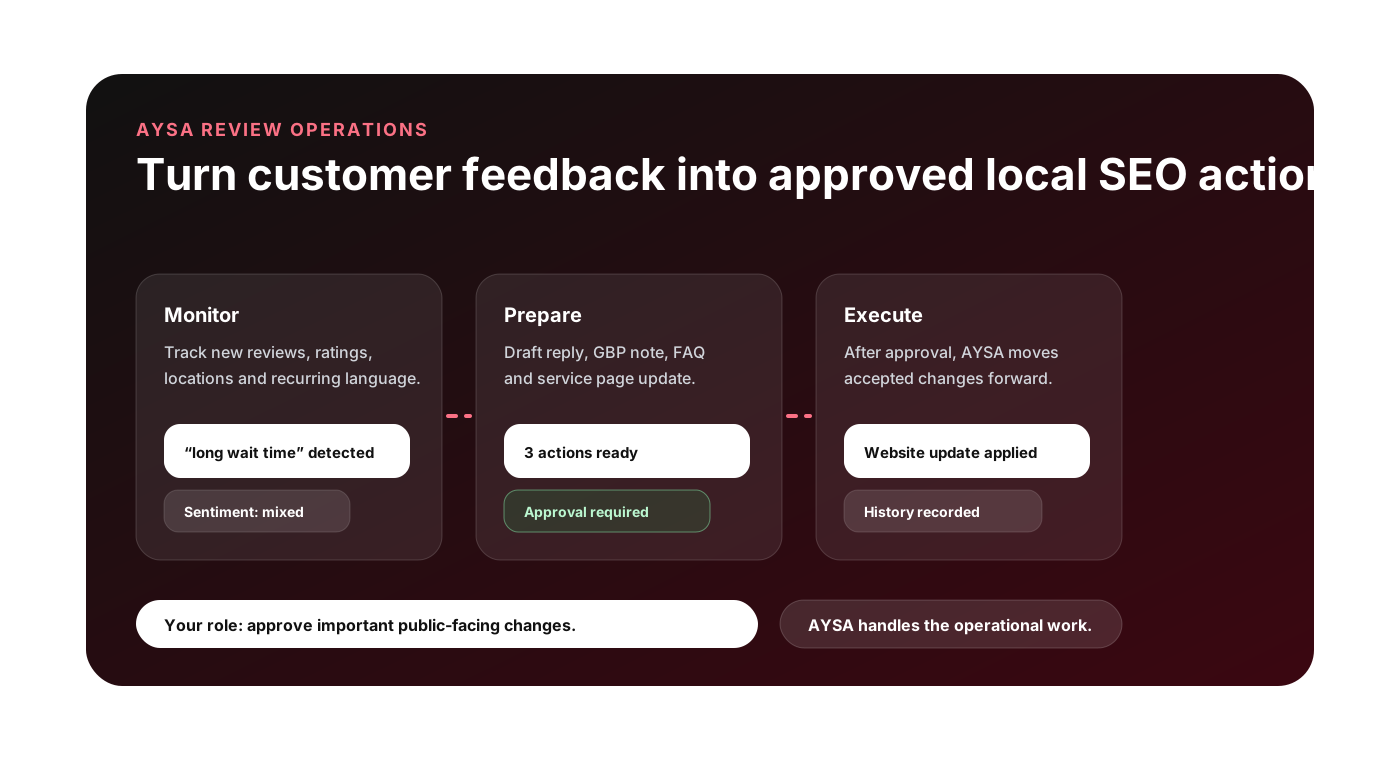
AYSA is designed around a different workflow: monitor signals, detect opportunities, prepare work, ask for approval and execute accepted changes inside the website workflow. In the context of Google reviews, that can mean:
- Identifying review language that should be reflected on service pages.
- Finding FAQ opportunities based on repeated customer questions.
- Preparing neutral review request templates for approval.
- Preparing review response drafts that stay professional and safe.
- Suggesting Google Business Profile improvements.
- Connecting review themes to local SEO content opportunities.
- Flagging sensitive cases that need human review.
- Turning accepted website changes into execution, not just recommendations.
This is especially useful for business owners and teams that do not want to live in SEO tools. The business should not need a specialist to interpret every review pattern. The system should surface the work, explain why it matters and ask for approval before public-facing changes are made.
Review requests for healthcare businesses
Healthcare businesses need extra care. A clinic can ask for feedback, but the tone should be respectful and privacy-aware. Do not pressure patients. Do not ask staff to identify patient conditions in responses. Do not use language that implies a review is required. Do not respond with sensitive details.
For a clinic like Adeomed, the QR code approach can be effective because it is passive and convenient. The patient or parent chooses whether to scan it. The wording should focus on honest feedback and helping other families, not on rating manipulation. The reception team should understand the script and avoid pushing for five-star reviews.
A strong healthcare review system should also connect feedback to service improvements. If reviews mention waiting time, appointment clarity or communication, those themes should be reviewed internally. SEO cannot compensate for a broken experience. It can only amplify what the business actually does.
Review requests for parking, travel and service businesses
Parking and travel-adjacent services have a different rhythm. Customers are often in a hurry before the service, but more relaxed after it. A review request one day after completion can work because the full experience is finished: booking, arrival, handoff, transfer, return and car pickup.
For Parkado.ro, the post-service review request can ask customers to share whether the process was clear and smooth. If the business uses vouchers as part of customer retention, keep that benefit separate from the review request. The review should remain optional and honest.
These reviews can also reveal SEO content gaps. If drivers repeatedly mention “airport transfer,” “secure parking,” “easy instructions,” “fast pickup” or “return process,” those concepts should be clearly explained on the website. If people ask the same questions before booking, those questions should become FAQs.
Common mistakes when asking for Google reviews
The mistakes are usually operational, not strategic. Businesses know reviews matter, but they do not build a clean system.
- Asking too early: the customer has not experienced enough to write a useful review.
- Asking too late: the customer no longer remembers the details.
- Asking only happy customers: this can become review gating.
- Offering rewards for reviews: this can violate platform policy and consumer protection expectations.
- Using five-star language: ask for honest feedback, not a rating outcome.
- Sending too many reminders: repetition can feel like spam.
- Ignoring negative reviews: unanswered criticism can damage trust.
- Copy-pasting responses: generic replies make the business look inattentive.
- Not using review insights: customer language should improve content, operations and GBP.
What to measure
Review growth should be measured, but not in a shallow way. Do not focus only on the star rating. A business with 4.9 stars and no recent reviews may look less active than a business with steady recent feedback. A business with many reviews but repeated complaints may have an operational issue. A business with strong reviews but weak service pages may be wasting customer language that could improve conversion.
Useful metrics include:
- Review request volume by channel.
- Review completion rate where measurable.
- Review rating distribution.
- Review recency.
- Response rate and response time.
- Recurring positive themes.
- Recurring negative themes.
- Local ranking and Google Business Profile performance trends.
- Website conversion changes after service page improvements.
The best review programs do not chase a perfect score. They build a reliable feedback loop.
Frequently asked questions
Can I ask customers for Google reviews?
Yes. Google Business Profile guidance allows businesses to remind customers to leave reviews and share a review link. The request should be honest, neutral and based on a real customer experience.
Can I offer a voucher for a Google review?
Be very careful. Google says businesses should not offer incentives in exchange for reviews, and consumer protection rules can apply to incentivized endorsements. If a voucher exists in a customer care flow, keep it separate from the review request and do not condition it on leaving a review or leaving a positive review.
Can I ask only happy customers to leave reviews?
No. That can become review gating. A safer workflow asks eligible real customers in a neutral way and does not filter the request based on expected rating.
Are QR codes good for Google reviews?
Yes, when used correctly. QR codes reduce friction in physical locations such as clinics, restaurants, showrooms and reception desks. The message near the QR code should ask for honest feedback, not five-star reviews.
Should I respond to every Google review?
You should read every review and respond where useful. Positive reviews deserve appreciation. Negative reviews deserve calm, professional handling. For sensitive industries such as healthcare, responses should avoid personal or private details.
Do Google reviews directly improve rankings?
Reviews are part of the broader local search environment, but no responsible SEO strategy should reduce local visibility to one factor. Reviews influence trust, click behavior, local relevance signals, customer language and conversion. They should be managed as part of the complete local SEO system.
The AYSA point of view
Asking for Google reviews is not a trick. It is customer communication. The businesses that win over time will not be the ones that pressure people into ratings. They will be the ones that ask at the right moment, make feedback easy, respond professionally and turn customer language into better service and better content.
For AYSA, reviews are part of the execution layer. They reveal what customers value, what they misunderstand, what they fear, what they praise and what the website should explain better. A review profile should not sit disconnected from SEO. It should feed the local SEO workflow, the Google Business Profile workflow, the content workflow and the approval workflow.
Less SEO work, more organic growth does not mean ignoring the human side. It means building systems that turn real customer feedback into approved action.
Sources and further reading
- Semrush: How to Ask for Google Reviews
- Google Business Profile Help: Get Google reviews
- Google Maps user-generated content policy: fake engagement and review integrity
- FTC: Soliciting and paying for online reviews
- FTC Endorsement Guides: What people are asking
Continue the AI search topic inside AYSA.
Use these pages to connect the article with AI SEO tools, AI visibility monitoring, AI Overviews and approved website execution.
Turn this topic into a website action plan.
Use these AYSA hubs to move from reading to technical fixes, AI visibility monitoring, research, glossary context and approval-first SEO execution.