
Google’s May 2026 Core Update: The “Best Default Destination” Era and What SMEs Must Do Next
May 2026 didn’t just reshuffle rankings—it clarified what Google wants to send users to by default: the most intent-aligned, market-correct, format-expected destination. Here’s what changed, why it matters for SMEs, and a practical plan to respond with measurable, approved execution using AYSA.ai.

Google’s May 2026 Core Update created a specific kind of pain for business owners: rankings moved in ways that didn’t line up with the old comfort blankets—brand authority, domain strength, and “we have a lot of content.”
But it also created clarity. In the best analysis I’ve seen so far, Aleyda Solis describes May as an “intent-destination reset,” where visibility shifted toward the source type that best matches the dominant intent, market context, and expected result format of a query set (source).
Here’s my practical framing for SMEs and agencies: May 2026 wasn’t “good sites vs bad sites.” It was Google tightening its opinion on the best default destination for each search. If your page isn’t that destination—regardless of authority—your visibility can slip.
This editorial is a standalone, action-oriented guide: what likely changed, why it matters, what can go wrong, and what to do next—especially if you need changes executed safely and consistently (which is where AYSA.ai fits).
Table of contents

- Concise summary
- Key takeaways (SME-first)
- The May 2026 Core Update in one sentence (and why that sentence matters)
- What actually moved: “source-type fit” beat raw authority
- Why Google is doing this now: less browsing, more selecting
- Result formats are strategy now (not just content)
- Forums and Q&A pulled back—yet social/video held up: the real lesson
- Localization got sharper—especially in UK ecommerce
- “Aggregators lost” is lazy thinking: jobs & travel show the nuance
- Health/YMYL: confidence mattered, but “result fit” decided the winners
- A concrete SME scenario: how a good business loses traffic for the wrong reason
- What SMEs should monitor (rankings are not enough anymore)
- What agencies should rethink: deliver “destination fit,” not deliverables
- The execution gap: why most “SEO recommendations” fail after a core update
- Where AYSA.ai fits: monitor → prepare changes → ask approval → execute
- What to do next (action list)
- Sources and further reading
Concise summary
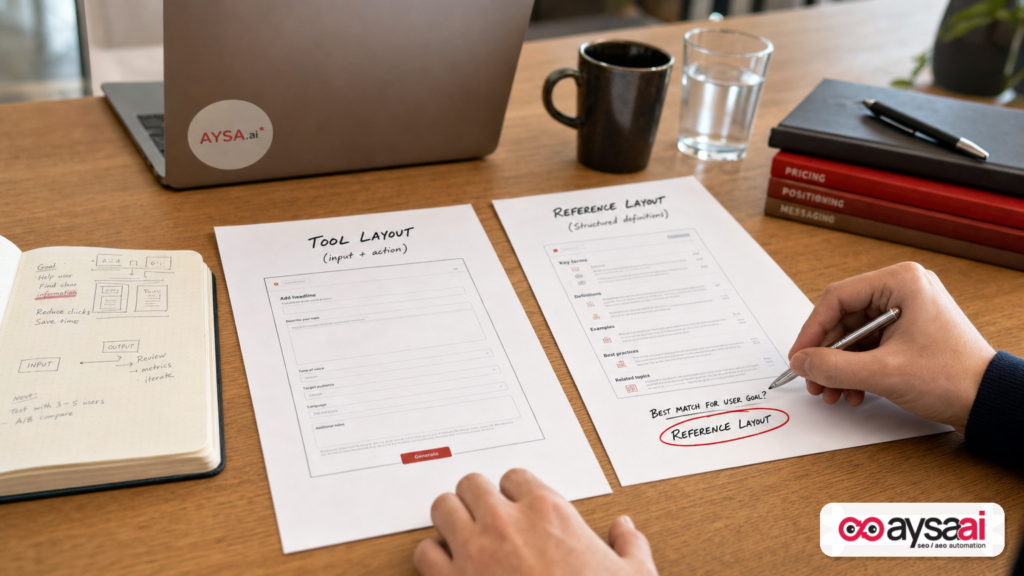
The May 2026 Core Update appears to have rewarded the source type that best matches searcher intent, market location, and expected result format—often favoring canonical references, local-market ecommerce entities, and category-defining transactional marketplaces. Meanwhile, derivative layers (some forums/Q&A, some utility/tool pages, and wrong-market ecommerce pages) looked more exposed.
For businesses, the fix is not “add more content” or “get more links.” It’s to map your priority queries to the destination type Google now expects—and then build pages that truly satisfy that intent in that market, in that format. Finally, you need an execution system that can ship changes quickly and safely, because insight without execution is just anxiety.
Key takeaways (SME-first)

- Authority is necessary but not sufficient. Aleyda’s analysis notes that even very authoritative domains saw declines; the real question became: are you the expected destination type for the query (source)?
- “UGC is dead” is the wrong takeaway. Forum/Q&A visibility contracted in her measured window, but major social/video platforms were mixed-to-positive; Google may be differentiating by surface and format, not simply UGC vs non-UGC.
- Localization isn’t an International SEO checkbox anymore. UK results shifting toward UK entities (and away from .com equivalents) suggests Google got more assertive about “market correctness.”
- Transactional marketplaces can still win. Jobs and travel marketplaces gaining is a reminder that “aggregator” is not a synonym for “thin.” If users complete the task there, it can be the best destination.
- Health/YMYL results were sorted by confidence and result fit. Trust matters, but the page type and query intent still decide outcomes (explainer vs tool vs official guidance vs institution).
- The practical move: audit your top query clusters and ask: “In this market and SERP format, what is Google’s best default destination now—and are we it?”
The May 2026 Core Update in one sentence (and why that sentence matters)
May 2026 pushed more queries toward the “best default destination” for that intent, in that market, in that expected format.
That sentence matters because it changes how you diagnose losses and plan recoveries.
In older playbooks, you’d interpret a drop as a “quality” or “authority” problem and respond with broad upgrades: more content, more E-E-A-T, more links, more technical clean-up.
Those can still help. But May suggests a sharper decision layer: Google can decide your site is high quality yet still not the default destination type it wants to show for that query cluster.
So the recovery work is not just “improve.” It’s “become the right kind of result.”
What actually moved: “source-type fit” beat raw authority
Aleyda’s measured analysis (May 26–June 2, 2026) highlights patterns where visibility moved toward source types that better match intent and market, and away from pages that feel like an extra layer between the user and the goal (Solis analysis).
One detail that should make every SEO lead pause: she notes that several highly authoritative domains saw declines during the window (examples mentioned include top publishers and public health/official domains). That doesn’t mean Google “doesn’t value authority.” It means authority is being filtered through a more opinionated “best destination” lens.
A practical taxonomy: 10 destination types you can actually plan around
If you’re an SME, you don’t need a philosophical debate. You need a list you can apply to your own search terms. For each priority query cluster, identify which destination type is winning now:
- Canonical reference (dictionary, definition, standard reference brand)
- Official source (government agency, regulator, institution)
- Local-market ecommerce entity (correct country storefront, currency, shipping)
- Transactional marketplace (complete the job: book, buy, apply)
- Explainer/guide (step-by-step, comparison, editorial)
- Tool/utility (calculators, checkers, symptom tools, price lookups)
- Video destination (watch-to-learn intent)
- Visual inspiration (images-first, collections)
- Community discussion (forums/Q&A, first-person experiences)
- News/current events (freshness-first)
Your goal isn’t to be everything. Your goal is to be the best destination type for the queries you care about—and not pretend your page is a “near match” when a stronger, more canonical source exists.
How to diagnose “wrong destination type” in 20 minutes
Pick one query where you dropped and do this:
- Open the SERP in an incognito window.
- Classify the top 10 results into destination types above.
- Circle the dominant pattern: are they mostly tools? mostly transactional? mostly canonical references?
- Now look at your landing page: is it the same type—or a “close cousin”?
If the SERP is mostly canonical reference brands and you’re a tool layer, you’re fighting the current. If it’s mostly video and you’re only text, you’re fighting the format. If it’s mostly local-market stores and you rank with the wrong-market .com page, you’re fighting the market.
Why Google is doing this now: less browsing, more selecting
We’re watching search behavior change in real time. Users aren’t just browsing lists of blue links; they increasingly want a fast, confident selection of the “best place to go” for the task at hand.
This is also happening alongside AI-driven discovery experiences (even outside traditional SERPs). Whether the interface is classic results, AI summaries, or multi-step journeys, the underlying requirement is similar: the system needs reliable destinations that match intent cleanly.
That’s why “destination fit” matters so much: it reduces ambiguity. Ambiguity is expensive for a search engine, and it’s frustrating for users.
May 2026 looks like Google reducing that ambiguity by narrowing what it considers a default destination per intent class—especially in areas where the web has grown thick with intermediary layers.
Result formats are strategy now (not just content)
One of the easiest mistakes after an update is to treat SERP format shifts as a “presentation issue.” They aren’t. They’re a ranking strategy issue.
If Google decides a query is best served by:
- a canonical reference entry,
- a product Category page on a local-market store,
- a marketplace where the task is completed,
- or a video tutorial,
…then even a well-written blog post can become the wrong object for that SERP. Not low quality. Wrong object.
A format-first playbook (what to build when formats change)
- If the SERP is tool-heavy: build (or improve) a tool, and wrap it with supporting content that clarifies who it’s for and why it’s accurate.
- If the SERP is marketplace-heavy: ensure your category pages, inventory, filters, and checkout path are competitive—because the destination is evaluated as a task completion engine, not as content.
- If the SERP is canonical reference-heavy: don’t try to out-dictionary the dictionary. Find adjacent intents you can own (examples, usage in your niche, industry-specific definitions, implementation guides).
- If the SERP is video-heavy: consider producing a video asset and building a page that supports it (transcript, steps, downloadable checklist) so you compete in the expected format.
This isn’t “chasing shiny objects.” It’s aligning with what users (and Google) appear to want for that query class.
Forums and Q&A pulled back—yet social/video held up: the real lesson
Aleyda’s breakdown suggests that forum/Q&A/open publishing surfaces declined in aggregate during the measured period, with large platforms like Reddit, Quora, and StackExchange showing drops, while major social and video platforms were mixed-to-positive (source).
It’s tempting to turn that into a headline: “Google is done with UGC.” But that’s too blunt.
The more useful interpretation for a business is this:
- Google may be rebalancing “first-hand experience” surfaces after boosting them heavily in prior years.
- Google may also be separating community discussion from other UGC formats like visual inspiration, social distribution, and video tutorials—because those formats satisfy intent differently.
If you relied on forums for traffic: what to do (without panic)
- Stop treating “discussion pages” as evergreen SEO landing pages. Discussion has a half-life. Make sure the pages you want to rank are built as stable destinations (guides, hubs, tools, category pages).
- Turn community insight into durable assets. Mine questions from your community and create authoritative, intent-complete pages that answer them.
- Build a format portfolio. If your entire strategy depends on one surface type, you’re fragile. Add video, structured guides, and tool pages where relevant.
Localization got sharper—especially in UK ecommerce
One of the most actionable patterns in Aleyda’s analysis is the UK ecommerce shift toward local-market entities—suggesting a stronger localization and “market fit” bias. The interpretation is straightforward: Google appears more willing to demote wrong-market storefronts in favor of the correct local entity when users are in a specific market (source).
If you’re an international ecommerce brand, this is not a minor SEO tweak. It affects revenue.
International ecommerce checklist: “prove you are the right market”
Some of these are technical. Most are business reality signals:
- Correct market URLs and signals: consistent Canonicalization and a clean international targeting setup (often using Hreflang, where applicable). If you’re unsure, consult Google’s official documentation on international targeting and hreflang; we’re not linking it here because it’s not included in the supplied research context.
- Currency, pricing, and taxes: display in-market currency and be transparent about VAT/taxes where applicable.
- Shipping and returns: in-market shipping speed, costs, and clear returns policy for that country.
- Inventory reality: don’t send UK users to products that aren’t actually available for UK delivery (Google can infer dissatisfaction signals over time).
- Local customer support signals: contact options, hours, and local expectations.
- Local trust: local reviews, local policies, and—where relevant—local store locations.
The strategic point: this update suggests that “.com ranks everywhere” is increasingly an unstable assumption. Market-correct entities win when the intent is purchase and the user expects local fulfillment.
“Aggregators lost” is lazy thinking: jobs & travel show the nuance
Aleyda highlights that jobs and travel marketplaces gained visibility in both the US and UK, which is a strong counterexample to blanket narratives like “Google is punishing aggregators” (source).
Here’s the distinction that matters for business strategy:
- Primary task destinations (where users actually complete the job—book, apply, buy) can be favored.
- Derivative layers (summaries, thin affiliates, “Top 10” lists without differentiated value) become more exposed.
Are you a derivative layer? Ask these uncomfortable questions
- Can the user complete the task on our site, or do we always send them elsewhere?
- Do we have unique inventory, pricing, availability, tools, or expertise?
- If Google removed us from the SERP, would users be worse off—or just take one more click?
- Are we the “category-defining” destination for a niche (even a small niche), or are we a commodity list?
If you’re an affiliate, comparison, directory, or utility site, May 2026 is a warning shot: you need a stronger reason to exist in the result set.
Health/YMYL: confidence mattered, but “result fit” decided the winners
In health, Aleyda’s analysis suggests outcomes were not simply “health sites up” or “health sites down.” Instead, performance split by source confidence and by whether the result type matched the query (explainer vs tool vs official/institutional guidance, etc.) (source).
For a clinic, med-spa, telehealth service, or health content publisher, that translates into a practical playbook:
- Separate your intents: symptoms, treatments, pricing, side effects, “when to see a doctor,” local services.
- Build the right page type per intent: patient-friendly explainer pages are different from clinical reference pages, and both are different from tools.
- Don’t assume institutional authority automatically wins. Even “official” sources can be misfit if the query expects a different destination type (for example, a patient-facing explainer rather than a broad policy page).
Important note: This article doesn’t claim medical advice outcomes—only search behavior implications based on the provided research context.
A concrete SME scenario: how a good business loses traffic for the wrong reason
Let’s make this painfully real.
Scenario: a UK-based home goods ecommerce brand with a .com and a .co.uk
You run an ecommerce brand. You have:
- a global
.comwith strong backlinks and years of history, - a UK
.co.ukyou launched more recently, - and a shared CMS where products sometimes canonicalize incorrectly.
Before May, your .com often ranked in the UK for high-intent product category terms because it had “more authority.” It wasn’t ideal, but sales still happened.
After May, you notice:
- UK Impressions drop on core category pages,
- your .co.uk impressions rise but don’t convert as well,
- and your support team gets more questions about shipping and returns.
What likely happened (based on the pattern Aleyda observed) is Google became more opinionated about sending UK users to UK market entities. If your UK entity isn’t fully “task-complete” (shipping clarity, currency, returns, local policies), or your canonical/hreflang signals are inconsistent, the algorithm may hesitate—or rank you lower than local competitors who are fully market-ready.
The fix is not “write more blogs.” The fix is market-correct destination work
- Resolve wrong-market canonicalization.
- Make the UK category pages clearly superior for UK shoppers (currency, delivery, FAQs, returns, trust).
- Ensure internal links in UK context point to UK URLs (navigation, related products, breadcrumbs).
- Validate your SERP formats: are category pages winning, or are marketplaces winning? Adjust accordingly.
This is the kind of work that produces revenue impact—but only if it gets executed reliably.
What SMEs should monitor (rankings are not enough anymore)
After a core update, most teams stare at rank trackers. It’s understandable—and incomplete.
To manage “best destination” shifts, you need to monitor four layers:
1) Query cluster visibility (not just single keywords)
If your business depends on 20–50 high-intent query clusters, you want to see aggregate movement by cluster and by page type. A single keyword can mislead you.
2) SERP composition and format drift
Track whether your important SERPs are becoming more:
- video-heavy,
- marketplace-heavy,
- local-heavy,
- tool-heavy,
- canonical-reference-heavy.
If the SERP changes, your content strategy must change with it.
3) Market correctness (international & local)
If you sell across countries, monitor wrong-market rankings and whether the correct entity is being selected. May’s pattern suggests localization decisions can swing quickly when Google recalibrates.
4) Business outcomes (leads, sales, not just clicks)
If the algorithm is picking “best destinations,” it may also change which pages bring traffic. That can shift conversion rate even if traffic stays similar.
Where AYSA fits in monitoring
AYSA is built to make search visibility measurable across modern search experiences, not just classic rankings. Start with:
- AYSA Monitoring to track performance changes and surface what moved.
- AI Search Visibility if your stakeholders care about being surfaced and cited in AI-driven journeys (AEO/GEO realities).
What agencies should rethink: deliver “destination fit,” not deliverables
If you run an agency (or you hire one), this update pressures a common service packaging problem:
- “We deliver 4 blog posts per month.”
- “We fix technical SEO issues.”
- “We build links.”
Those are inputs. May 2026 puts the spotlight back on outcomes: Are you building the right destination types for the intents that matter?
The agency shift: from content calendars to intent portfolios
Agencies should present strategy as an intent portfolio that maps to destination types:
- Transactional intents: category pages, inventory depth, marketplace integrations, local entity signals.
- Comparison intents: differentiated comparison frameworks, first-party data, buyer guides.
- How-to intents: step-by-step guides, video, downloadable assets, tooling.
- Support intents: self-serve FAQs, troubleshooting hubs that reduce customer support load.
The deliverables can follow. But the strategy must start with “what destination type does Google want here?”
The execution gap: why most “SEO recommendations” fail after a core update
Core updates create a predictable workflow trap:
- The SEO or agency identifies what changed.
- They write a smart audit and a list of recommendations.
- The list sits in a backlog because dev/design/content is busy.
- Two months later, the SERPs shift again.
The business doesn’t lose because it lacked ideas. It loses because it lacked a reliable execution mechanism with governance.
Why “approved execution” is the missing layer
Businesses (correctly) worry about pushing changes that could:
- break templates,
- harm conversion rate,
- create compliance risk (especially in YMYL),
- or create inconsistent international signals.
So they slow down—right when speed matters.
What we’ve learned building AYSA is that the winning operational model is:
- monitor what moved,
- prepare specific, reversible changes,
- ask for approval with clear before/after context,
- execute only what’s accepted, with traceability.
Where AYSA.ai fits: monitor → prepare changes → ask approval → execute
AYSA is not “another dashboard.” It’s an execution system for SEO/AEO/GEO that closes the gap between insight and shipping.
If May 2026 taught us anything, it’s that the market rewards teams who can adapt destination types quickly—without chaos.
A practical AYSA workflow for a core update response
- Identify affected clusters and pages. Use Monitoring to spot where the real declines happened (cluster-level where possible).
- Classify SERP intent and format. Decide if Google is rewarding a canonical reference, a local entity storefront, a marketplace, a tool, or a media format.
- Generate a change plan. Use AYSA to prepare page updates: structure, internal linking, schema where appropriate, content reshaping, localization signals—tailored to destination fit.
- Approval-first governance. Stakeholders approve only the changes they’re comfortable shipping.
- Execute and validate. Ship accepted changes, then watch whether impressions and qualified traffic recover.
Useful AYSA links
What to do next (action list)
Use this as a 14-day plan. Keep it boring. Boring wins.
1) Pick your “money clusters” (not 500 keywords)
Choose 10–30 query clusters tied to revenue or qualified leads. Examples:
- “best running shoes for flat feet” (ecommerce)
- “emergency dentist near me” (local service)
- “book boutique hotel in [city]” (hospitality)
- “pricing for [service]” (B2B)
2) For each cluster, label the destination type Google now favors
Use the taxonomy above and SERP observation. Don’t guess—look.
3) Decide whether you should compete—or pivot
- If the SERP is dominated by canonical reference brands, don’t waste months trying to outrank them with a generic definition page.
- Instead, pivot to adjacent intents you can own (implementation, buying, troubleshooting, local availability).
4) Fix the biggest “market correctness” risks (if you sell internationally)
Audit wrong-market pages ranking, canonical inconsistencies, and whether local storefront pages are fully market-ready (currency/shipping/returns/support).
5) Build at least one format expansion per quarter
If your category depends heavily on video, visuals, or tools, create one high-quality asset and a supporting page that can become your default destination.
6) Use AYSA to ship changes with governance
Start with monitoring, then move into prepared, approval-based execution so you don’t get stuck in endless recommendation loops:
Sources and further reading
- Aleyda Solis: Google May 2026 Core Update Analysis: Intent, Market Fit and Source Type Drove the Biggest Visibility Shifts
- Sistrix (tool referenced in the source analysis): Sistrix
- Related context from Aleyda’s site (mentioned as comparison point): March 2026 Core Update coverage
- Aleyda Solis AI Search category (broader research context): AI Search articles
- SEOFOMO newsletter hub (mentioned in source page): SEOFOMO
Final note: If you felt the May 2026 update, don’t treat it like a one-time storm. Treat it as evidence that Google is formalizing a “default destinations” map. Your job is to be on that map—by intent, by market, and by format—and to have the operational muscle to adjust when the map changes.
Continue the AI search topic inside AYSA.
Use these pages to connect the article with AI SEO tools, AI visibility monitoring, AI Overviews and approved website execution.
Turn this topic into a website action plan.
Use these AYSA hubs to move from reading to technical fixes, AI visibility monitoring, research, glossary context and approval-first SEO execution.

