Entity Optimization Without Schema: The Practical Playbook For AI Search Visibility
Schema helps, but it’s not the job. Entity optimization is about building a stable, verifiable identity for your brand, products, people, and locations—so search engines and LLMs can confidently connect the dots. Here’s the technical, editorial, and operational playbook SMEs and agencies can implement (and monitor) without relying on markup alone.

Entity Optimization is one of those SEO phrases that gets repeated so often it starts to lose meaning. For most teams, it becomes shorthand for “add Schema markup” and move on.
That’s a mistake—especially now that large language models (LLMs) and AI-powered search experiences are assembling a narrative about your business from many sources, not just “ranking” a single page.
This editorial is a practical, technical playbook for strengthening your entities without relying on schema as the primary lever. Schema still matters—but it’s the label, not the identity. The identity is created through consistency, architecture, identifiers, Crawlability, and real-world corroboration.
Research lead and inspiration: Search Engine Journal (Ask An SEO). I’m expanding the topic into a full operating system you can apply as an SME, in-house team, or agency.
Concise summary
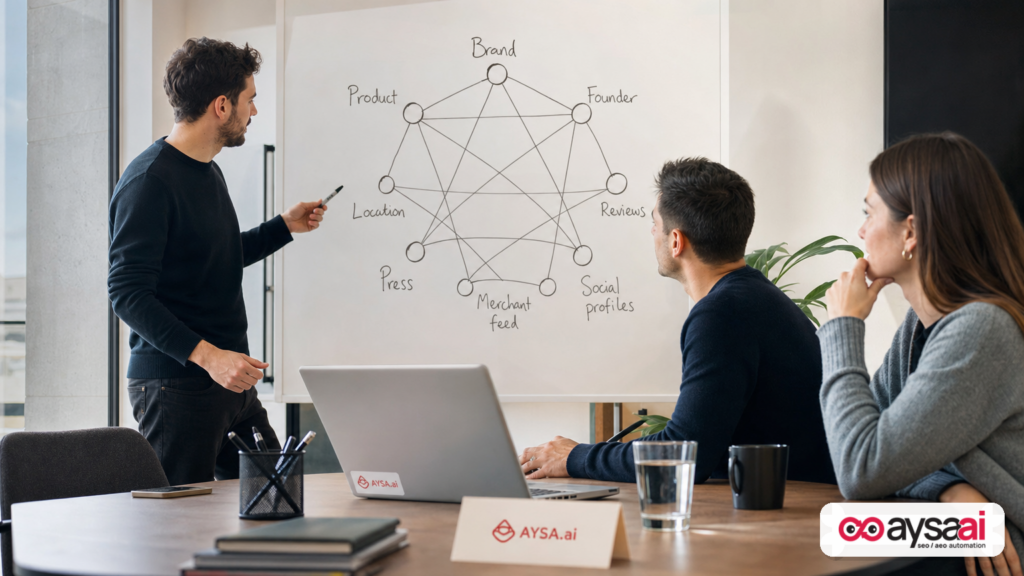
- An entity is a uniquely identifiable “thing” (brand, person, product, location). Entity optimization is the work of making those things unambiguous to machines.
- Schema is supportive, not sufficient. Google and other systems cross-check schema against page content and off-site references. If reality doesn’t match markup, markup won’t save you.
- Non-schema levers include stable identifiers (SKUs/GTINs), entity homes, taxonomy + Internal linking, consistent naming (including addresses), feed alignment, and crawl/render accessibility.
- LLM visibility depends on whether machines can confidently connect your brand to your products/services, expertise, and locations across the web.
- AYSA’s role: monitor entity signals, prepare changes, request approval, then execute accepted updates on the site—turning entity optimization into ongoing operations.
Table of contents

- What changed: from keywords to entities to AI answers
- The new reality: LLMs don’t “rank pages,” they reconstruct brands
- What “entity optimization” actually means (plain business English)
- Why schema is the first idea—and why it’s rarely the full answer
- The non-schema toolkit: 10 ways to strengthen entities with technical SEO
- Entity-first architecture: taxonomy, internal links, breadcrumbs, and canonical homes
- Identifiers that reduce ambiguity (SKUs, GTINs, ISBNs) and where they belong
- Co-occurrence patterns: how to teach machines relationships using content + structure
- Crawlability and rendering: if bots can’t access it, your entity doesn’t exist
- A concrete SME scenario: the multi-location clinic that “split into two entities”
- What agencies must rethink: deliverables, governance, and ongoing entity drift
- How AYSA turns entity optimization into ongoing operations
- What to do next
- Sources and further reading
What changed: from keywords to entities to AI answers

SEO used to be a simpler negotiation: pick keywords, create pages, earn links, and climb rankings. The web was messy, but the model was legible.
Then Google shifted from strings to things—investing for years in entity understanding through its Knowledge Graph, Semantic Retrieval, and disambiguation systems. In that world, your business is not just a set of pages. It’s a set of entities and relationships:
- A brand entity connected to a website, phone number, addresses, founders, and social profiles.
- Product entities connected to SKUs, GTINs, categories, specifications, compatible accessories, and reviews.
- Person entities (authors, clinicians, executives) connected to credentials, expertise areas, and publications.
- Location entities connected to addresses, service areas, opening hours, and local citations.
Now layer in LLM-driven discovery (AI Overviews, AI Mode-like experiences, chat assistants, and other generative interfaces). These systems don’t just fetch the “best page.” They often create a synthesized answer and cite sources selectively. Their output quality depends on how confidently they can map your identity and offerings.
In other words: entity optimization moved from an advanced SEO concept to a business survival skill for discoverability.
The new reality: LLMs don’t “rank pages,” they reconstruct brands
LLMs and modern retrieval systems aim to build a coherent representation of your business. If their inputs are inconsistent, they hedge, omit details, or fill gaps with whatever pattern seems statistically plausible.
That’s where entity optimization becomes practical:
- If your brand name is spelled three different ways across your site and profiles, you may be treated as multiple entities.
- If you changed addresses and only updated your website, machines may think you have two locations—or that your location is uncertain.
- If your product naming varies by page template, feed, and category page, systems may struggle to match reviews/specs to the exact model.
- If “Dr. Jessica Smith” writes content for your clinic but there’s no stable author page and no corroborating identity signals, her expertise may not be attributed reliably.
Entity optimization is the antidote to “AI ambiguity.” It doesn’t guarantee favorable answers—but it reduces the probability that AI systems misunderstand who you are, what you sell, and what you’re known for.
For businesses, this is not an academic distinction. The cost of ambiguity shows up as:
- Brand searches returning incomplete or outdated facts.
- Wrong associations (your brand linked to a similarly named company).
- Product answers citing the wrong variant or mismatched specs.
- Local discovery issues (wrong address/hours).
- Trust problems (AI can’t confidently connect expertise to authors).
What “entity optimization” actually means (in plain business English)
An entity is a “thing” that can be uniquely identified regardless of how it’s described in text. Your brand is an entity. Your CEO is an entity. Your flagship product is an entity. Each clinic location is an entity. Even a specific product variant (size/color/model year) can be an entity.
Entity optimization is the discipline of making those entities:
- Stable: one identity, not five slightly different ones.
- Verifiable: supported by multiple matching signals across the web.
- Connected: relationships are explicit (brand → products, author → articles, location → services).
- Machine-readable: accessible to crawlers and parsers, not trapped behind fragile JavaScript patterns or inconsistent templates.
Helen Pollitt’s framing in SEJ is the right starting point: entity optimization is about building connections and relationships and removing ambiguity for search engines and LLMs. Where I’ll push further is how you operationalize this with technical SEO + governance—because most failures are process failures, not theory failures.
Why schema is the first idea—and why it’s rarely the full answer
Schema.org structured data is attractive because it looks like a direct line to machine understanding. You label content and relationships explicitly. Done, right?
Not exactly.
Three realities matter:
1) Markup is a claim; the ecosystem is the evidence
Google has long indicated it uses structured data as a supporting signal, and it cross-checks it against page content and other signals. If you claim an author, a rating, or an organization identity that doesn’t match what Google can verify, you shouldn’t expect the markup to carry that identity.
Schema is still valuable, but think of it as a serialization format for a truth you’ve already made consistent.
Primary reference: Schema.org (the vocabulary itself; use it to understand available properties and relationships).
2) Schema implementations are often shallow
Most sites implement the easiest schema (Organization, Article, Product) via plugins or templates. That’s fine, but it usually stops at “type labeling.” Entity optimization needs deeper relationship modeling (e.g., consistent identifiers, sameAs links, canonical entity homes, and internal structure).
3) LLMs don’t “trust schema”; they rely on consistent signals
Even if schema helps some systems interpret your pages, LLM-based experiences often draw on a mix of crawled content, citations, and learned relationships. Your markup alone is not a durable moat. Durable entity signals come from your entire digital footprint and how your site expresses relationships.
The non-schema toolkit: 10 ways to strengthen entities with technical SEO
Here’s the practical work that actually reduces ambiguity. You’ll notice many items are not “SEO tricks.” They’re basic information governance—but implemented in a way machines can verify.
1) Standardize your canonical business name (and stick to it everywhere)
Pick the exact legal/brand name format you want machines to learn. Then apply it consistently:
- Site header/footer
- About page
- Contact page
- Press page
- Social profiles
- Directory listings
- PDFs and downloadable assets (often overlooked)
If you want humans to say “Acme Dental,” but your legal name is “Acme Dental LLC,” decide which is the canonical public identity and which appears in legal contexts. The worst case is mixing them randomly.
2) Normalize NAP (name, address, phone) and treat it as code
For local and multi-location businesses, NAP consistency is entity consistency. Treat it with engineering discipline:
- One “source of truth” record per location.
- Consistent formatting (Suite vs Ste, Street vs St—pick a standard).
- Update processes that propagate changes to your site and major citations.
This is also where operations breaks: new locations open, phone systems change, and marketing pages lag behind. Entity drift follows.
3) Build entity homes (canonical pages) for key “things”
Search systems often look for a canonical “home” for an entity—a page that acts like the definitive reference.
Create entity homes for your core entities, such as:
- Brand home: a robust About page (not a thin story page).
- Location homes: one page per physical location, with consistent NAP, services, and unique supporting details.
- Product homes: one canonical page per product or model, with stable identifiers and specs.
- Author/person homes: one page per author or expert, with credentials, topic focus, and a list of related work.
Entity homes are the backbone of your internal linking and your “relationship graph.”
4) Enforce template-level consistency (headings, labels, fields)
SEOs often focus on content, but entity recognition can hinge on consistent structural cues.
- If you sell products, call them “Products” across UI labels, navigation, and templates (not “Items” here and “Solutions” there without reason).
- Use consistent H2/H3 patterns that map relationships (“Specifications,” “Compatible Models,” “Ingredients,” “Services at this location”).
This is not about keyword stuffing. It’s about predictable structure that helps machine parsing and reduces ambiguity.
5) Use stable internal IDs and expose external identifiers where appropriate
When two products have similar names, the words are ambiguous. IDs are not. Use stable identifiers across:
- Product pages
- Category listings
- On-site search results
- Feeds (merchant feeds, inventory feeds)
- Support docs and manuals
Examples include SKU, GTIN, ISBN, and other industry identifiers. The key is not just having them—it’s using them consistently wherever the product appears.
6) Make relationships obvious with internal linking that mirrors your taxonomy
Internal linking isn’t just for crawling. It teaches relationship structure:
- Category → subcategory → product
- Brand → product lines → individual models
- Author → articles → topic hubs
- Location → services → staff
When internal linking is random (or purely “related posts” widgets), you lose the chance to express clean parent/child relationships.
7) Implement breadcrumbs as a business ontology, not just navigation
Breadcrumbs reinforce hierarchy. They’re both UX and entity semantics. A breadcrumb like:
Home → Clothing → T-Shirts → Women’s T-Shirt Model A
is a machine-readable statement of relationships. Even without schema, the consistent presence of this hierarchy across templates can help systems infer taxonomy.
8) Align feeds with on-site truth (and fix mismatches immediately)
Feeds matter because they’re structured, machine-ready, and frequently crawled by specialized systems.
For ecommerce, that includes sources like Google Merchant Center, which relies on product feeds. If your feed says one price or title and your page shows another, you create confusion and can trigger disapprovals or inconsistent understanding.
Primary reference: Google Merchant Center Help (official docs; specifics vary by program and region).
9) Reduce duplicate and near-duplicate entity pages
Duplicate pages split signals and create entity confusion. Common culprits:
- Multiple URLs for the same product variant (sorting/filter parameters creating indexable duplicates).
- Multiple “About” pages across subdomains with slightly different brand descriptions.
- Location pages generated by templates but also recreated manually by marketers.
Use canonicalization, consistent internal linking to the preferred entity home, and a governance rule: “one entity, one canonical page.”
10) Ensure bots can crawl and render the content that defines your entities
You can have perfect entity homes, but if the content is hidden behind heavy client-side rendering, blocked resources, or fragile scripts, many systems will miss it.
Google can render JavaScript, but relying on that as a default is an operational risk—especially for non-Google bots and for systems that crawl at different budgets or capabilities. When entity understanding is the goal, prioritize:
- Server-side rendering (SSR) or otherwise ensuring key content is present in initial HTML.
- Fast response times and stable status codes for entity home pages.
- Clean indexation controls so the right entity pages are discoverable.
Primary reference for crawling/indexing fundamentals: Google Search Central documentation.
Entity-first architecture: taxonomy, internal links, breadcrumbs, and canonical homes
If you only change one thing after reading this, change your site architecture mindset. Most websites are built for humans (good) and marketing campaigns (often necessary), but not for consistent entity representation.
Entity-first architecture means:
- You can point to a single page and say, “This is the home for that product.”
- You can point to a single page and say, “This is the home for that location.”
- Every other reference on the site links back consistently.
Taxonomy is your website’s ontology in disguise
A taxonomy is a classification system—categories, subcategories, tags, collections, service lines. Done well, it replaces “keyword targeting” with a structured topical framework that machines can infer.
Signs you have a taxonomy problem:
- Categories overlap and compete (e.g., “Outdoor,” “Camping,” “Hiking” with no clear hierarchy).
- Product pages live in multiple category paths with different breadcrumbs.
- Blog tags are random and endless (“tips,” “best,” “2026,” “guide,” “quick”).
Fixing taxonomy isn’t glamorous, but it’s one of the highest ROI ways to reduce ambiguity and improve discoverability over time.
Internal linking should reflect relationships, not recency
Many sites use “related posts” based on recency or a shallow similarity algorithm. For entity optimization, internal links should be strategic:
- Link child entities to parent entities (product → collection; service → location; article → author).
- Link sibling entities where the relationship is real and consistent (product variants, compatible accessories).
- Link to entity homes from anywhere the entity is mentioned in a meaningful way (not every mention, but core references).
Entity homes should answer “what is this?” comprehensively
An entity home is not a placeholder page. It should contain enough factual context that a machine (and a human) can resolve ambiguity.
For example, a location page should include:
- Full standardized address + phone
- Hours (kept current)
- Services offered at that location
- Unique supporting context (parking, entrances, service area)
- Links to staff profiles (if applicable)
A product home should include:
- Canonical product name
- Stable identifier(s)
- Specs and variant relationships
- What it’s compatible with / belongs to
- Clear images and consistent captions
Identifiers that reduce ambiguity (SKUs, GTINs, ISBNs) and where they belong
Identifiers are one of the most underrated non-schema entity signals, particularly for ecommerce. A SKU is not just an inventory tool—it’s a disambiguation device.
Practical guidance:
- Pick your canonical identifier set. If GTIN exists, prefer it. If you manufacture, consider MPN. If you’re retailing books, ISBN is critical.
- Expose identifiers in predictable places. A product details block, a “Specifications” section, or a collapsible panel is fine. The key is consistent template placement.
- Use the same identifier in feeds and on-page. Avoid situations where the feed uses an internal SKU but the page shows only a marketing name.
- Do not create new IDs casually. If the SKU changes because of a platform migration, keep mapping and redirects so history isn’t lost.
Important note: not every business should surface every internal ID publicly. But most ecommerce businesses can present a SKU/MPN/GTIN in a way that doesn’t harm UX and does improve machine clarity.
Co-occurrence patterns: how to teach machines relationships using content + structure
Helen Pollitt points out an essential concept: co-occurrence—the repeated appearance of related entities together in consistent contexts—helps systems learn relationships.
In plain terms: if your website consistently talks about the right entities together (and in structured ways), machines learn what belongs with what.
Co-occurrence in content (not keyword stuffing)
This isn’t about jamming terms into paragraphs. It’s about contextual clarity.
Example for a hotel:
- Location entity: “Downtown Austin”
- Amenities entities: “pet-friendly,” “pool,” “EV charging”
- Nearby entities: “Austin Convention Center” (if relevant and accurate)
When those entities appear consistently on the correct pages (the right location page, the right room type page), the relationships become easier to infer.
Co-occurrence in structure: tables, lists, and comparisons
Machines love repeated patterns. Consider:
- Comparison tables for product variants (same product entity, different attributes).
- Lists of services tied to a specific location.
- FAQ sections that reference the entity home explicitly (“At our Phoenix location, we…”).
These structures turn relationships into predictable, extractable formats—even without explicit markup.
Heading hierarchy is a relationship signal
Headings communicate scope:
- H2: “Acme Dental Phoenix”
- H3: “Services”
- H3: “Our dentists”
- H3: “Directions & parking”
That hierarchy helps parsers understand that services and dentists are attributes/related entities connected to that location entity.
Crawlability and rendering: if bots can’t access it, your entity doesn’t exist
There’s a basic rule in search that still holds in AI discovery: if a bot can’t reliably fetch, parse, and render your key content, it can’t learn your entities.
Common technical issues that hurt entity understanding:
- Entity content loaded only after user interaction (tabs that never render server-side, accordions that are injected late).
- Critical facts embedded in images (opening hours as a JPEG, “specs” as a screenshot).
- Inconsistent status codes (location pages that occasionally 500, product pages that 302 to variants unpredictably).
- Blocked assets that prevent proper rendering.
When you’re building entity homes, treat them like your most important landing pages. They should be fast, stable, and accessible.
Start here for official technical guidance: Google Search Central: Crawling and indexing.
A concrete SME scenario: the multi-location clinic that “split into two entities”
Let’s make this painfully real.
Imagine an SME: a regional healthcare clinic with two locations. They move one office across town. The operations team updates:
- The website contact page (new address)
- A couple of PDFs (new address)
But they forget to update:
- Old blog author bio that lists the previous address
- Supplier partner pages
- Local directory citations
- Legacy location page that’s still indexable because it’s linked from an old sitemap
What happens next is predictable: machines see conflicting location facts and may treat them as separate entities or as uncertain data. This can show up as:
- Users seeing the old address in branded searches.
- Inconsistent directions in AI summaries.
- Confusion over which services are available where.
The fix is not “add LocalBusiness schema.” The fix is entity governance:
- Make one canonical location page the entity home (and redirect the old one).
- Standardize NAP sitewide (footer, contact blocks, JSON data in CMS, etc.).
- Update major citations and partner references where feasible.
- Ensure internal links and breadcrumbs reinforce the current location structure.
- Monitor for drift going forward (because it will drift again).
What agencies must rethink: deliverables, governance, and ongoing entity drift
Agencies are often set up to ship campaigns and pages. Entity optimization asks for something less exciting but more defensible: system integrity over time.
If you’re an agency, you should rethink:
Your deliverables are probably too page-centric
“We optimized 10 pages” doesn’t mean your brand entity is clean. Consider deliverables like:
- Entity inventory (brand, products, locations, people)
- Canonical entity home map
- Identifier strategy (what identifiers exist, where they appear)
- Taxonomy and internal linking blueprint
- Entity drift monitoring plan
Governance beats heroics
Most entity failures happen after a redesign, a platform migration, a new location opening, or a new marketer “improving copy.”
So agencies should sell (and implement) governance:
- Change control for templates that contain entity facts.
- Rules for naming products and variants.
- Rules for author identity and bio updates.
- Periodic audits for duplication and mismatch.
AI visibility is now part of “SEO outcomes”
Clients are going to ask: “What does AI say about us?” If you only optimize for rankings, you’ll miss the question. If you optimize entities, you’re closer to controlling the narrative.
At AYSA, we frame this as AI search visibility: being consistently understood and correctly represented across engines and AI interfaces.
How AYSA turns entity optimization into ongoing operations (not a one-off project)
Entity optimization fails when it’s treated as a project with an end date. Real businesses change weekly:
- New products launch.
- Prices and inventory change.
- Teams publish content under new authors.
- Locations open, move, or change hours.
- CMS plugins and templates evolve.
So the correct model is operational:
- Monitor for mismatches, duplication, drift, and crawl/render issues.
- Prepare recommended fixes and improvements (with the exact changes proposed).
- Ask for approval so humans stay in control—especially for brand-critical facts.
- Execute accepted changes safely and consistently across the site.
That workflow is exactly how AYSA is built. If you want the product-level view, start with:
- AYSA Monitoring (the “don’t let it drift” layer)
- AYSA AI SEO tools (the execution system that prepares changes)
- Pricing (for teams deciding build vs buy)
- AYSA Blog (ongoing guidance and playbooks)
Where AYSA fits best in entity optimization:
- Template consistency: catching when a template change removes identifiers or breaks heading hierarchy.
- Entity home integrity: monitoring whether canonical pages remain crawlable and linked.
- Internal linking maintenance: keeping relationships reinforced as new pages/products arrive.
- Multi-location control: surfacing NAP mismatches and stale location facts.
This matters because “entity work” often dies in the gap between strategy and execution. A system that prepares changes, requests approval, and executes accepted updates closes that gap—without giving up control.
What to do next
If you’re an SME owner, a marketer, or an agency lead, don’t start by rewriting your schema. Start by reducing ambiguity.
1) Do a fast entity inventory (one hour)
- Brand (one)
- Locations (all)
- Products/services (top 20 that matter)
- People (authors, experts, leadership)
For each, answer: “Where is the canonical home page?” If you can’t answer in one sentence, you have work to do.
2) Fix the top 5 consistency problems
- Inconsistent business name variants
- Old addresses/phone numbers
- Duplicate location pages
- Products without stable identifiers
- Authors without author pages
3) Repair taxonomy and internal links so they express relationships
- Make parent/child relationships explicit in navigation and breadcrumbs.
- Ensure entity homes link to children and children link back to homes.
- Remove or noindex junk tag pages that dilute topical structure (case-by-case).
4) Make entity pages crawlable and render-friendly
- Ensure critical facts are in HTML, not images.
- Ensure SSR (or equivalent) for key entity content when possible.
- Use Search Console and crawl tools to verify discoverability.
5) Operationalize it (monitoring + approved execution)
Decide who owns entity integrity. Then put monitoring and change control in place so you don’t re-break it next month.
If you want an execution system that fits that model, this is the path:
- Set up monitoring for drift and crawl issues.
- Use an approved execution workflow to safely apply site changes over time (AYSA’s core operating model).
- Track outcomes under the umbrella of AI search visibility, not just old-school ranking reports.
Sources and further reading
- Search Engine Journal — Ask An SEO: Entity optimization beyond schema (Helen Pollitt)
- Schema.org (official structured data vocabulary)
- Google Search Central (official documentation)
- Google Search Central: Crawling and indexing
- Google Merchant Center Help (official feed and product data guidance)
Related AYSA resources:
Continue the AI search topic inside AYSA.
Use these pages to connect the article with AI SEO tools, AI visibility monitoring, AI Overviews and approved website execution.
Turn this topic into a website action plan.
Use these AYSA hubs to move from reading to technical fixes, AI visibility monitoring, research, glossary context and approval-first SEO execution.