
Google Search Console’s New AI Reporting: How to Turn AI Overview Impressions Into Real Business Growth
Google Search Console now reveals which pages appear in AI Overviews, AI Mode, and AI features in Discover. Here’s how to interpret that data, what it changes for SEO, and how SMEs and agencies can turn AI impressions into measurable leads and revenue—without gambling on guesswork.

Google is finally giving businesses something they’ve been asking for since AI Overviews began reshaping search: visibility into whether (and where) your content is being used inside Google’s generative experiences.
If you’ve been staring at a flat Organic traffic line while customers say “I saw you in Google’s AI answer,” you’re not imagining things. A new section in Google Search Console (GSC) labeled Generative AI is rolling out and shows which pages receive Impressions in AI Overviews, AI Mode, and AI-related features in Discover. The announcement and early walk-through were covered by Search Engine Journal.
Here’s the problem: the new report is impression-heavy and outcome-light. It does not (at least in the initial form being discussed publicly) give you the full set of levers you’re used to—Clicks, CTR, positions, and query-level detail. So the opportunity is not “a new dashboard.” The opportunity is a new way to answer a business question you could not answer before:
Which pages does Google trust enough to use as source material when it generates answers?
In this editorial, I’ll show you how to translate that signal into practical decisions: what to keep, what to upgrade, what to consolidate, what to retire, and how to build the kind of “non-commodity” content that still earns clicks and customers even when the summary is right there on the SERP.
Concise Summary
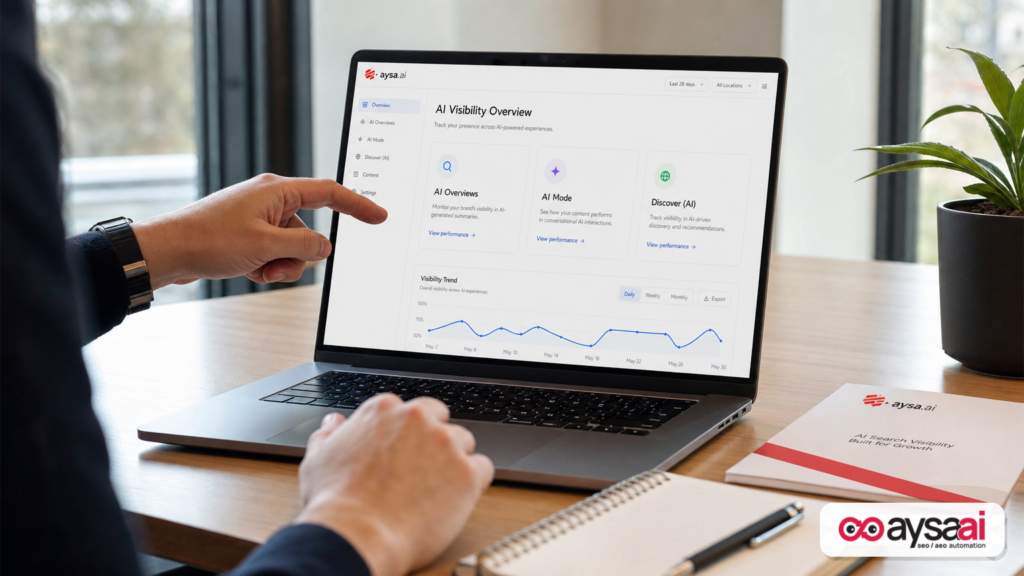
- What changed: GSC is rolling out a new Generative AI report showing impressions for your pages in AI Overviews, AI Mode, and AI features in Discover.
- Why it matters: AI impressions reveal which URLs Google uses for grounding its AI answers—an authority signal you’ve never had at this granularity.
- What to do: Treat AI impressions as a leading indicator; cross-reference with normal Search performance; then upgrade pages to win the next step (trust, differentiation, action).
- Risk: Misrepresentation, brand dilution, and “invisible wins” (your content is used, but your business doesn’t benefit).
- Where AYSA fits: AYSA monitors AI visibility signals, prepares prioritized fixes, asks for approval, and executes accepted changes—turning reporting into shipped improvements. See AI search visibility and monitoring.
Table of Contents
- What Google Changed: A New “Generative AI” Performance Report In GSC
- Why Google Is Sharing This Now (And What That Implies)
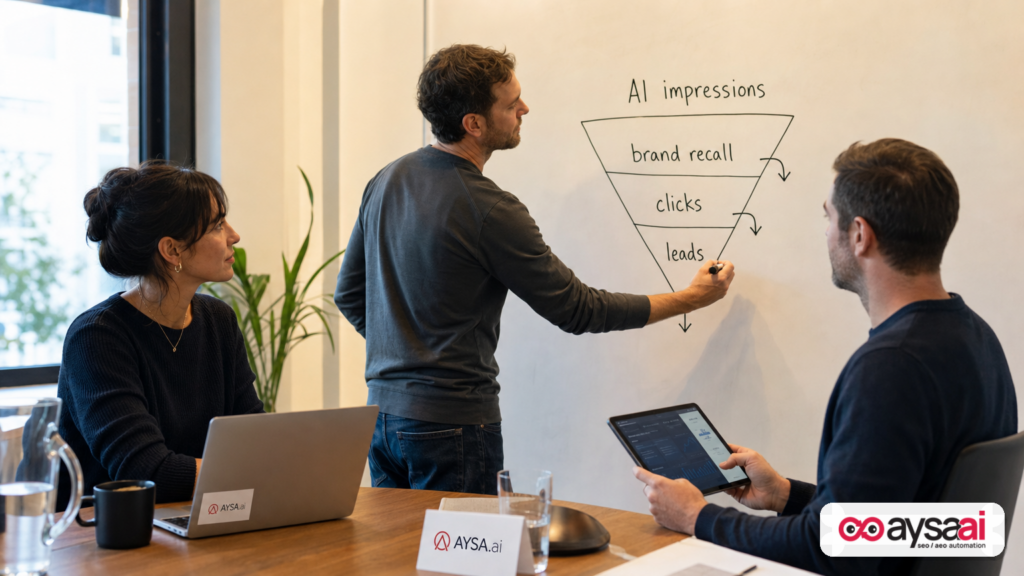
- The Metric That Matters Now: “AI Impressions” As A Leading Indicator
- How To Interpret The New Report Without Overreacting
- How To Segment Pages: The 4 Buckets That Drive Action
- How To Create Pages People Still Click When AI Summarizes The Answer
- SME Scenario: A Local Clinic That’s “Mentioned Everywhere” But Booking Fewer Visits
- What Agencies Should Rethink: Reporting, Retainers, And Deliverables
- The Opt-Out Toggle: Governance, Not A Knee-Jerk Move
- A Practical Workflow: From GSC AI Impressions → Decisions → Approved Execution
- What To Monitor Weekly (SMEs) And Monthly (Teams/Agencies)
- What To Do Next
- Sources And Further Reading
What Google Changed: A New “Generative AI” Performance Report In GSC
Google Search Console has long been the most important “truth source” for organic search measurement because it’s the closest you can get to first-party data about how Google is showing your site.
Now, according to the reporting discussed by Marie Haynes in Search Engine Journal’s coverage, Google is rolling out a new Performance section labeled “Generative AI” that surfaces impressions for your pages when they appear in:
- AI Overviews
- AI Mode
- AI features in Discover
It also supports filtering by things business owners already understand and can act on:
- Pages
- Countries
- Devices
- Date ranges
Even if Google only provides impressions (and not clicks/CTR/position) in this first iteration, it changes the conversation. Before, your “AI visibility” was mostly anecdotal: screenshots, rank trackers trying to approximate generative results, or customers saying “Google told me…”
Now you can answer: Which URLs are being pulled into AI experiences? That’s the starting point for strategy—and for execution.
Why Google Is Sharing This Now (And What That Implies)
Anytime Google gives the ecosystem more measurement, it’s rarely pure generosity. Search Engine Journal’s article points to regulatory pressure in the UK (notably the Competition and Markets Authority, CMA) pushing for more transparency and attribution, and it connects that to a new opt-out control surfacing in GSC.
Let’s be practical about what this means for businesses:
- Attribution is now a formal pressure point. When AI answers use publisher or business content, regulators and stakeholders want clearer linking and control.
- Google is signaling that AI features are “real search.” Not experimental side panels. Not a lab. A distribution surface that your content may depend on.
- You should expect more AI-era reporting changes. This is likely step one, not the finish line.
From my perspective at AYSA.ai, the biggest implication is operational: teams need to stop treating “AI search” like a trend and start treating it like a new measurement layer that affects content planning, technical hygiene, and brand governance.
Because if your content is used as a source in AI results, you’re already in the AI game—whether you’re ready or not.
The Metric That Matters Now: “AI Impressions” As A Leading Indicator
Business owners are trained to worship lagging indicators:
- Clicks
- Leads
- Revenue
Those matter. But when the platform shifts, leading indicators become your early warning system—and your early opportunity system.
AI impressions are a leading indicator of relevance and trust. They tell you: “Google is willing to cite or draw from this page when it generates an answer.”
That’s not the same as “Google ranks this page #1.” It’s closer to “Google thinks this page is a good ingredient.” Different game.
Why impressions still help (even without clicks)
Many marketers complained that impressions alone are not enough. They’re right—if you try to use the report like a classic SEO report. But that’s not how to use it.
Use it as a page selection and prioritization tool:
- Which pages should we protect? Pages that are used in AI features are now brand-critical—even if they’re not your highest traffic pages.
- Which pages should we upgrade first? If Google already sees them as helpful, a well-executed upgrade can turn “AI visibility” into “business outcomes.”
- Which topics is Google comfortable using us for? That can guide what you expand into next.
Then—and this part matters—cross-reference with your standard GSC Performance report. The SEJ coverage suggests exactly this: if a page has high AI impressions and also strong organic clicks, that page likely contains the “non-commodity” value AI can’t fully replace.
How To Interpret The New Report Without Overreacting
When new data appears, people do two unhelpful things:
- They panic and assume a decline is inevitable.
- They victory-lap impressions as if they were revenue.
Let’s set a cleaner interpretation model.
What an AI impression likely represents
Based on how GSC impressions typically work, an “impression” is counted when your URL is shown in a result surface. In generative features, “shown” could mean cited, linked, or used in a carousel/module. The exact counting mechanics may evolve, and Google may clarify over time.
Editorial guidance: Until Google publishes detailed documentation for this specific report (not included in the provided research context), treat AI impressions as directional rather than absolute.
Common mistakes to avoid
- Mistake 1: Treating AI impressions like rankings. Your page can be used in AI Overviews without being a top “10 blue links” result in the way you’re used to thinking.
- Mistake 2: Changing the wrong page. If your product page is getting AI impressions but your policy page is the one leaking trust, you’ll miss the real fix.
- Mistake 3: Optimizing for “being cited” instead of “being chosen.” Citations are nice. Bookings are nicer.
This is exactly where an execution system matters. Insight without changes is trivia.
How To Segment Pages: The 4 Buckets That Drive Action
To make AI impression data useful, you need a simple segmentation that produces decisions. Here’s a model we use in advisory conversations because it’s easy for SMEs and agencies to align on.
Bucket A: High AI impressions + high organic clicks
Interpretation: You have “non-commodity” pages. AI uses them, and people still click.
What to do:
- Protect these pages from accidental regressions (content rewrites, template changes, missing images, broken internal links).
- Upgrade them with what AI can’t provide easily: first-hand experience, original visuals, proof, calculators, checklists, comparisons, caveats, and clear next steps.
- Strengthen conversion paths (calls, forms, booking flows, demo CTAs) without making the page feel like a hard sell.
AYSA fit: Monitoring plus change governance—track performance shifts, propose upgrades, and execute accepted changes safely. See AYSA monitoring.
Bucket B: High AI impressions + low organic clicks
Interpretation: Google values the information, but the page is not winning the click—or the query intent doesn’t require a click.
What to do:
- Audit the snippet/brand promise: does the title/meta promise something specific enough to earn a click?
- Add a “reason to visit” that a summary can’t replace: downloadable templates, exact pricing ranges, step-by-step photos, interactive tools, or a decision framework.
- Evaluate whether the page should be a supporting page rather than a main landing page (and route internal links accordingly).
Bucket C: Low AI impressions + high organic clicks
Interpretation: Traditional SEO is working, but you are not being used in AI features. This is a future risk and a future opportunity.
What to do:
- Improve clarity and structure: headings, direct answers, definitions, and clean entity signals (without turning the page into a robotic FAQ).
- Build supporting content that makes your main page more “groundable.”
- Strengthen authority signals: demonstrate experience, include original data, show ownership (author info, organization info) where appropriate.
Bucket D: Low AI impressions + low organic clicks
Interpretation: The page is underperforming everywhere.
What to do:
- Decide: update, merge, redirect, or delete.
- Stop paying “content tax” (maintenance time) on pages that don’t serve customers.
- Use the freed time to build one exceptional asset.
This 4-bucket system is intentionally simple. It gets you to action fast.
How To Create Pages People Still Click When AI Summarizes The Answer
The SEJ coverage makes an important point: pages that keep getting clicked even when AI Overviews exist usually have something the overview doesn’t.
Let’s turn that into a practical checklist you can apply page-by-page.
The “non-commodity” checklist
AI summaries are good at synthesizing common knowledge. They’re weaker (or at least less trustworthy) when the user wants specificity, proof, nuance, or accountability.
To earn clicks in an AI-first SERP, build pages with:
- First-hand experience: real steps you took, mistakes you made, what you’d do differently, and why.
- Original visuals: your photos, your annotated screenshots, your diagrams, your before/after examples.
- Original research or primary evidence: even simple internal data summaries can be differentiating (avoid inventing stats; use what you can legitimately support).
- Decision support: comparison tables, “if/then” logic, what to choose based on constraints.
- Process transparency: how you do the work, what’s included, what’s not included, timelines, expectations.
- Local/operational specificity: service areas, licensing, scheduling constraints, on-site details, inventory realities—things a generic summary can’t reliably know.
- Risk and caveats: what can go wrong, who this is not for, when to talk to a professional.
How to write for AI visibility without writing “for AI”
There’s a trap here: you can try to reverse-engineer generative systems and end up with sterile pages that satisfy nobody.
Instead, aim for two layers:
- Layer 1: Clear, structured answers. A human and a model can quickly understand what the page is about.
- Layer 2: Deep value. The reason to click: proof, tools, context, or an actionable plan.
If you only do layer 1, you risk becoming pure “training data.” If you only do layer 2, you risk never being selected as a source.
The winners do both.
SME Scenario: A Local Clinic That’s “Mentioned Everywhere” But Booking Fewer Visits
Let’s make this real with a scenario I’ve seen repeatedly across local services (clinics, dental offices, physical therapy, med spas, urgent care, and specialty practices).
The situation
A local clinic notices:
- Patients mention “Google’s AI answer” recommended them.
- Brand searches are steady.
- But appointment requests from organic search are down.
In the new GSC Generative AI report, they see high impressions on:
- A generic “Services” page
- A blog post answering “Is X treatment safe?”
- A location page
What’s likely going wrong
AI Overviews can answer the informational part (“what is it,” “is it safe,” “who is it for”) without sending the click. That means your site must win at what comes next:
- Trust
- Differentiation
- Frictionless booking
If the page AI cites is thin, outdated, or vague, you can end up with the worst of both worlds: you’re visible, but you don’t convert.
A practical fix plan
- Upgrade the cited pages first: add clinician-reviewed content, clear disclaimers, and “what to expect” sections.
- Add proof that a summary can’t provide: facility photos, practitioner bios, licensing, and treatment-specific FAQs reflecting real patient questions.
- Improve the action path: booking CTA above the fold, insurance info, pricing ranges where possible, and a short “Is this right for me?” checklist.
- Measure properly: track calls, form submits, and booking completions; don’t rely on CTR alone.
AYSA fit: This is exactly the kind of workflow where “monitor → propose → approve → execute” wins. The clinic doesn’t need more advice; it needs changes shipped without breaking compliance or brand tone. Start with AI search visibility and then operationalize via AYSA AI SEO tools.
What Agencies Should Rethink: Reporting, Retainers, And Deliverables
If you run an agency or you’re the internal marketing lead managing agencies, this GSC change has a hidden message:
The unit of value is shifting from rankings to presence + influence + outcomes.
Rankings still matter, but generative features scramble the classic “we moved from position 5 to 3” narrative. Clients care about three things:
- Are we being cited/used?
- Are we getting chosen/clicked?
- Are we getting paid?
New deliverables to consider
- AI visibility audits: which URLs show in AI features, by country/device/time window.
- Page-level “reason-to-click” upgrades: not more posts—better assets.
- Conversion path optimization for cited pages: treat AI-cited informational pages as acquisition pages.
- Governance: when and why you’d consider opting out, and how you’d mitigate misrepresentation.
How retainers should evolve
In an AI SERP, the biggest failure mode is producing recommendations that never get implemented. Which is why agencies should productize execution—or partner with systems built for it.
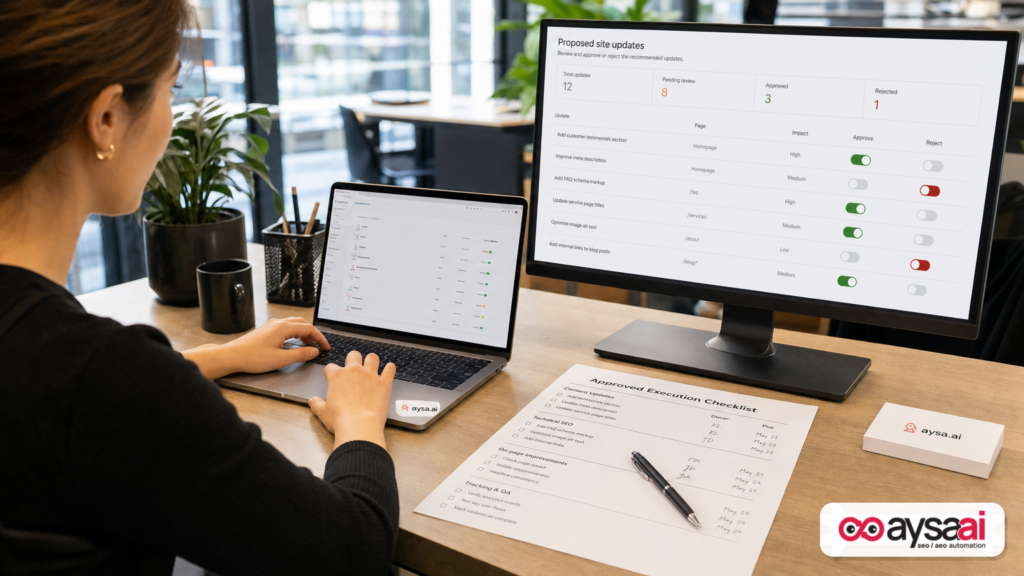
AYSA’s model is built around approved execution: we monitor, prepare prioritized website changes, ask for your approval, and then execute what you accept. This reduces the “strategy debt” that kills SEO in real businesses.
If you’re an agency, this can be layered on top of your strategy work to make sure fixes ship consistently. If you’re an SME, it reduces the burden of finding and coordinating multiple vendors.
Learn more at AYSA pricing and explore implementation ideas in the AYSA blog.
The Opt-Out Toggle: Governance, Not A Knee-Jerk Move
The SEJ coverage notes a new toggle in GSC allowing site owners to prevent their content from being used to power AI features. This is conceptually similar to the google-extended control, but surfaced in a more accessible UI.
Two truths can coexist:
- Some publishers and businesses may opt out on principle or due to repeated misrepresentation.
- For most commercial sites, opting out is close to opting out of the future of search distribution.
When would opting out be rational?
Without making claims beyond the supplied context, here are the business reasons that could justify exploring opt-out (with legal and brand counsel where appropriate):
- Persistent, harmful inaccuracies that you cannot correct through better on-site/off-site representation.
- Regulatory or compliance risk (certain medical, financial, or legal contexts) where summaries could mislead users and create liability exposure.
- Strategic positioning where you want to reserve content for paid, gated, or contractual distribution—rare for most SMEs.
Usually, the better move is: fix the inputs
If AI features are getting your brand wrong, the first move is typically not “leave.” It’s “improve the source material.” That means:
- Up-to-date service/product descriptions
- Clear policy pages (returns, shipping, guarantees)
- Accurate location and contact details
- Consistent brand messaging across the web
Execution wins here. This is the kind of work that can be monitored and shipped continuously rather than treated as a one-time audit. Start with monitoring.
A Practical Workflow: From GSC AI Impressions → Decisions → Approved Execution
Data becomes useful when it becomes a process. Here’s a workflow you can run monthly if you’re an SME, or weekly if you’re a larger team.
Step 1: Export the AI-visible page list
From the Generative AI report, pull the list of pages with the highest AI impressions for the last 28 days and last 3 months. (You want both: the short window shows recent shifts; the longer window reduces noise.)
Note: The SEJ piece mentions uncertainty about whether this will be available via the GSC API. Until that’s confirmed publicly, assume you may need to export manually.
Step 2: Cross-reference with standard GSC Performance
For each page, capture standard organic metrics from the regular Performance report:
- Clicks
- Impressions
- CTR
- Average position (directional)
Now apply the 4 buckets discussed earlier.
Step 3: Identify “missing value”
Use a simple diagnostic question (inspired by the SEJ article’s suggestion):
- What does this page have that an AI Overview doesn’t?
- Why would a human click?
If you struggle to answer, that’s your upgrade brief.
Step 4: Ship upgrades that increase choice, not just visibility
Prioritize upgrades that improve:
- Trust: experience, proof, transparency.
- Specificity: real constraints, real steps, real comparisons.
- Action: the next step is obvious and low-friction.
Where AYSA fits: This is the heart of our model. AYSA can monitor changes, propose page improvements, and then—crucially—ask for approval before executing. That governance layer matters for brands that can’t risk rogue changes. Explore the workflow at AYSA AI SEO tools.
What To Monitor Weekly (SMEs) And Monthly (Teams/Agencies)
The goal isn’t to stare at AI impressions all day. The goal is to detect shifts early and respond with high-leverage updates.
Weekly checks (SMEs)
- Top AI-impression pages changed? Any new pages appearing unexpectedly?
- Brand-critical pages gaining AI visibility? Make sure they’re accurate and updated.
- High AI impressions + declining clicks? Investigate whether the SERP is now satisfying the intent without a click, and add “reason-to-click” value.
Monthly checks (teams/agencies)
- Country/device splits: Are AI features affecting mobile differently? Are certain markets ahead?
- Content clusters: Which themes/topics are your “AI authority” zones?
- Conversion alignment: Are AI-visible pages mapped to a business goal (lead, sale, booking, demo)?
If you want to operationalize this beyond spreadsheets, start with an always-on monitoring layer: AYSA Monitoring.
The AYSA.ai Perspective: AI Search Is Forcing A New Discipline—Execution
In 2015, SEO was already competitive, but it was still largely “rank → click → convert.” In 2026, the loop is more complex:
- You can be used without being visited.
- You can be visible without being chosen.
- You can “win” impressions and still lose revenue.
That’s why this new GSC reporting matters. It exposes where Google is using you—and where you must upgrade your content and pages to convert that visibility into outcomes.
But here’s my strongest opinion: the winners in AI search will not be the teams with the prettiest dashboards. They’ll be the teams that can consistently ship improvements with quality control.
AYSA is built for that. We don’t just “suggest.” We:
- Monitor performance and visibility signals (including AI-era visibility where available).
- Prepare prioritized recommendations and concrete site changes.
- Ask for approval (governance and safety).
- Execute accepted changes on the website.
If you’re trying to turn AI search disruption into an advantage, start here:
What To Do Next
- Find the report: In GSC, look under Performance for “Generative AI” (availability may be rolling out by region).
- Export top AI pages: Capture top pages for last 28 days and last 3 months.
- Bucket the pages: Combine AI impressions with standard GSC clicks to classify into the four action buckets.
- Upgrade 3 pages first: Choose the highest-leverage pages and add first-hand proof, tools, decision support, and clear next steps.
- Protect brand-critical accuracy: Ensure AI-visible pages have updated facts, policies, hours, pricing ranges (if applicable), and contact paths.
- Operationalize execution: Use a system (like AYSA’s approved execution) to ship improvements monthly, not “someday.”
Sources And Further Reading
- Search Engine Journal – GSC’s New AI Overview Reporting: How Can We Use This Information?
- Search Engine Journal – Latest News (context on ongoing Google/AI reporting changes)
- Search Engine Journal – SEO (broader SEO context and analysis)
- Search Engine Journal – Google Algorithm Updates (history/context)
- AYSA.ai – AI Search Visibility
- AYSA.ai – AI SEO Tools
- AYSA.ai – Monitoring
- AYSA.ai – Pricing
- AYSA.ai – Blog
Continue the AI search topic inside AYSA.
Use these pages to connect the article with AI SEO tools, AI visibility monitoring, AI Overviews and approved website execution.
Turn this topic into a website action plan.
Use these AYSA hubs to move from reading to technical fixes, AI visibility monitoring, research, glossary context and approval-first SEO execution.