
Microsoft Opens Audience Ads to Crypto Exchanges: What It Really Means for Growth (and How to Execute Safely)
Microsoft is expanding Audience Ads eligibility for cryptocurrency exchanges in markets where crypto advertising is already allowed. That sounds like a simple policy update—but it changes how crypto brands can build demand, how performance marketers should structure full-funnel measurement, and how compliance teams must operationalize approvals across regions and creatives.

Microsoft quietly made a meaningful move for crypto advertisers: eligible cryptocurrency exchanges can now access Audience Ads inventory in all markets where Microsoft already allows crypto advertising—while keeping the same compliance requirements in place. The update was reported by Search Engine Land.
On paper, this is “just” an inventory expansion. In practice, it’s a signal that crypto marketing is evolving from a narrow, high-intent search play into a broader, full-funnel growth discipline—where measurement, creative testing, landing page governance, and region-by-region compliance become the real constraints.
I’m writing this as Marius Dosinescu from AYSA.ai, with a strong point of view: most teams won’t lose in crypto advertising because they lack bidding tricks. They’ll lose because they can’t execute safely at speed—across markets, pages, claims, tracking, and approvals. That is exactly where an “Approved Execution” system matters: monitor the site and campaigns, prepare changes, ask for approval, then execute what’s accepted.
Concise summary

- What changed: Microsoft now allows cryptocurrency exchanges (where permitted) to run Audience Ads, not just search placements—provided they meet existing policy requirements and local regulations.
- Why it matters: Audience inventory enables demand creation (awareness and consideration) alongside traditional demand capture (search intent).
- What can go wrong: Compliance and localization gaps, misaligned landing pages, weak measurement (especially view-through and cross-channel), and brand safety issues.
- What to do next: Start with a controlled test, tighten governance, build an auditable approval workflow, and connect paid media expansion to on-site execution.
Key takeaways (for busy operators)

- This is not “crypto ads got easier.” It’s “crypto ads got wider.” The scrutiny remains.
- Audience Ads changes the game for growth. You can reach people earlier in the decision cycle, not just when they search.
- Full-funnel requires different KPIs. You need a plan for assisted conversions, cohort behavior, and incrementality—otherwise you’ll over-credit the last click.
- Landing pages become the bottleneck. If your pages aren’t compliant, localized, and consistent, the best media plan won’t scale.
- Execution wins. The teams that can monitor, propose, approve, and ship improvements weekly will beat teams that “set campaigns and hope.”
Table of contents
- What changed: Microsoft expanded Audience Ads eligibility for crypto exchanges
- What Audience Ads are (and how they differ from search)
- Why it matters: crypto marketing is moving from “intent capture” to “demand creation”
- Who benefits most (and who should be cautious)
- The compliance reality: “More inventory” doesn’t mean “less scrutiny”
- Creative + landing page alignment: where most performance leaks happen
- Measurement: how not to lie to yourself with full-funnel ads
- How this interacts with search behavior and AI-driven discovery
- A concrete SME scenario: a mid-market crypto exchange expanding beyond search
- What agencies should rethink (and how to explain it to clients)
- An execution plan you can actually run (SME + agency friendly)
- Where AYSA fits: approved execution for regulated growth
- What to do next (checklist)
- Sources and further reading
What changed: Microsoft expanded Audience Ads eligibility for crypto exchanges
The update is straightforward but consequential: Microsoft is allowing cryptocurrency exchanges to run Audience Ads in all markets where Microsoft already permits crypto advertising—so long as advertisers comply with Microsoft’s Cryptocurrency and Related Products policies and local regulations. This was covered in Search Engine Land’s report.
Two important clarifications embedded in the announcement:
- It’s an inventory expansion, not a compliance relaxation. If you weren’t eligible yesterday, you’re not suddenly eligible today.
- It extends beyond search. Crypto exchanges can now participate in Microsoft’s broader native advertising network—where users are consuming content, not necessarily searching.
That second point is the strategic unlock. Search is great when demand already exists. Audience placements are how you build the demand that search later harvests.
What Audience Ads are (and how they differ from search)
Search ads are demand capture. A user types something like “best crypto exchange fees” and you appear (if you can bid, rank, and comply).
Audience/native ads are demand creation and demand shaping. Users are reading news, browsing content, or exploring partner sites. Your ad appears in context—often as a native placement—aimed at sparking interest or nudging consideration.
Operationally, this means:
- Different intent signals. Search intent is explicit; audience intent is inferred.
- Different creative expectations. Native placements punish generic, hypey messages. They reward clarity.
- Different measurement traps. Upper-funnel inventory produces more assisted conversions, longer cycles, and more cross-device journeys.
That’s why this Microsoft policy update matters: it’s not a new ad format—it’s a new growth motion being opened to a category that is heavily regulated and often constrained by ad platform rules.
Why it matters: crypto marketing is moving from “intent capture” to “demand creation”
Crypto advertising has often been boxed into a narrow performance loop:
- Bid on high-intent terms.
- Drive traffic to a sign-up page.
- Optimize CPA until it stops working.
That loop breaks for three common reasons:
- Competition drives up CPCs in the small set of “safe” eligible placements.
- Trust becomes the constraint. People don’t sign up for financial products instantly because an ad said “low fees.”
- Regulation and policy add friction. You can’t just rewrite copy daily without governance.
Audience inventory gives exchanges a way to build familiarity and trust earlier—if they can execute responsibly. That means educational angles, product clarity, transparent risk language, and localized compliance by market.
Also, there’s a broader marketing trend here. Search marketing is being reshaped by AI and new discovery patterns. Search Engine Land’s broader coverage in this period touches on AI performance reporting and AI visibility challenges (for example, Google Search Console AI performance reports and how Attribution is evolving in AI surfaces, like in this piece on tracking AI search visibility when attribution falls short). Even if your core acquisition is paid, your brand is being discovered and evaluated across more surfaces than ever.
Audience Ads is one more step in that direction: marketing that influences decisions before the click.
Who benefits most (and who should be cautious)
Crypto advertisers who benefit most
- Exchanges expanding into new (already approved) markets where Search volume is limited but content consumption is high.
- Brands with a differentiated story (security posture, transparency, product breadth, customer support) that needs more than a search headline to land.
- Teams with a real compliance workflow—not a last-minute legal review that blocks creative testing.
Who should be cautious
- Any exchange relying on aggressive claims that can’t be consistently supported on landing pages and help docs.
- Teams without measurement maturity. If you can only measure last-click conversions, you may kill the channel prematurely—or worse, scale it based on misleading signals.
- Organizations without localization capacity. Market-by-market variation is not optional in regulated categories.
The compliance reality: “More inventory” doesn’t mean “less scrutiny”
Microsoft’s update (per Search Engine Land’s coverage) explicitly maintains existing compliance requirements and local regulatory constraints. In other words: policy still drives eligibility.
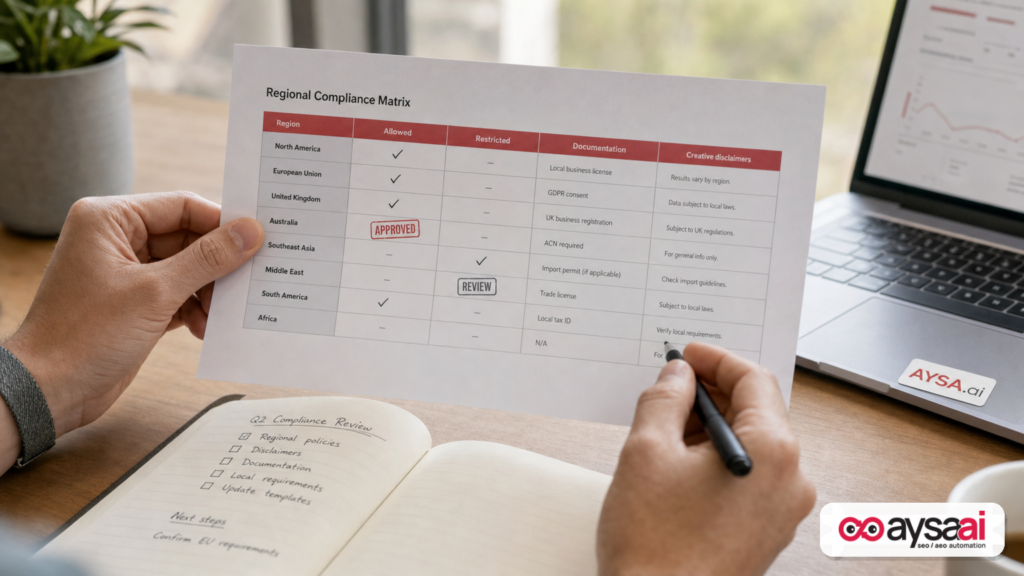
In regulated categories, compliance is not a department you “hand things to.” It’s a system you build. That system should answer:
- Which markets are allowed vs restricted?
- What documentation is required for each market?
- What risk language or disclaimers must appear in creative and on landing pages?
- What audiences must be excluded or treated carefully?
- What claims are never allowed (or require substantiation)?
There’s also a more subtle point: native inventory can magnify brand risk. Search ads are shown next to search results. Audience/native placements can appear alongside content. If you don’t manage exclusions, topic categories, and placement controls carefully, you can end up adjacent to content you don’t want to be near—especially in a category already under public and regulatory scrutiny.
This is not fearmongering; it’s operational reality. Treat brand safety and compliance as part of performance, not as overhead.
Creative + landing page alignment: where most performance leaks happen
When advertisers expand beyond search, they often try to reuse search-style messaging: short, transactional, “sign up now” prompts. That tends to underperform in native placements—and it can create compliance inconsistencies.
For crypto exchanges, landing page alignment usually breaks in four places:
1) Claim consistency
If an ad suggests “lowest fees” or “fastest withdrawals” but the landing page doesn’t clearly define terms, conditions, and scope, you’ll get policy friction and user distrust.
2) Risk disclosure and clarity
In finance-adjacent categories, clarity is Conversion rate optimization. You don’t want to bury disclosures, but you also don’t want to confuse users. The right pattern is usually: clear value proposition, clear explanation, clear next step, and accessible disclosures.
3) Geo-specific experiences
If eligibility varies by market, your landing experience must reflect that. Avoid sending everyone to a single global page if your product availability, onboarding flow, or legal language differs by region.
4) Post-click speed and trust signals
Native traffic can be less forgiving than search traffic. Slow pages, vague FAQs, and missing support details can tank performance.
This is where “marketing” becomes “execution.” If your landing pages aren’t updated quickly and safely, you can’t keep up with creative testing, market requirements, or platform feedback.
AYSA’s approach is built for this reality: monitoring what changes, preparing improvements, routing them for approval, and then executing accepted site updates. That reduces the gap between what campaigns need and what the website actually delivers.
Measurement: how not to lie to yourself with full-funnel ads
When you add Audience Ads, you’re adding a channel that often drives:
- More view-through influence (people see the ad, don’t click, later search and convert).
- Longer time-to-convert (especially for higher-friction onboarding).
- More cross-device behavior (see on mobile, convert on desktop later).
If you evaluate Audience Ads only by last-click CPA, you’ll likely conclude it “doesn’t work.” That’s not a guarantee it works—but it means your measurement model is incomplete.
Minimum viable measurement for SMEs
If you’re an SME exchange or a small agency team, you don’t need a PhD in attribution to start. But you do need a few non-negotiables:
- Clean naming conventions for campaigns/ad groups/ads so you can do basic analysis without chaos.
- UTM discipline (consistent source/medium/campaign) to reduce “direct/none” masking and to understand assisted behavior.
- Clear conversion definitions (account creation vs verified account vs first deposit vs first trade). Pick what matters, and track the funnel.
- Holdout mindset (even if informal): pause a region or audience segment and compare, rather than assuming correlation is causation.
Search Engine Land has also highlighted how attribution is getting harder as discovery shifts into AI and new surfaces. If you’re serious about growth, you’ll increasingly need methods that don’t depend entirely on last-click tracking. Their piece on tracking AI search visibility when attribution falls short is a useful reminder that modern visibility is broader than traditional analytics sees.
How this interacts with search behavior and AI-driven discovery
Even though this Microsoft update is a paid media policy change, it sits in the same macro trend as SEO and AI Search disruption: the journey is fragmenting.
Users might:
- See an audience/native ad while reading financial news.
- Later ask an AI assistant to compare exchanges.
- Then search branded terms to validate legitimacy.
- Then visit review sites, app stores, or social proof sources.
So the job of marketing becomes less “win the click” and more “win the evaluation.” This is where AEO/GEO (Answer Engine Optimization / Generative Engine Optimization) intersects with paid growth. If your brand messaging, product pages, and knowledge assets are inconsistent—or hard for systems to interpret—you’ll lose the evaluation step even if you win the impression.
At AYSA, we think about this as an execution loop: improve the website and content so that both humans and machines can understand it, monitor visibility shifts, and ship changes continuously. If you’re new to these concepts, start here:
Paid media doesn’t replace that foundation. It amplifies it.
A concrete SME scenario: a mid-market crypto exchange expanding beyond search
Let’s make this real with a scenario a non-SEO business owner can relate to.
Scenario
You run a mid-market cryptocurrency exchange with a lean team:
- 1 growth marketer managing search and paid social
- 1 designer (shared across the company)
- part-time compliance/legal support
- a product team that ships monthly
You’re already advertising on Microsoft search in eligible markets. It works, but growth is slowing because branded and high-intent terms are saturated and expensive. Now you can run Audience Ads in those same markets.
What you should not do
- Copy/paste search headlines into native ads.
- Send all traffic to your homepage or a generic sign-up page.
- Judge success in 7 days by last-click conversions only.
- Launch in every market at once without a compliance matrix and approval process.
What you do instead
- Create two landing paths:
- Educational path (what you are, how custody/security works, fees explained, support options, risk disclosures)
- Conversion path (sign-up optimized, with transparent steps and region-appropriate legal language)
- Run Audience Ads in controlled segments:
- Prospecting: content-aligned audiences + strict brand safety controls
- Remarketing: site visitors who didn’t complete onboarding
- Measure the funnel:
- Landing engagement (time on page, scroll depth)
- Account creation
- Verification completed
- First deposit / first trade (whatever is your real value moment)
- Operationalize approvals: every creative and landing page update gets a trackable approval step—so you can move faster without breaking rules.
This is exactly the type of workflow where AYSA helps: continuously monitor pages, prepare improvements (copy clarity, structured data, trust signals, internal linking, compliance placements), request approval, and then execute accepted changes quickly. See Monitoring and Pricing for how teams typically adopt this operational model.
What agencies should rethink (and how to explain it to clients)
If you’re an agency, Microsoft’s Audience Ads expansion for crypto exchanges changes the conversation you need to have with clients.
Shift from “channel management” to “growth system”
Clients often buy “PPC management.” But full-funnel success requires:
- creative production cadence
- landing page iteration
- compliance workflows
- measurement and reporting maturity
In other words, it requires execution beyond the ad account. This is where agencies can differentiate—or get squeezed.
The new retainer is governance + iteration
In regulated categories, the value is often:
- building a repeatable approval pipeline
- creating a “message map” that keeps ads, pages, and disclosures consistent
- shipping iterative landing page improvements
That’s also why “approved execution” matters. Instead of emailing docs back and forth, agencies can propose changes, route them for approval, and ship them—without stepping outside governance. This is the difference between doing marketing and operating marketing.
For more on how search and marketing work is evolving, Search Engine Land has published broader context on why traditional approaches can stall, like why so much SEO work no longer drives growth. Even though that piece is SEO-focused, the same business idea applies here: effort doesn’t equal outcomes if execution isn’t aligned to how discovery and evaluation actually happen now.
An execution plan you can actually run (SME + agency friendly)
Here’s a practical plan you can run in 30–60 days without pretending you have an enterprise analytics team.
Phase 0 (Week 1): Guardrails and readiness
- Confirm eligibility by market. Don’t assume one region’s rules apply elsewhere.
- Build a compliance matrix. Market → allowed products → required disclaimers → restricted audiences → documentation needs.
- Define “value moment.” What conversion actually matters? Account created? Verification? First deposit?
Phase 1 (Weeks 2–3): Landing pages that match the funnel
- Create one educational landing page that answers common trust questions.
- Create one conversion landing page optimized for onboarding.
- Localize critical compliance language where required.
This is where AYSA can help teams move faster without chaos: monitor what exists, prepare changes, request approval, execute. Start with AYSA’s AI SEO tools and Monitoring to establish a baseline and a continuous improvement loop.
Phase 2 (Weeks 3–6): Controlled Audience Ads test
- Prospecting campaign with conservative targeting and strong brand safety controls.
- Remarketing campaign focused on users who visited but didn’t complete onboarding.
- Creative testing: 3–5 variants that emphasize clarity over hype (product transparency, security posture, fee explanation, support availability).
Phase 3 (Weeks 6–8): Measurement review and scaling rules
- Report by cohort (new vs returning users, region, device).
- Look for lift in branded search and direct traffic as supporting signals (not proof, but useful context).
- Set scaling rules: increase budget only if both compliance stability and downstream funnel quality hold.
Where AYSA fits: approved execution for regulated growth
AYSA isn’t an ad platform. We’re an execution system for modern visibility—SEO, AEO, and the on-site foundation that paid media depends on.
Here’s how we fit into a Microsoft Audience Ads expansion for crypto exchanges:
- Monitor: Track site changes, visibility shifts, and content performance signals that impact acquisition quality. Start at Monitoring.
- Prepare improvements: Generate prioritized recommendations for landing pages and supporting content—clarity, structure, trust signals, internal linking, and machine-readable context.
- Ask for approval: Regulated categories require auditability. Changes should be proposed and approved before they go live.
- Execute accepted changes: Speed matters, but so does control. AYSA executes what you approve.
If your team is also thinking about brand presence in AI-driven discovery, we connect the dots between what your website says and how it can be interpreted across new search experiences. Learn more at AI Search Visibility.
And if you want examples and tactical guidance, our blog is where we publish execution-minded playbooks for teams that need results, not theory.
What to do next (action list)
- Confirm eligibility by market (and document it in a simple matrix).
- Build two landing paths: education + conversion, with region-aware compliance language.
- Start small with Audience Ads: one prospecting test + one remarketing test.
- Adopt minimum viable measurement: UTMs, funnel conversions, cohort reporting.
- Set brand safety controls before you scale.
- Operationalize approvals so compliance doesn’t become your growth ceiling.
- Implement an execution loop (monitor → propose → approve → ship). If you want that systemized, evaluate AYSA: Pricing.
Sources and further reading
- Search Engine Land: Microsoft expands Audience Ads eligibility for cryptocurrency exchanges
- Search Engine Land: Google Search Console AI performance reports and controls
- Search Engine Land: 4 ways to track AI search visibility when attribution falls short
- Search Engine Land: Why so much SEO work no longer drives growth
- AYSA: AI search visibility
- AYSA: AI SEO tools
- AYSA: Monitoring
- AYSA Blog
Note on policy specifics: Search Engine Land’s report references Microsoft’s cryptocurrency advertising policies and the requirement to comply with local regulations. This editorial does not reproduce Microsoft’s policy text; teams should review Microsoft Advertising’s official policy documentation directly within their Microsoft Advertising account or Microsoft’s official policy pages to confirm requirements for each target market.
Continue the AI search topic inside AYSA.
Use these pages to connect the article with AI SEO tools, AI visibility monitoring, AI Overviews and approved website execution.
Turn this topic into a website action plan.
Use these AYSA hubs to move from reading to technical fixes, AI visibility monitoring, research, glossary context and approval-first SEO execution.

