The Unwritten War in SEO: Old Agency Retainers vs AI Execution Systems
The real conflict in SEO is not agencies versus AI. It is the old retainer/reporting model versus faster systems that turn search work into approved execution.
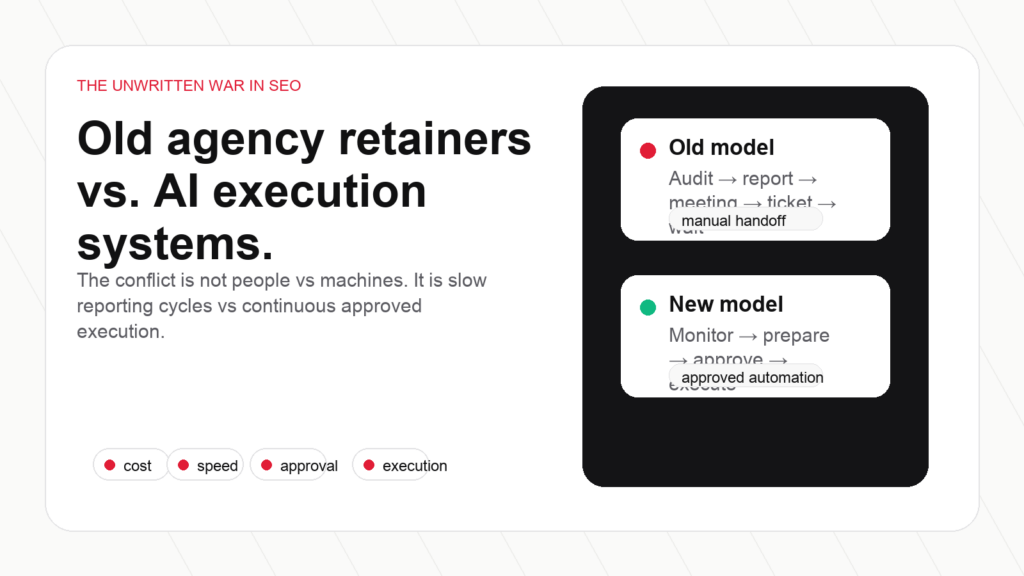
Executive summary: The SEO market is entering an unwritten war. Not a public war between agencies and AI tools, and not a simplistic “humans versus machines” story. The real conflict is between two operating models. The old model is built around retainers, audits, reports, meetings, manual tickets and slow implementation. The new model is built around continuous Monitoring, AI-assisted preparation, human approval and automated execution inside the website workflow.
This article is intentionally balanced. Good agencies are not obsolete. Strategy, judgment, brand understanding, technical experience and commercial thinking still matter enormously. But the traditional delivery model is under pressure because search is changing faster than manual SEO workflows can comfortably handle. AI Search, AEO, GEO, zero-click behavior, agentic discovery, technical complexity and content volume all increase the amount of work required. The question is no longer “who knows SEO?” The question is “who can execute the right SEO work fast enough, safely enough and consistently enough?”
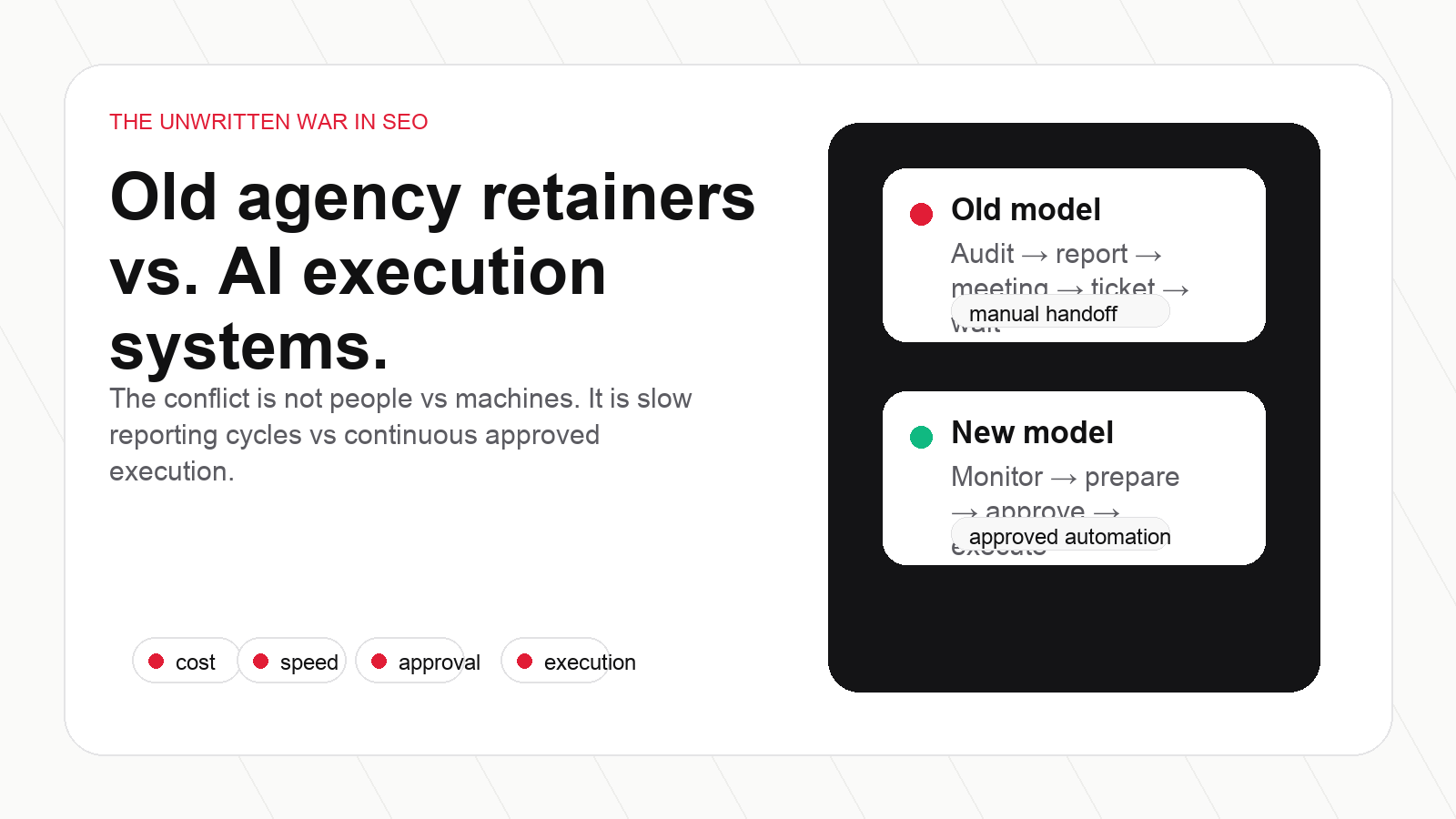
The core thesis: the war is about execution capacity
For years, the SEO market has been built around a familiar model. A business hires an agency or consultant. The agency performs an audit, sends reports, prepares a strategy, recommends actions, maybe writes content, maybe builds links, maybe asks developers to fix technical issues, and then both sides wait. Some work gets implemented. Some work gets stuck. Some work is forgotten. Three months later the report is refreshed and the cycle begins again.
This model can work when the business has budget, a capable internal team, a strong technical setup and a patient decision-making process. It breaks down when the business is small, the owner is not an SEO specialist, the website is full of WordPress problems, content needs are large, technical issues are recurring, and Google changes the search interface faster than the team can implement recommendations.
The old model was designed for a slower web. The new search environment is different. Google Search is filled with richer result types, AI Overviews, AI Mode experiments, local packs, shopping modules, video surfaces, zero-click behavior and more fragmented discovery. Search is no longer only about ranking for a Keyword. It is about being understood, cited, retrieved, compared and selected across classic search, answer engines and AI-assisted workflows.
That means SEO work is becoming more operational. A business needs ongoing keyword and topic monitoring, Search Console interpretation, content refreshes, schema maintenance, internal link improvements, crawl/indexation checks, technical fixes, authority building, AI Visibility Tracking, local/business profile consistency and action history. This is not a one-time report. It is a continuous execution system.
My view is that the next SEO winner is not the company that owns the prettiest dashboard. It is the company that turns information into approved action fastest. The old model sells advice. The new model sells execution capacity.
What the old agency model gets right, and where it breaks
It would be unfair and inaccurate to say agencies are the problem. Many agencies have built real expertise. Good SEO agencies understand markets, link profiles, site migrations, information architecture, local search, ecommerce, content quality and technical risk. They know when a recommendation is dangerous, when a ranking change is noise and when a client is chasing the wrong metric. That judgment is valuable.
The problem is not expertise. The problem is delivery shape. Traditional SEO retainers often bundle strategy, reporting, calls, content, technical recommendations and account management into a monthly package. That package has a natural limit: people hours. If the client needs hundreds of small page improvements, dozens of internal links, repeated meta rewrites, weekly Search Console interpretation, multiple technical checks, content briefs, review monitoring, authority opportunities and AI visibility tracking, the agency must either increase price, reduce depth or slow down execution.
This creates a quiet mismatch. The client buys “SEO growth,” but much of the retainer is consumed by analysis, communication and coordination. The work that directly changes the website may represent only a fraction of the monthly relationship. Agencies know this. Clients feel it, even if they cannot diagnose it. The frustration usually sounds like: “We have reports, but not enough actually changes on the website.”
There is also a knowledge problem. Many SMEs do not want to become SEO specialists. They do not want to learn canonical tags, crawl budget, schema, topical authority, AI visibility, hreflang, internal link equity or zero-click behavior. They want clear business outcomes: more relevant visibility, more qualified visits, more phone calls, more bookings, more sales, more authority and fewer technical surprises.
The old model often requires the client to interpret too much. The agency says what should be done. The client has to approve, chase, implement, check, coordinate with developers and decide what matters. In a market where search changes slowly, that may be acceptable. In the AI search era, it is too much friction.
Why pressure is rising now
Three forces are increasing pressure on the traditional SEO agency model: AI adoption, search interface fragmentation and implementation volume.
First, AI adoption is no longer theoretical. McKinsey’s 2025 State of AI survey reports that 88% of respondents say their organizations use AI regularly in at least one business function, up from 78% a year earlier. It also reports that 23% are scaling agentic AI systems somewhere in the enterprise, while another 39% are experimenting with AI agents. That means the largest organizations are already redesigning workflows around AI. SMEs may be slower, but the direction is clear.
Second, search behavior is changing. SparkToro and Datos’ 2024 zero-click study found that for every 1,000 Google searches in the EU, only 374 clicks went to the open web; in the U.S., the number was 360. The study also reported that nearly 60% of searches ended without a click. Not every industry is affected equally, and zero-click does not mean zero value. But it does mean that SEO must think beyond the old ranking-to-click model.
Third, implementation volume is rising. AI search requires better topic coverage, clearer entities, better structured data, more useful pages, stronger internal links, fresher content, better local and business information, stronger authority signals and better measurement. At the same time, technical SEO remains unresolved for many WordPress and ecommerce sites: plugin bloat, slow mobile performance, duplicate content, crawl waste, broken links, poor schema, redirect chains, sitemap problems and thin category pages.
The contradiction is obvious: SEO needs more execution while many delivery models are still built around manual work. This is why the agency model feels strained. It is not because agencies lack intelligence. It is because the work has become too continuous, too granular and too operational for a purely human handoff model.
The numbers behind the shift
SEO is not becoming cheaper in the traditional model. Ahrefs’ SEO pricing research, based on a survey of 439 SEO providers, found that monthly retainers are common and that agency retainers skew higher than freelancers. The exact market price varies by country and quality, but the pattern is consistent: professional SEO requires recurring budget because the work is ongoing.
That is reasonable. SEO is not a one-hour task. The issue is not that agencies charge for recurring work. The issue is what the client receives for the recurring budget. If most of the value is advice, reporting and meetings, the client may still face a separate implementation burden. If the retainer includes execution but is constrained by hours, the business may receive only a small number of changes each month.
In parallel, AI is becoming embedded in marketing workflows. HubSpot’s AI marketing research indicates that many marketers already use AI at work and that AI is moving from experimentation toward regular workflow support. McKinsey’s broader survey shows enterprise adoption accelerating. The pressure is not that AI replaces every expert. The pressure is that AI reduces the cost of producing drafts, analyzing patterns, summarizing data and preparing recommendations. Once those tasks get cheaper, clients naturally ask why execution is still slow.
Search economics are also changing. If fewer searches result in classic organic clicks, then SEO value must be measured more broadly: visibility, brand demand, citations, mentions, local actions, assisted conversions, AI referrals, direct traffic and conversion quality. That requires better instrumentation and faster feedback loops. Monthly PDF reporting is not enough.
For SMEs, the cost equation is brutal. A local business, ecommerce store, clinic, hotel, florist, car rental service or airport parking operator may need SEO desperately, but it may not have the budget for a premium agency, the time to manage a complex retainer or the expertise to judge every recommendation. These businesses need something between “do it all manually” and “hire a large agency.” They need an execution layer.
Eastern Europe: a market where the execution gap is visible
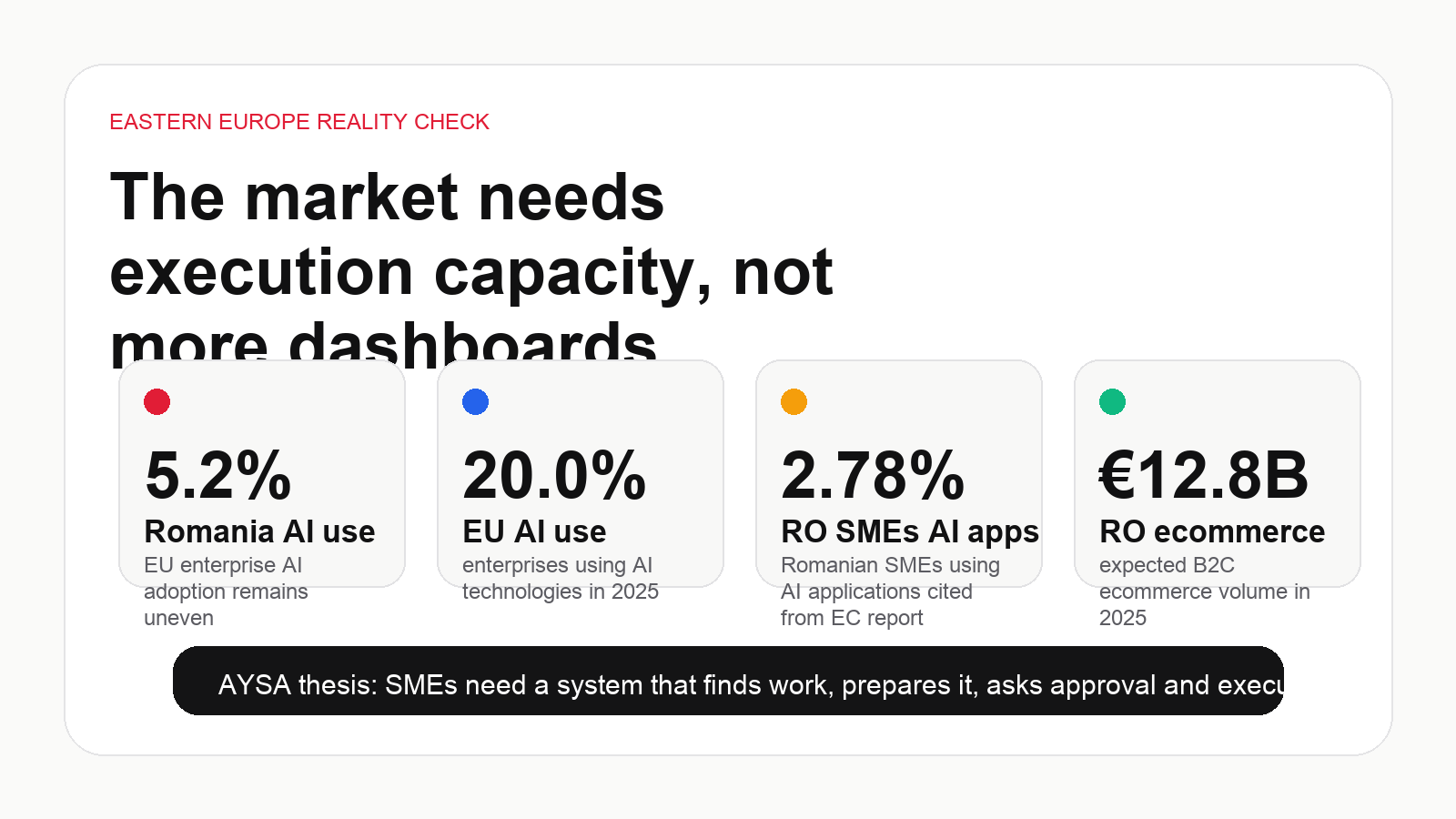
Eastern Europe is a useful lens because it combines strong entrepreneurial energy with uneven digital maturity. Romania is a good example. The ecommerce market is growing quickly: reports citing the European E-Commerce Report 2025 place Romania’s B2C ecommerce volume around EUR 12.8 billion in 2025, about 3.5% of GDP, ranking Romania 9th in Europe and 3rd in Central and Eastern Europe after Poland and Czechia. That is not a small market.
At the same time, digitalization gaps remain. Romanian media reports citing ARMO and the European E-Commerce Report note that only around 12% of Romanian SMEs sell online, below the European average. Eurostat’s 2025 AI adoption data shows that 20.0% of EU enterprises with 10 or more employees used AI technologies, but Romania was at 5.2%, Poland at 8.4% and Bulgaria at 8.5%, among the lowest in the EU.
This creates a very specific SEO problem. The market opportunity is real, but many businesses do not have the internal capability to execute at modern speed. They may have WordPress websites with heavy themes, slow hosting, plugin conflicts, poor content structure and weak tracking. They may depend on agencies for strategic advice but still lack implementation capacity. They may use ChatGPT for text, but not know how to connect that text to Search Console data, keyword mapping, internal links, technical fixes, schema and authority building.
In Romania and the wider region, the biggest SEO bottleneck is often not knowledge. It is operational maturity. Businesses know they should improve SEO. They know competitors are growing. They know AI is changing search. But they do not have the workflow to turn that awareness into weekly website improvements.
This is where the old model becomes fragile. A business that needs 300 small improvements cannot wait for a quarterly audit. A business that needs to compete in AI search cannot rely only on a content calendar. A business with technical debt cannot grow through articles alone. Eastern Europe needs affordable execution capacity, not only consulting.
The new model: approved SEO execution systems
The new SEO model is not “let AI do everything.” That would be reckless. The new model is approved execution. The system monitors data, identifies opportunities, prepares work, explains the reason, asks for approval and executes accepted changes inside the website workflow. Human judgment remains involved where it matters. The repetitive implementation burden is reduced.
This model changes the unit of value. Instead of paying mainly for hours, reports and meetings, the business pays for execution volume: research, monitoring, content briefs, page improvements, internal links, technical fixes, schema recommendations, content generation, authority opportunities and approved changes. The client still controls important decisions, but the system does the heavy lifting.
The difference is especially important for WordPress. A modern SEO execution system should understand the website, not just generate text. It should see which pages exist, which pages rank, which queries bring impressions, which titles underperform, which pages are orphaned, where internal links are weak, which schema opportunities match visible content, which redirects are needed and which technical issues block crawlability or indexability.
For AI search, the system should also think beyond classic SEO. It should monitor AEO and GEO signals, prepare answer-ready content, improve entity clarity, strengthen topical authority, identify brand and authority gaps, and help the website become easier to cite, recommend and compare. This is not a one-time migration. It is a continuous loop.
Approved execution is the middle ground between manual agency work and uncontrolled automation. It avoids blind autopilot while removing the endless copy-paste, ticket-chasing and report interpretation that slow down SMEs.
Traditional retainer loop
Audit, report, meeting, recommendation, ticket, wait, partial implementation, another report.
Approved execution loop
What happens to agencies?
Agencies do not disappear. But the agency role changes. The agencies that survive and grow will move up the value chain. They will focus more on strategy, positioning, creative differentiation, technical judgment, brand authority, complex migrations, experimentation, analytics interpretation and client education. They will use execution systems to scale the repetitive work.
The agencies that struggle will be the ones that sell reports as if reports were outcomes. If a client can use an AI execution system to identify and apply many routine SEO improvements faster and cheaper, a retainer based on manual reporting becomes hard to defend. The agency must provide judgment that the system cannot provide alone.
There is also a white-label opportunity. Agencies can use execution platforms to serve more clients without hiring linearly. A small agency could manage strategy and client relationships while an approved execution layer handles technical checks, content preparation, on-page improvements, monitoring and action history. That is not a threat to good agencies. It is leverage.
The uncomfortable truth is that the “SEO specialist as manual operator” role will shrink. The “SEO specialist as strategist, quality controller and systems thinker” role will grow. This is similar to what happened in many industries: automation does not remove expertise; it changes where expertise creates value.
What SMEs should choose
SMEs should not choose based on ideology. They should choose based on what they need. If a business has complex positioning, aggressive competition, legal risk, multi-market SEO or large technical migrations, a strong agency or senior consultant can be extremely valuable. If a business mainly needs consistent execution across research, on-page SEO, technical monitoring, content improvements and authority building, an AI execution platform may deliver faster value.
The best setup may be hybrid. A business can use an execution agent for continuous work and still bring in experts for strategy, audits, migrations, complex content governance or high-risk decisions. This is not a contradiction. It is a better allocation of human expertise.
Before choosing an SEO provider, an SME should ask practical questions: How many website changes will actually be made each month? Who implements them? How are approvals handled? Is Search Console connected? Are technical fixes tracked? Is content mapped to keywords and topics? Are internal links improved? Are authority opportunities explained before spending? Is action history visible? Are AI search and answer engine readiness considered? Can the business see what changed?
If the answer is mostly “you will receive a report,” the business should be careful. Reports are useful, but they are not growth. SEO growth comes from changes that improve the website, strengthen authority and help search systems understand the business.
Where AYSA fits
AYSA is built on the belief that SEO should move from research to approved execution. It is not an agency in the traditional sense and it is not a generic chat model. AYSA connects to the website context, Google data and approval workflow, then prepares actions the user can approve. After approval, AYSA can execute accepted changes inside the website workflow.
That matters for non-SEO users. The business owner does not need to learn every technical term. The agent explains what it found, what it recommends and why it matters. The user stays in control of important decisions while AYSA handles the operational work: research, technical SEO, on-page updates, content planning, AI visibility, monitoring and authority opportunities.
AYSA also fits the Eastern European reality. Many SMEs want growth but cannot afford slow, high-touch SEO operations. They need a system that reduces manual work, helps them compete with larger players and turns search recommendations into action. The product thesis is simple: less SEO busywork, more organic growth.
My opinion is that the future will not belong to “AI content factories” or to old reporting retainers. It will belong to execution systems with human control. The businesses that win will be the ones that learn faster, approve faster and implement faster without sacrificing trust.
Final take: the old model will not die, but it will be forced to evolve
The unwritten war in SEO is already happening. Clients are asking why reports do not become action. Agencies are asking how to deliver more without hiring endlessly. Tool vendors are adding AI features. Search engines are becoming answer engines. AI assistants are becoming research and decision interfaces. SMEs are stuck in the middle, needing more work done with less complexity.
The old agency model will not vanish. But it will become harder to sell slow execution as premium service. The new model will not replace human judgment. But it will make manual handoff workflows look increasingly outdated.
For business owners, the question is practical: do you want to buy SEO activity, or do you want approved SEO execution? If the answer is execution, then the next generation of SEO will look very different from the last one.
Less SEO work. More organic growth.
Move from SEO reports to approved website execution.
AYSA monitors your website, prepares SEO, AEO and AI visibility work, asks for approval and executes accepted changes inside your website workflow.
Sources and further reading
This analysis cites and interprets data from McKinsey’s 2025 State of AI survey, Eurostat’s 2025 enterprise AI adoption data, Ahrefs’ SEO pricing research, SparkToro and Datos’ zero-click search study, Romania Insider’s coverage of the European E-Commerce Report 2025, ZF English on Romania ecommerce volume, and HubSpot’s AI trends for marketers research. The AYSA sections are our product interpretation and do not claim guaranteed rankings, guaranteed AI Overview inclusion or guaranteed answer-engine citation.
Continue the AI search topic inside AYSA.
Use these pages to connect the article with AI SEO tools, AI visibility monitoring, AI Overviews and approved website execution.
Turn this topic into a website action plan.
Use these AYSA hubs to move from reading to technical fixes, AI visibility monitoring, research, glossary context and approval-first SEO execution.