The Personalized Internet Is Here: Why SEO Must Move Beyond the Average User
Search is becoming more personal, contextual and AI-assisted. Here is why SMEs need SEO and AEO execution built around real customer contexts, not one average keyword.
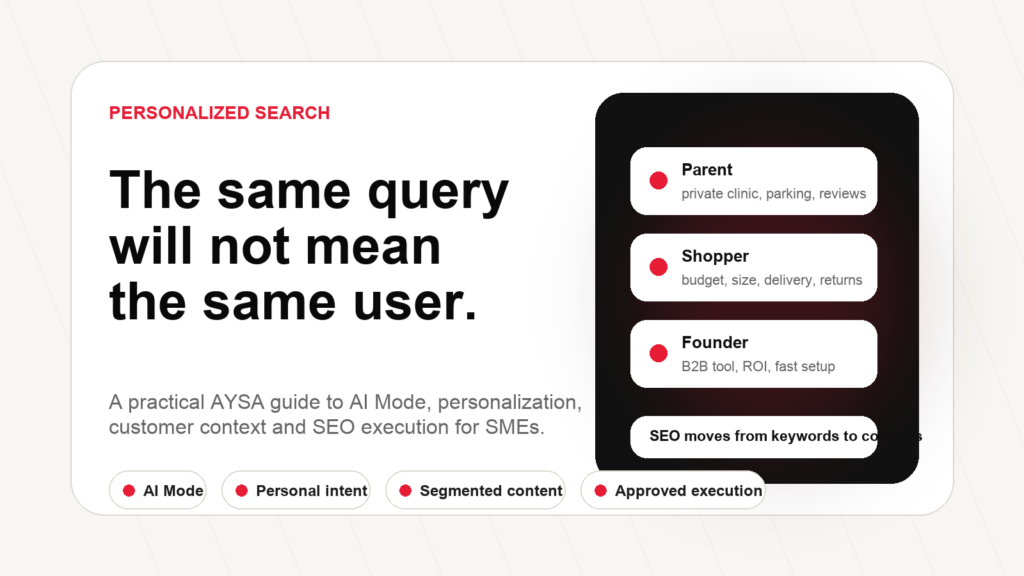
Executive summary: The internet is moving from one shared result page toward many context-aware experiences. Search results, AI answers, recommendations, maps, product suggestions and assistants increasingly depend on who is asking, where they are, what they want to do next, what device they use, what they have done before and what the system can infer from the query context.
That does not mean classic SEO is dead. It means the old habit of optimizing for one average Keyword and one average ranking position is no longer enough. A business owner does not need more abstract dashboards. They need a way to understand different customer situations, prepare content and technical improvements for those situations, approve the important changes and execute them consistently. That is exactly where an AI SEO execution agent like AYSA fits.
What changed: the web is becoming more personal, not just more intelligent
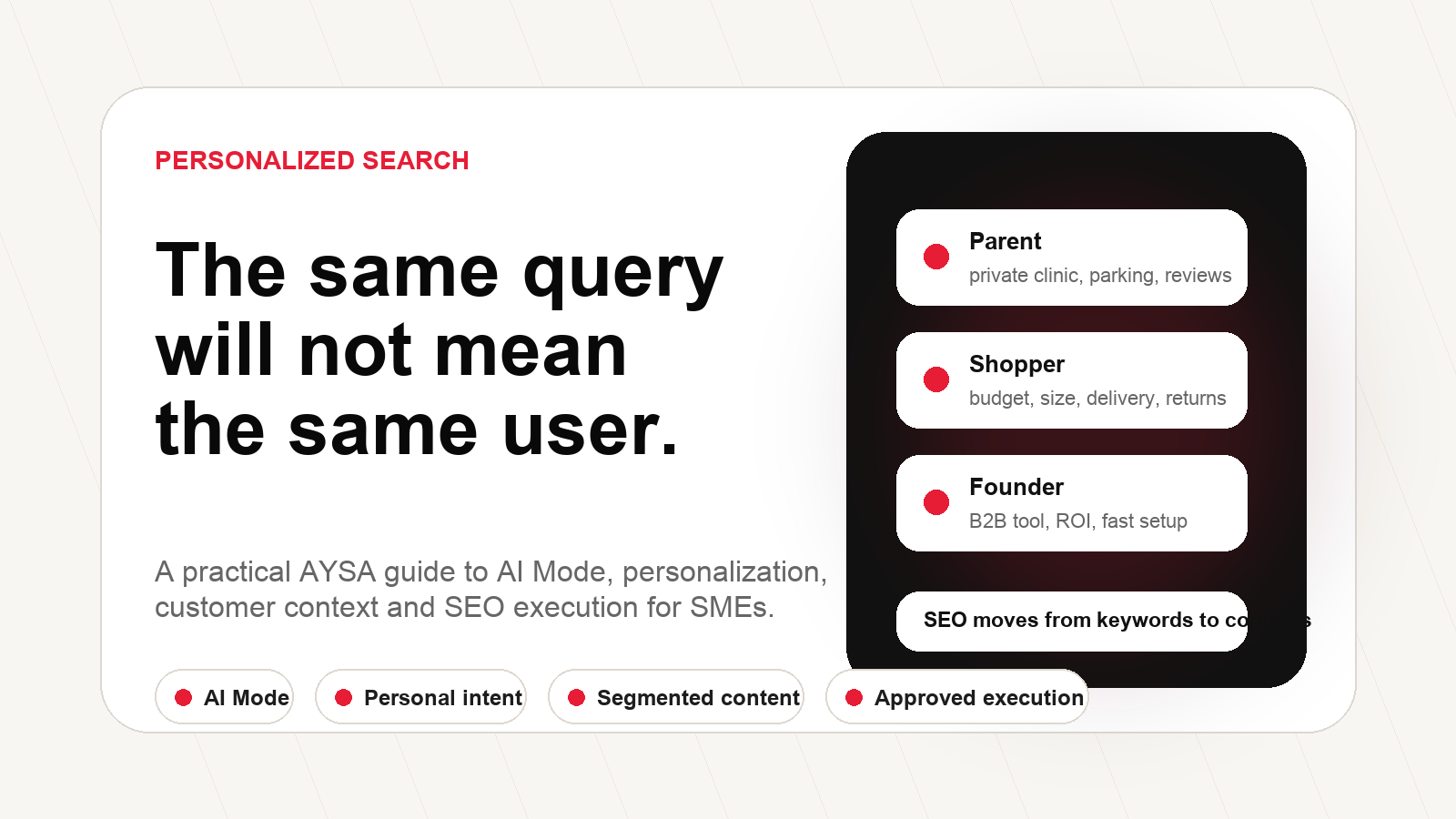
A useful way to understand the next phase of search is this: the web is becoming less like a fixed list of pages and more like a system that adapts to the user’s situation. Two people can ask the same question and need different answers. A parent searching for a pediatric clinic at 11 p.m. has a different intent from a parent comparing private clinics for a routine appointment. A florist buying SEO software has a different context from a SaaS founder trying to monitor AI visibility. A local business owner does not need the same answer as an enterprise SEO team.
The ProductLedSEO essay “The Personalized Internet Is Here” captures this shift well: the internet is moving toward individualized experiences, and businesses need to think beyond static pages written for a single generic visitor. I agree with the direction, but I would add a practical SEO layer: personalization becomes valuable only when the business can execute against it. Insight without execution becomes another report.
For years, SEO teams simplified the world into average metrics. Average ranking. Average CTR. Average Session Duration. Average Conversion rate. Average position. These metrics are still useful, but they hide the most important thing: people search from different needs, constraints and levels of readiness.
AI-assisted search accelerates this. AI systems do not only return “ten blue links.” They synthesize, compare, summarize, ask follow-up questions and sometimes act as an interface between the user and the web. The result is that websites need to be understandable at a deeper level: entities, offers, locations, prices, availability, policies, comparisons, proof, reviews, answers, risks and next steps all become part of the retrievable context.
The average user is a dangerous fiction
The “average user” is convenient for reporting, but it is weak for strategy. Nobody wakes up as an average user. People search because they have a specific job to do.
Consider a medical query. “Best pediatric clinic in Bucharest” may include several user contexts:
- a parent looking for urgent care tonight;
- a parent comparing private clinics for a toddler;
- a parent who needs online booking and parking;
- a parent looking for a specific specialty;
- a parent trying to avoid crowded hospitals;
- a parent who cares most about reviews and empathy;
- a parent who needs transparent prices before booking.
A generic page that says “we are a clinic in Bucharest” does not satisfy these contexts. A stronger page helps the user compare options, understand when to choose urgent care, evaluate doctors, see booking options, check location, read trust signals and make a decision.
The same principle applies to ecommerce. “Best running shoes” is not one query. It can mean beginner shoes, marathon shoes, wide feet, injury prevention, waterproof models, budget options, premium models, local availability or fast delivery. The old SEO habit was to build one big page and hope it ranks. The newer search reality pushes us to answer more precisely.
This does not mean every business should create thousands of thin pages. That would be the wrong lesson. The right lesson is to create useful content architecture: strong category pages, comparison pages, FAQs, guides, local pages, product detail pages, internal links and structured information that reflect real customer situations.
Old SEO habit
Pick one keyword, write one generic page, track one average ranking and wait for traffic.
Personalized search reality
Map real user contexts, prepare specific improvements, approve the work and execute continuously.
Google AI Mode and the personalization signal
Google has been moving Search toward more AI-assisted and context-aware experiences. In its public communication about AI Mode, Google describes a Search experience that can handle more complex questions, use advanced reasoning and help users explore topics with follow-up questions. Google has also discussed more personalized assistance across its products, including ways AI can use context when the user chooses to connect relevant information.
The important SEO point is not that every search result is fully personalized today. That would be an overstatement. The important point is directional: search interfaces are becoming more capable of interpreting context, intent and task depth. If the interface can understand more about the user’s situation, websites need to provide clearer, richer and more structured signals about the business.
Google’s own AI features guidance for website owners is still grounded in familiar fundamentals: make unique, helpful content for people, make pages crawlable, allow Google to access content, use Structured data when appropriate, keep snippets useful and avoid blocking important resources. The difference is that these fundamentals now matter in a more demanding environment. Content needs to be clear enough for humans and extractable enough for AI-assisted systems.
In practical terms, the website should answer questions such as:
- Who is this business for?
- What does it actually offer?
- Where does it operate?
- What makes it trustworthy?
- Which user problem does each page solve?
- What are the constraints, prices, service areas, booking steps or delivery rules?
- What should the user compare before deciding?
- What proof supports the claim?
These are not “AI tricks.” They are business clarity signals. AI search simply punishes vagueness faster.
What this means for SEO: rankings become a layer, not the whole system
Classic rankings still matter. If a page cannot be crawled, indexed or understood, it will struggle in classic search and AI-assisted search. But ranking reports alone are less complete than they used to be.
The future-facing SEO workflow needs several layers:
- Technical accessibility: search engines and AI systems must be able to crawl, render and understand the content.
- Entity clarity: the business, products, services, locations and people must be easy to identify.
- Intent coverage: pages must answer different stages of the customer journey, not only the obvious money keyword.
- Topical authority: the website needs enough useful coverage around the topic to be trusted as a source.
- Local and commercial proof: reviews, policies, prices, availability, case examples and comparison criteria matter.
- Internal linking: related pages should reinforce each other semantically, not sit as isolated articles.
- Freshness and monitoring: pages must be updated when the market, product, policy, algorithm or customer behavior changes.
- Approval-first execution: important changes should be reviewed before publication, then executed without manual busywork.
This is where many SMEs get stuck. They can read a report, but they do not have a system for turning the report into website changes. Agencies can help, but agency execution is often limited by time, budgets, communication loops and the amount of detail required. Traditional SEO tools can show data, but they usually leave implementation to the user.
Personalized search increases the execution burden. If you need content for more situations, internal links between more concepts, better structured pages, more frequent updates and stronger monitoring, the old manual workflow becomes too slow.
A practical playbook for SMEs
If you run a small or medium business, the personalized internet can sound intimidating. It should not. The goal is not to build a different website for every person. The goal is to make the website useful for the real segments you already serve.
1. Replace “keyword only” thinking with customer situations. Start with the real situations that bring customers to you. A clinic might list urgent care, routine appointments, parent concerns, location constraints and insurance questions. A florist might list weddings, funerals, same-day delivery, corporate flowers and seasonal gifts. A SaaS company might list setup, pricing, comparison, integration and troubleshooting needs.
2. Build pages that help decisions, not just rankings. A strong page should help users compare, understand and act. It should include criteria, examples, limitations, next steps and proof. For AEO and AI search, concise answer blocks and clear section headings are especially valuable.
3. Strengthen internal links by meaning. Link related pages because the user journey requires it, not because you need to stuff anchor text. A page about technical SEO should link to crawlability, indexability, canonical tags, Core Web Vitals, sitemap health and redirect strategy. A page about pediatric clinics should link to appointments, specialties, reviews, locations and pricing if those pages exist.
4. Make the business entity obvious. Search systems need to understand who you are. Keep business name, services, locations, contact details, opening hours, authorship, reviews and policies consistent across the website and external profiles.
5. Monitor changes continuously. Search behavior changes. Google changes. AI systems change. Competitors change. Customer expectations change. Content that worked last year may be incomplete this year. Monitoring is not optional anymore.
6. Approve important actions before execution. Automation should not mean blind publishing. Pricing, medical claims, legal statements, authority-building actions, technical redirects and major content changes need approval. The workflow should be: detect, prepare, explain, approve, execute.
One-size-fits-all content
“We offer professional services. Contact us for more information.”
Context-ready content
“Choose this service if you need same-day delivery, online booking, transparent pricing and local support in your city.”
How to measure SEO when results become more personal
Personalization makes measurement harder, but not impossible. It means you should stop pretending one metric tells the whole truth.
Useful measurement layers include:
- Search Console trends: impressions, clicks, CTR and average position by query, page, country and device.
- Segmented page performance: performance by page type, intent, location, category and funnel stage.
- AI visibility checks: whether the brand appears in AI answers, AI search interfaces, comparison answers and answer engines for relevant prompts.
- Conversion quality: leads, bookings, calls, checkout events, assisted conversions and qualified inquiries.
- Content coverage: whether the website covers the real questions customers ask before buying.
- Execution velocity: how quickly detected opportunities become approved website changes.
In my opinion, execution velocity is the underrated metric. A business that can detect a shift, update pages, improve internal links, add answer-ready sections and publish approved changes in days will beat a business that waits months for the next SEO meeting.
That does not mean speed replaces quality. It means quality needs an operating system.
The AYSA view: personalization turns SEO into an execution system
AYSA was built around a simple belief: SEO should move from research to approved action. The personalized internet makes that belief more important.
If every customer context matters, a business needs more than a static audit. It needs an agent that can understand the business, monitor performance signals, identify different user intents, prepare content and technical actions, ask for approval and execute accepted changes inside the website workflow.
For a non-specialist, the value is not “AI writes text.” That is too narrow. The value is that the agent can reduce the distance between opportunity and implementation. It can help answer questions such as:
- Which pages are too generic for the queries they receive?
- Which service pages lack the proof a buyer needs?
- Which topics are missing from our authority map?
- Which internal links should connect related pages?
- Which pages should be refreshed because the market changed?
- Which AI visibility gaps suggest the brand is not easy to cite or recommend?
- Which technical issues block crawlability, indexability or extraction?
The future of SEO is not a dashboard full of averages. It is a workflow that understands context and turns that understanding into approved execution.
That is why I would not frame personalization as a threat. I would frame it as a forcing function. It forces businesses to become clearer, more useful, more structured and faster at implementation. The winners will not be the companies with the most generic content. They will be the companies whose websites answer real user situations better than competitors and keep improving as search changes.
Search is becoming personal. Your SEO workflow cannot stay generic.
If you are still optimizing for one imaginary average user, let AYSA prepare the next actions.
AYSA monitors SEO, AEO and AI visibility signals, learns your business context, prepares intent-specific website actions, asks for approval and executes accepted changes inside your website workflow.
Sources and further reading
This article was inspired by ProductLedSEO’s “The Personalized Internet Is Here”. It was cross-checked against Google’s public Search guidance, including the Google Search Central guide to creating helpful, reliable, people-first content, Google’s AI features and your website guide, and Google’s public updates about AI Mode in Search. The AYSA sections are our editorial and product perspective. We do not claim guaranteed rankings, guaranteed AI Overview inclusion or guaranteed AI citations.
Continue the AI search topic inside AYSA.
Use these pages to connect the article with AI SEO tools, AI visibility monitoring, AI Overviews and approved website execution.
Turn this topic into a website action plan.
Use these AYSA hubs to move from reading to technical fixes, AI visibility monitoring, research, glossary context and approval-first SEO execution.