SEO Without a Hypothesis Is Just Busywork
A practical AYSA guide to hypothesis-led SEO: how to move from checklists and random tasks to measurable experiments, approved execution and real learning.
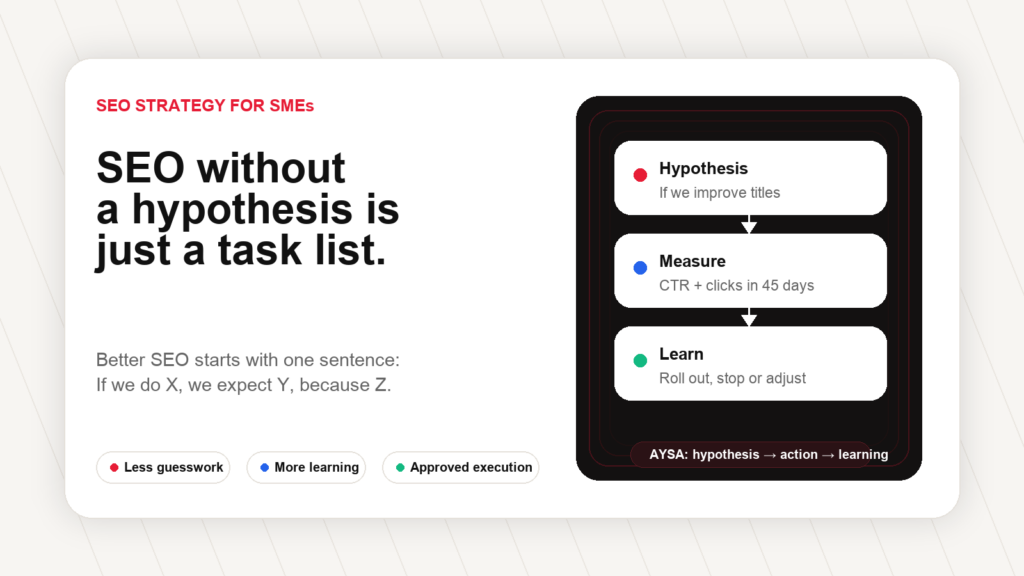
Executive summary: SEO work without a hypothesis often looks productive but produces weak learning. Teams update titles, publish articles, build links, fix technical issues and refresh pages because those tasks sound like SEO. The problem is that activity is not strategy. A hypothesis-led SEO workflow starts with a clear expectation: if we do this specific action, for this specific page or cluster, we expect this measurable outcome, because this user or search behavior is currently underserved.
This article was inspired by Eli Schwartz’s ProductLedSEO piece on SEO without a hypothesis. The AYSA view is that the future of SEO, AEO and AI visibility is not more random execution. It is connected learning: monitor signals, form a hypothesis, prepare the work, get approval, execute, measure, and decide whether to roll out, stop or adjust.
The problem with checklist SEO
Most SEO teams and business owners are surrounded by checklists. Add keywords to titles. Improve meta descriptions. Publish more articles. Build internal links. Fix 404s. Add schema. Refresh old content. Improve Core Web Vitals. Build backlinks. Monitor rankings. Every item can be valid in the right context. None of them is a strategy by itself.
Checklist SEO becomes dangerous because it creates the feeling of progress without proving anything. A business can spend months completing SEO tasks and still not know which actions changed performance, which pages mattered, which assumptions were wrong or which ideas deserve more investment.
This is especially painful for SMEs. A large company can absorb wasted motion. A small business cannot. If a local clinic, ecommerce shop, florist, parking service or B2B company spends limited money on SEO, the work must teach the business something. It should not only produce a report that says “we optimized 40 pages.” It should answer: what did we believe, what did we change, what happened, and what should we do next?
Eli Schwartz’s article argues that SEO needs hypotheses, not blind execution. I agree. In my opinion, the strongest SEO programs behave less like factories and more like learning systems. They still execute. They still publish. They still fix. But they keep a clear line between the reason for the work and the result of the work.
What a good SEO hypothesis looks like
A good SEO hypothesis is a testable statement. It does not need to be academic. It needs to be specific enough to guide action and honest enough to be falsifiable.
A simple format works well:
If we do X, for page or cluster Y, we expect result Z, because user/search behavior A is currently underserved.
For example:
- Title CTR hypothesis: If we rewrite title tags for pages with high Impressions and low CTR, we expect more Clicks within 30 to 60 days, because the current titles do not match the user’s decision language.
- Content gap hypothesis: If we create comparison pages for service categories where users search “best,” “near me,” “price” or “reviews,” we expect more qualified organic visits and assisted conversions, because the website currently only has generic service pages.
- Internal linking hypothesis: If we add contextual links from informational pages to commercial pages, we expect better crawl discovery and stronger conversion paths, because useful supporting content is currently isolated.
- Technical hypothesis: If we fix redirect chains and canonical conflicts on product categories, we expect cleaner indexing and more stable visibility, because Google is currently seeing duplicated or inefficient crawl paths.
- AEO hypothesis: If we add concise, reviewed answer blocks to service pages, we expect better answer-readiness and improved long-tail visibility, because users and AI systems need clear, extractable explanations.
The wording matters. “Improve SEO” is not a hypothesis. “Publish more content” is not a hypothesis. “Build authority” is not a hypothesis. Those are activities or outcomes. A hypothesis connects action, target, reason and measurement.
Weak task
“Optimize 50 meta titles.”
This can be useful, but it does not say why the titles matter, which pages are selected, what should happen or how success will be judged.
Better hypothesis
“If we rewrite titles for pages with high impressions and low CTR, we expect more clicks because the current titles do not reflect the searcher’s buying criteria.”
Examples for SMEs: where hypotheses become practical
For a small business, hypothesis-led SEO should not be complicated. It should make prioritization easier. Here are practical examples.
Private medical clinic. The clinic has service pages, but they are too generic. A useful hypothesis could be: if we add doctor proof, appointment process, location details, patient FAQs and medically reviewed answer blocks to priority service pages, we expect better qualified traffic and higher booking intent, because patients need trust and clarity before choosing a clinic.
Florist or local ecommerce business. The website has many product pages, but category pages are weak. A hypothesis could be: if we improve category pages with gift-use cases, delivery areas, seasonal intent and internal links to relevant products, we expect more non-branded organic revenue, because users often search by occasion and location rather than by product SKU.
Airport parking or car rental service. The website has price and service pages, but limited comparison content. A hypothesis could be: if we build pages that explain parking options, transfer time, airport proximity, booking process and trust signals, we expect more organic leads, because users compare convenience and reliability before booking.
B2B service company. The website has a homepage and a few service pages, but no proof-led content. A hypothesis could be: if we publish use-case pages that connect problem, process, outcome and objections, we expect more qualified demo requests, because the buyer needs to understand fit before contacting sales.
These examples share the same pattern. They start with a real user problem. They identify a missing or weak page experience. They propose a specific change. They define an expected signal. They can be measured after execution.
How to measure without fooling yourself
Measurement is where SEO hypotheses often break. Search is noisy. Rankings move for reasons outside your control. Google updates, competitors, seasonality, crawling, indexing, SERP features, AI Overviews, ads and local packs can all affect results. That does not mean measurement is impossible. It means you need to be careful.
Start with the right baseline. For SEO changes, Google Search Console is usually the first place to look because it shows impressions, clicks, CTR and average position for your verified property. The Search Console Performance report can help you compare queries, pages, countries, devices and dates. It is not perfect attribution, but it is a practical source of first-party search data.
Then define the measurement window. Title and meta changes may need several weeks. Technical indexation fixes may need crawling and reprocessing. New content may need months. Local SEO changes may show faster or slower depending on competition and review signals. AI visibility can be even less linear because answer engines may change retrieval behavior quickly.
A good measurement plan includes:
- Baseline period: what was performance before the change?
- Target pages: which pages were changed?
- Control pages: which similar pages were not changed?
- Primary metric: clicks, CTR, impressions, leads, rankings, bookings or conversions?
- Secondary signals: indexation, crawl activity, engagement, assisted conversions, brand searches or AI mentions?
- Decision rule: what result means roll out, stop or adjust?
The decision rule is important. Many teams measure only to produce charts. A hypothesis-led workflow measures to decide. If the result is positive, expand. If the result is negative, learn and stop. If the result is inconclusive, refine the hypothesis or wait for more data.
Hypotheses for AEO and AI search
AEO and AI search make hypothesis-led SEO even more important because the old “rank and click” model is not enough. Google’s own documentation on AI features and your website emphasizes that the fundamentals still matter: helpful, reliable content, crawlability, indexability, structured data where appropriate and a good page experience. But how users discover and evaluate information is changing.
For AEO, useful hypotheses might look like this:
- If we add concise answer sections to service pages, we expect better visibility for long-tail informational queries because the page becomes easier to extract and understand.
- If we clarify entity information such as brand, services, locations, people, prices and process, we expect stronger AI retrieval readiness because answer systems need unambiguous facts.
- If we connect related pages through contextual internal links, we expect better topical coverage because search and AI systems can understand the cluster more easily.
- If we update thin glossary pages with real examples and related concepts, we expect stronger semantic coverage because definitions alone are not enough for useful retrieval.
- If we improve authority signals and third-party references, we expect better trust context because the website is not the only source describing the brand.
No one should claim guaranteed AI Overview inclusion or guaranteed ChatGPT citations. That would be dishonest. But businesses can still test whether clearer content, stronger structure, better internal links and more credible authority signals improve their visibility across search surfaces.
The AYSA operating model: hypothesis, approved action, learning
AYSA was built because many businesses do not fail at SEO because they lack reports. They fail because recommendations do not become consistent, approved execution. Hypothesis-led SEO solves the first half of the problem: it makes the work smarter. AYSA solves the second half: it helps move from idea to approved action.
In the AYSA workflow, an agent can monitor Search Console, Analytics, website structure, technical issues, content gaps, AI visibility signals and authority opportunities. It can then propose a hypothesis: this page gets impressions but weak CTR; this cluster lacks topical coverage; this service page does not answer the user’s buying questions; this technical issue may block crawl efficiency; this authority opportunity could support a priority page.
The important part is what happens next. AYSA does not need the user to become an SEO specialist. It prepares the work, explains why it matters, asks for approval and can execute accepted changes inside the website workflow. That turns SEO from “someone should do this” into an operating loop:
- Detect a signal.
- Form a hypothesis.
- Prepare the change.
- Ask for approval.
- Execute the accepted action.
- Measure the result.
- Keep the learning for the next decision.
That last step matters. SEO memory is often terrible. Agencies change, employees leave, spreadsheets disappear, decisions are forgotten and the business repeats old experiments. A useful execution system should keep action history: what changed, when, why, who approved it, what result followed and what the next hypothesis should be.
In my opinion, this is where SEO is going. The old model was task-based: make a list and do the list. The better model is hypothesis-based: decide what you believe, test it, measure it and learn. The next model is agentic execution: the system helps detect, prepare, approve, execute and remember the work.
Less SEO guesswork. More organic learning.
If your SEO roadmap is just a list of tasks, let AYSA turn it into approved experiments.
AYSA monitors your website, prepares SEO and AI visibility actions, asks for approval and helps you measure what worked, so your next move is based on learning, not noise.
Sources and further reading
This article was inspired by Eli Schwartz’s ProductLedSEO essay “SEO without a hypothesis is just…”. Measurement recommendations were cross-checked with Google’s documentation for the Search Console Performance report, Google Search Central guidance on creating helpful, reliable, people-first content, and Google’s official documentation on AI features and your website. The AYSA sections are our editorial and product perspective. We do not claim guaranteed rankings, guaranteed AI citations or guaranteed traffic growth from any individual SEO test.
Continue the AI search topic inside AYSA.
Use these pages to connect the article with AI SEO tools, AI visibility monitoring, AI Overviews and approved website execution.
Turn this topic into a website action plan.
Use these AYSA hubs to move from reading to technical fixes, AI visibility monitoring, research, glossary context and approval-first SEO execution.