
How to Forecast SEO and AEO Growth Without Lying to Yourself
A practical AYSA guide to forecasting SEO and AEO growth using market size, search behavior, click potential, AI visibility and execution capacity.
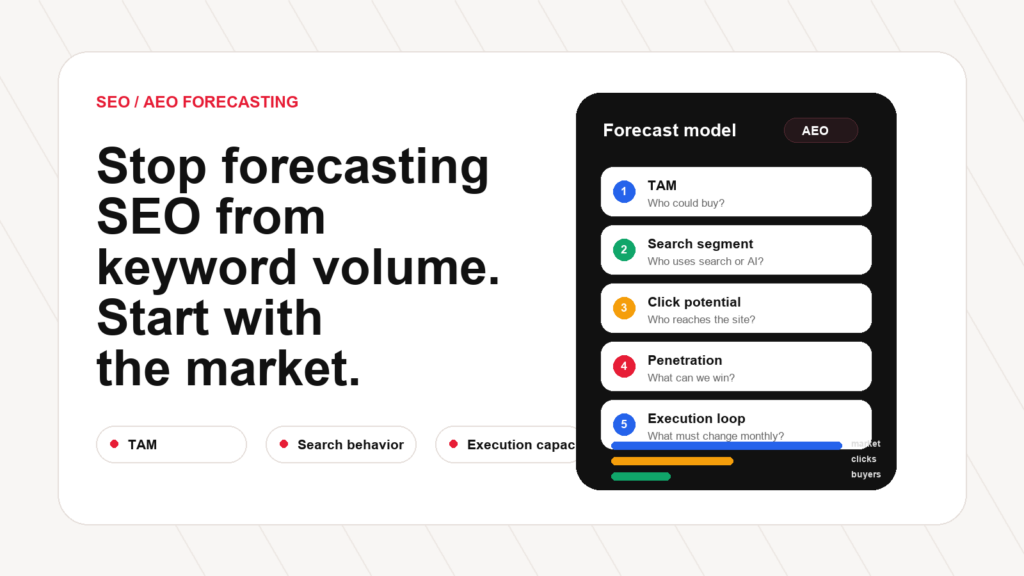
Executive summary: Most SEO forecasts are too confident because they start from Keyword volume, assume a ranking position, apply a generic CTR curve and pretend the result is a business forecast. That was already fragile in classic SEO. In the AI Search era, it is even weaker. Search demand is fragmented across Google, AI Overviews, AI Mode, ChatGPT, Perplexity, Gemini, marketplaces, social discovery and direct brand journeys. Clicks still matter, but they are no longer the only visibility event.
A better SEO/AEO forecast starts with the market: who could buy, how many of them use search or AI systems to decide, what share of that behavior is reachable, what pages or answers can influence the decision, and what execution capacity the business has. AYSA fits because forecasting is not only math. It is a promise about future execution. If the website cannot produce better pages, stronger internal links, technical fixes, authority signals and AI-ready answers, the forecast is just a spreadsheet fantasy.
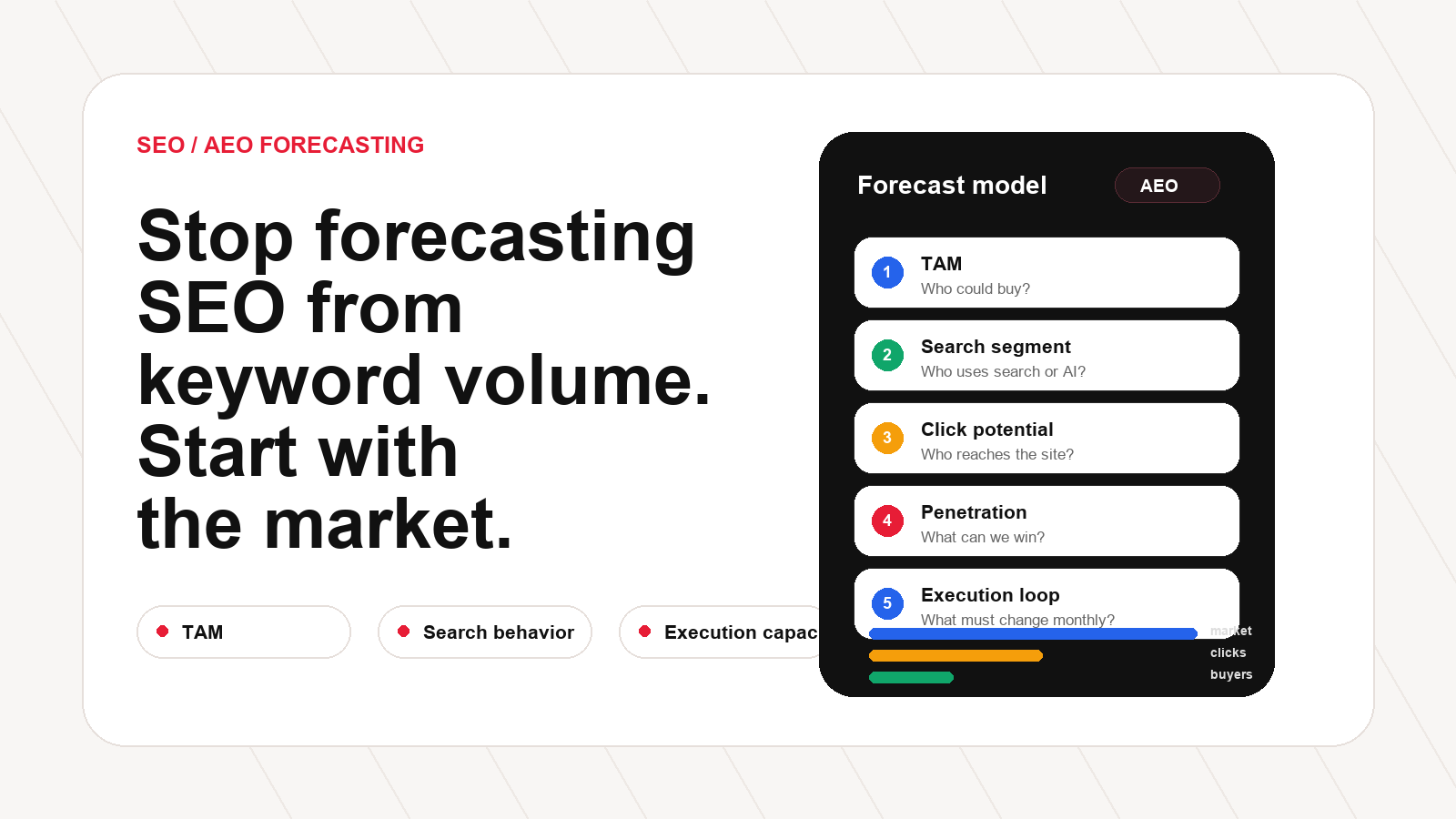
The forecasting problem: SEO numbers often look precise but are not reliable
SEO forecasting has always had a credibility problem. A spreadsheet can look serious while hiding assumptions that are extremely fragile. Take a keyword with 10,000 estimated monthly searches. Assume a page reaches position three. Apply a CTR curve. Multiply by Conversion rate. Add average order value. Now you have a revenue forecast.
The problem is that every step is uncertain. Keyword volume tools estimate demand, but they do not show the full market. Rankings vary by location, device, personalization, brand familiarity, SERP features and time. CTR curves are averages, not laws. AI Overviews, ads, local packs, shopping units, videos, forums and answer boxes change click behavior. Conversion rates depend on product-market fit, pricing, trust, availability and the quality of the page.
This does not mean forecasting is useless. It means forecasting should be honest. The goal is not to predict the future perfectly. The goal is to make better decisions: which topics deserve investment, which pages should be built or refreshed, which technical fixes matter, how much revenue might be influenced, and what execution work is required to make the opportunity real.
The ProductLedSEO article “How to forecast SEO/AEO growth” points in the right direction by moving away from keyword-only thinking and toward market-based forecasting. That is the correct upgrade. SEO and AEO are not only traffic channels. They are demand-capture and demand-assistance systems.
Why keyword volume is not enough anymore
Keyword volume is still useful. It helps us understand language, topics, seasonality and rough demand. But it is not the same as market size. It is also not the same as reachable opportunity.
There are several reasons keyword volume alone is weak:
- Many searches are invisible or undercounted. Long-tail queries, conversational prompts and zero-volume keywords can still bring qualified buyers.
- AI search changes behavior. Users may ask longer questions in AI Mode, ChatGPT or Perplexity instead of typing short keywords into Google.
- Searches do not equal buyers. Some queries are informational, some are navigational, some are comparison-based and some are ready to buy.
- SERP features absorb clicks. AI Overviews, local packs, ads, shopping results and answer boxes can reduce classic organic clicks.
- Brand and trust change outcomes. A known brand can convert with fewer clicks; an unknown brand may need more proof.
- Execution changes the forecast. A business with weak pages, slow site speed and poor internal linking will not capture the same opportunity as a business that executes well.
Google Search Console remains essential because it shows real impressions, clicks, CTR and average position for your site. But even GSC is not a full market forecast. It shows where you already appear, not everything you could influence. It also does not show every AI answer, every off-site brand mention or every assistant-style recommendation.
That is why the forecast needs layers.
Weak forecast
Keyword volume × ranking position × average CTR × conversion rate = revenue guess.
Better forecast
Market size × search/AI behavior × reachable visibility × execution capacity × conversion quality.
A better TAM-based model for SEO and AEO
A more mature model starts with TAM, or total addressable market. In simple terms: how many people or companies could realistically need the product, service or information you offer?
For SEO and AEO, we can translate TAM into a funnel:
1. Total market. How many potential buyers exist in the target geography or segment?
2. Search-assisted market. What percentage of those buyers use search, AI search, marketplaces, maps, social search or review platforms during the decision?
3. Relevant intent pool. Which queries, prompts and discovery moments indicate a problem your business can solve?
4. Reachable visibility. Where can your brand realistically appear: organic results, local packs, product pages, guides, comparison pages, AI answers, answer engines, publisher mentions, reviews and marketplace listings?
5. Penetration target. What share of that reachable visibility could you win within a realistic timeframe?
6. Click and attention model. How much of that visibility becomes visits, assisted visits, brand searches, direct visits, calls, bookings or store visits?
7. Conversion model. What percentage of those actions become leads, customers or revenue?
8. Execution requirement. What must be built, fixed, refreshed or approved to reach that target?
This model is more honest because it admits SEO is not just a ranking problem. It is a market access problem. The business needs visibility where decisions happen and content that helps the user move forward.
The AEO layer: forecasting visibility when the click may not happen
AEO forecasting is harder because answer engines and AI search systems can influence the user without sending a traditional click. A brand may be mentioned in an AI answer. A page may be cited. A product may be recommended. A local business may be included in a comparison. The user may later search the brand directly, call the business or visit a marketplace listing.
This means the forecast should include both direct and assisted outcomes.
A useful AEO model can include:
- AI mention potential: how often the brand could appear in relevant prompts;
- Citation potential: how often the website could be used as a source;
- Recommendation potential: whether the business is included in AI-generated option lists;
- Entity strength: how clearly the business is understood across the web;
- Answer readiness: whether pages contain concise, structured answers;
- Authority coverage: whether third-party sources support the brand’s claims;
- Assisted demand: increases in brand search, direct traffic, calls, email inquiries or assisted conversions.
Do not pretend these numbers are as clean as ecommerce revenue from paid search. They are not. But ignoring them is worse. If AI search becomes part of the customer journey, a forecast that only counts classic blue-link clicks will understate the value of being referenced, cited or recommended.
Inputs that actually matter in a real forecast
A serious SEO/AEO forecast should include a small set of inputs that can be updated as real data arrives.
Market inputs: target geography, buyer segments, business model, average order value, lead value, sales cycle, seasonality and buying frequency.
Search inputs: query groups, current impressions, current clicks, CTR, current ranking ranges, existing pages, missing pages, competitor coverage and SERP features.
AEO inputs: AI mention checks, citation checks, answer-engine visibility, prompt clusters, entity clarity and third-party authority sources.
Execution inputs: number of pages that can be created, refreshed or improved per month; technical fixes; internal links; schema improvements; content approvals; authority-building actions; and development capacity.
Conversion inputs: lead rate, booking rate, checkout rate, call quality, close rate, return rate and customer lifetime value.
Risk inputs: algorithm volatility, AI Overview changes, competitor investment, seasonality, dependency on paid traffic, indexation issues and content quality constraints.
The forecast should produce ranges, not fake certainty. A conservative scenario, realistic scenario and upside scenario are more useful than one heroic number.
A practical SME example
Imagine a private medical clinic in Bucharest. A weak forecast might start with “pediatric clinic Bucharest” keyword volume and estimate traffic from ranking in the top three. That misses most of the real market.
A better forecast starts with patient situations: urgent fever, routine checkups, private pediatric appointment, online booking, easy parking, good reviews, specific doctors, neonatal care, insurance, prices and after-hours availability.
Some of those users search Google. Some use Maps. Some ask ChatGPT or Gemini to compare options. Some look at reviews. Some ask friends. Some click ads. Some search the brand after seeing a recommendation. The website has to support all of that.
The SEO/AEO opportunity is not one keyword. It is a cluster of pages and signals:
- a strong service page for pediatric consultations;
- doctor profile pages with credentials and schedules;
- FAQ content answering parent concerns;
- local pages and maps consistency;
- reviews and reputation signals;
- schema markup that reflects visible content;
- comparison content that helps parents decide;
- internal links between symptoms, services, doctors and booking;
- technical performance so pages load quickly on mobile.
The forecast should estimate how many of these assets can be built or improved, how quickly they can be approved, and what visibility range they might influence. It should also track whether the work creates bookings, not only clicks.
This is where execution becomes the difference between a forecast and a plan.
The AYSA view: forecasting is only useful if you can execute the assumptions
From the AYSA perspective, the biggest forecasting mistake is not mathematical. It is operational. Businesses forecast growth from pages they have not built, technical fixes they have not implemented, content they have not refreshed, internal links they have not added and authority signals they have not earned.
AYSA is designed to close that gap. It can monitor SEO, AEO and AI visibility signals, detect opportunities, prepare the work, explain the business reason, ask for approval and execute accepted changes inside the website workflow.
That matters because every forecast contains assumptions. If the forecast assumes 20 new useful pages, AYSA can help prepare them. If it assumes better internal linking, AYSA can identify and propose links. If it assumes stronger answer readiness, AYSA can prepare FAQ sections and structured content. If it assumes technical health, AYSA can detect crawl, indexability, speed, sitemap, canonical and redirect issues. If it assumes freshness, AYSA can monitor decay and prepare updates.
In my opinion, the future of SEO forecasting is not a bigger spreadsheet. It is a connected execution system. Forecasting should tell the business where growth could come from. The execution layer should then make the work happen.
That is especially important for SMEs and non-specialists. They do not need a fantasy projection. They need a realistic growth model and a way to move from “we should do this” to “approved and published.”
Forecasts do not grow traffic. Execution does.
If your SEO/AEO forecast depends on pages, fixes and updates that nobody has time to implement, try AYSA.
AYSA monitors your website, prepares growth actions, asks for approval and executes accepted SEO, AEO and AI visibility improvements inside your website workflow.
Sources and further reading
This article was inspired by ProductLedSEO’s article on forecasting SEO/AEO growth. It was cross-checked with Google Search Console documentation for the Performance report, Google’s guide to AI features and your website, Google’s guidance on helpful content, and broader research on zero-click and AI search behavior from sources such as SparkToro and Pew Research Center. The AYSA sections are our editorial and product perspective. We do not claim guaranteed rankings, guaranteed AI citations or guaranteed traffic growth.
Continue the AI search topic inside AYSA.
Use these pages to connect the article with AI SEO tools, AI visibility monitoring, AI Overviews and approved website execution.
Turn this topic into a website action plan.
Use these AYSA hubs to move from reading to technical fixes, AI visibility monitoring, research, glossary context and approval-first SEO execution.

