
SEO Authority Building in Romania: Publisher Networks, Advertorials, Digital PR and the Adverlink Automation Layer
A deep, practical analysis of SEO authority building in Romania: publisher marketplaces, advertorials, press releases, risks, Google rules, quality criteria and how AYSA integrates with Adverlink for approved execution.
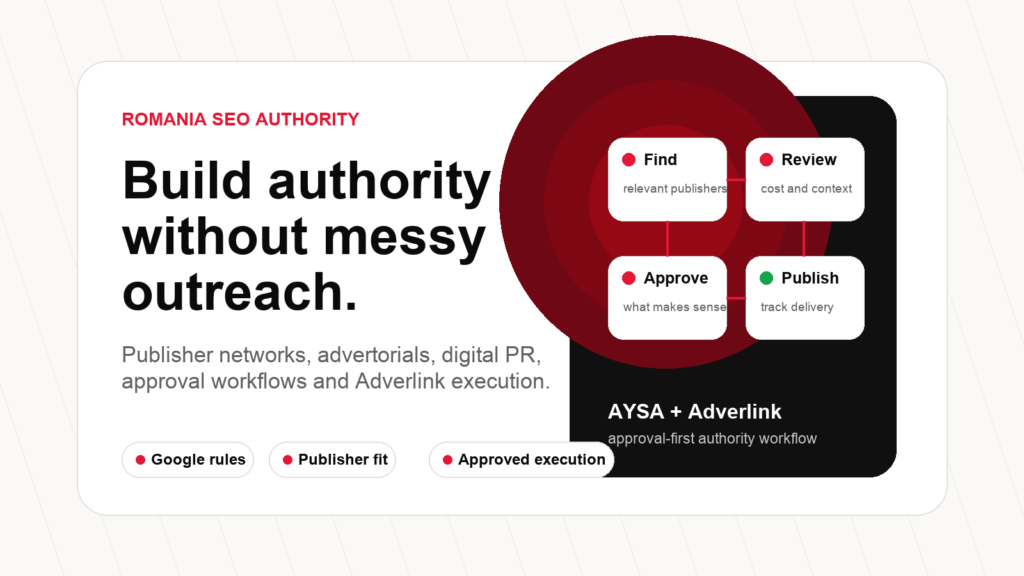
Executive summary: The Romanian market for Authority Building has moved far beyond cold Outreach and random advertorial buying. Today, businesses can use publisher marketplaces, native advertising platforms, press release distribution services, niche publications, Digital PR, sponsored articles and link insertion workflows. The opportunity is real, but so is the risk: low-quality placements, irrelevant publishers, aggressive Anchor text, duplicate articles, poor disclosure, tracking chaos and campaigns that create links without building trust.
This article uses the term SEO authority building, not “link buying,” because the mature version of the practice is not about buying a URL on a page. It is about earning and funding relevant visibility across the web, documenting why a placement makes sense, approving spend, publishing with quality controls, qualifying sponsored links where needed, and tracking delivery. That distinction is exactly why AYSA.ai is integrated with Adverlink.net (HTTPS://adverlink.net/): to make authority workflows faster, more controlled and less dependent on manual emails, spreadsheets and follow-up.
Romania has an authority-building market, but most SMEs still experience it as chaos
If you run an ecommerce store, a medical clinic, a local service company, a SaaS product or a B2B business in Romania, you eventually hear the same advice: “you need links,” “you need advertorials,” “you need authority,” “you need PR,” “you need mentions.” The advice is not entirely wrong. Search engines and AI-assisted systems use signals from across the web to understand whether a brand, website, entity or page deserves attention. A business that is never mentioned, cited, reviewed or referenced outside its own website is harder to understand as a trusted market participant.
The problem is that the Romanian market often compresses this whole subject into a crude transaction: buy an advertorial, get a link, wait for ranking. That model is too shallow. It ignores relevance, topic fit, editorial context, user value, disclosure, link attributes, brand positioning, authority distribution, tracking and the business reason for the placement. It also encourages the worst behavior: placing almost identical articles on unrelated websites, using unnatural anchors, buying from random lists, and measuring only how many links were delivered.
A better name is SEO authority building. Authority building includes Link Building, but it is broader. It includes publisher relationships, niche articles, digital PR, expert commentary, sponsored educational content, citations, Brand Mentions, local visibility, ecommerce category support, founder visibility and thought leadership. In Romania, this can involve a business magazine, a niche ecommerce publication, a local news site, a vertical blog, a specialist directory, a press release network or a publisher marketplace.
For small and mid-sized businesses, the hard part is not only finding these opportunities. It is deciding which ones are worth paying for, understanding the risk, writing a useful article, approving the budget, tracking whether the article was published, checking the link, and connecting the placement back to SEO goals. That is where most manual authority workflows break.
The main authority-building channels in Romania
The Romanian market has several practical channels. They overlap, but they are not identical. A business that understands the difference can choose more intelligently.
Publisher marketplaces are platforms where advertisers can discover websites and publications that accept paid content, sponsored articles or advertorial placements. The value is speed, inventory visibility and operational structure. Platforms such as WhitePress Romania (https://www.whitepress.com/ro/) present themselves around content marketing and publisher access. Their role is to make it easier to order content distribution at scale, instead of negotiating each placement from scratch.
Self-service advertorial platforms reduce the friction of buying native content placements. Romanian examples include platforms and services around Publyo, Advertoria and similar ecosystems. Publyo has been publicly described as a Romanian SaaS platform for self-service marketplaces for advertorials and press releases, which is important because it shows the market moving from manual brokerage toward software-led publishing workflows.
Press release distribution is a different layer. A press release may be useful for announcements, launches, investments, partnerships or company milestones. Sites like ComunicateDePresa.ro operate in the press-release/public communication space. The SEO value of a press release depends heavily on context, publication quality, indexing, duplication, link qualification and whether the announcement is genuinely newsworthy. A press release is not automatically an authority strategy.
Digital PR is closer to earning editorial attention: data stories, founder commentary, company milestones, research, case studies, market opinions, interviews, expert quotes and unique perspectives. This is usually harder than buying an advertorial, but it can build stronger brand trust. In Romania, a founder interview in business media, a useful market report or a relevant ecommerce story can have more long-term value than ten generic paid posts.
Niche placements matter because topical relevance matters. A flower ecommerce brand does not need only high-DA general news sites. It may benefit from lifestyle, wedding, local delivery, gifts, events and ecommerce-related contexts. A private medical clinic should be far more careful, because healthcare content is sensitive and must avoid irresponsible claims. A SaaS SEO product should prioritize marketing, ecommerce, technology, business and publisher ecosystem contexts.
Link insertions and content edits can be legitimate when they improve an existing relevant article and are handled transparently, but they are also easy to abuse. A placement in an old article that has no topical fit and uses an exact-match anchor purely for ranking is risky and weak. A relevant reference that helps readers understand the topic can be different, especially when sponsorship or relationship rules are handled correctly.
What Google actually says about paid links and sponsored content
Any serious authority-building article must start with Google’s rules, not with agency folklore. Google’s spam policies explicitly describe link spam (https://developers.google.com/search/docs/essentials/spam-policies#link-spam) as links intended to manipulate rankings, including buying or selling links for ranking purposes. Google also provides guidance on how to qualify outbound links (https://developers.google.com/search/docs/crawling-indexing/qualify-outbound-links) using attributes such as rel="sponsored", rel="nofollow" and rel="ugc".
This does not mean businesses cannot advertise, sponsor content, run PR, pay publishers or distribute announcements. Advertising and sponsored content are normal parts of marketing. The issue is whether links are being used to manipulate organic ranking signals without qualification, disclosure or editorial integrity. In other words: the problem is not that a business paid for visibility. The problem is pretending that a paid editorial relationship is an organic editorial vote and then over-optimizing it for ranking.
For Romanian SMEs, the practical rule is simple: authority building should be treated as marketing plus SEO governance. Pay for visibility when it makes business sense. Choose relevant publishers. Avoid manipulative anchors. Avoid networks that publish anything for anyone. Use sponsored or nofollow attributes where appropriate. Keep the content useful. Track the work. Do not promise guaranteed rankings from a placement.
This is also why a platform workflow is not enough by itself. A marketplace can help with access and ordering, but the business still needs judgment. Is this publisher relevant? Is the article useful? Does the anchor make sense? Is the page indexable? Is the placement disclosed properly? Is the link attribute appropriate? Does the article support a real content cluster? Does the placement build brand trust or only add one more URL to a spreadsheet?
What a good Romanian authority placement should pass before approval
A placement should not be approved just because the domain looks strong. Domain metrics can be useful screening signals, but they are not strategy. A page can come from a strong domain and still be irrelevant, thin, non-indexed, hidden, poorly written or risky. The more mature checklist starts with business fit.
Topical relevance: the publisher, section and article topic should make sense for the business. A Romanian ecommerce platform can publish about category strategy, shopping behavior, product guides, consumer trends or market education. A clinic can publish medically reviewed education or company news, but it should avoid irresponsible health claims. A SaaS product can publish about workflow automation, SEO operations, AI visibility, ecommerce growth or agency productivity.
Reader usefulness: the article should help a real reader. A sponsored article that is only a disguised anchor-text vehicle is weak. A useful article explains a problem, gives context, presents examples and connects naturally to the brand. If the page would be embarrassing to share with a customer, it is probably not a good authority asset.
Placement context: the page should be accessible, indexable, not orphaned, not buried in a spammy category and not surrounded by unrelated casino, loan or adult content. The publisher’s editorial environment matters.
Anchor discipline: exact-match anchors should be used carefully. Natural anchors, branded anchors, URL anchors and contextual references are often safer and more believable. The goal is not to force the phrase “best SEO automation tool” into every link. The goal is to build a believable web of references around a brand, product and topic.
Disclosure and link qualification: sponsored placements should follow the publisher’s rules and Google’s guidance. If a link is sponsored or paid, it may need to be qualified as sponsored or nofollow depending on the relationship and editorial policy. Pretending the relationship does not exist is not a durable strategy.
Tracking: a placement should not disappear into a report. Track URL, publication date, target page, anchor, link attribute, indexability, topic, cost, responsible workflow and follow-up. Without tracking, authority building becomes accounting, not SEO operations.
Where AYSA and Adverlink fit: from authority recommendation to approved publication workflow
AYSA’s role is not to blindly buy links. That would be the wrong message and the wrong product. AYSA’s role is to connect authority building to the same operating model used across the rest of SEO execution: monitor, prepare, explain, ask for approval, execute accepted work and track outcomes.
The integration with Adverlink.net (https://adverlink.net/) matters because authority building is one of the slowest and most operationally messy parts of SEO. Without a workflow, a business must identify publishers, request prices, negotiate, brief writers, approve copy, chase publication, check the link, store invoices, track status and remember which page was supported. For a small business owner, this is too much. For an agency, it becomes repetitive project management. For an AI SEO agent, it becomes a perfect candidate for controlled automation.
In a healthy AYSA + Adverlink workflow, the agent can detect where authority support may be useful, such as a commercial page with relevant content but weak external validation, an ecommerce category that needs stronger topical proof, a local business that lacks mentions in relevant Romanian publications, or a new content hub that needs distribution. AYSA can then prepare recommendations, explain why the opportunity matters, show the business context and ask for approval before any additional spend or authority action.
After approval, Adverlink can support the publisher execution layer: matching opportunities, moving the placement toward publication and tracking delivery. That can be automated or semi-automated depending on the sensitivity of the placement, publisher requirements, budget and editorial review. The important part is that the user is not forced to become a link-building specialist. The user reviews and approves. The system handles the operational work.
This is a stronger position than “we have backlinks included.” It says: authority building is part of the SEO execution layer, but it is controlled. Included permanent links can be part of a subscription plan, and additional publisher opportunities can be surfaced through Adverlink. Purchases or authority actions require separate approval before execution. That is the right balance between speed and governance.
Manual authority building
Export targets, email publishers, negotiate prices, brief content, track links in spreadsheets, check status manually.
Risk: slow publishing, inconsistent quality and unclear relationship to SEO priorities.
Approved execution workflow
A practical authority-building playbook for Romanian SMEs
Step 1: Fix the page before promoting it. Do not build authority to a weak page. If the target page has thin content, unclear offer, poor mobile performance, missing trust signals or weak internal links, fix that first. Authority should amplify a useful page, not compensate for a bad one.
Step 2: Choose the business objective. Are you supporting a category page, a local service page, a new product, a content hub, a medical guide, a founder story, a funding announcement or an ecommerce seasonal campaign? The placement type should follow the objective.
Step 3: Match publisher and topic. A general news site can be useful for broad awareness, but niche relevance often matters more for SEO and credibility. A flower ecommerce brand, a parking service, a clinic and a SaaS SEO platform should not all buy the same article format on the same type of website.
Step 4: Write for readers first. The article should be useful, specific and credible. If it reads like a generic SEO text with one anchor inserted near the middle, it is not good enough. Include examples, practical explanations, market context and a natural reason for mentioning the brand.
Step 5: Approve spend and risk. The business should understand what is being purchased, why it matters, what the link attribute is, whether the content is sponsored, and what the expected role of the placement is. Not every placement is worth buying. Not every publisher is worth using.
Step 6: Track delivery and maintain the asset. Check that the article was published, the link works, the page is indexable, the anchor is correct, the link attribute matches the agreement, and the article remains live. Record it in the authority history, not only in an invoice folder.
Step 7: Connect authority to content clusters. Authority building works better when it supports a coherent content system. If AYSA has built a research cluster around technical SEO, local SEO, ecommerce SEO or AI visibility, placements should reinforce those clusters. Random links to random pages do not build a durable topical map.
The risks: what can go wrong in authority building
The first risk is irrelevance. A Romanian business buys placements wherever they are cheap or available, without regard for topic, audience or page quality. This creates a link graph that looks transactional and does little for brand trust.
The second risk is anchor over-optimization. If every paid article points with exact-match commercial anchors, the pattern is unnatural. Good authority building uses a mix of branded, natural, URL and contextual anchors, and it avoids forcing keywords where they do not belong.
The third risk is duplicate or generic content. Some advertorial campaigns use templated articles with small edits. That may technically deliver a URL, but it does not create strong content value. A serious campaign should produce original, useful, audience-aware articles.
The fourth risk is no disclosure or wrong link qualification. Google is clear that sponsored links should be qualified. Publishers and advertisers should align on disclosure and attributes. A short-term ranking chase should not create long-term compliance risk.
The fifth risk is no tracking. A business pays for placements but cannot later answer basic questions: which pages were supported, what anchors were used, which articles are still live, which publishers were used, what attributes were applied, and how the work relates to current SEO priorities.
The sixth risk is outsourcing judgment entirely. A marketplace or agency can help with execution, but the business still needs a quality system. AYSA’s advantage is not that it removes approval. It reduces manual work while preserving approval where it matters.
How authority building changes with AI search, AEO and GEO
AI-assisted search increases the importance of clarity and entity strength. When people ask answer engines for recommendations, comparisons or explanations, the system may draw from pages, publishers, reviews, profiles, articles and other public signals. No business can guarantee citation in AI answers, but a business that is consistently described across credible, relevant sources is easier to understand than a business that exists only on its own homepage.
This does not mean “buy mentions everywhere.” It means build a coherent public footprint. If AYSA is an AI SEO execution agent, the web should contain relevant evidence around AI SEO, SEO automation, WordPress execution, AEO, GEO, authority building, founder credibility, Adverlink and the company’s product story. If a clinic wants to be understood as a trusted pediatric provider in Bucharest, it needs consistent local, medical and patient-useful signals. If an ecommerce brand wants authority in a category, it needs useful category content, product guides, reviews, mentions and relevant publisher support.
Authority building for AI search is therefore less about isolated links and more about entity reinforcement. The question becomes: do trusted pages on the web help systems understand who you are, what you do, what you are known for and why you are relevant?
My point of view: Romania does not need more random advertorials. It needs authority operations.
My opinion is that Romanian businesses have been sold too many “packages” and too few operating systems. Ten advertorials per month is not a strategy. A list of domains is not a strategy. A spreadsheet with DA, traffic and price is not a strategy. A real strategy starts with the business, the website, the content cluster, the commercial priority, the risk profile and the approval workflow.
For AYSA, authority building is not a side gimmick. It belongs inside the same execution model as research, technical SEO, on-page SEO, content, monitoring and AI visibility. The agent should understand the business, detect where authority can help, prepare recommendations, explain them in plain language, request approval, and use an integrated network like Adverlink to reduce manual work after approval.
That is the mature version of this market: faster than manual outreach, safer than blind buying, more useful than generic reports, and easier for SMEs to control. Less SEO work. More organic growth.
Less SEO work. More organic growth.
Turn authority opportunities into approved website growth actions.
AYSA monitors your website, prepares SEO and authority-building recommendations, asks for approval and uses integrated workflows such as Adverlink to help execute accepted actions with tracking and control.
Explore Off-Page SEO
Sources and further reading
- Google Search Central: Spam policies for Google web search, link spam section (https://developers.google.com/search/docs/essentials/spam-policies#link-spam)
- Google Search Central: Qualify your outbound links to Google (https://developers.google.com/search/docs/crawling-indexing/qualify-outbound-links)
- Google Search Central Blog: A reminder on qualifying links and link spam update (https://developers.google.com/search/blog/2021/07/link-tagging-and-link-spam-update)
- WhitePress Romania (https://www.whitepress.com/ro/)
- ComunicateDePresa.ro (https://www.comunicatedepresa.ro/)
- Adverlink.net (https://adverlink.net/)
- ZF IT Generation: Marius Dosinescu, Adverlink.net and the publisher marketplace context (https://www.zf.ro/zf-it-generation/zf-it-generation-marius-dosinescu-adverlink-net-marketplace-22497036)
- Profit.ro: Marius Dosinescu launches a service for publishers and advertisers (https://www.profit.ro/povesti-cu-profit/media-advertising-csr/antreprenorul-marius-dosinescu-lanseaza-un-serviciu-pentru-publisheri-si-advertiseri-21722344)
Continue the AI search topic inside AYSA.
Use these pages to connect the article with AI SEO tools, AI visibility monitoring, AI Overviews and approved website execution.
Turn this topic into a website action plan.
Use these AYSA hubs to move from reading to technical fixes, AI visibility monitoring, research, glossary context and approval-first SEO execution.

