
Google UCP Checkout in Search: What Agentic Commerce Means for Ecommerce SEO
Google is testing checkout closer to Search and AI interfaces. Here is what Universal Commerce Protocol means for ecommerce SEO, product data, Merchant Center readiness and approved execution.
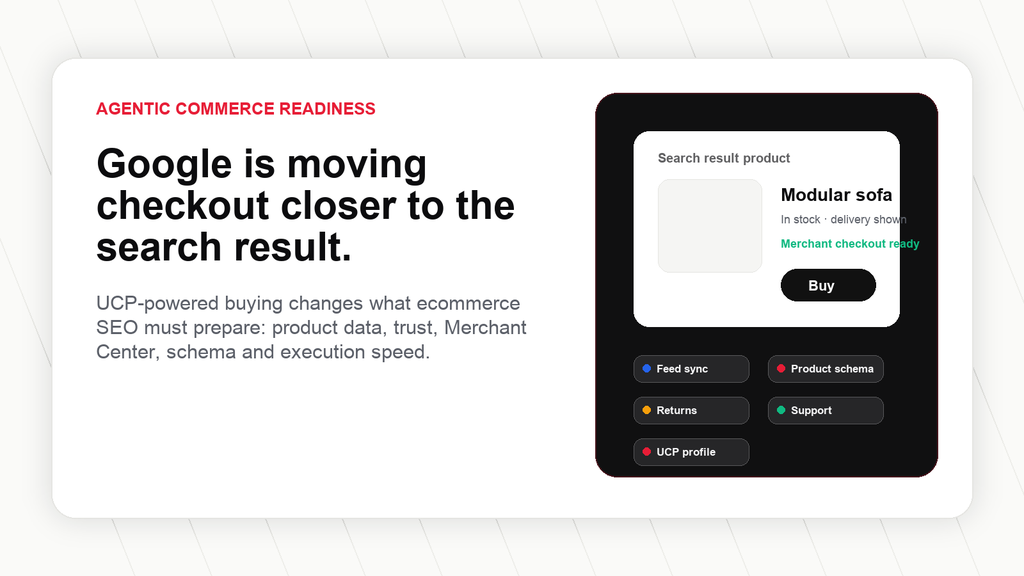
Executive summary: Google checkout buttons appearing directly in main Search results are not just a new shopping UI. They are a signal that Ecommerce SEO is moving closer to the transaction layer. If discovery, comparison and purchase can happen inside search or AI-assisted interfaces, merchants need product data, schema, Merchant Center feeds, policies, inventory and trust signals to be accurate enough for machines to use.
The important question is not whether the website is dead. It is not. The website remains the source of truth. The question is whether the website, feed and merchant data describe the same reality clearly enough for Google Search, AI Overviews, AI Mode, shopping surfaces and future commerce agents to trust the offer.
What happened: checkout moved closer to the search result
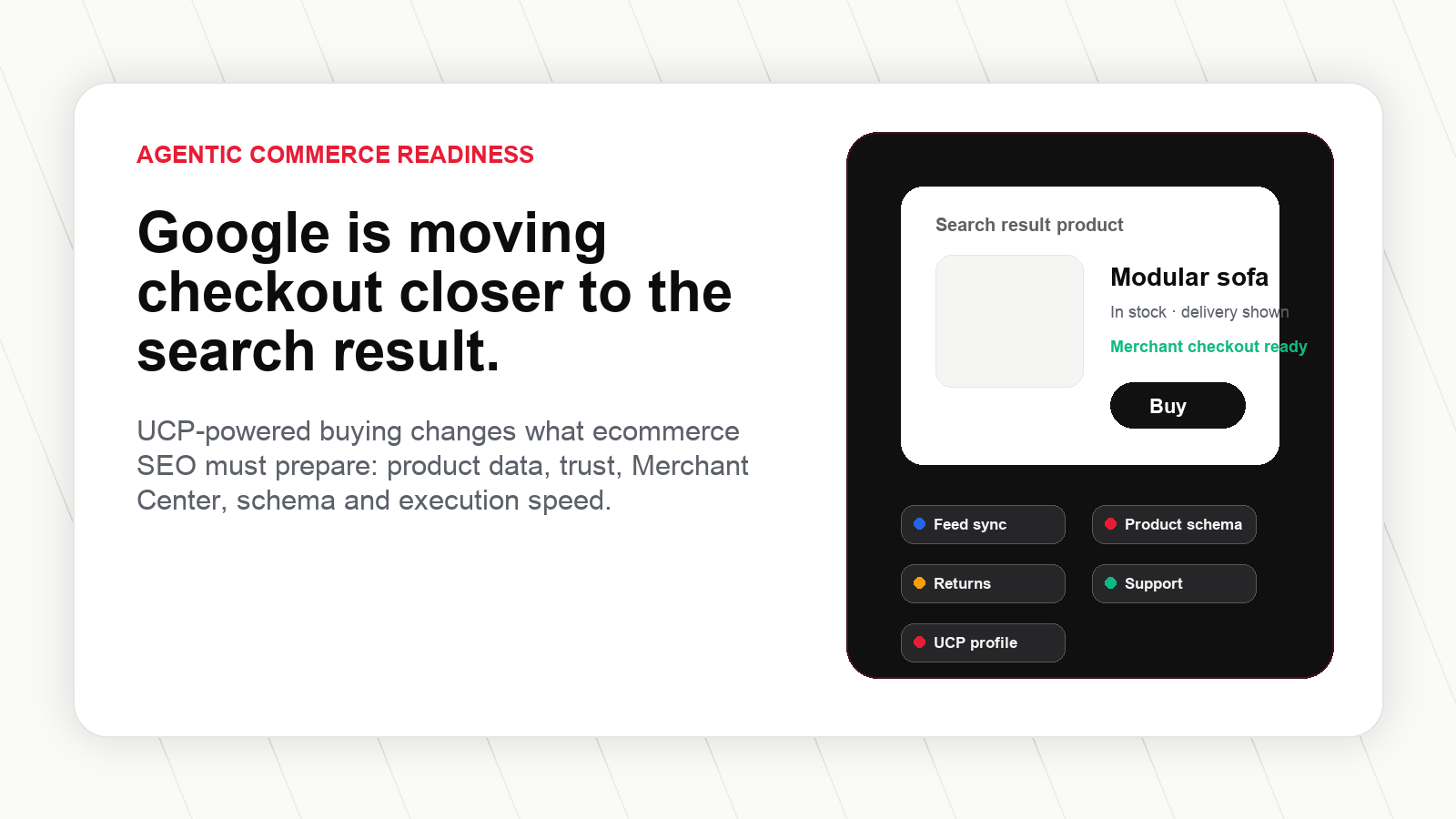
Semrush reported that Google has begun showing Checkout buttons directly in main Search results for some shopping-related queries. In the observed flow, a user can click a checkout action from the result and open a purchase dialog without first doing the classic journey of search result, merchant website, cart, checkout and payment.
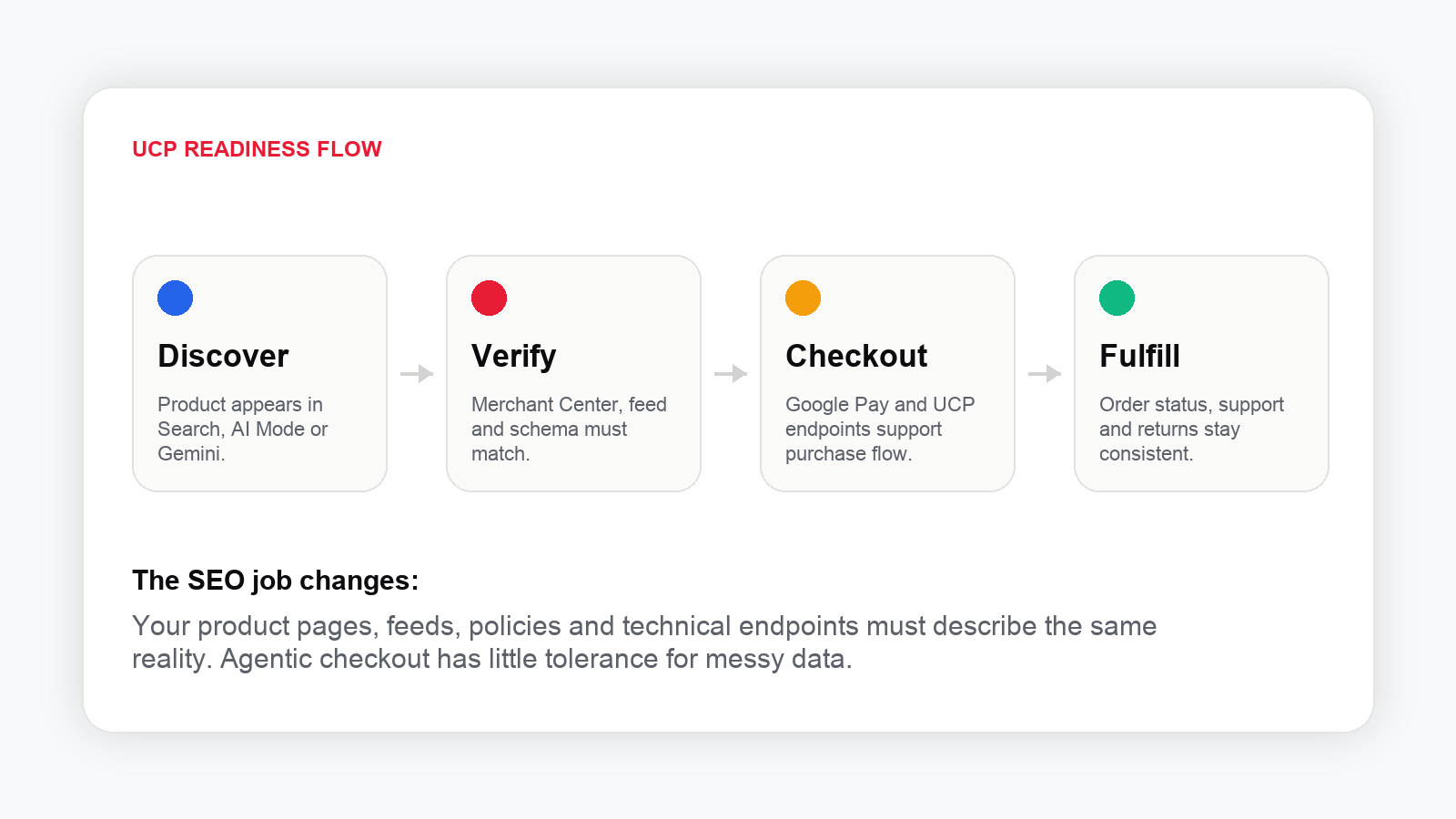
For ecommerce owners, this is easy to underestimate. A button is small. But the behavior behind the button is not small. It compresses the journey between discovery and transaction. It asks Google, the merchant, the product feed, the payment layer and the user’s intent to agree very quickly on the same facts: what is being sold, whether it is available, what it costs, where it ships, what the policies are and how the order is completed.
This is not the first time Google has moved commerce closer to search. Shopping results, free listings, Merchant Center, product snippets, local inventory and product Structured data have all been steps in that direction. The new layer is the agentic-commerce language around standardized checkout and machine-readable purchase workflows.
The practical takeaway is simple: ecommerce SEO is no longer only about ranking a Category page or writing a better product description. It is becoming an operating system for product data, search visibility, checkout readiness and continuous corrections.
What Universal Commerce Protocol is, according to Google
Google announced the Universal Commerce Protocol in March 2026. The official developer post describes UCP as an open protocol for standardizing the purchase process across cart, checkout and payment experiences. It is designed for a world where AI agents and search interfaces can help users move from intent to purchase while keeping the user in control.
The official framing matters. Google does not present UCP as a plugin trick or a ranking shortcut. It is a commerce protocol. It sits near checkout, payments, identity, cart state, merchant systems and agent workflows. Google also notes that UCP is not limited to Google products and that it is designed to work with other protocols, including the Agent Payments Protocol and Model Context Protocol.
That means ecommerce SEO teams should not treat this as a normal SERP feature. A normal SERP feature can often be handled with better content, schema and eligibility work. UCP points to something deeper: if search and AI surfaces can initiate or support transactions, merchants need operational consistency across the whole buying path.
Why this changes ecommerce SEO
Traditional ecommerce SEO has usually focused on visibility: rank the category, rank the product, win the product snippet, improve CTR, build authority and convert the visitor once they land on the store. That model is still valid, but it is no longer complete.
If checkout can start closer to the search result, the search system needs confidence before the user lands on the merchant website. It needs to understand product identity, price, availability, seller identity, shipping context, return policies and whether the offer is reliable. Some of those signals come from content. Some come from structured data. Some come from Merchant Center. Some come from the merchant’s commercial policies and operational execution.
This creates a new class of SEO work: not just “optimize the page,” but “make the business machine-readable and transaction-ready.”
A product page that says one thing, a feed that says another, and a returns page that is vague will not be ready for this world. A category page with thin descriptions and no useful comparison logic may still get indexed, but it may not be strong enough when an AI or commerce interface needs to select a reliable option for a user. A store with strong products but messy schema, missing GTINs, inconsistent availability or poor shipping clarity may lose opportunities without understanding why.
The ecommerce SEO job starts to look more like a data governance and execution job. The website still matters, but the website is only one surface.
Product data becomes SEO infrastructure
Google’s own documentation already shows this direction. The Product structured data documentation explains how product markup can help Google understand product pages and become eligible for product-related search experiences. The Merchant Center product data specification defines the attributes merchants use to describe items for Google’s commerce ecosystem.
These are not decorative fields. For a real store, they are the foundation of machine-readable commerce. Title, description, image, availability, condition, price, sale price, brand, GTIN, MPN, product category, shipping, tax and return data are not just “feed admin.” They describe whether Google can understand the offer with enough confidence.
For SMEs, this is where the pain starts. The owner sees a website. Google sees many data layers:
- the visible product page;
- structured data on the page;
- Merchant Center feed attributes;
- shipping and return policies;
- availability and inventory data;
- business identity and trust signals;
- review and rating context where eligible;
- technical Crawlability and indexability.
If these layers disagree, ecommerce SEO becomes fragile. A merchant can pay for content, links and ads, but still leak trust because the product ecosystem is inconsistent.
The measurement problem: where did the sale really happen?
Checkout closer to Search also creates a measurement question. If a user discovers a product in Google, interacts with a shopping surface, begins checkout from a Search result and completes the order through a standardized flow, what does the merchant’s analytics report show? Is the session attributed cleanly? Is it organic? Shopping? Referral? Direct? A new commerce surface? Something else?
This is not a reason to resist the change. It is a reason to prepare measurement carefully. Ecommerce teams should expect more blurred boundaries between SEO, shopping data, AI visibility, product feeds and conversion reporting. The same customer journey may touch classic search, AI-assisted recommendations, Merchant Center, product pages and checkout infrastructure.
That is why the old “SEO report” is not enough. A ranking report cannot tell you if your product data is mismatched. A keyword report cannot tell you if your return policy is too vague for a commerce agent. A traffic dashboard cannot tell you if checkout eligibility is blocked by schema drift or feed errors. The operating model has to connect discovery, data, technical readiness and execution.
Merchant readiness checklist for UCP-style commerce
Most stores do not need to panic. They need to become cleaner. The following checklist is a practical starting point for ecommerce teams that want to be ready for UCP-style commerce and AI-assisted buying flows.
1. Make product identity unambiguous
Product names should be clear, not stuffed. Product descriptions should explain what the item is, who it is for, variants, dimensions, materials, compatibility, use cases and limitations. Where possible, use identifiers such as GTIN, MPN and brand consistently. If Google or an AI system cannot identify the product, the transaction layer becomes weaker.
2. Align page, schema and feed
The visible product page, Product structured data and Merchant Center feed should agree. Price, availability, currency, images and variants should not drift. If the page says “in stock” and the feed says otherwise, you have an SEO and commerce trust problem.
3. Clarify shipping, returns and support
Agentic checkout cannot rely on vague policy pages. Shipping times, return windows, contact paths, refund terms and support availability should be easy to find and machine-readable where possible. A human customer needs clarity. A commerce agent needs it even more.
4. Reduce technical friction
Fast pages, crawlable HTML, clean canonicals, no unnecessary faceted crawl traps and stable product URLs still matter. UCP does not replace technical SEO. It raises the cost of technical mess because the product data layer must be trusted across several systems.
5. Monitor data drift
Ecommerce sites change constantly. Prices change, products go out of stock, categories move, content is rewritten, redirects are added, schema breaks, feed rules change and plugins update. Readiness is not a one-time audit. It is continuous monitoring.
What this means for small and mid-sized ecommerce businesses
Large retailers can assign teams to feeds, analytics, SEO, conversion tracking, product content, technical SEO and platform integrations. SMEs rarely have that luxury. The same person may manage products, pricing, ads, customer support and the website. That is exactly why these changes matter.
If commerce moves closer to Search and AI interfaces, smaller businesses cannot afford messy execution. They need a system that finds issues, explains them in plain language, prepares the fixes and asks for approval. They do not need another dashboard that says “there are 174 problems.” They need help deciding what to do next and then getting it done.
For a Shopify or WooCommerce store, examples might include:
- detecting product pages where schema does not match visible price or availability;
- finding category pages with weak buyer guidance;
- identifying missing shipping or return clarity;
- spotting products with poor images or incomplete attributes;
- mapping internal links between categories, guides and products;
- monitoring Merchant Center feed errors and warnings;
- preparing content improvements for AI search and answer readiness;
- flagging product pages that receive impressions but do not convert because the page does not answer the buyer’s real concern.
The value is not the audit. The value is the approved execution loop.
The AYSA point of view: ecommerce SEO is becoming an execution layer
My view is that UCP is part of a broader shift: search is becoming more operational. Google Search, AI Overviews, AI Mode, shopping surfaces and answer engines are all moving toward answers that are more useful, more contextual and closer to action. For ecommerce, the action is often purchase.
This does not mean every merchant should chase every new feature. It means merchants should build a cleaner execution foundation. If your website, feed, schema, policies and technical layer are aligned, you are better prepared for classic SEO, AI visibility and future commerce surfaces. If they are messy, every new surface multiplies the mess.
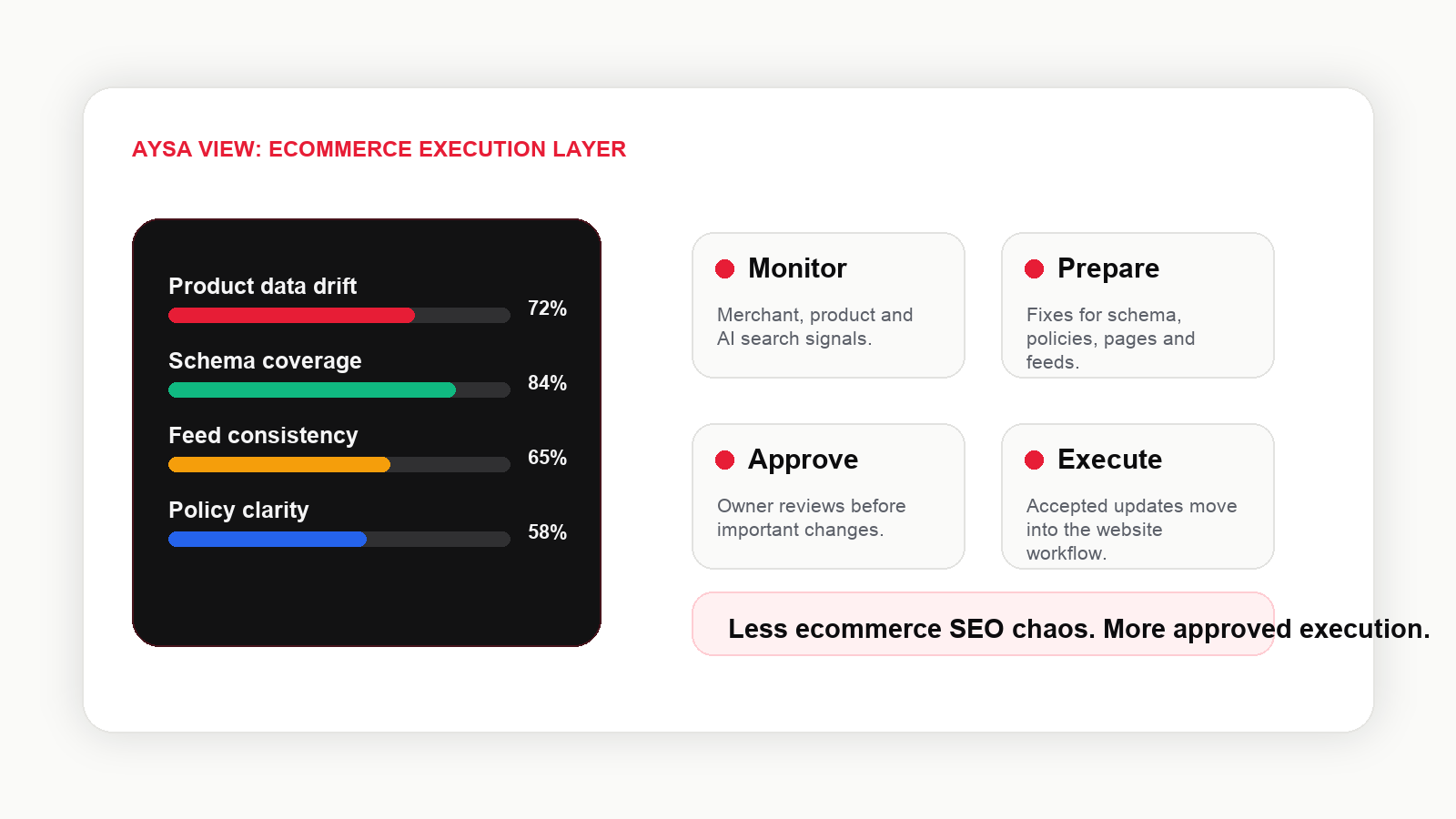
This is where AYSA fits naturally. AYSA is not built to be another SEO report. It is built to monitor, prepare, ask for approval and execute accepted changes inside the website workflow. In an ecommerce context, that means AYSA can help prepare the work required to keep product pages, content, technical SEO, AI visibility and authority-building efforts moving in the same direction.
The merchant still stays in control. Sensitive changes, commercial decisions and spending require approval. But the boring work does not have to remain manual forever. That is the core advantage: less SEO work, more organic growth.
Practical recommendation: do not treat Google UCP as a speculative future topic. Treat it as a signal to clean your ecommerce data layer now: product pages, schema, Merchant Center, shipping, returns, crawlability, internal linking and measurement.
Sources and further reading
- Semrush: Google Launches Checkout Buttons Directly in Main Search Results
- Google Developers Blog: Universal Commerce Protocol
- Google Search Central: Product structured data
- Google Merchant Center: Product data specification
Less ecommerce SEO chaos. More approved execution.
AYSA helps monitor your website, prepare SEO and AI visibility work, ask for approval and execute accepted changes inside your website workflow.
Continue the AI search topic inside AYSA.
Use these pages to connect the article with AI SEO tools, AI visibility monitoring, AI Overviews and approved website execution.
Turn this topic into a website action plan.
Use these AYSA hubs to move from reading to technical fixes, AI visibility monitoring, research, glossary context and approval-first SEO execution.

