
How to Scale AI Content Without Scaling SEO Risk
Scaling AI content is a priority for many teams, but publishing faster is not the same as growing safer. Here is how businesses can use AI content without creating thin, risky or generic pages.
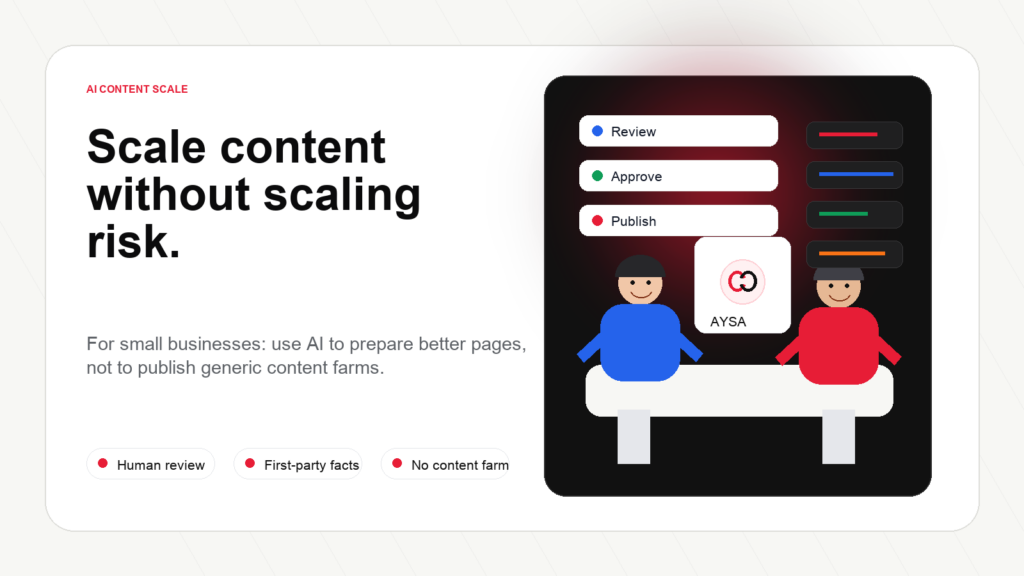
Executive summary: Scaling AI content is becoming a priority because businesses need more useful pages, faster updates, stronger topical coverage and better visibility across classic search and AI-assisted search. But speed is not the same as quality. The risk is not “AI wrote it.” The risk is publishing generic, unreviewed, unhelpful pages at scale.
For small and medium-sized businesses, the right question is simple: can AI help us explain our services, answer real customer questions and keep our website fresh without turning the site into a content farm? The answer is yes, but only if AI is used inside a controlled workflow: research, first-party facts, human review, approval and execution.
Why AI content scale matters now
Search Engine Journal recently framed scaling AI content as a major enterprise priority. That makes sense. Every serious website has more content work than the team can manually handle: old pages need refreshes, product pages need clearer descriptions, service pages need stronger explanations, category pages need buying guidance, FAQs need updating, and new search behavior around AI Overviews and answer engines creates even more pressure.
But this is not only an enterprise problem. It is even more painful for SMEs. A local clinic, ecommerce store, florist, SaaS startup, accountant, dentist or repair service rarely has a full SEO department. The owner knows the business, but not always the SEO process. The team may know the customer, but not how to turn that knowledge into pages that rank, convert and stay compliant with search quality standards.
That is why AI content is attractive. It promises speed. It can draft pages, summarize topics, prepare FAQs, rewrite metadata, cluster ideas and generate outlines. Used well, it can help a business explain itself better. Used badly, it creates hundreds of pages that sound like every other page on the internet.
The difference is not the model. The difference is the workflow.
context
draft
approval
safe scale
Where AI content risk really starts
AI content risk usually starts when teams confuse production with progress. They ask: how many pages can we publish this month? They should ask: how many useful pages can we publish, review, maintain and improve?
A website can be damaged by content that is technically readable but strategically empty. This is the kind of page that defines a topic in generic terms, adds no real experience, answers no specific customer question, and exists only because a Keyword tool found a phrase. It may not be obviously “spam” to a business owner, but it is not useful enough to deserve visibility.
For an SME, this often appears in familiar ways:
- City pages where only the location name changes.
- Service pages that say “professional, high-quality, affordable” without explaining the service.
- Blog posts that summarize common knowledge without examples.
- FAQs that answer questions nobody actually asks.
- AI-generated category text that does not help people choose products.
- Medical, legal or financial content that gives confident advice without careful review.
- Pages published without internal links, schema, evidence, author context or a next step.
The penalty risk is only one part of the problem. The bigger day-to-day problem is wasted opportunity. A weak AI page consumes crawl attention, internal Link equity, editorial time and brand trust without moving the business forward.
What Google says about AI content and scaled abuse
Google’s public guidance is more nuanced than many headlines suggest. Google does not say that AI-assisted content is automatically bad. In its guidance on AI-generated content, Google says its focus is on the quality of content, not the method of production. The key question is whether the content is helpful, reliable and created primarily for people.
Google’s documentation on helpful, reliable, people-first content asks whether the page provides original information, reporting, research or analysis; whether it gives a complete description of the topic; whether it is written by someone with experience or expertise; and whether users would trust it.
The danger zone is described more clearly in Google’s spam policies, especially around scaled content abuse. The issue is not only automation. The issue is using automation or human labor to create many pages primarily to manipulate search rankings without adding value for users.
That means a business can use AI responsibly. But it cannot outsource judgment. AI can draft. AI can summarize. AI can suggest. AI can organize. But someone, or some controlled workflow, must decide whether the page is accurate, useful, specific, trustworthy and worth publishing.
Same structure, same claims, no real examples or business context.
Confident statements without sources, limits, expertise or review.
Pages target keywords but do not help a person decide what to do.
Content is checked, improved and published only after approval.
Voice of users: what business owners actually worry about
The public SEO conversation is full of technical phrases: scaled content abuse, helpful content, Entity Optimization, topical authority, AI visibility and information gain. Those terms matter, but most business owners ask simpler questions.
They ask: “Can AI help me write pages without sounding fake?” “Will Google punish my website?” “How do I know if the text is correct?” “Who checks the claims?” “What should I publish first?” “How much content is enough?” “What if my competitors are publishing faster?” “Can I do SEO without hiring an agency?”
Those questions are healthy. They point to the real issue: trust. A business owner does not want a dashboard full of warnings. They want a clear answer: this page is worth improving, this is what should change, this is why it matters, this is safe to publish, and this is what still needs human approval.
On Reddit and SEO communities, the same concern appears repeatedly in different forms: people are not only asking whether AI content can rank. They are asking how to avoid producing pages that look cheap, duplicated or risky. That voice of the user should shape the strategy. AI content should reduce workload, not create a new pile of low-quality pages that someone has to clean later.
A safer workflow for scaling AI content
A safer AI content system starts before writing. It starts with knowing the business, the audience, the market and the purpose of the page.
1. Start with real business context
AI needs context: what the business does, where it operates, who it serves, what makes it different, what customers ask, what objections appear before purchase, what services matter most, and what claims can be supported. Without this, AI fills the gaps with generic language.
2. Use search data, not only keyword lists
Search Console impressions, existing rankings, competitor pages, internal search data, Google Business Profile questions, sales conversations and customer support tickets can all reveal what people actually need. A keyword list alone is not enough.
3. Decide the page job
Each page should have a job. Is it a service page, comparison page, local landing page, buying guide, FAQ hub, category page, technical explanation or product page? The job controls the structure. The structure controls usefulness.
4. Add first-party facts
First-party facts make content harder to copy and more useful: real process details, delivery areas, service limitations, pricing guidance, case examples, product specifications, opening hours, team experience, common customer questions and photos or screenshots where appropriate.
5. Review claims before publishing
AI can make confident claims. That is why review matters. Medical, legal, financial and safety-related content need especially careful review. Even for normal business pages, claims about price, availability, guarantees and outcomes should be checked.
6. Connect the page internally
Publishing a page without links is like opening a shop in a side street with no sign. Connect related services, glossary terms, guides, examples, pricing and contact pages. Internal links help users and search systems understand the site.
7. Monitor and refresh
AI content is not “done” after publishing. Search behavior changes. Competitors update. Google changes presentation. AI answers shift. Pages need monitoring, refreshes and sometimes pruning.
Unsafe scale
AI drafts pages, publishes them automatically, and nobody checks if they are accurate, useful or aligned with the business.
Result: more pages, more risk, more cleanup later.
Controlled scale
Where product-led SEO fits
There is a useful lesson in product-led SEO: content should come from the product, the customer and the business reality, not from an abstract keyword list. We discussed this idea in an older AYSA conversation with Eli Schwartz about product-led SEO. The video is not used here as a source of truth for Google’s policies, but it is a useful context piece for thinking about content that starts from real customer value.
Related context: Product-Led SEO with Eli Schwartz – e-commerce SEO.
For SMEs, the takeaway is practical. Do not ask AI to “write 50 SEO articles.” Ask what customer decisions your website fails to support. Ask what product or service information is missing. Ask which pages need examples, proof, locations, pricing guidance, FAQs, comparisons or clearer next steps.
The AYSA point of view
AYSA is built for approved SEO execution, not uncontrolled content generation. That distinction matters. The goal is not to flood a website with AI pages. The goal is to help businesses turn research, monitoring and customer context into useful approved content and page improvements.
AYSA can help identify pages with impressions but weak CTR, service pages that do not answer customer questions, missing content opportunities, internal link gaps, FAQ opportunities for answer readiness, title and meta improvements, schema candidates, and content refresh needs. Then AYSA prepares the work, explains why it matters, asks for approval and can execute accepted changes inside the website workflow.
For a business owner, that means less manual SEO work. You do not need to become a full-time SEO specialist. You need a clear workflow that tells you what matters, what should change, what needs approval and what can be executed safely.
That is the difference between AI content as a risky publishing machine and AI content as an operating system for organic growth.
Final take
Scaling AI content without penalty is not about finding a magic prompt. It is about building a quality system. The system needs real business context, search data, user intent, first-party facts, review, approval, internal linking, monitoring and refresh.
AI can help a small business explain itself better. It can help a team move faster. It can reduce repetitive SEO work. But it should not remove judgment. The safest and strongest content strategy is not “publish everything AI can write.” It is “use AI to prepare better work, then approve and execute what actually helps users.”
Less SEO work. More organic growth.
Scale useful content with approval, not blind automation.
AYSA monitors your website, prepares content and SEO improvements, asks for approval and executes accepted updates inside your website workflow.
Sources
Continue the AI search topic inside AYSA.
Use these pages to connect the article with AI SEO tools, AI visibility monitoring, AI Overviews and approved website execution.
Turn this topic into a website action plan.
Use these AYSA hubs to move from reading to technical fixes, AI visibility monitoring, research, glossary context and approval-first SEO execution.

