UCP and Agentic Commerce: The New Ecommerce SEO Playbook for “Buy on My Behalf” Search
Google’s Universal Commerce Protocol (UCP) shifts ecommerce SEO from “ranking pages” to “being selectable and transactable by AI agents.” Here’s what changes, what breaks, and the step-by-step plan SMEs and agencies can execute now—with AYSA’s approved automation to keep data, trust, and capabilities clean.

Agentic commerce is the first change in ecommerce search that forces us to stop thinking primarily in “pages and rankings” and start thinking in “capabilities and transactions.” That’s not a buzzword shift. It’s an operational shift.
Google’s announcement of the Universal Commerce Protocol (UCP) frames the direction clearly: an open standard intended to help AI-driven shopping work across the journey—discovery, negotiation of merchant capabilities, checkout, orders, and post‑purchase workflows. If that vision holds, Ecommerce SEO expands from “getting discovered” to “being selected and successfully fulfilled by an agent.”
This article is my practical, business-first playbook for what UCP-era ecommerce SEO will demand. It’s based on what’s been publicly disclosed so far, including Google’s official UCP implementation documentation and Aleyda Solis’ early analysis of the SEO implications (source). Where details are still unknown (analytics and Attribution are the big ones), I’ll call that out and focus on what you can do now without guessing.
Concise summary
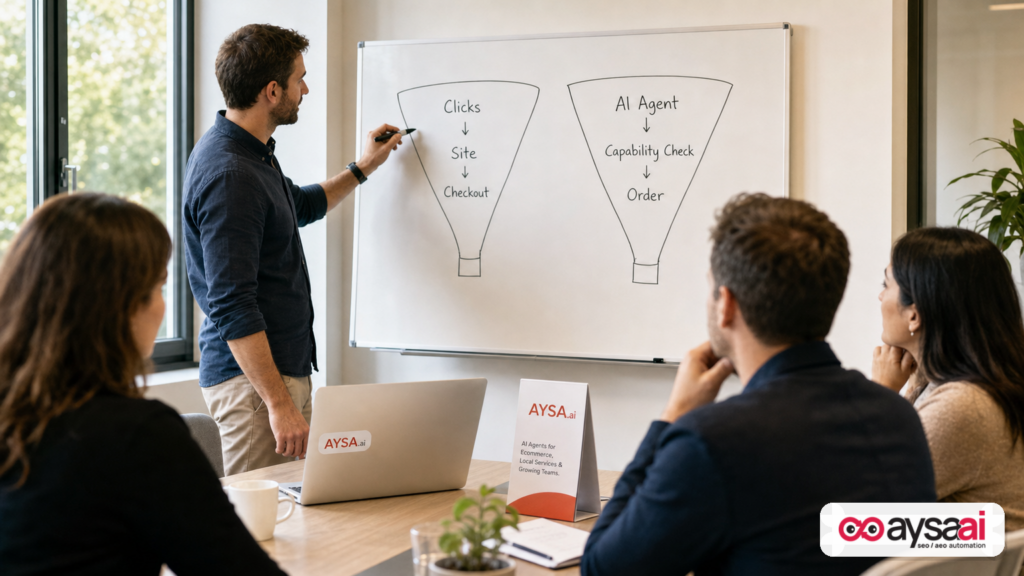
- UCP expands ecommerce SEO from ranking pages to enabling agent-mediated purchases.
- Merchant Center stays foundational, but with more attributes that map to conversational and AI-led product discovery.
- Trust becomes a hard requirement: policies, identity consistency, and fulfillment reliability can affect whether agents transact at all.
- Structured product data (on-site + feeds) becomes a gating layer, not a nice-to-have.
- Discoverability becomes capability-based: your site must publish declared capabilities (e.g., via a manifest) and reliably execute them.
- Traffic becomes a weaker KPI; order-based and server-side measurement will matter more as flows shift off-site.
- Execution is the moat: Monitoring, data hygiene, cross-team alignment, and fast fixes are what separate “present” from “eligible.”
Table of contents

- Key takeaways (for founders and operators)
- What changed: from “Search sends traffic” to “Search completes the purchase”
- Why UCP matters even if you don’t sell on Google
- The three pillars of UCP-era ecommerce SEO: Data, Trust, Capabilities
- Merchant Center: still the hub, now a bigger SEO surface area
- Trust: the requirement that quietly decides whether agents will transact
- Structured data and feed alignment: your new “don’t break prod” rule
- Capability-based discoverability and the UCP manifest
- From ranking pages to enabling transactions: what SEO teams must own now
- The measurement reset: how to prove SEO value when traffic doesn’t move
- SME scenario: “The best stroller under $300” and the agent that buys it
- What agencies must rethink: deliverables, retainers, and new failure points
- Practical action plan: 30/60/90-day UCP readiness
- Where AYSA fits: approved execution, monitoring, and keeping you eligible
- What to do next
- Sources and further reading
Key takeaways (for founders and operators)

If you own or operate an ecommerce business, here’s the business translation:
- Ranking is no longer the finish line. You can rank, be mentioned, even be “recommended,” and still lose if the agent can’t verify your policies, confirm availability, or complete checkout reliably.
- Your product catalog becomes an API problem. You’re not just merchandising for humans; you’re structuring reality for machines: identifiers, variants, shipping, returns, warnings, substitutions, accessories, use cases.
- Eligibility will be earned daily. One broken policy link, inconsistent pricing between feed and site, or stale availability can turn into silent exclusion (or degraded visibility) in agentic flows.
- Your competitive edge becomes operational. The winners are the merchants with clean data pipelines, clear trust signals, and the ability to fix issues quickly—faster than competitors.
- SEO becomes cross-functional by necessity. It will touch engineering, ops, support, legal/compliance, and finance—not because SEO wants to, but because commerce requires it.
For marketers: the era of “publish content + optimize titles + build links” isn’t over, but it’s no longer sufficient. If you’re still measuring success mostly in sessions, you’re going to misread performance.
What changed: from “Search sends traffic” to “Search completes the purchase”
For 20+ years, ecommerce SEO has followed a simple logic:
- Make pages crawlable and indexable
- Rank for product/category queries
- Win the click
- Convert on-site
That model assumes the user is the one doing the shopping actions: comparing, adding to cart, entering shipping info, making payment, tracking the order, managing returns.
Agentic commerce flips that assumption. The user might still initiate the intent (“find me the best…”) but the execution can be delegated to an AI agent that can:
- Interpret constraints (budget, size, compatibility, delivery windows)
- Negotiate what’s possible with merchants (capabilities)
- Complete checkout and post-purchase workflows
UCP, per Google’s description, aims to standardize discovery, capability negotiation, and commerce operations across platforms. In practice, that means your site and your commerce systems are no longer just “where people buy.” They become part of an interoperable network where agents decide who is safe, accurate, and reliable enough to transact with.
SEO people have always said “Technical SEO matters.” UCP is the first mainstream framing where technical and operational reliability can matter more than the page.
Why UCP matters even if you don’t sell on Google
A common reaction I hear from operators is: “We don’t rely on Google Shopping,” or “We’re mostly email and returning customers,” or “We sell on marketplaces.”
UCP still matters because it represents a direction of travel: shopping experiences where the interface is conversational and the execution is delegated. Even if your current acquisition mix is diversified, search-mediated demand still leaks into most ecommerce businesses through:
- Brand discovery (someone hears about you, then searches you)
- Category discovery (someone searches the product type, then compares brands)
- Replacement and replenishment (someone searches to re-buy and wants it quick)
- Support and returns (people search policies and troubleshooting)
If agents become a meaningful layer between intent and purchase, your “search presence” becomes inseparable from your “commerce readiness.” Not just “is the page indexed,” but “can the agent safely and correctly buy from you.”
And if you sell through multiple channels (DTC + retail partners + marketplaces), data consistency and trust become even harder—and therefore more differentiating.
The three pillars of UCP-era ecommerce SEO: Data, Trust, Capabilities
If you’re trying to explain this shift to a founder or CFO, don’t start with JSON manifests. Start with a model they already understand: eligibility.
In agentic commerce, you can think of eligibility as three pillars:
1) Data (product truth)
Is your product information precise, complete, fresh, and consistent across all systems (site, feeds, schema, inventory, pricing, shipping)? Agents don’t “infer” missing details the way humans do; they exclude or downgrade uncertainty.
2) Trust (merchant truth)
Are you a stable entity with clear policies, reliable fulfillment behavior, consistent identity, and the signals that reduce risk? Trust is no longer just a soft ranking factor; it becomes a prerequisite for executing financial transactions.
3) Capabilities (can you actually do the thing)
Can you support the workflows an agent needs (checkout methods, post-purchase actions, customer support), and do you declare those capabilities accurately and execute them reliably?
The key point: your “SEO” work now includes protecting these pillars from drift. Not once, but continuously.
Merchant Center: still the hub, now a bigger SEO surface area
Aleyda Solis’ analysis highlights a pragmatic reality: Google’s UCP implementation is built on top of Merchant Center. That means Merchant Center isn’t just “for Shopping ads people.” It’s a foundational asset for organic and AI-mediated commerce surfaces, too.
Google has publicly indicated Merchant Center configuration requirements such as return policies and customer support info, plus product feed updates that signal eligibility and compliance. Those are not glamorous tasks. They’re also the kind of tasks that, when skipped, create invisible ceilings.
What changes in practice
- Policy and support info become structured inputs, not merely pages on your site.
- Feed hygiene becomes a daily operational function, not a quarterly marketing project.
- New “conversational commerce” attributes (as described in the source) suggest that your feed may need to answer the kinds of questions humans ask in conversation: compatibility, alternatives, and usage scenarios.
This is where many SMEs and even mid-market brands will stumble—not because they can’t do it, but because ownership is unclear. Is it marketing? Is it merchandising? Is it ops? Is it engineering?
In a UCP world, the answer is: it’s cross-functional, and someone must be accountable. SEO is often the best candidate to quarterback because SEO already lives at the intersection of discovery and technical reality.
Practical Merchant Center checks you should formalize
- Return policies are defined, accurate, and aligned with on-site policy pages
- Customer support contact info is complete and current
- Product identifiers are consistent across feed and site (SKU/GTIN/MPN where applicable)
- Warnings/compliance data are present where relevant
- Eligibility flags and attributes are documented internally so changes don’t get “optimized away” later
If you need a forcing function: treat Merchant Center like production infrastructure. Changes require a checklist, and issues require alerts.
Trust: the requirement that quietly decides whether agents will transact
SEO has spent the last decade debating “quality,” “authority,” and “E‑E‑A‑T.” Those concepts are fuzzy because they describe a mixture of signals and outcomes.
Agentic commerce makes trust less philosophical and more binary: will an agent proceed with a transaction, yes or no?
Based on what’s been disclosed, merchant trust under UCP relates to stability of merchant identity, consistency of data across systems, and predictability in fulfillment/returns/payment behavior. Notice something: two of those are operational, not marketing.
What “merchant trust” looks like in the real world
- Identity consistency: Your legal business name, domain, contact details, and Brand entity references match across your site, Merchant Center, and third-party citations.
- Policy transparency: Returns, shipping, warranties, and customer support workflows are easy to find and unambiguous.
- Reputation signals: Reviews and authoritative mentions exist and are consistent with how you present yourself.
- Operational reliability: You do what you say you do—especially around shipping times and returns.
Even without new UCP-specific trust scoring details, you can already see the direction: agents need to reduce risk. In risk reduction, clarity beats persuasion.
How ecommerce brands accidentally destroy trust signals
- They change return windows on-site but forget to update structured inputs elsewhere
- They hide support behind forms with no SLA or phone number
- They publish “fast shipping” copy while the warehouse consistently misses cutoffs
- They split brands/domains without clear entity relationships
My POV: in the agentic era, “trust” will be less about wordsmithing and more about operational truth being consistently expressed across your data sources. That’s a solvable problem—if you treat it like one.
Structured data and feed alignment: your new “don’t break prod” rule
If you run an ecommerce site and you’re not treating Structured data as critical infrastructure, you’re behind. Not because Schema markup is magical, but because it’s one of the clearest ways to communicate product truth to systems that can’t afford ambiguity.
The source analysis calls out increased importance for Product, Offer, and AggregateRating structured data, as well as accurate price, availability, shipping, and policy markup—and critically, alignment between on-site structured data and Merchant Center feeds.
Google has historically cross-validated feeds against site data. Under a purchase-executing agent model, inconsistencies can do more than lower rankings—they can block transactions.
Alignment problems that are common (and avoidable)
- Sale price mismatches (feed updated faster than on-site, or vice versa)
- Variant confusion (structured data describes one size/color, while feed lists another)
- Availability drift (inventory system updates, but schema stays stale)
- Shipping/returns mismatch (policy pages updated, structured inputs lag behind)
Make it operational: treat schema as part of your release process
Most teams treat structured data as an SEO plugin task—something that gets “set and forget.” That’s a mistake. In UCP-era commerce SEO, your structured product data should be:
- Versioned with code releases
- Validated automatically (linting/testing) before deployment
- Monitored for drift post-deploy
Even if UCP evolves beyond what’s public today, this discipline pays off because it reduces the operational chaos that already costs ecommerce brands money.
Capability-based discoverability and the UCP manifest
Classic SEO asks: “Can Google find this page?”
Capability-based discoverability asks: “Can an agent safely and successfully interact with this merchant to do what the user asked?”
According to the source analysis, UCP introduces the idea that merchants will publish a JSON manifest at /.well-known/ucp listing available services/capabilities. Agents can fetch this to discover features, endpoints, and payment configurations without bespoke integrations.
This is a major mindset shift for SEO teams, because it looks a lot like what developer platforms have been doing for years (machine-readable capabilities). Ecommerce SEO is becoming “platform SEO.”
What capability declarations mean for SEO leaders
- Being present in search is not enough. You must be callable—by machines.
- Ambiguity can equal invisibility. If your declared capabilities are incomplete or inaccurate, agents can skip you even if your brand is strong.
- Reliability becomes a ranking-like factor. If your capabilities exist but fail in execution, expect reduced selection over time.
What you can do now (without waiting for perfect clarity)
- Inventory your commerce capabilities: payment methods, shipping options, pickup, subscriptions, returns workflow, customer support channels
- Document system owners: who owns the checkout flow, OMS, customer support stack, returns portal
- Map “capability truth” to public claims: ensure your site copy, policies, and support pages match reality
- Plan for manifest ownership: which team will publish and maintain it, and what the change control process will be
You don’t need to implement anything speculative to benefit from this exercise. It’s operational clarity—and operational clarity is a compounding advantage.
From ranking pages to enabling transactions: what SEO teams must own now
This is the part that will make some SEO teams uncomfortable: UCP-era ecommerce SEO is not just a marketing channel. It’s an enablement function for transactions.
That doesn’t mean SEO teams become engineers. It means SEO teams must own the “discovery-to-transaction” risks that can silently remove a merchant from consideration.
A modern ecommerce SEO responsibility list
- Merchant representation: Ensure your entity, brand, policies, and support info are consistent across your web presence and Merchant Center.
- Product data governance: Own the definition of “truth sources” for price, availability, identifiers, shipping, and returns.
- Content that answers agent-style questions: Compatibility, substitutes, use cases, and accessories—structured in ways machines can parse.
- Operational monitoring: Catch breakages in schema, feeds, policy links, and other gating issues early.
- Cross-functional escalation: When a fulfillment promise is routinely broken, treat it as a discovery risk, not an ops-only issue.
Content still matters—just differently
Some people will interpret agentic commerce as “content doesn’t matter anymore.” I don’t buy that. Content remains crucial because it’s where you define and differentiate:
- Use-case fit (who this is for, who it’s not for)
- Compatibility details
- Setup and troubleshooting
- Comparisons and alternatives (including within your own catalog)
The difference is you should increasingly design content as answerable and extractable. If your best information is buried in a hero carousel or a PDF, it’s not agent-ready.
The measurement reset: how to prove SEO value when traffic doesn’t move
The source analysis makes an important point: UCP-enabled commerce may shift transactions into AI-driven flows that don’t generate traditional pageviews or sessions. That has two big implications:
- Your analytics may undercount the value you create. If a user’s agent buys without a normal browsing session, client-side analytics like GA4 may not capture the journey in familiar ways.
- Your organization may defund SEO by mistake. If leadership still expects “more SEO traffic,” they’ll interpret a flat traffic graph as failure—even if orders and margin improve.
Google has not (as of the provided research context) published detailed analytics/attribution guidance for UCP. So we shouldn’t pretend we know the final model. But we can anticipate the direction: server-side attribution, backend order data, and platform reporting will become more important.
What to measure when clicks are missing
At minimum, ecommerce teams should get disciplined about:
- Orders and revenue by channel/source (where available)
- Gross margin (not just revenue)
- Refund/return rate and reasons
- On-time shipping and cancellation rate
- Customer support load (tickets per order, first response time)
Why these? Because agentic commerce will likely prefer merchants that are predictable and low-risk. These operational metrics are proxies for “agent confidence,” even if the agent scoring model is opaque.
How to report SEO in an agentic world
- Move from “sessions” to “eligible catalog coverage” (how much of your catalog is consistently valid across feeds and on-site data)
- Track “data mismatch incidents” like you track uptime incidents
- Report “time to fix” for eligibility blockers
- Align SEO goals with commerce outcomes: conversion rate, margin, repeat purchase—because that’s what the agent optimizes for
This is a measurement mindset shift, not a tooling trick.
SME scenario: “The best stroller under $300” and the agent that buys it
Let’s make this real with a scenario you can picture.
Business: a 12-person ecommerce brand selling baby gear (strollers, car seat accessories, travel systems). They run on Shopify, use a 3PL, and rely on Google + influencer traffic.
User intent: “I need the best travel stroller under $300 that fits in an overhead bin, works with my infant car seat, and can arrive by Friday.”
In classic SEO, your job is to rank a category page or a guide, win the click, and hope the user navigates to the right SKU and converts.
In agentic commerce, an AI assistant might:
- Ask clarifying questions (car seat model, airline, child age)
- Build a shortlist across merchants
- Filter by delivery date and return policy
- Confirm compatibility
- Buy the item and schedule delivery
Now look at where the stroller brand can win or lose:
Where you win
- Your feed includes compatibility attributes and accessory relationships.
- Your return policy is explicit, structured, and consistent.
- Your availability and shipping cutoffs are accurate.
- Your structured data matches your feed pricing and stock.
- Your support info is easy to verify (chat hours, email, phone).
Where you lose (even if you “rank”)
- Stroller is “in stock” on the page, but actually backordered in the OMS.
- Compatibility is buried in a PDF manual or a blog comment thread.
- Return policy page says 60 days, Merchant Center says 30 days.
- Shipping says “2–3 days” but your 3PL consistently takes 2 days to fulfill.
This is why I keep repeating: execution becomes the moat. It’s not enough to say “we have great products.” Agents will prefer merchants whose data and operations reduce risk.
What agencies must rethink: deliverables, retainers, and new failure points
If you run an agency—or you hire one—UCP-era ecommerce SEO forces a hard question:
Are you selling rankings, or are you selling eligibility and commerce outcomes?
In the old model, an agency could “do SEO” largely within the marketing perimeter: content plans, on-page optimization, some technical work, link building, reporting.
In the new model, an agency that can’t coordinate with product, engineering, and ops will be limited. Not because those teams are “nice to have,” but because the failure points move upstream into:
- Feed management and catalog governance
- Policy accuracy and compliance coordination
- Checkout and post-purchase reliability
- Backend measurement and attribution
New agency deliverables that will matter
- Merchant Center governance: audits, configuration playbooks, change control checklists
- Schema + feed alignment QA: automated validation plans, monitoring, incident response
- Capability mapping: documenting what the business can do and ensuring it’s expressed consistently
- Cross-functional enablement: meeting rhythms, escalation paths, stakeholder dashboards
What to stop doing (or at least stop overvaluing)
This is opinionated, but practical: if you’re spending most of your retainer on things that don’t improve data truth, trust, or capability execution, you’ll be squeezed. Examples:
- Publishing generic “SEO blog content” that doesn’t connect to products, compatibility, or purchase decisions
- Obsessing over minor title tag experiments while your feed is stale
- Reporting on traffic alone while ignoring revenue quality and operational KPIs
Content and classic SEO fundamentals still matter. But the weighting changes.
Practical action plan: 30/60/90-day UCP readiness
You don’t need to wait for every UCP detail to ship. You can become “agent-ready” by building operational discipline around the pillars that already matter.
First 30 days: establish truth sources and eliminate obvious blockers
- Assign an owner for Merchant Center accuracy and completeness (named person, not “marketing”).
- Audit Merchant Center for return policy and customer support completeness; document what’s missing and fix it.
- Inventory product identifiers: confirm SKU/variant IDs are consistent across site, feed, and back office.
- Validate product structured data on representative product templates; fix critical errors and inconsistencies.
- Write a “single source of truth” doc for price, availability, shipping promises, and returns policy.
By 60 days: make it measurable and monitorable
- Implement automated checks for feed vs on-site mismatches (price, availability, identifiers).
- Create an incident workflow: when a mismatch is detected, who fixes it and how fast?
- Improve product data for AI interpretation: compatibility, substitutes, accessories, and usage scenarios (start with top sellers).
- Test AI visibility in your category: how do AI Mode/Gemini-style surfaces present products and merchants? Track changes qualitatively over time (don’t overfit to one snapshot).
- Prepare measurement upgrades: ensure order data is accessible and can be reconciled against acquisition reporting, even if sessions are missing.
By 90 days: build cross-functional governance
- Set a monthly “merchant trust review”: policies, support, reviews, fulfillment SLAs, cancellations/returns.
- Formalize release controls for schema and feed logic (testing before deploy, rollback plan).
- Create a capability map (what you can do) and align it with on-site claims and Merchant Center settings.
- Train teams: marketing, support, ops, engineering—so they understand that small changes (like a policy tweak) can impact eligibility.
Where AYSA fits: approved execution, monitoring, and keeping you eligible
Agentic commerce increases the penalty for operational drift. The hard part isn’t knowing what to do—it’s consistently doing it, across teams, without breaking things.
This is exactly where AYSA is designed to help: an execution system that monitors, prepares changes, asks for approval, and then executes accepted website updates. In other words: you keep control, but you gain speed and consistency.
1) Monitoring that focuses on eligibility, not vanity
With AYSA Monitoring, the goal isn’t to produce another SEO report. The goal is to catch the issues that can quietly reduce your ability to be selected and transacted with:
- Product structured data errors or missing required fields
- Price/availability inconsistencies across templates
- Policy page changes that create contradictions
- Critical technical issues that interrupt crawling and data extraction
In a UCP-shaped future, this is not “nice to have.” It’s business continuity.
2) AI Search visibility as a first-class KPI
As surfaces evolve (AI Mode, conversational shopping), teams need a way to operationalize visibility beyond classic SERP positions. AYSA’s AI Search Visibility focus helps you measure presence and consistency where AI is influencing decisions—without pretending traffic is the only outcome.
3) Approved execution: fast fixes without risky autopublishing
In ecommerce, the wrong automated change can cost real money. That’s why governance matters. AYSA’s model—prepare → request approval → execute—fits commerce realities:
- AYSA can propose fixes (e.g., structured data consistency, internal linking improvements, on-page clarifications).
- Your team reviews and approves changes before they go live.
- Once approved, AYSA executes—reducing the lag between “we saw the issue” and “it’s fixed.”
This is especially important when eligibility depends on freshness and accuracy. Slow fixes are expensive.
4) Tools and playbooks you can build on
If you want to see how AYSA approaches AI-era SEO execution, start here: AYSA AI SEO Tools. For broader context and implementation thinking, our AYSA blog covers practical frameworks for SMEs and agencies.
And if you’re evaluating whether this is a fit for your organization’s stage, see AYSA pricing to understand the operating model.
What to do next
- Pick an owner for Merchant Center + product data governance this week.
- Run a feed vs site alignment audit across top products: price, availability, identifiers, shipping claims.
- Make policies machine-consumable: clear, consistent, and aligned between on-site pages and structured inputs.
- Turn schema into a release-controlled asset with validation and monitoring.
- Reset reporting: add order quality + operational KPIs, not just sessions.
- Implement monitoring + approved execution so eligibility issues don’t sit in a backlog for weeks.
Sources and further reading
- Aleyda Solis: What UCP Means for Ecommerce SEO: Preparing for Agentic Commerce
- Google (announcement): Agentic commerce, AI tools, and an open protocol for retailers and platforms
- Google Developers: Universal Commerce Protocol (UCP) guides
- AYSA: AI Search visibility
- AYSA: Monitoring
- AYSA: AI SEO tools
- AYSA: Blog
- AYSA: Pricing
Note: UCP is still emerging. Some operational details—especially analytics and attribution—may evolve. The recommendations above focus on durable requirements: data consistency, trust clarity, capability accuracy, and the ability to monitor and fix issues fast.
Continue the AI search topic inside AYSA.
Use these pages to connect the article with AI SEO tools, AI visibility monitoring, AI Overviews and approved website execution.
Turn this topic into a website action plan.
Use these AYSA hubs to move from reading to technical fixes, AI visibility monitoring, research, glossary context and approval-first SEO execution.