Google Search Console Adds AI Visibility Reports and AI Opt‑Out Controls: What SMEs Should Do Now (and What We Still Can’t Measure)
Google is rolling out Search Console reporting for AI search features and testing an opt-out toggle that can block your content from AI Overviews, AI Mode, and AI in Discover. Here’s what changed, why it matters, and a practical action plan for SMEs and agencies—especially when clicks are still missing.

Google just took two small steps that could force a big conversation in every business that depends on organic search: (1) early AI visibility reporting inside Search Console, and (2) the beginnings of a real control to block your content from being used in Google’s AI answers.
If you’re an SMB owner, a head of marketing, or an agency trying to explain why “rankings are fine” but leads are weird, this matters because it changes what visibility means. AI Search features are turning classic searches into reading sessions—sometimes without a click—and you can’t manage what you can’t measure.
This editorial breaks down what changed, why it matters, and what to do next, with a practical decision framework and an Execution Plan built for operators—not spectators.
Concise summary
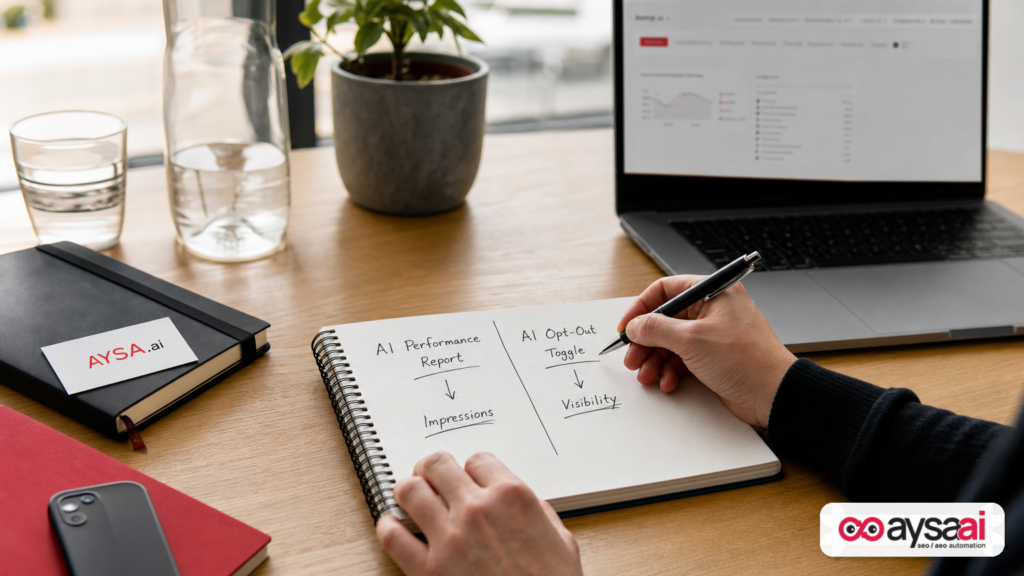
- Google is rolling out a new Search Console report for generative AI search features (AI Mode, AI Overviews, and AI in Discover). It includes Impressions and visibility breakdowns, but no click data.
- Google is testing a Search Console toggle that lets some publishers block their content from appearing in AI features (and from being used to ground responses). Opting out means no AI-feature traffic or impressions from those surfaces.
- These capabilities are rolling out to a subset of website owners in the UK first, with broader expansion expected later.
- For SMEs, the opportunity is: treat AI visibility as a new channel with its own KPIs, governance, and content operations. For agencies, the challenge is: explain and execute without perfect Attribution.
Key takeaways (the operator’s view)

- Impressions are not outcomes. Google’s AI report is useful, but it doesn’t answer the question your CFO cares about: “Did it drive revenue?”
- Opt-out is a business lever, not a protest. Some sites should consider it; others will hurt themselves by opting out without an alternative demand engine.
- AI search creates “citation competition.” You’re not only competing to rank—you’re competing to be selected, summarized, and trusted by the model.
- The winners will execute faster. Monitoring AI visibility and shipping approved site changes quickly will beat arguing about whether AI search is “fair.”
Table of contents

- What Google actually announced (and what it didn’t)
- Why Google is doing this now: pressure, policy, and platform reality
- Inside the new Search Console AI performance report
- The clicks problem: why the new report still leaves you guessing
- AI Overviews turned search into “reading sessions”—what that changes for SMEs
- Should you block your content from AI Overviews/AI Mode? A decision framework
- What can go wrong (even if you do everything “right”)
- New KPIs for AI-era search: AEO/GEO metrics that executives understand
- A practical action plan for SMEs (30/60/90 days)
- What agencies should rethink: reporting, contracts, and value
- Where AYSA.ai fits: monitoring + approved execution
- What to do next (checklist)
- Sources and further reading
What Google Actually Announced (and What It Didn’t)
According to reporting by Search Engine Land, Google is rolling out two related—but separate—capabilities inside Google Search Console:
- A new AI performance report for generative AI features in Google Search (and Discover), showing impressions and visibility breakdowns for when your pages appear in AI answers.
- A control (toggle) to block your content from appearing in AI search features such as AI Overviews, AI Mode, and AI Overviews in Discover (testing phase; limited availability).
What Google did not announce is almost as important:
- No click metrics for traffic from AI answers to your site (at least not today).
- No revenue or conversion attribution by AI surface (and to be fair, Search Console has never been revenue attribution software).
- No guarantee of global access now; the rollout is currently limited to a subset of UK site owners, based on the source reporting.
Why Google Is Doing This Now: Pressure, Policy, and Platform Reality
Google didn’t wake up one morning and decide publishers deserved more visibility and control. This is happening because AI search changed the economics of the open web fast—then regulators and publishers responded.
Search Engine Land notes these features are rolling out first in the UK, and ties the control to regulatory requirements. The UK’s Competition and Markets Authority (CMA) has been cited as pushing for opt-out controls that include the ability for publishers to opt out of content being used for AI-related purposes.
Here’s the practical business interpretation:
- Regulators want clearer boundaries. Opt-out mechanisms create a policy-friendly narrative: “publishers have choice.”
- Publishers want leverage. If AI answers reduce clicks, publishers want either (a) compensation, (b) control, or (c) both.
- Google needs the web to stay healthy. AI answers still need high-quality sources to ground responses. If creators stop publishing or block crawling, AI quality degrades.
So yes—this is about “helping site owners.” But it’s also about keeping the content supply chain functioning.
Inside the New Search Console AI Performance Report
The most useful thing Google is doing here is acknowledging that AI search features are a distinct surface—and that site owners need visibility into how they show up there.
Based on the Search Engine Land report, the new AI report includes:
- Impressions: how often URLs from your site appeared in generative AI features in Search and Discover.
- Pages (URLs): which pages appeared in AI features.
- Countries: visibility by country.
- Devices: device breakdown for Search (not necessarily all surfaces).
- Dates: time series with multiple granularities.
That’s enough to answer some important operator questions:
- “Are we even being cited/used in AI answers?”
- “Which pages are being pulled into AI answers?”
- “Is this happening in the markets we care about?”
- “Did something we changed last month correlate with visibility?”
But it’s not enough to answer: “Is it worth it?” Yet.
Why impressions still matter (even without clicks)
SMEs often hear “impressions are vanity.” In AI search, that’s not entirely true.
In classic SEO, impressions can be a proxy for demand and relevance, but clicks are the bridge to revenue. In AI search, impressions can also represent brand exposure—because the user may read an answer, remember a brand name, and convert later via direct traffic, email, or a branded search.
That doesn’t mean impressions are enough. It means impressions are now closer to a top-of-funnel channel signal than they used to be in traditional search.
The Clicks Problem: Why Google’s New AI Report Still Leaves You Guessing
Let’s be direct: without click data, AI reporting in Search Console is incomplete for business decision-making.
Search Engine Land reports that the new report does not include click data, and that Google’s position is essentially: they’re still working with site owners to determine which additional metrics would be helpful over time.
What this means in practice:
- You can measure presence, not performance. You’ll see that you appeared, not whether it drove action.
- You’ll have to triangulate. You’ll infer impact from other systems: CRM leads, ecommerce orders, call tracking, GA4, branded search trends, and assisted conversions.
- Reporting gets political. If you’re an in-house marketer, you’re going to have to defend investment without clean attribution. If you’re an agency, you’ll need a better narrative than “trust us.”
How to operate without click data (without fooling yourself)
Here’s the “grown-up” approach to AI search measurement in 2026:
- Track AI impressions by page cluster. Don’t obsess over single URLs. Group pages by topic or product line.
- Correlate with branded demand. If AI impressions rise and branded searches rise in the same region/time window, that’s a signal (not proof) of brand lift.
- Watch conversion rate, not just sessions. AI may reduce low-intent visits. In some businesses, fewer sessions with higher conversion rate is a win.
- Run controlled changes. Make one meaningful change (e.g., restructure a buying guide), annotate it, and observe the AI impressions trend.
None of this replaces click data. But it keeps you from making emotional decisions with partial information.
AI Overviews Turned Search Into “Reading Sessions”—What That Changes for SMEs
For years, SEO was a simple trade: create content, rank, win clicks. AI Overviews and AI Mode weaken that trade by answering more questions directly on the SERP.
Search Engine Land has separately discussed this shift in user behavior in an article titled “What to do now that AI Overviews turned search into reading sessions”. The headline nails the core change: the SERP is no longer a list of options; it’s increasingly a destination.
For SMEs, that creates three new realities:
- Some of your best content may be “consumed” without a visit. That’s a visibility win and a traffic loss at the same time.
- The click you do get may be more qualified. If AI filters casual browsers, fewer but better visits can happen—depending on your niche.
- Being cited becomes a competitive advantage. You’re competing to be one of the sources the model trusts—not only to rank #1.
A concrete SME scenario: local clinic vs. ecommerce store
Scenario A: a local dermatology clinic. A user searches “is this mole concerning?” AI Overviews provides general guidance and urges seeing a professional. If the clinic is cited, that brand exposure can matter—but the clinic probably still relies on local intent searches (“dermatologist near me,” “skin cancer screening [city]”) to convert.
Scenario B: an ecommerce store selling air purifiers. A user searches “best air purifier for allergies.” AI summarizes options, pros/cons, and may mention brands. If your product category pages never get clicked because AI answers the shopping research, you lose a big chunk of discovery traffic—unless you become one of the named, trusted sources or shift into other acquisition channels.
The clinic might treat AI impressions as brand lift. The ecommerce store might treat AI impressions as survival metrics and invest aggressively in “citation readiness.”
A Practical Decision Framework: Should You Block Your Content From AI Overviews/AI Mode?
The new opt-out toggle (limited rollout) introduces a question that used to be hypothetical: Should we block AI from using our content in AI answers?
Before you answer, separate three concepts that often get mixed together:
- Indexing for classic search (blue links): historically the core SEO relationship.
- Inclusion in AI answer surfaces (AI Overviews/AI Mode/Discover AI): a newer distribution channel.
- Model training / fine-tuning (broader AI use cases): a different concern with different implications.
Search Engine Land reports that opting out will mean you won’t receive traffic or impressions from Google’s generative AI features, but it should not be used as a ranking signal for the rest of web search outside those AI features.
When opting out can make sense
Opt-out may be rational if:
- You are a publisher with high dependency on informational query traffic and AI answers are clearly substituting for visits.
- Your content is costly to produce (investigative reporting, proprietary research, paid expert content) and AI summarization undermines your business model.
- You have strong alternative distribution (email, app, direct subscriptions, social, partnerships) and can afford to reduce SERP exposure.
- You have a clear legal/compliance posture that requires limiting reuse or summarization (varies by industry and jurisdiction—consult counsel).
When opting out is usually a mistake
Opt-out can backfire if:
- You’re an SME that relies on discovery. If people don’t already know you, losing AI visibility can reduce brand exposure.
- You sell products/services where trust-building matters. Being cited in AI answers can be a credibility flywheel.
- You have weak brand demand. If you’re not getting branded searches, you can’t assume “people will find us anyway.”
- Your competitors stay in. AI answers will still cite someone—often the most structured, authoritative sources.
A simple decision worksheet (no jargon)
Use this quick scoring model with your team. Rate each 1–5:
- AI substitution risk: Are AI answers likely to replace clicks for your key queries?
- Brand leverage: Do you already have enough demand to withstand losing AI impressions?
- Content defensibility: Is your content truly unique/proprietary—or is it easily replaced?
- Monetization dependency: Do you monetize pageviews (ads/affiliate) or conversions (leads/sales)?
- Competitive posture: Are competitors being cited more than you right now?
If substitution risk and monetization dependency are high while brand leverage is low, you’re in a dangerous spot—blocking may feel good but could reduce your remaining visibility. If brand leverage is high and content defensibility is high, opt-out becomes more plausible.
What Can Go Wrong (Even If You Do Everything “Right”)
AI search introduces failure modes that classic SEO didn’t force you to confront as often:
1) Misattribution: “AI stole our traffic” vs. “we lost relevance”
When traffic drops, teams blame AI. Sometimes that’s correct. Other times, you lost because competitors improved content, user experience, pricing, or brand trust.
Without click metrics, it’s easy to misdiagnose. That’s why you need broader monitoring and a disciplined change log.
2) The wrong pages are getting AI visibility
You might earn AI impressions on top-of-funnel informational pages, while money pages (product pages, service pages) remain invisible. Visibility feels good—revenue doesn’t move.
Your job becomes: connect informational authority to commercial outcomes through internal linking, clear entity/topic structure, and conversion-ready UX.
3) Brand safety and “answer drift”
Even if your page is cited, the AI summary can drift away from your nuance or disclaimers. That’s a reputation risk, especially for medical, legal, and financial topics.
Control mechanisms may reduce exposure, but they also reduce the chance to be the grounding source in the first place.
4) One toggle won’t solve governance
Even if the toggle exists, most organizations still need internal governance: who decides, who reviews risk, and what “success” looks like.
This is where execution systems matter: monitoring, decision workflows, approvals, and then shipping the changes—fast.
New KPIs for AI-Era Search: AEO/GEO Metrics Executives Understand
AEO (Answer Engine Optimization) and GEO (Generative Engine Optimization) can sound like new labels for old work. But the measurement lens is genuinely changing.
Given what Google is providing today (impressions, pages, countries, devices, dates) and what it’s not providing (clicks), here are practical KPIs you can adopt without inventing metrics:
1) AI Visibility Share (directional)
- What it is: AI impressions trend for your priority topic clusters over time.
- Why it matters: If impressions are falling while total demand is stable, you’re losing AI presence.
2) AI Page Mix (are the right pages being used?)
- What it is: The distribution of AI impressions across page types: blog posts, guides, product pages, location pages.
- Why it matters: If only informational pages show up, you may be building awareness without monetization.
3) Market Coverage
- What it is: AI impressions by country/region vs. where you sell.
- Why it matters: If you’re visible in the wrong markets, your content strategy may be too generic or mislocalized.
4) Assisted outcomes (triangulated)
- What it is: Correlations between AI impressions trend and business outcomes (branded search, direct traffic, lead volume).
- Why it matters: It’s not perfect attribution, but it’s better than arguing based on gut feel.
A Practical Action Plan for SMEs (30/60/90 Days)
If you’re running an SME, you don’t have time for theory. Here’s a plan that respects reality: incomplete reporting, fast changes, limited teams.
First 30 days: get your baseline and reduce blind spots
- Audit what Google is showing you today. If you have access to the AI performance report, export the top pages and segment them into: informational, commercial, local, support, policy/legal.
- Annotate changes. Start a simple change log: content updates, technical releases, pricing changes, and major campaigns.
- Define “money pages.” Identify the 10–50 pages that actually drive leads/sales. You need to know if AI visibility supports them.
- Set an AI visibility watchlist. Choose 5–10 topic clusters that matter commercially (not just what gets traffic).
- Decide governance for opt-out. Even if you don’t have the toggle, decide who would be involved: CEO/GM, marketing, legal/compliance (if relevant).
If you want a dedicated system to operationalize this monitoring, AYSA offers monitoring workflows designed for ongoing visibility changes: AYSA Monitoring.
Next 60 days: make your content “AI-selectable” without rewriting the internet
You don’t need to “make everything AI.” You need to make your best assets easy to trust and easy to cite.
- Refresh the pages that already earn AI impressions. Improve clarity, add succinct definitions, tighten structure (headings), and ensure claims are supported.
- Build a small set of canonical guides. One “best page” per major intent: “how it works,” “pricing,” “comparisons,” “FAQs,” “setup,” “returns,” “warranty,” etc.
- Strengthen internal linking to conversion paths. If AI surfaces your guides, those pages must route users to products/services naturally.
- Validate technical basics. Crawlability, indexability, performance, and structured data where appropriate. (We’re not citing a schema guide here because none was provided as an official source in the research context; treat this as general best practice.)
AYSA’s execution model is designed for this phase: it can prepare changes, ask for approval, then execute accepted updates—so you’re not stuck in “recommendations only.” Start here: AI SEO Tools.
By 90 days: build a repeatable AI search operating cadence
- Create an AI visibility review meeting. Monthly for SMEs, weekly for larger teams.
- Separate three workstreams:
- Visibility: increase AI impressions on priority topics.
- Conversion readiness: make cited pages lead somewhere.
- Risk controls: compliance, disclaimers, brand safety.
- Implement “approved execution” governance. Decide what changes marketing can ship without escalations vs. what needs leadership sign-off.
If you’re actively trying to understand whether AI recommends you in your category and how you show up across AI discovery, start with an AI visibility lens: AI Search Visibility.
What Agencies Should Rethink: Reporting, Contracts, and Value
AI search surfaces create an agency problem: clients want performance reporting, but platforms are offering partial measurement.
If you run an agency, the fix isn’t to hide. It’s to reframe deliverables around what can be responsibly measured and executed.
1) Move from “ranking reports” to “visibility + outcomes”
Rankings still matter, but they’re no longer the headline. Your reporting should include:
- AI impressions trends (when available)
- Topic cluster coverage
- Branded demand indicators
- Conversion metrics from analytics/CRM
- Execution velocity (how quickly changes go live)
2) Update scopes: AEO/GEO is production, not theory
“We will optimize for AI” is not a scope. A scope is:
- Number of priority clusters owned
- Number of pages refreshed per month
- Internal link/structure changes shipped
- Monitoring cadence and incident response (drops/spikes)
3) Be honest about uncertainty—and build decision frameworks
Clients can handle uncertainty. They can’t handle vagueness. Give them:
- A clear explanation of what Google reports and what it withholds
- A decision framework for opting out (if/when available)
- A plan to diversify acquisition so the business isn’t hostage to any one SERP feature
The AYSA.ai Perspective: Monitoring + Approved Changes Beat “SEO Theater”
In the AI search era, most teams don’t fail because they don’t know what to do. They fail because execution is too slow and too fragmented:
- Analytics shows a trend, but nobody owns action.
- SEO creates recommendations, but dev can’t prioritize.
- Content updates happen, but they’re not tied to a visibility hypothesis.
- Leadership wants certainty, but the platform won’t provide perfect attribution.
AYSA is built for the reality that SEO/AEO/GEO is an execution discipline. The operating loop looks like this:
- Monitor what’s changing in visibility (including AI-era signals when available): Monitoring
- Prepare recommended site changes tied to a clear goal (visibility, conversion, structure)
- Ask for approval so businesses keep governance and brand control
- Execute accepted changes so improvements actually ship (not just live in a spreadsheet)
This “approved execution” approach matters more as search becomes more dynamic and less transparent. If you’re evaluating an operating system for SEO that can keep pace with AI surfaces, start with the platform overview and tools: AI SEO Tools.
For pricing and packaging, see: AYSA Pricing.
For more strategy and implementation patterns, browse: AYSA Blog.
What to Do Next (Action List)
- Check if you have the AI performance report in Search Console (availability may be limited by region/rollout).
- Export your AI-visible URLs and tag them by intent (info vs commercial vs local).
- Create a “citation readiness” sprint: refresh the top AI-visible pages for clarity, trust, and internal links to conversion paths.
- Decide who owns opt-out decisions (even if you can’t toggle yet): marketing, leadership, legal/compliance.
- Set new KPIs: AI impressions trend by cluster, AI page mix, market coverage, assisted outcomes.
- Implement an execution loop so insights become approved site changes—not decks.
Sources and further reading
- Search Engine Land: Google Search Console AI performance reports and controls to block your content in AI responses
- Search Engine Land: What to do now that AI Overviews turned search into reading sessions
- Search Engine Land: Microsoft releases Web IQ (context on AI-era webmaster tooling)
- Search Engine Land: How to use schema markup to optimize for the agentic web (context)
- Search Engine Land: Beyond RAG: why AI search platforms are now agentic (context)
Note: This editorial is based on the supplied research context and does not assume access to private Google documentation beyond what is referenced in the source reporting. If/when Google publishes an official help-center page for the AI report and the opt-out toggle, it should be added to the reading list for primary-source validation.
Continue the AI search topic inside AYSA.
Use these pages to connect the article with AI SEO tools, AI visibility monitoring, AI Overviews and approved website execution.
Turn this topic into a website action plan.
Use these AYSA hubs to move from reading to technical fixes, AI visibility monitoring, research, glossary context and approval-first SEO execution.