Google Is Testing AI Search Reporting In Search Console: What To Measure Now (And How To Win When Click Data Arrives)
Google is testing a dedicated AI Search visibility toggle and new Search Console reports for AI impressions. That’s a turning point for measurement—yet it still omits clicks and queries. Here’s what changed, why it matters to SMEs and agencies, and a practical action plan to protect traffic while building AI citations.

Google is finally signaling (with product, not just messaging) that AI Search visibility is a first-class reporting surface. If you’ve been trying to explain to a founder why traffic changed even though “rankings look fine,” you already know why this matters.
According to reporting from Search Engine Journal, Google is testing two new capabilities in Search Console for a subset of websites in the UK:
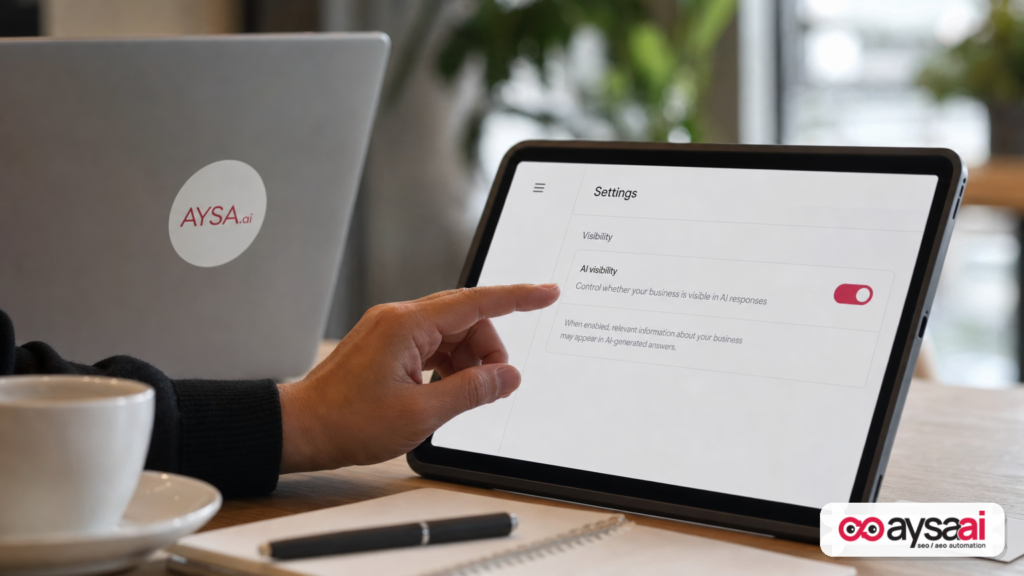
- An AI visibility toggle that controls whether a site can appear inside Google’s generative AI search experiences (including AI Overviews, AI Mode, and AI Overviews in Discover).
- Dedicated AI performance reports that show Impressions for URLs appearing in those AI surfaces, with breakdowns by page/country/device/date (including hourly granularity), but without Clicks or query-level reporting.
I’m writing this as Marius Dosinescu from AYSA.ai, and I’m going to be direct: the report is a meaningful step, but it’s not the measurement that businesses actually need yet. The real opportunity is how you use this early signal to redesign your analytics, content, and execution system so you’re ready when Google inevitably expands what’s measurable (and when competitors start treating AI citations like a new kind of ranking).
This editorial is not a news rewrite. It’s a practical resource for SMEs and agencies: what changed, why it matters, what can go wrong, and what to do next—plus how AYSA fits as an execution engine that monitors, prepares changes, asks for approval, and ships the accepted updates.
Concise summary
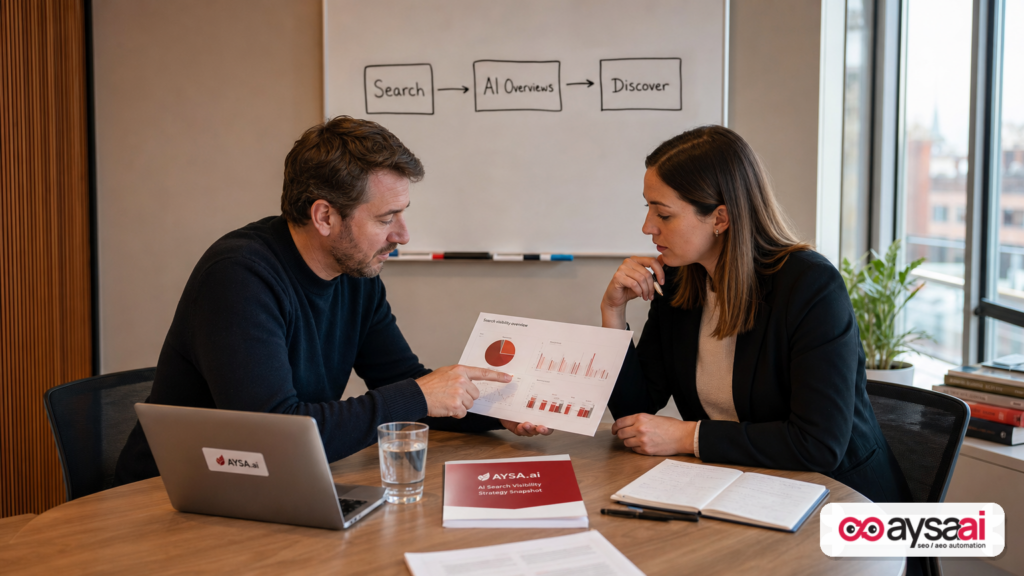
- Google is testing AI-specific reporting in Search Console. That’s a shift from “AI traffic is mixed into totals” to “AI gets its own view.”
- The new reports are impressions-only. Helpful for visibility, still weak for ROI and optimization because clicks and queries are missing.
- The toggle raises a new governance question. You may be able to opt out of AI surfaces—but opting out could mean forfeiting a major discovery channel.
- Businesses should prepare now. Instrument outcomes, build citation-worthy pages, clean up entity signals, and implement an execution cadence.
- AYSA’s role: continuous Monitoring + Approved Execution so AI-search readiness doesn’t become an endless backlog.
Table of contents
- What changed: AI visibility control + AI impressions reporting
- Context: why AI Overviews/AI Mode broke traditional SEO reporting
- The AI visibility toggle: strategy, risk, and governance
- What the new AI Search Console reports likely show (and don’t)
- The measurement gap: why impressions alone can mislead
- How AI search changes user behavior (and why your funnel feels weird)
- A concrete SME scenario: visibility up, calls down
- What to measure now: practical proxy KPIs and dashboards
- What to fix on your website to earn AI citations
- What agencies should rethink: deliverables, reporting, and accountability
- Where AYSA fits: monitored, approved, executed AI-search improvements
- What to do next (action list)
- Sources and further reading
What changed: AI visibility control + AI impressions reporting
Historically, Google Search Console has been the closest thing the industry gets to an “official scoreboard” for organic search performance. If it’s not in GSC, it’s hard to make it real for a busy executive team.
That’s why these tests matter. As described by Search Engine Journal, Google is testing:
1) An AI visibility toggle
This control is framed as a way to decide whether your site is eligible to appear inside generative AI experiences. In practical terms, it’s an eligibility gate for exposure. If you opt out, you don’t get impressions or traffic from those AI surfaces.
Google’s reported positioning is that this control is not meant to be a ranking factor for traditional “blue link” search results outside AI features—i.e., it shouldn’t punish your normal SEO performance just because you opted out of the AI layer. (As always, treat this as policy intent, not a mathematical guarantee.)
2) Dedicated AI performance reports (impressions-only)
Google is also testing a dedicated performance report that shows how often your URLs are shown within AI surfaces across Search and Discover—broken down by page, country, device, and time, down to hourly granularity.
This matters because (per SEJ’s coverage) AI visibility has been counted inside overall totals, but wasn’t isolatable. So teams couldn’t answer basic questions like:
- “Did AI Overviews cause our impressions to spike?”
- “Which pages are being surfaced by AI?”
- “Is AI exposure happening more on mobile than desktop?”
The catch (and it’s a big one): these new reports omit clicks and queries. So you can see exposure, but you still can’t tie it to traffic, lead volume, or revenue in a straightforward way.
If you’ve lived through the last decade of SEO reporting, you can probably predict the immediate consequence: stakeholders will latch onto the only visible number (impressions) and start making strategy calls based on partial truth.
Context: why AI Overviews/AI Mode broke traditional SEO reporting
Traditional SEO reporting assumes a fairly stable chain:
- User searches a query
- Google returns a list of results
- The user clicks a result
- The site gets a session and maybe a conversion
AI search interrupts that chain in at least three ways:
1) The “answer” becomes the first interaction
In AI Overviews and AI Mode-like experiences, Google can satisfy user intent with an on-SERP summary. That changes the economics of a click. The user may still see your brand, but never visit your site.
2) Google can cite many sources, but not distribute clicks evenly
Even if your URL is cited, the click-through behavior depends on placement, perceived authority, and whether the answer already feels “complete.” Visibility and traffic decouple.
3) Search Console’s legacy metrics are built around a list of results
Positions, CTR, and query mappings were designed for ranked lists. SEJ notes that Google has previously indicated that links within AI Overviews can share a single position, which makes classic “position-based” optimization less reliable.
That’s the environment this test arrives in: businesses are asking for measurement clarity, and Google is providing some structure—just not the part that ties to outcomes yet.
The AI visibility toggle: strategy, risk, and governance
A toggle sounds simple. Operationally, it’s a boardroom decision disguised as a settings option.
If your site gets the toggle, you’ll have three strategic questions to answer before anyone touches it:
1) What is our AI-surface objective?
- Direct response: do you need clicks, leads, and purchases now?
- Brand distribution: do you need to be present where answers are formed, even if clicks are lower?
- Defensive positioning: do you need to prevent competitors or aggregators from becoming the default cited “authority” for your category?
2) What content risk are we managing?
Some publishers and businesses worry that AI answers commoditize their content: the user gets the gist, and the site loses the visit. If your business model is ad-driven publishing, that risk is more acute than if you’re a service business where the real conversion is a consultation call.
3) Are we ready to measure tradeoffs?
Without AI click data, opting out can feel emotionally satisfying (“don’t use us”), but you might be opting out of the newest top-of-funnel distribution channel without a replacement plan.
My point of view: for most SMEs, an opt-out posture is rarely the best first move. The smarter approach is to (a) improve the inputs that make AI cite you accurately, (b) instrument outcomes so you can detect changes, and (c) only then decide whether the AI surface is net-positive.
Google frames this as building on earlier controls (like snippet controls and Google-Extended, per the SEJ summary). The important takeaway is that Google is acknowledging a new class of web governance: eligibility to appear in AI answers is now a policy decision, not just an algorithmic outcome.
What the new AI Search Console reports likely show (and don’t)
Based on SEJ’s description, the dedicated AI report provides:
- Impressions: how often your URLs appeared in AI features across Search and Discover
- Dimensions: page, country, device, date/time (hourly)
That already enables a few practical analyses:
AI exposure by page
You can identify which URLs are feeding AI answers. That’s huge, because most sites have “money pages” (services/products) and “supporting pages” (guides, FAQs). AI might surface a guide more than a product page, which affects your funnel.
AI exposure by country and device
If AI features roll out unevenly (which they often do), you can see whether your exposure is concentrated in a specific region or skewing mobile. That helps you forecast operational impact (support tickets, phone calls, in-store visits).
Hourly granularity
Hourly is not a vanity detail. It helps correlate visibility spikes with events: PR hits, social mentions, product launches, outages, or algorithm changes. It’s also a big hint that Google expects AI surfaces to change quickly and frequently—so daily averages can hide volatility.
But the report omits two critical elements:
Missing metric #1: clicks
Impressions tell you that Google showed your URL. They don’t tell you whether humans engaged.
Missing metric #2: queries
Queries are the “why” behind the exposure. Without query data, you can’t directly connect AI impressions to intent patterns, content gaps, or competitive movements.
Google reportedly said it intends to add more metrics over time (per SEJ). That’s worth watching, but businesses shouldn’t wait. You need a measurement strategy now, using proxies and operational signals.
The measurement gap: impressions are helpful, but clicks and queries are the real business metrics
Here’s the uncomfortable truth: impressions-only reporting can increase confusion if you don’t set expectations.
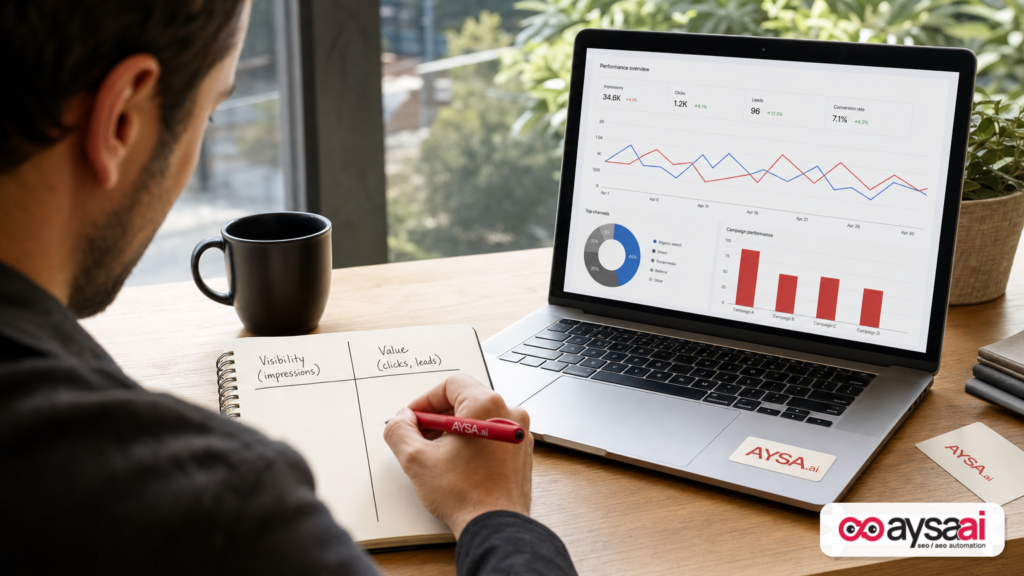
Consider three outcomes that all look “good” in impressions:
- Outcome A: Your URL appears in an AI Overview and gets clicked frequently.
- Outcome B: Your URL appears in an AI Overview but gets almost no clicks because the answer is complete.
- Outcome C: Your URL appears, but the AI answer partially misrepresents your offer, reducing conversions when people do click.
All three can raise AI impressions. Only one is clearly positive. That’s why “AI impressions up” is not a business win by default.
Until click data exists, you have to treat AI impressions as a leading indicator, not an outcome metric. It’s like PR: getting mentioned is good, but you still need to track pipeline impact.
How AI search changes user behavior (and why your funnel feels weird)
When business owners tell me “we’re showing up everywhere but revenue is flat,” it’s usually not a single issue. It’s a behavior shift plus measurement blind spots.
AI compresses the research phase
AI answers turn “10 clicks across 10 tabs” into a single summary. That reduces exploration, which can reduce traffic to informational content—even if your brand is cited.
AI reshapes what “top of funnel” means
Historically, top-of-funnel was your blog post ranking for a broad query. In AI search, top-of-funnel might be your brand being named in the answer, even if the click goes to a review site, a directory, or a forum.
AI increases the value of being understood correctly
Classic SEO rewarded being crawlable and relevant. AI surfaces reward being interpretable: clear entities, clear claims, consistent facts, strong corroboration across the web.
This is why AEO/GEO (answer engine optimization / generative engine optimization) is not just “new jargon.” The optimization target is different: you’re optimizing for accurate summarization and citation, not only for rank and click.
A concrete SME scenario: the local clinic that suddenly “shows up everywhere” but sees fewer calls
Let’s make this real with a scenario I see constantly—especially in local and service businesses.
Business: a multi-doctor dental clinic in a mid-sized city.
Before AI:
- The clinic ranks top 3 for “emergency dentist [city]” and “teeth whitening [city]”.
- They get steady calls from the website and Google Business Profile.
- Their SEO reporting is mostly: rankings, clicks, calls, bookings.
After AI surfaces expand:
- The clinic starts appearing in AI-generated answers for “How much is teeth whitening?” and “Best dentist for anxious patients.”
- They notice more people mentioning the clinic by name—but web form submissions decline.
- Search Console totals look stable, but phone calls fluctuate.
What’s going on?
- Users may be getting price ranges and “what to expect” directly in the AI answer, reducing visits to informational pages.
- The AI answer might cite the clinic alongside aggregators; the click goes elsewhere.
- The clinic’s own pages might be cited, but if the AI answer satisfies the intent, the user calls later (offline) or searches the brand directly.
How the new AI report helps (even without clicks):
- You can see which specific pages are being used in AI surfaces.
- You can correlate AI impression spikes with call spikes, brand search lift, direction requests, or appointment volume.
The operational takeaway: AI visibility can be positive while web sessions decline. If you only manage to sessions, you may “optimize away” the very pages that are earning AI citations and driving offline conversions.
What to measure now: practical proxy KPIs and dashboards (without hallucinating certainty)
If Google doesn’t provide AI clicks and queries yet, you still have to run the business. Here’s a measurement model I recommend—built around what you can observe today.
1) Separate “AI visibility” from “SEO traffic” in your reporting narrative
When the AI impressions report becomes available, don’t fold it into the same KPI stack as organic clicks. Treat it as a distinct channel:
- Channel: AI Search Visibility
- Primary metric: AI impressions (from GSC AI report)
- Goal: stable and growing presence for high-value topics/pages
This protects you from the classic leadership trap: “impressions up = we’re fine.”
2) Build a correlation dashboard for outcomes you already track
You can’t attribute perfectly, but you can correlate responsibly. Track weekly trends for:
- Branded search demand (from your existing tools/processes; if you use GSC query data, look at brand variations in the standard report)
- Direct traffic and returning users (in your analytics platform)
- Conversions by channel (forms, calls, bookings, purchases)
- Assisted conversions (if your analytics setup supports it)
- Lead quality signals (close rate, average order value, consultation-to-sale rate)
The goal isn’t to “prove” AI did it. The goal is to detect when AI visibility changes align with real business movement.
3) Track “citation readiness” as an operational KPI
This is the KPI most SMEs skip because it doesn’t sound like revenue—until it is.
- Coverage of essential entity pages (About, Contact, pricing, locations, policies)
- Schema presence and validity where appropriate
- Content freshness for pages that AI surfaces
- Consistency of brand facts across your site (names, addresses, product specs, medical disclaimers, etc.)
AI engines reward clarity and consistency. Your website should read like a dependable knowledge base, not a patchwork of landing pages built for ads.
4) Monitor Discover separately if your business depends on it
SEJ notes the report includes AI Overviews in Discover. If you’re a publisher, ecommerce brand with editorial content, or any brand that relies on content discovery, Discover volatility matters.
When AI features influence Discover exposure, you may see swings that are not strictly “SEO problems” but product-surface changes. That affects staffing, inventory, and cash flow planning.
What to fix on your website to earn AI citations (and reduce the risk of being misrepresented)
Even with imperfect measurement, the playbook for improving AI visibility is not magic. It’s disciplined information architecture, strong entity signals, and content that answers questions in a way machines can summarize safely.
Here are the highest-leverage areas for most SMEs.
1) Make your “source-of-truth” pages unmissable
AI systems (and humans) need canonical pages:
- Clear About page: who you are, what you do, why you’re credible
- Clear Contact page: accurate details, hours, service area
- Clear Pricing or “how pricing works” page (where feasible)
- Clear policy pages (returns, refunds, shipping, privacy)
If these are missing or thin, AI may use third-party sources to fill the gaps—sometimes incorrectly.
2) Create and maintain “answer pages” for high-intent questions
AI Overviews often trigger on questions and comparisons. SMEs should have concise pages that:
- Define the problem
- Provide a straightforward answer
- Explain options and tradeoffs
- State what your business offers (with constraints)
- Link to next steps (booking, product category, quote form)
This is not “blog for blog’s sake.” It’s building the pages AI wants to cite when someone is close to buying.
3) Strengthen entity consistency across the site
AI answers tend to be more accurate when your brand’s facts are consistent:
- Same business name format across pages
- Consistent product naming and specs
- Clear author and expert attribution when appropriate
- Location details that match your public listings (for local businesses)
4) Add structure where it helps (without turning pages into schema spam)
Structured data can help clarify meaning, but it’s not a cheat code. Use it where it genuinely matches the content: organization details, products, FAQs, how-to steps, and local business data—depending on your industry.
Important: I’m intentionally not naming specific schema types as “guaranteed AI boosts.” If you can’t verify the impact, treat schema as clarity infrastructure, not a ranking hack.
5) Update pages that AI is already surfacing
The new AI impressions report is especially valuable here: if Google’s AI surfaces your page, that page becomes a high-stakes asset. Keep it fresh, accurate, and conversion-ready.
That includes:
- Ensuring the first screen contains the main answer
- Adding “last updated” where appropriate
- Improving internal links so users who do click can take action quickly
What agencies should rethink: deliverables, reporting, and accountability
AI search reporting is going to create pressure on agencies in two directions:
1) Clients will demand “AI performance” reports
Even if clicks aren’t provided, clients will ask:
- “Are we showing up in AI Overviews?”
- “Why are competitors cited instead of us?”
- “Should we opt out?”
If your agency doesn’t have a clear framework, you’ll default to vague commentary. That’s a fast path to churn.
2) Agencies will need a new service layer: AI citation engineering
This isn’t just content writing. It’s a combination of:
- Entity architecture
- Content systems built around questions and comparisons
- Technical hygiene (crawlability, indexation, canonicalization)
- Brand corroboration across the web (where appropriate)
3) Execution speed will matter more than ideation
When reporting starts to show AI exposure by page and by hour, clients will expect agility: “this page is being surfaced—update it this week.”
Most agencies (and internal teams) lose here because execution gets trapped in tickets, approvals, and dev backlogs.
That’s exactly where an approved execution model becomes a competitive advantage.
Where AYSA fits: monitored, approved, executed AI-search improvements
At AYSA.ai, we treat AI search as an execution problem as much as a strategy problem.
Most businesses don’t fail because they didn’t know what to do. They fail because:
- Measurement is ambiguous
- Work piles up in a backlog
- Changes don’t ship consistently
- No one owns the end-to-end loop
AYSA is built around a simple operating system:
- Monitor your search visibility and site signals continuously
- Prepare recommended changes (content, technical, on-page)
- Ask for approval so humans stay in control
- Execute the accepted changes on your website
In the context of these new Google tests, that means:
- When the AI impressions report shows a spike for a page, AYSA can flag it as a priority asset and propose updates that improve clarity and conversion pathways.
- If AI impressions concentrate in a region/device, AYSA can help you tailor the supporting pages and internal linking for that audience.
- If you’re debating an AI visibility toggle, AYSA’s monitoring helps you make that decision with evidence—not vibes.
If you want to explore the system, start here:
- AI Search Visibility (what we track and why it matters)
- Monitoring (how the signals flow into decisions)
- AI SEO Tools (execution capabilities)
- Pricing (fit for SMEs vs agencies)
- Blog (ongoing playbooks and updates)
One more important note: “approved execution” isn’t just compliance theater. In AI search, a wrong claim, an outdated price, or a misphrased medical/legal statement can create real business risk if it becomes the cited source. Humans should approve changes. But humans also need the changes done.
What to do next (action list)
Whether you’re an SME owner, in-house marketer, or agency lead, here’s a practical next-step plan that doesn’t require waiting for Google to finish testing.
1) Establish an AI search reporting line item now
- Create a placeholder in your monthly reporting deck: “AI Search Visibility.”
- Document what you can measure today vs what you can’t.
- Make sure leadership understands: impressions are visibility, not value.
2) Identify your likely AI-cited pages
- List your top informational pages and your top converting pages.
- Find overlaps: pages that both answer questions and lead to action.
- Prioritize updates to those pages first.
3) Strengthen your “facts layer”
- Audit About/Contact/Locations/Pricing/Policies for accuracy and completeness.
- Standardize brand facts across the site.
- Remove contradictory statements across old blog posts and landing pages.
4) Improve conversion paths for AI-driven visitors
- Add clear next steps on pages that answer common questions.
- Make calls-to-action specific (book, quote, compare, check availability).
- Reduce friction: fast pages, clear forms, visible phone number for service businesses.
5) Build a decision framework for the AI visibility toggle (if/when you get it)
- Define what “net positive” means: revenue, leads, brand lift, offline conversions.
- Decide who approves a toggle change (CEO? marketing lead? legal?).
- Plan a test window and a rollback plan.
6) Put execution on rails
- Decide how often you’ll ship AI-readiness improvements (weekly is a good target for most SMEs).
- Use an approved execution system so changes don’t die in a backlog.
- If you want AYSA to run that loop: start with Monitoring and then align changes to your goals.
Sources and further reading
- Search Engine Journal — Google Tests Dedicated AI Search Reports In Search Console
- Search Engine Journal — Latest news (context on ongoing AI search changes)
- Search Engine Journal — SEO section (broader SEO impact coverage)
- Search Engine Journal — Local SEO (for local businesses affected by AI summaries)
- Search Engine Journal — Enterprise SEO (for teams needing governance and reporting frameworks)
Note on primary sources: The SEJ coverage references a Google blog post describing these tests. That primary link is not included in the supplied research context, so I’m not linking it directly here. If you have it, add it to the Sources section in WordPress for maximum credibility.
AYSA resources:
If you’re an SME and you want the simplest takeaway: don’t panic about AI search—operationalize it. Treat AI visibility as a measurable channel, improve the pages AI is most likely to cite, and make sure your execution cadence is fast enough to keep up with product changes you don’t control.
Continue the AI search topic inside AYSA.
Use these pages to connect the article with AI SEO tools, AI visibility monitoring, AI Overviews and approved website execution.
Turn this topic into a website action plan.
Use these AYSA hubs to move from reading to technical fixes, AI visibility monitoring, research, glossary context and approval-first SEO execution.