Search Isn’t Dying—It’s Being Redistributed by AI: The New Playbook for SMEs and Agencies
A million-keyword study suggests search demand isn’t collapsing—it’s relocating. Here’s what changed, why AI is accelerating the shift, and the practical SEO/GEO actions SMEs and agencies should take to stay discoverable across Google, YouTube, Reddit, and chatbots.

By Marius Dosinescu (AYSA.ai)
For the last 18 months, I’ve watched a familiar pattern repeat across small businesses and agencies: Organic traffic dips, panic sets in, budgets get cut, and someone says, “AI killed search.”
That’s not what’s happening. What’s happening is more uncomfortable—and more actionable: search demand is being redistributed. Some query types are collapsing. Others are growing. And discovery is increasingly split across Google, AI answer experiences, and “social search” platforms like YouTube and Reddit.
A large study published by Search Engine Land (in collaboration with Fractl) analyzed more than one million high-volume keywords and paired that with a consumer survey. Their framing matters: the net Search volume across the dataset was essentially flat, but the distribution changed. In other words: demand didn’t vanish—it moved.
This editorial is my practical playbook for operators: what changed, why it matters, how to diagnose what you’re seeing, and the execution system you need to keep up—especially if you’re an SME without a full-time SEO department.
Table of contents

- A concise summary (for busy operators)
- Key takeaways
- Context: the “AI is killing search” narrative—and what the data really implies
- Search isn’t shrinking; it’s redistributing (and that changes your job)
- Why some industries feel pain faster than others
- The highest-risk zone: non-branded, information-heavy queries
- Discovery moved beyond Google: YouTube, Reddit, and the new multi-platform baseline
- The new funnel: “AI mentioned us” is a measurable growth channel
- The audit you should run first (before rewriting your whole strategy)
- What to build now: content patterns that survive AI answers
- Authority is the moat: what AI systems can cite and trust
- Measurement in 2026: what to track when clicks are no longer the whole story
- The execution gap: strategy doesn’t ship changes
- Where AYSA fits: monitoring → prepared changes → approval → execution
- What to do next (action list)
- Sources and further reading
A concise summary (for busy operators)
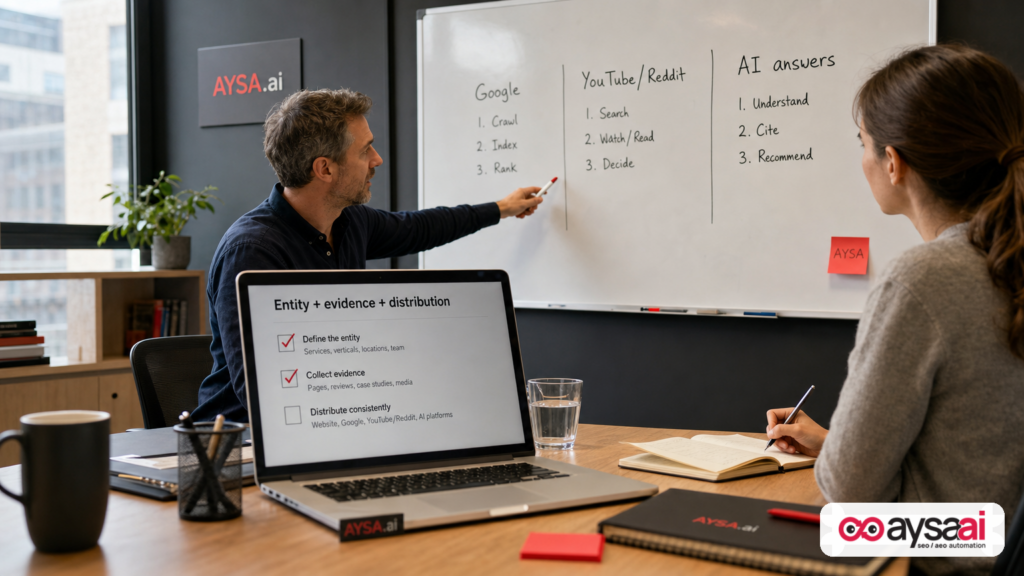
Here’s the operational reality most teams are missing:
- Some of your best keywords may be dying because AI can answer them without sending a click.
- Overall demand can still look “flat” at the market level while your site experiences a steep drop—because demand relocated to different queries, different formats, and different platforms.
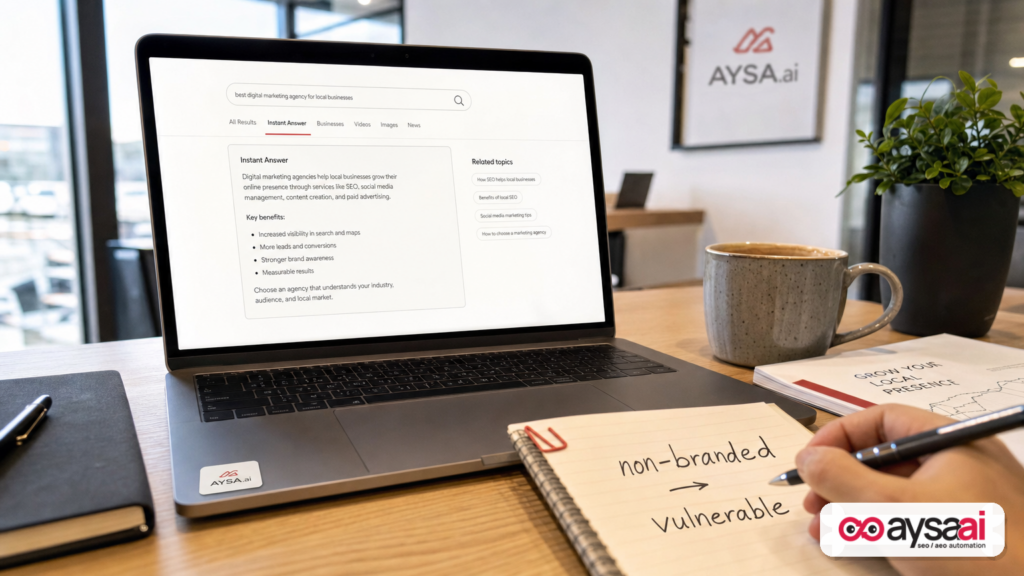
- Non-branded informational queries are most vulnerable. Transactional and brand-led discovery tends to be more resilient.
- Google isn’t going away—but a meaningful minority of users are building new habits around AI and social platforms, so your distribution needs to expand.
- The new competitive edge is execution: continuous Monitoring, fast content updates, and systematic Authority Building that makes you eligible to be referenced in AI answers.
If you’re a small business, your goal isn’t to “beat AI.” Your goal is to be discoverable wherever your customers ask—and to ship improvements faster than competitors.
Key takeaways
- Don’t confuse a traffic decline with a business decline. Validate whether revenue, qualified leads, and branded demand are holding.
- Stop measuring SEO as a single channel. Discovery is multi-surface: Google results, AI answers, YouTube, Reddit, and retailer marketplaces (for ecommerce).
- Rebalance content away from “one-and-done answers.” Build assets that require depth, evidence, comparison, and next steps.
- Invest in authority signals. AI systems favor entities with consistent, corroborated information across the web.
- Build an “Approved Execution” pipeline. Strategy and audits aren’t enough; you need a way to publish improvements continuously without bottlenecks.
Context: the “AI is killing search” narrative—and what the data really implies
In 2024, Gartner predicted traditional search engine volume would decline substantially by 2026 as consumers shifted to AI chatbots and virtual agents. The Search Engine Land / Fractl research set out to test that directional prediction using Semrush Keyword data and a consumer survey (methodology and details are outlined in their article: What 1 million keywords reveal about AI’s impact on search).
I’m not here to reprint their findings. But there are two conclusions worth building an operator-grade strategy around:
- There is real decline in a meaningful slice of high-volume search demand—and it varies a lot by vertical.
- The bigger story is reallocation: demand moved to other keyword sets and behaviors, which means there are still growth opportunities if you chase the new demand instead of defending the old.
This is why “SEO is dead” is the wrong mental model. SEO isn’t dead; static SEO is dead. The teams that win now run search like an operations discipline: monitor, diagnose, ship, measure, repeat.
Search isn’t shrinking; it’s redistributing (and that changes your job)
When search demand redistributes, three things happen at the same time:
- Some keywords lose volume sharply. This is what the market feels.
- Other keywords gain volume. This is what winners capture.
- User journeys fragment. The same person might ask a chatbot a question, verify with Google, then search on YouTube or Reddit for lived experience.
In practice, that means your annual SEO plan can’t be a once-a-year keyword list + content calendar. If your portfolio includes lots of “explain X” content, you may be sitting on assets that are now answered without a click. Meanwhile, demand might be shifting toward comparison, decision support, troubleshooting, local availability, and brand-specific follow-ups.
Operator translation: Stop asking, “How do we rank #1 for this keyword?” Start asking, “What does the customer do next after an AI answer, and how do we become the brand they pick during that next step?”
If you want a durable framework, treat your market as a set of jobs-to-be-done:
- Learn (definitions, explanations, quick summaries)
- Evaluate (comparisons, reviews, alternatives)
- Decide (pricing, availability, proof, policies)
- Act (booking, purchase, signup, contact)
- Resolve (support, troubleshooting, returns)
AI eats the “Learn” layer first—especially when the answer is stable and generic. The rest of the layers still create demand, but the query language changes. Your job is to follow that language.
Why some industries feel pain faster than others
The Search Engine Land study highlights a pattern that matches what I see in the field: industries where users primarily want information (not a transaction) are more exposed. If the exchange can be completed inside an AI chat window, the click never happens.
Contrast that with industries where a user must still do something on a website—book, buy, compare inventory, configure, integrate, submit a claim, or sign a contract. Those categories tend to retain demand because the customer still needs a destination.
Here’s the practical takeaway for SMEs:
- If you sell a product/service that requires configuration or human trust (B2B SaaS, home services, local clinics), you can often shift rather than lose demand—if your site and brand are the obvious next step.
- If you publish information that can be summarized (definitions, broad health/wellness guidance, basic finance explanations), you should assume some demand will compress, and you need a plan to monetize or redirect attention elsewhere.
This isn’t a moral judgment about content quality. Some of the best content on the web is still “summarizable.” The issue is distribution: AI changed how that content gets consumed.
The highest-risk zone: non-branded, information-heavy queries
The Search Engine Land research notes that non-branded queries are especially exposed. That makes intuitive sense: if a user didn’t ask for a specific brand, AI can satisfy the intent without sending them anywhere.
So what do you do if your traffic historically came from non-branded informational keywords?
1) Don’t overreact—classify the intent
Put your top pages into buckets:
- Instant-answer content: definitions, “what is…”, basic “how to…”
- Decision support: comparisons, “best for…”, “X vs Y”, alternatives
- Proof and trust: credentials, policies, sourcing, safety, case studies
- Transactional: product/category, booking, pricing, quotes, signup
If you’re heavy in instant-answer content, you don’t need to delete it. You need to upgrade it into a pathway—make the page the best starting point for a real decision, not just a definition.
2) Build brand gravity so non-branded becomes branded
When AI recommends “a project management tool,” a chunk of users still search that brand before they commit. That downstream branded demand is how some categories stay resilient.
If your business isn’t becoming a named option inside your category, you’ll keep losing the “anonymous” top-of-funnel traffic and won’t recover it as branded demand.
3) Engineer the next click
AI may answer “what is deductible,” but it can’t:
- quote your policy,
- show local availability,
- offer a tailored estimate,
- book your appointment slots,
- guarantee delivery times,
- or reflect your exact inventory.
Your pages should lean into what AI can’t do without your systems.
Discovery moved beyond Google: YouTube, Reddit, and the new multi-platform baseline
One of the most useful parts of the Search Engine Land piece is the consumer behavior angle: people are using more platforms to search, especially YouTube and Reddit. That aligns with what any founder sees anecdotally: users want demonstrations and lived experience, not just answers.
Here’s the non-obvious business advantage: YouTube and Reddit can compound visibility because they also show up in Google results. So you’re not “leaving SEO”—you’re expanding the surfaces where you can win.
What SMEs should do with YouTube
- Publish problem-solution videos for high-intent use cases (setup, troubleshooting, comparisons).
- Use consistent naming for your product/service and core entities across video titles, descriptions, and your website.
- Turn every strong support ticket theme into a short video.
What SMEs should do with Reddit (without being cringe)
- Monitor category questions and objections; use them to update your website copy and FAQs.
- Participate as humans (founder, operator, clinician, technician) with real constraints and disclosures.
- Don’t treat it as “Link Building.” Treat it as market research + trust building.
If your team needs a starting point for monitoring and triaging visibility across surfaces, AYSA’s approach is to operationalize this: monitoring that flags meaningful change, plus workflows that prepare improvements for approval and execution.
The new funnel: “AI mentioned us” is a measurable growth channel
The Search Engine Land survey reports that many consumers are likely to visit a brand’s website after an AI chatbot mentions or recommends it. That’s the new discovery funnel:
- Mention in an AI answer (discovery)
- Brand search / direct visit (validation)
- Website action (conversion)
Classic SEO taught us to obsess over rankings and clicks. AI-driven discovery forces a different obsession: eligibility and selection. Are you a brand the system considers credible enough to include? And when it includes you, does the user have a reason to take the next step?
That’s why “GEO” (generative engine optimization) and “AEO” (answer engine optimization) aren’t buzzwords—they’re the practical extension of reputation, clarity, and proof.
If you want to focus on this systematically, start with your baseline visibility: AI Search Visibility. If you can’t measure whether you’re being mentioned, you can’t improve it.
The audit you should run first (before rewriting your whole strategy)
If your traffic is down, you need to determine which problem you have:
- Demand decline: fewer people searching those terms.
- Share loss: demand is stable, but competitors took visibility.
- Tracking distortion: SERP layouts changed (AI answers, features), reducing clicks without reducing impressions.
The Search Engine Land study recommends looking at keywords that are losing volume and identifying queries gaining momentum. That’s exactly right. Here’s a simplified operator workflow:
Step A: Map your top pages to query intent
For each page that lost traffic, label it:
- Informational (instant answer)
- Comparison/evaluation
- Transactional
- Support
- Brand
Step B: Compare impressions vs clicks
If impressions are stable but clicks drop, you’re likely seeing more zero-click behavior or SERP feature displacement. If impressions drop too, demand likely moved—or you lost rankings.
Note: the Search Engine Land context includes a relevant reference to Google Search Console reporting fixes (Google indexing report in Google Search Console fixed). The lesson isn’t the specific incident; it’s that measurement systems can be noisy. Don’t make strategic decisions on a single week of data.
Step C: Identify “replacement queries”
When “how to do X” declines, what grows instead might be:
- “X checklist”
- “X template”
- “X vs Y”
- “best X for Y”
- “X cost” or “X pricing”
- “X near me” or “X in [city]”
This is the real opportunity: new demand clusters that still lead to real clicks and revenue.
Step D: Decide whether to defend, upgrade, or retire
- Defend if it drives high-quality leads and still converts.
- Upgrade if it’s informational but can be turned into decision support.
- Retire/consolidate if it’s thin, duplicative, or no longer aligned with how users discover.
Execution note: many teams get stuck right here. The audit is easy; the shipping is hard. We’ll come back to that.
What to build now: content patterns that survive AI answers
Let’s be blunt: if your content is a clean, generic explanation that can be summarized, AI will summarize it. That doesn’t mean you stop educating. It means you stop publishing pages that end at “understanding.”
Pattern 1: “Decision pages,” not “answer pages”
A decision page includes:
- clear use cases,
- constraints and trade-offs,
- comparisons and alternatives,
- pricing ranges or cost drivers (when possible),
- proof (reviews, credentials, sourcing, case examples),
- and a next step (quote, demo, appointment, cart).
AI can summarize this, but it can’t replace the decision infrastructure and the trust layer.
Pattern 2: “Proof-first” content
Most SMEs bury credibility. In an AI era, you should surface it:
- Who wrote this and why are they qualified?
- What’s your policy (returns, cancellations, warranties)?
- What standards do you follow?
- What data did you collect that others don’t have?
This overlaps with the broader idea (also covered in the Search Engine Land context) that proprietary data can be a defensible asset for AI citations (Why proprietary data is your most defensible AI citation asset). Even if you’re small, you still have proprietary inputs: aggregated support insights, anonymized customer patterns, inventory trends, seasonal demand, service timelines, or failure modes you see every day.
Pattern 3: Content designed for multiple platforms
One of the highest-leverage shifts you can make is to create content once and distribute it intelligently:
- Website guide → YouTube walkthrough
- FAQ → short video + support macro
- Comparison page → Reddit-friendly explainer (without shilling)
If you treat each platform as a silo, you’ll always be behind. If you treat them as a distribution system, you create compounding visibility.
Authority is the moat: what AI systems can cite and trust
In classic SEO, authority often got reduced to “links.” Links still matter, but AI-driven discovery makes the concept broader: consistency, corroboration, and clarity across sources.
AI systems (and modern search) tend to prefer brands that are:
- Consistent entities (same name, same offerings, same expertise signals across the web)
- Well-described (clear positioning, clear differentiation)
- Supported by third-party references (credible mentions, reviews, coverage)
- Backed by evidence (policies, documentation, credentials, original data)
This is why digital PR and GEO increasingly overlap. Not “PR for vanity,” but PR as distribution of proof.
It’s also why your own website must be structured like a reference, not just a brochure: clear about who you serve, what you do, what you cost (even if ranges), and what outcomes look like.
If you’re an agency, this should change your deliverables: not just content production, but authority production.
Measurement in 2026: what to track when clicks are no longer the whole story
When SERPs (and AI answers) satisfy intent without a click, clicks become an incomplete metric. But you still need metrics that an owner can trust.
Keep these classic metrics—but interpret them differently
- Impressions: still a proxy for demand and visibility.
- Clicks: still matter, but zero-click environments compress them.
- Branded search: increasingly important as a downstream effect of AI recommendations.
- Conversion rate by landing page intent: decision pages should convert better than pure answers.
Add these “AI-era” metrics
- AI mention rate: how often your brand appears in AI answers for your category/use cases.
- Share of comparisons: how often you’re included in “best/alternatives/vs” discussions (on-site and off-site).
- Return visits + direct traffic trend: a sign of brand lift and trust loops.
AYSA’s philosophy here is simple: if you can monitor it, you can improve it. That’s why our product center of gravity is monitoring + execution, not just reporting. Start here: AYSA Monitoring.
The execution gap: strategy doesn’t ship changes
Most SEO failures in 2026 are not “wrong strategy.” They’re operational failures:
- Teams find issues but never publish fixes.
- Content updates wait on approvals for weeks.
- Engineering backlogs eat technical improvements.
- Agencies deliver audits, not outcomes.
This is why I like a point made elsewhere in the Search Engine Land context: AI deliverables should be judged by outcomes, not effort (Why AI deliverables should be judged by outcomes, not effort). That principle applies to SEO too. Your customer doesn’t care that you “created a content brief.” They care that leads went up.
In the AI era, speed of iteration is a moat. If your competitor can update 30 pages a month (based on monitoring) and you update 3, they will outrun you—even with similar content quality.
Execution is the difference between “we know what to do” and “we did it.”
Where AYSA fits: monitoring → prepared changes → approval → execution
AYSA.ai exists because SMEs and lean agencies need the compounding benefits of SEO and AI visibility—without hiring a huge team or living in spreadsheets.
Our model is straightforward:
- Monitor your site and visibility for meaningful change (not noise): Monitoring
- Prepare recommended updates (content, technical, on-page) based on what’s actually shifting
- Ask for approval so humans stay in control of brand, compliance, and risk
- Execute accepted changes on the website so improvements ship continuously
That’s how you keep up with redistribution: you don’t “set and forget.” You run a weekly operating cadence that keeps your site aligned with how people discover.
If you’re just getting started, use these as your on-ramps:
- AYSA AI SEO Tools (see what’s possible)
- AI Search Visibility (know if you’re being mentioned)
- Pricing (choose a plan that matches your execution appetite)
- Blog (ongoing playbooks and operator guidance)
A concrete SME scenario: a local clinic losing “symptom” traffic
Let’s make this real with a scenario I’ve seen variations of many times.
Business: a local dermatology clinic.
Old SEO playbook: publish articles like “What causes eczema?” and “How to treat acne fast,” rank for non-branded informational queries, then capture appointment requests.
What changes with AI answers: those queries are increasingly answered directly in AI experiences. The user gets a summary, then either does nothing or searches for something more specific.
Redistributed demand often shows up as:
- “eczema treatment near me”
- “dermatologist for acne [city]”
- “accutane side effects timeline” (deeper decision support)
- “before and after acne scar treatment” (proof + visuals)
- “cost of chemical peel [city]” (pricing intent)
Clinic action plan:
- Keep symptom pages, but upgrade them with decision pathways and local next steps.
- Create treatment comparison pages with clear candidacy criteria and risks.
- Add pricing ranges and financing/policy clarity (where appropriate).
- Publish short YouTube videos explaining procedures and recovery timelines.
- Monitor which pages lose impressions vs clicks, and ship updates monthly.
This clinic doesn’t win by fighting over generic definitions. It wins by being the best local, credible, decision-ready next step.
What agencies should rethink (before clients churn)
If you run an agency, AI-driven redistribution changes what clients will tolerate:
1) Audits without execution will be seen as waste
Clients want outcomes. If you hand them a 60-page deck and ask them to “implement,” you’re putting your retention at risk.
2) Reporting must connect to business goals
When clicks decline due to zero-click behavior, “traffic down” can be a misleading narrative. Agencies need to report on:
- lead quality,
- conversion rate changes,
- branded demand trend,
- and the client’s share of comparison intent.
3) Content must be designed for citations and decisions
The agency deliverable isn’t “blog posts.” It’s “decision support assets + proof assets + distribution.”
If you want a tactical weekly cadence, the Search Engine Land context includes a workflow concept worth adapting (How to build a 120-minute weekly SEO workflow that gets results). You don’t need the exact workflow to be true—you need the principle: consistent, time-boxed iteration beats sporadic big pushes.
What can go wrong (and how to avoid self-inflicted damage)
When teams react to AI shifts, they often make one of these mistakes:
Over-pruning content
Yes, some content loses value. But aggressive pruning can delete:
- internal linking pathways,
- topical authority signals,
- and the very evidence AI systems use to understand your entity.
Chasing “AI optimization hacks”
If someone promises a prompt trick or markup tweak that guarantees inclusion in AI answers, treat it like a miracle diet. Sustainable gains come from authority, clarity, and distribution—not gimmicks.
Ignoring brand and PR because “we do SEO”
In a mention-driven funnel, brand and credibility are part of performance. The lines are blurring; your org chart shouldn’t block the work.
Measuring the wrong KPI and cutting too early
If you measure only traffic, you will cut the channel that’s quietly increasing branded demand and conversions. Keep traffic in view, but judge the program on outcomes.
What to do next (action list)
- Run a demand-shift audit: list your top 50 pages by lost traffic and label them by intent (answer vs decision vs transaction).
- Separate impression loss from click loss: if impressions are stable, assume SERP/AI displacement and improve conversion pathways.
- Identify 10 “replacement” query themes: comparisons, costs, alternatives, local intent, troubleshooting, setup, and policy clarity.
- Upgrade 5 pages into decision pages: add comparisons, candidacy criteria, proof, and next steps.
- Pick one non-Google platform to operationalize: YouTube for demonstrations, Reddit for real objections and language.
- Build one defensible authority asset: a small proprietary dataset, a benchmark report, a transparent policy page, or a credentialed editorial process.
- Install an execution cadence: weekly monitoring + monthly publishing targets, with an approval pipeline that doesn’t stall.
- Measure AI visibility: establish a baseline so improvements aren’t guesswork: AI search visibility.
Sources and further reading
- Search Engine Land: What 1 million keywords reveal about AI’s impact on search
- Search Engine Land: Why proprietary data is your most defensible AI citation asset
- Search Engine Land: Why AI deliverables should be judged by outcomes, not effort
- Search Engine Land: How to build a 120-minute weekly SEO workflow that gets results
- Search Engine Land: The new SEO stack: What replaces your old toolset
- AYSA: AI SEO Tools
- AYSA: AI Search Visibility
- AYSA: Monitoring
- AYSA: Pricing
- AYSA: Blog
Continue the AI search topic inside AYSA.
Use these pages to connect the article with AI SEO tools, AI visibility monitoring, AI Overviews and approved website execution.
Turn this topic into a website action plan.
Use these AYSA hubs to move from reading to technical fixes, AI visibility monitoring, research, glossary context and approval-first SEO execution.