Competitors Are Hijacking Your Branded Searches in Google Ads: The Practical Defense Playbook for SMEs (and the SEO/AEO Layer Everyone Misses)
Competitors don’t just “bid on your name.” They use dynamic keyword insertion, comparison pages, and brand‑modifier queries to siphon high-intent branded demand—often without violating policy. Here’s how to detect it, quantify the damage, and build a defense that combines Paid Search, SEO, and AI-era brand visibility with AYSA’s approved-execution workflow.
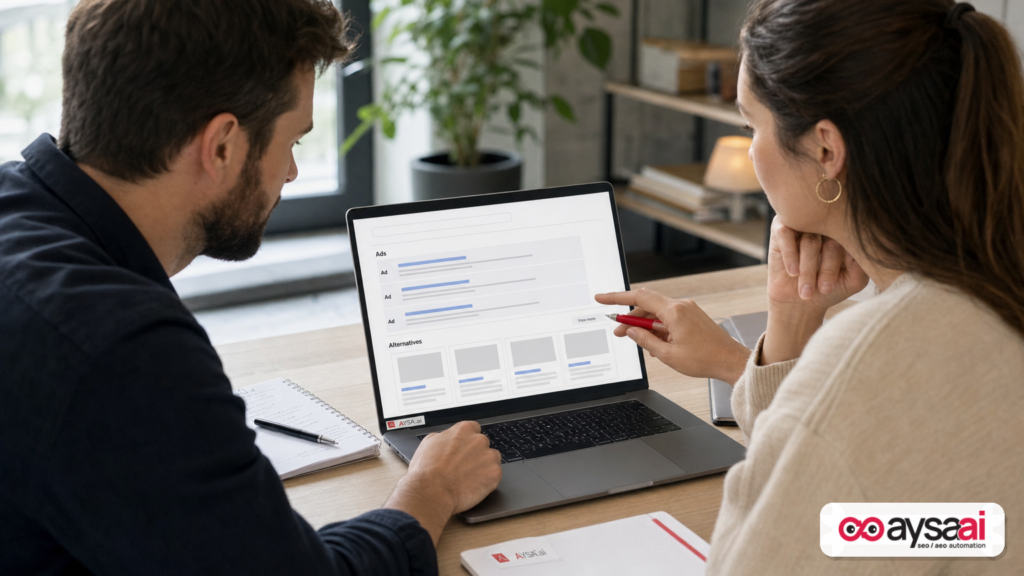
Branded Search used to be the safest traffic in the building. Someone types your company name into Google, Clicks the obvious result, and converts. But in 2026, branded demand is increasingly treated like a contested battlefield—especially in Google Ads—where competitors can siphon high-intent traffic without ever putting your trademark in their ad copy.
This isn’t just “competitors bidding on your brand.” That’s old news. The newer reality is coordinated tactics across Keyword strategy, ad automation, and landing-page persuasion—often within Google’s rules. You can lose Conversion rate, raise your cost per acquisition, and watch “direct” or “organic” branded performance weaken… while everything looks normal inside your account.
This editorial is my practical defense playbook for SMEs and growth teams: what changed, why it matters, how to detect the tactics early, and how to build a proportionate response that mixes Paid Search, SEO, and AI-era visibility. I’m writing this from the AYSA.ai perspective: execution matters, and teams don’t fail because they lack ideas—they fail because they can’t ship the right changes fast enough, with the right approvals.
Primary research inspiration: Search Engine Land – How competitors target your branded traffic with Google Ads.
Concise summary
Competitors can intercept your branded demand in Google Ads through (1) dynamic keyword insertion (DKI) that makes ads appear to reference your brand, (2) comparison/alternatives landing pages that do the convincing after the click, and (3) brand-modifier keywords like “your brand alternatives” and “your brand pricing review.” Most of this is policy-compliant. The best defense is not panic bidding—it’s a system: monitor branded SERPs, segment brand-modifier intent, build the right content and landing pages, measure the economics, and use trademark enforcement only when there’s clear misuse. AYSA fits as an approved-execution engine to monitor, propose, and ship the changes across SEO/AEO/GEO assets that help you own the narrative beyond a single ad slot.
Key takeaways
- Your brand keyword is no longer a single query. “Brand + modifier” searches behave like mid-to-late funnel comparison shopping and need separate strategy and pages.
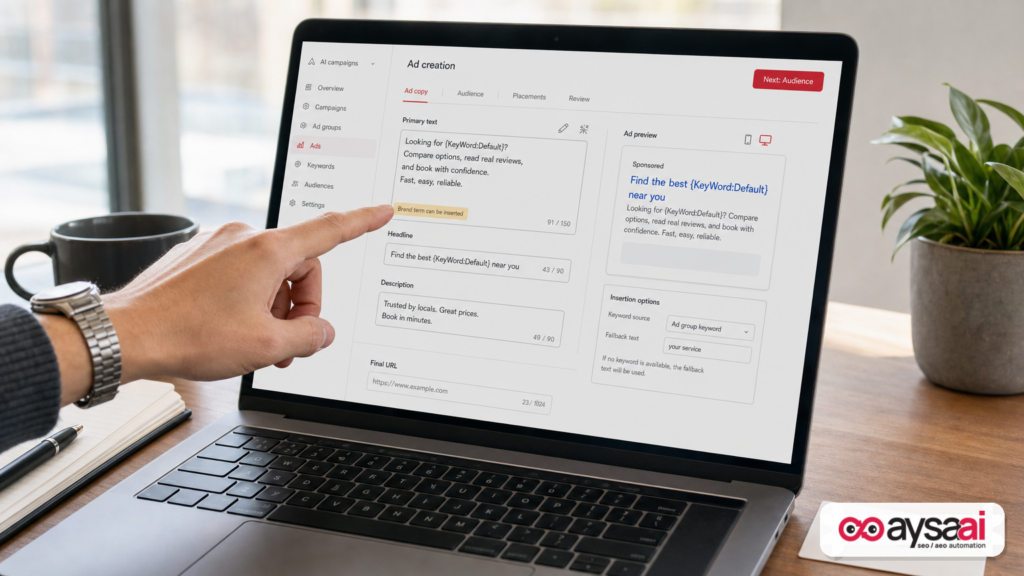
- Google Ads automation can work against you. DKI can insert a brand into an ad headline in ways most teams never audit in the live SERP.
- Landing pages are the persuasion layer. Competitors can run neutral ads and still win post-click with “alternatives” and “vs.” pages.
- Defense must be economic. Your goal is not to “win every impression,” but to defend profitably—spend less defending than the value you protect.
- Owning the narrative is cross-channel. Paid + SEO + reviews + third-party listings + AI visibility all shape what a buyer believes when they search your name.
Table of contents
- What’s actually happening on branded searches (and why it feels like “my organic traffic disappeared”)
- Why this is getting worse now (even if your brand is growing)
- Tactic #1 — Dynamic Keyword Insertion (DKI): the loophole most brands never audit
- Tactic #2 — Comparison and “alternatives” landing pages: the post-click ambush
- Tactic #3 — Brand modifier keywords: the intent segmentation most teams skip
- How to detect branded hijacking early (without living in incognito mode)
- How to quantify the damage: defense economics for SMEs
- Paid Search defenses that don’t turn into a blank-check bidding war
- The bigger defense: “own the SERP,” not just the ad slot
- SEO/AEO/GEO layer: how AI-era discovery changes branded defense
- The SME scenario: a local clinic that lost “free” branded leads overnight
- What agencies should rethink (and what SMEs should demand)
- Where AYSA fits: monitoring + approved execution for branded protection
- What to do next
- Sources and further reading
What’s actually happening on branded searches (and why it feels like “my organic traffic disappeared”)
When business owners say “our organic traffic is disappearing,” they often mean something more specific:
- Branded traffic is down.
- Branded conversion rate is down.
- Phone calls and form fills drop even though “brand awareness” is up.
It’s easy to blame SEO or a Google update. But branded demand can be attacked upstream in the SERP.
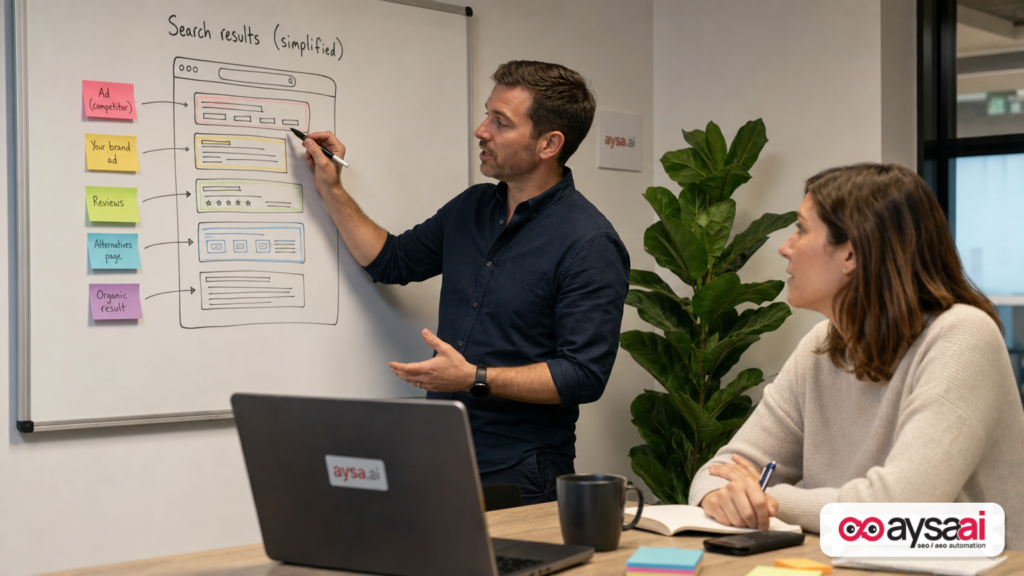
On a typical branded search today, the top of the page may include:
- Your own Search ad (if you bid on your name).
- One or more competitor ads that trigger on brand terms or brand-modifier terms.
- Shopping units, maps, review snippets, “Top” lists, and “alternatives” pages.
- Organic sitelinks… if you still control them.
When competitors insert themselves at the top, you don’t always lose all clicks—you lose the best clicks: the buyers with the highest intent who would have converted quickly. That’s why the symptom shows up as a conversion-rate decline rather than a simple traffic decline.
Search Engine Land’s analysis highlights three common tactics that make this possible: DKI, comparison pages, and brand modifier keywords. Those are the core of the modern branded hijack.
Why this is getting worse now (even if your brand is growing)
Branded hijacking is not new. What’s new is that it’s easier, cheaper to test, and harder to spot—especially for SMEs without a dedicated paid search analyst.
Three forces are pushing this trend:
1) Ad automation reduces the friction to “compete on your name”
DKI and other automated text tactics let advertisers look relevant to a branded query without writing bespoke copy. That matters because ad copy is where many policy lines are enforced. If the platform inserts the query dynamically, advertisers can often stay within policy while still appearing to “mention” the brand in the headline.
2) Buyers research differently: “brand + qualifier” is the new bottom funnel
Ten years ago, many prospects searched “Acme” and clicked. Today, they search:
- “Acme pricing”
- “Acme reviews”
- “Acme vs Beta”
- “Acme alternatives”
These are commercially valuable because the buyer is signaling hesitation or evaluation. Competitors don’t need to beat you on “Acme” to hurt you—they can win the moments where buyers decide whether to commit.
3) SERP real estate is crowded and narrative-driven
Between ads, review platforms, comparison content, and AI-driven surfaces, the branded SERP is no longer a simple navigation query. It’s an information environment. If you don’t shape it, someone else will.
Tactic #1 — Dynamic Keyword Insertion (DKI): the loophole most brands never audit
Dynamic Keyword Insertion is a feature that inserts the user’s query (or a variant) into ad text to make the ad look more relevant. On paper, it’s about improving relevance and CTR. In practice, it creates a branded loophole.
Here’s the core issue described in the Search Engine Land piece: if a competitor bids on your brand terms and uses DKI, the ad headline can dynamically include your brand name because Google inserts the triggered keyword at runtime. The competitor didn’t explicitly type your trademark into the ad copy—Google did the assembly.
Why this matters for SMEs: you can be “out-branded” on your own name, visually, in the ad unit. The user sees your brand in the headline, assumes it’s you (or an official partner), clicks, and lands on a competing offer.
What to look for in the wild
- An ad headline that appears to reference your brand even when the advertiser’s visible domain is clearly different.
- Ads that feel “too perfectly matched” to a long-tail branded query.
- Ad text that changes across searches, devices, or locations.
Why DKI is hard to catch inside your account
You don’t have visibility into competitors’ ad template logic inside your Google Ads UI. Even if you run Auction Insights, you won’t see how their copy is being assembled.
And here’s the uncomfortable part: many brands accidentally set up DKI in ways that can backfire on them, too. If your own DKI setup is broad and you match competitor terms, your ads can end up showing competitor names in your headlines. That’s not just embarrassing—it can be legally risky depending on the context and jurisdiction. (If you need a primary source on trademark policy in ads, Google’s own policy documentation is the right place to confirm current rules; I’m not linking it here because it’s not included in the provided research context, and policies change.)
DKI defense: practical steps
- Audit your own ads: If you use DKI or similar automated insertion, test against competitor terms and brand-modifier terms to make sure you’re not inserting names you shouldn’t.
- Document competitor occurrences: When you see your brand inserted into a competitor ad, capture evidence with date/time/location/device notes. You may need this for escalation.
- Don’t assume a complaint will solve it: If the advertiser didn’t “type” your trademark, enforcement may be inconsistent. Strategy is usually the better lever.
Tactic #2 — Comparison and “alternatives” landing pages: the post-click ambush
Many business owners focus on the ad copy: “Are they using my name?” That’s a narrow view.
The more effective competitor play often looks like this:
- Bid on your brand or your brand-modifier terms.
- Run neutral, policy-compliant ad copy (no trademark mention, no direct attack).
- Send the click to a page titled “YourBrand Alternatives” or “YourBrand vs Competitor.”
- Win the buyer with framing: feature tables, pricing callouts, selective comparisons, and “why choose us” messaging.
Search Engine Land calls out a key dynamic: Google tends to evaluate ad copy more directly than landing-page content for these competitive claims. So as long as the ad stays generic, the persuasion can happen after the click.
Why it works (even when the content isn’t “wrong”)
A well-made comparison page can be truthful and still manipulative:
- It can emphasize categories where the competitor is strong.
- It can omit your differentiators.
- It can use language like “teams switch because…” without naming sources.
- It can guide the reader into a decision path that favors the advertiser.
And even when the ad itself is generic, the landing page can increase relevance to the query, improving auction performance. The post-click experience becomes part of the competitive advantage.
Comparison page defense: don’t just “counter,” out-inform
Your defensive options are broader than “bid harder.”
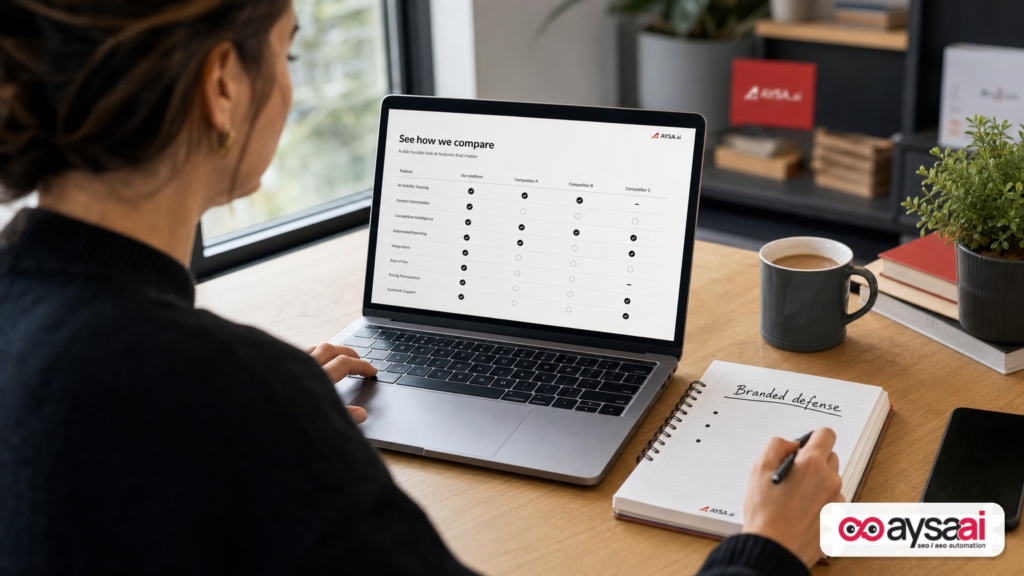
- Create your own comparison assets: Build honest “vs” and “alternatives” pages that address the evaluation questions directly, without trashing competitors. The goal is clarity and trust.
- Build third-party reinforcement: Buyers trust review platforms, directories, and analyst-like summaries. A branded defense strategy must include those surfaces, not just your own site.
- Make your pricing and positioning easy to understand: The fastest way to lose “pricing” modifier searches is to hide the ball. If you’re not transparent, someone else will define your pricing story for you.
Tactic #3 — Brand modifier keywords: the intent segmentation most teams skip
The most important strategic shift is this: not all branded searches are navigational.
Competitors increasingly target “brand + modifier” queries because those searches:
- are lower funnel,
- signal evaluation, and
- offer more legal/policy flexibility (ad copy can remain generic).
Examples of modifier families:
- Pricing: “Brand pricing”, “Brand cost”, “Brand fees”
- Trust: “Brand reviews”, “Brand complaints”, “Brand ratings”
- Comparison: “Brand vs X”, “X vs Brand”
- Alternatives: “Brand alternatives”, “apps like Brand”
- Support intent: “Brand login”, “Brand phone number” (yes, competitors sometimes target these too)
Why you must treat modifier queries as a separate audience
If you lump all branded terms into one campaign/ad group, you lose visibility into what’s being attacked and what’s converting. You also risk paying too much for the wrong intent.
A buyer searching “Brand” might already be committed. A buyer searching “Brand alternatives” is asking permission to leave. You need different messaging, different landing pages, and different success metrics.
Defending modifiers without overpaying
- Segment in campaigns/ad groups: Separate exact brand from modifier clusters so you can see Auction Insights patterns per intent type.
- Build intent-matched landing pages: “Pricing” queries should land on a page that answers pricing questions fast. “Alternatives” queries should land on a page that compares categories fairly and highlights your differentiation.
- Measure downstream value: Modifier traffic may convert at different rates and different deal sizes. Don’t optimize to CTR; optimize to margin.
How to detect branded hijacking early (without living in incognito mode)
Most SMEs discover branded hijacking too late—after performance changes show up in monthly reporting. By then, you’re already paying the tax.
Detection has to be operational, not heroic. Here’s a practical approach:
1) Build a SERP check routine (lightweight, repeatable)
- Check your core brand query weekly.
- Check your top 5 modifier queries weekly (pricing, reviews, alternatives, vs competitor, support/login).
- Check from mobile and desktop.
Yes, manual checks don’t scale—but they establish baseline reality. You can’t defend what you don’t see.
2) Add monitoring where it matters
If you have meaningful brand spend or you’re in a competitive market (legal services, SaaS, home services, ecommerce), you need automated monitoring across locations/devices. Competitors often use geotargeting or dayparting to avoid being seen by you while still intercepting your customers.
AYSA’s angle here is straightforward: monitoring shouldn’t stop at rank tracking. You want monitoring that ties visibility changes to recommended actions and then executes those changes after approval. Start here: AYSA Monitoring.
3) Watch account-level signals that often indicate brand pressure
- Branded CPC creeping upward without a clear explanation.
- Branded conversion rate declining even though brand search volume appears stable.
- More “research” language showing up in Search Terms (pricing, reviews, alternatives).
Auction Insights is useful directionally, but it won’t tell you the landing-page story or the DKI loophole story. Use it as one input, not your only proof.
How to quantify the damage: defense economics for SMEs
Here’s the principle I want every founder to adopt: defense is not a moral crusade; it’s a business decision.
You need to estimate:
- What the competitor activity is costing you (in extra spend and lost conversions).
- What your counter-moves will cost (in spend + content + monitoring + operational time).
- Which option yields the best return and lowest risk.
A simple model you can run without fancy tools
Use this as a starting point (adjust for your business):
- Baseline branded performance: last period when branded CPC and conversion rate looked “normal.”
- Current branded performance: current CPC, CTR, conversion rate, cost per conversion.
- Estimate incremental cost: (current CPC − baseline CPC) × branded clicks.
- Estimate lost conversions: (baseline CVR − current CVR) × branded clicks.
- Estimate lost value: lost conversions × average conversion value (or LTV proxy).
Even if your numbers are imperfect, the model forces discipline. You’ll quickly see whether you’re fighting over hundreds of dollars or tens of thousands per month.
Don’t over-defend the wrong intent
Some modifier traffic is inherently “leaky.” A buyer searching “Brand alternatives” may be shopping no matter what. If you spend like that traffic is guaranteed revenue, you can destroy margin.
Your goal is to:
- protect navigational brand demand efficiently,
- address research-intent modifiers with the right content and messaging, and
- avoid paying premium CPCs for clicks that were never yours to begin with.
Paid Search defenses that don’t turn into a blank-check bidding war
Let’s talk tactics that work in the real world for SMEs—where budgets are real and time is limited.
1) Run a clean, tightly controlled brand campaign
Many businesses try to “save money” by not bidding on their own brand. In a world where competitors target you, that often becomes false economy.
A well-built brand campaign should be:
- Highly relevant with strong ad assets and sitelinks that answer the top navigational needs (pricing, login, contact, demos, locations).
- Separated by intent so exact brand doesn’t get blended with modifier clusters.
- Protected from accidental expansion that triggers competitor terms (watch match types and automation settings).
2) Win with message match, not only bid
If a competitor is sending users to an alternatives page, the defensive move isn’t always to increase your bid. It’s to increase your relevance:
- Use ad copy that clarifies “Official site,” “Direct pricing,” “Book with us,” “No resellers,” etc. (truthful and compliant).
- Use sitelinks to land users directly on the page they were seeking (pricing, reviews, comparison, support).
3) Build landing pages for modifier intent
This is where most brand defenses fail: they send every brand click to the homepage.
Homepage is not an answer. It’s a menu. Modifier queries are questions.
You should have dedicated pages for:
- Pricing (even if it’s “starting at” or “request a quote,” add clarity).
- Reviews/testimonials (with context and proof, not fluff).
- Comparisons/alternatives (honest and category-level, not petty).
- “Official” support/contact pages (to prevent support-intent hijacking).
4) Use trademark enforcement only when it’s clearly warranted
If a competitor uses your trademark directly in ad copy in a way that violates policy, escalation may be appropriate. Search Engine Land notes using Google’s trademark complaint process when a trademark is used directly in ad copy and escalating if the pattern continues.
But in many cases (modifier bidding, comparison pages, generic ads with post-click persuasion), strategy will outperform legal escalation—especially for SMEs who can’t afford prolonged fights.
The bigger defense: “own the SERP,” not just the ad slot
Here’s the contrarian truth: if your entire branded defense is “bid on my name,” you’re playing a shrinking game.
Modern branded defense is about owning the results page. That includes:
- Your ads
- Your organic sitelinks and knowledge-like results
- Review platforms and directories
- Comparison content you influence (directly or indirectly)
- AI-driven citations and brand mentions
Search Engine Land’s piece makes an important point: strong brands don’t rely only on their own pages. They influence the narrative across the search results ecosystem—publishers, review sites, directories, analysts, affiliates. That’s how you reduce the power of a single competitor’s “alternatives” page.
Third-party presence is not vanity; it’s defense
For many categories, buyers trust:
- industry directories,
- review sites,
- local listings,
- credible publishers.
If those surfaces are empty (or negative), competitors can fill the gap with comparison pages and sponsored content.
That doesn’t mean “buy links” or manipulate reviews. It means build a legitimate footprint that matches how buyers research.
SEO/AEO/GEO layer: how AI-era discovery changes branded defense
This article is about Google Ads tactics—but brand defense is bigger than paid search now.
As AI-driven discovery grows (including AI summaries in search experiences and LLM-driven “which tool should I pick” prompts), brand visibility is increasingly about being cited and recommended, not just ranking.
That’s where AEO (Answer Engine Optimization) and GEO (Generative Engine Optimization) come in. Even if a competitor can buy an ad above your result, they still need the broader market to believe their story. Your job is to make your story the easiest to cite and verify across the web.
AYSA’s relevant surfaces:
- AI Search Visibility — understand and improve how your brand shows up in AI-driven experiences.
- AI SEO Tools — support the workflows required to build, update, and maintain defensible pages.
- AYSA Blog — practical execution ideas and playbooks.
Why AI-era search makes branded defense more urgent
- Buyers ask broader questions: “What’s better than X?” “Is X worth it?”
- Answers are synthesized: the model pulls from multiple sources, and if your sources are weak, you lose narrative control.
- Competitors can seed the web with comparison framing: not necessarily with spam—often with legitimate content marketing and partner placements.
The defense is to publish clarity and proof: structured product/service pages, transparent pricing explanations, up-to-date FAQs, and authoritative third-party references.
The SME scenario: a local clinic that lost “free” branded leads overnight
Let’s make this real with a scenario that mirrors what we see across local services.
Business: a multi-location physical therapy clinic.
What they notice: phone calls drop, appointment requests soften, and staff says “people keep asking if we’re affiliated with [new chain competitor].” The owner assumes SEO is broken.
What’s actually happening:
- A competitor starts bidding on the clinic’s brand + location modifiers (e.g., “ClinicName downtown pricing,” “ClinicName reviews”).
- The competitor’s ad copy stays generic: “Book an appointment today.”
- The click lands on a “ClinicName Alternatives” page framed as a neutral comparison.
- Meanwhile, the clinic’s own brand campaign sends traffic to the homepage with no pricing context and no “insurance accepted” clarity—exactly the questions brand-modifier searchers are asking.
What a proportionate fix looks like:
- Segment the clinic’s branded campaign: exact brand vs modifiers (pricing, reviews, locations).
- Create dedicated pages: insurance & pricing explanation, “why choose us,” location pages with strong proof, and a transparent FAQ.
- Improve organic results: ensure location pages are indexable, internally linked, and answer the exact modifier questions.
- Monitor SERPs weekly and alert on competitor appearance spikes.
This is exactly where execution systems outperform “ideas.” The clinic doesn’t need a 40-slide strategy deck. They need approved changes shipped quickly—pages created, copy updated, internal links fixed, schema added where appropriate, and monitoring turned on.
What agencies should rethink (and what SMEs should demand)
If you run an agency—or you hire one—branded defense is an area where complacency shows fast.
1) Stop reporting branded performance as one line item
Branded should be segmented by intent. Your reporting should show:
- Exact brand
- Brand + pricing
- Brand + reviews
- Brand + alternatives / vs
- Brand + support/login
Otherwise you’ll “average out” the problem and miss where competitors are attacking.
2) Own the post-click story
Agencies that only manage bids and ads are leaving clients exposed. Competitors are winning with landing pages and narrative framing. A defense plan must include CRO, content, and SEO execution.
3) Build a rapid-response SLA for branded threats
If your client calls and says “I saw a competitor ad on our name,” the response cannot be “we’ll look into it next month.” You need a fast audit workflow:
- SERP evidence capture
- Modifier query mapping
- Landing page gap analysis
- Budget impact estimate
- Action plan with owner and due dates
This is also where tools and automation should help—but only if they lead to execution, not more dashboards.
Where AYSA fits: monitoring + approved execution for branded protection
At AYSA.ai, we’re building for the gap most teams live in: you can know what to do and still fail because you can’t ship it.
Branded defense requires consistent, cross-functional execution across Paid Search, SEO, and content. The workflow looks like this:
- Monitor: detect changes in branded visibility patterns and query intent shifts. (Monitoring)
- Prepare: turn detection into specific recommended actions—new pages, updated copy, internal linking improvements, structured information, FAQ expansions, and content updates that address modifier intent.
- Ask for approval: SMEs need control. Changes should be proposed clearly, with rationale and expected outcome.
- Execute accepted changes: ship updates consistently so you’re not stuck in “strategy limbo.”
This is also why our approach intersects with AI-era visibility. Branded defense is not only about preventing a stolen click today. It’s about ensuring your brand is the default answer across search, reviews, and AI-driven recommendations. Explore: AI Search Visibility and AI SEO Tools.
If you’re trying to price this work, don’t start with “how many hours.” Start with the value of branded demand you’re defending. AYSA pricing context: AYSA Pricing.
What to do next
If you want a practical action list you can run this week, here it is.
1) Build your branded query map (60 minutes)
- List your exact brand terms (including common misspellings).
- List your top modifiers: pricing, reviews, alternatives, vs, support/login, locations (if relevant).
2) Audit the live SERP for each modifier cluster (60–90 minutes)
- Mobile + desktop checks.
- Note competitor ads, “alternatives” pages, review units, and any confusing copy.
- Save evidence with date/time.
3) Separate campaigns/ad groups by intent (half day)
- Exact brand is its own bucket.
- Pricing/reviews/alternatives/vs are separate.
- Ensure you have landing pages that match each.
4) Create or upgrade the 4 defensive pages (1–2 weeks)
- Pricing explanation page (clarity beats secrecy).
- Reviews/testimonials page (with context and trust signals).
- Comparison/alternatives page (honest, category-led, defensible).
- Official support/contact/login page (reduce confusion).
5) Put monitoring and response cadence in place (ongoing)
- Weekly SERP checks + monthly deeper review.
- Track branded CPC and branded conversion rate as “defense KPIs.”
- Turn insights into shipped changes, not just notes.
If you want AYSA to help operationalize that cycle—monitor, propose, approve, execute—start here: AYSA Monitoring.
Sources and further reading
- Search Engine Land: How competitors target your branded traffic with Google Ads
- Search Engine Land: Google tests AI-generated summaries in Search ads
- Search Engine Land: ChatGPT Thinking mode changes which brands get cited
- Search Engine Land: Why proprietary data is your most defensible AI citation asset
- Search Engine Land: A Google Ads targeting tactic that cut invalid clicks by 50%
AYSA internal reading:
Note on policy and enforcement: This editorial discusses common competitive tactics and strategic responses. Google Ads policies and trademark enforcement can change and vary by region. When you need policy certainty, validate against current official Google documentation and/or qualified counsel.
Continue the AI search topic inside AYSA.
Use these pages to connect the article with AI SEO tools, AI visibility monitoring, AI Overviews and approved website execution.
Turn this topic into a website action plan.
Use these AYSA hubs to move from reading to technical fixes, AI visibility monitoring, research, glossary context and approval-first SEO execution.