Rankings Aren’t Visibility Anymore: How To Win AI Citations (And Measure The Gap) In 2026
Microsoft’s new Bing AI reporting makes one thing official: ranking well and being cited by AI are two different outcomes. Here’s what changed, why it matters for SMEs and agencies, and the practical playbook to earn citations—using measurement, content structure, and approved execution with AYSA.

Search used to have one scoreboard: rankings that turned into Clicks. In 2026, that mental model breaks—because a growing share of “search” ends with an answer, not a list of links.
Microsoft recently made this shift concrete by separating classic search performance reporting from AI citation reporting inside Bing’s own tooling. That product decision matters more than any hot take: it’s an index owner publicly acknowledging that ranking a page and citing a passage are different jobs with different success metrics.
This editorial explains what changed, why it affects every business (not just SEOs), and how to build an operating system for AI visibility—one that measures the gap between rankings and citations and then closes it with practical content and technical improvements. I’ll also show where AYSA fits as an execution layer that monitors, prepares improvements, asks for approval, and implements accepted changes.
Concise summary
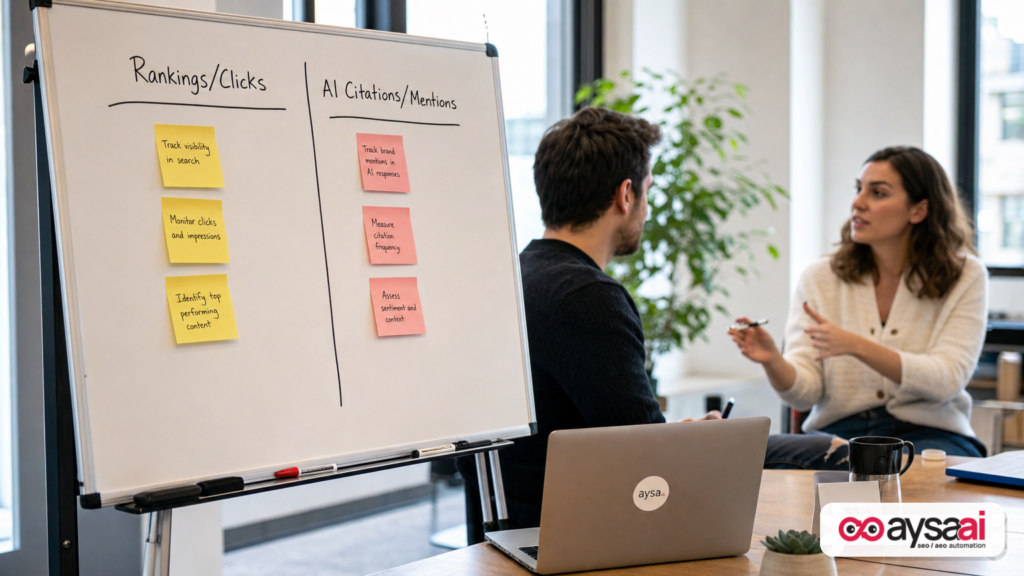
- Rankings ≠ AI visibility. You can rank well and still not get cited in AI answers.
- Pages aren’t the only unit anymore—passages are. AI systems often extract sections (chunks) as evidence.
- First-party reporting is real but narrow. Each platform can only report what happens on its own surfaces.
- The strategy shift: build self-contained, attributable, fresh “answer blocks,” and measure citation share and coverage over time.
- Execution wins. The businesses that move fastest will be the ones with a workflow to turn insights into approved site changes—reliably.
Key takeaways (print this for your next meeting)

- Stop treating “position” as your north star. Add AI citations, mentions, and answer-surface coverage to your core KPIs.
- Design content to survive extraction. If a paragraph can’t stand alone, it’s weak evidence.
- Refresh is a visibility tactic now. Stale facts are dangerous in AI answers; freshness becomes a trust gate.
- Authority becomes “attributable authority.” AI systems prefer clear sources, entities, and claims they can cite.
- Measure the delta. Track where you rank vs. where you’re cited for the same topics, then systematically close the gap.
Table of contents

- The New Reality: Search Has Two Scoreboards
- Why Microsoft’s Move Matters (Even If You Don’t “Do Bing”)
- What Changed: From Ranking Documents To Selecting Passages
- The Hidden Question: Who Is Doing The Telling?
- How AI Systems Choose Evidence: Completeness, Freshness, Authority
- The Content Structure Playbook: Make Every Section Citation-Ready
- Technical Access: Crawling, Indexing, Grounding (Not The Same)
- Measurement: How To Track The Rank-To-Citation Gap Without Fooling Yourself
- An SME Scenario: The Local Clinic That “Ranks” But Doesn’t Get Cited
- Agency Reset: New Deliverables, New Reporting, New Risk
- Where AYSA Fits: Monitoring + Approved Execution For AI Visibility
- What To Do Next (30/60/90 Day Plan)
- Sources & further reading
The New Reality: Search Has Two Scoreboards
For most of the last two decades, “search performance” was shorthand for a simple chain:
- rank higher → get more Impressions → earn more clicks → drive more leads/sales
That chain still exists. But it’s no longer the only chain—and for many queries, it’s not even the primary chain.
AI answers introduce a second scoreboard:
- Citations/mentions (did the AI answer use your content as evidence?)
- Share of Voice inside answers (how often you show up vs. other sources)
- Coverage across surfaces (which engines and assistants include you)
In classic search, the winner is the page that ranks. In AI answering, the winner is the source the model can lift, attribute, and trust—often at the passage level.
That’s the core operating change. And it forces a mindset shift for business owners:
- Traffic is no longer the only proxy for visibility.
- Visibility is no longer a single metric.
- SEO is no longer just “optimize pages.” It’s optimize evidence.
Why Microsoft’s Move Matters (Even If You Don’t “Do Bing”)
The most important detail here isn’t “Bing has a new report.” It’s what that report implies.
Microsoft is one of the few companies that:
- runs a major search engine and web index, and
- ships AI answer experiences on top of that index, and
- provides publisher-facing reporting tied to those AI experiences.
In other words, it can show—inside its own products—how classic search outcomes and AI outcomes diverge.
Search Engine Journal’s coverage summarizes the point well: Microsoft’s reporting reinforces that rankings and citations measure different outcomes, which means businesses need new visibility strategies across AI search surfaces. I’m using that article as a research input and recommending you read it directly for context: Microsoft Just Proved A Point About Search Today (Search Engine Journal).
Even if your customers “use Google,” Microsoft’s move still matters because it’s an early, explicit productization of a broader trend: search is splitting into ranked discovery and answer generation. Once one index owner operationalizes that split in tooling, others tend to follow in their own ways.
What Changed: From Ranking Documents To Selecting Passages
Classic search is largely document-oriented. Yes, modern engines understand entities and sections, but the primary outcome you chase is: your page ranks for the query.
AI answering systems often work differently. They may still retrieve pages from an index, but then they:
- extract relevant passages (chunks) rather than “rewarding” the whole page,
- judge whether each passage can support a claim,
- compile multiple sources into a synthesized answer, and
- optionally show citations.
This passage-first behavior has a brutal consequence for businesses:
You can have a high-quality page that ranks well, but no individual section on that page is strong enough to be selected and cited.
That’s not a philosophical point. It’s an execution point. If your content is written like a narrative—with heavy intros, pronoun references, and “as discussed above”—it may read fine for humans scrolling. But it can fail when an AI system lifts a paragraph out of context.
In practical terms, this means your “SEO checklist” needs new items, like:
- Does each key section answer a specific question in the first 1–2 sentences?
- Does it name the entity/product/service explicitly (not “this approach”)?
- Does it include a clear claim supported by specifics that can be cited?
- Would it still make sense if copied into a standalone answer?
The Hidden Question: Who Is Doing The Telling?
There’s a subtle trap in the new world of AI search reporting: the cleanest dashboards are also the narrowest.
When a platform reports AI visibility, it reports:
- what happened on that platform’s own AI surfaces,
- using that platform’s definition of what a citation is,
- with that platform’s incentives shaping what gets revealed.
That doesn’t make the data “bad.” It makes it bounded.
The SEJ source also notes that Google is rolling out its own AI reporting in Search Console for AI features (again: within Google’s ecosystem). For readers who want a baseline reference on Search Console itself, Google’s official documentation is the place to start: Google Search Console Help (Google).
Here’s the practical business implication:
- If you only measure AI visibility using one platform’s dashboard, you’re measuring “performance in one house,” not “performance in the market.”
This is why I expect a “split stack” to become normal:
- First-party dashboards to see precise performance on each platform.
- Third-party/cross-surface monitoring to understand visibility across assistants and answer engines using consistent methods.
If you’re a small business owner, this might sound like enterprise complexity. It doesn’t have to be—if you narrow your monitoring to the handful of topics that drive revenue and reputation.
How AI Systems Choose Evidence: Completeness, Freshness, Authority
Microsoft’s framing (as described in the SEJ source) is useful because it forces teams to stop treating AI visibility as “mystical.” It becomes operational: AI systems retrieve evidence and score it for usefulness as grounding.
Whether you use Microsoft’s terminology or not, the three dimensions are intuitive and practical for content and SEO teams:
1) Completeness: can the passage stand on its own?
Completeness is about self-sufficiency. A passage is more likely to be used as evidence when it contains:
- a direct answer,
- key qualifiers (who/what/when), and
- enough context to be accurate without needing surrounding paragraphs.
If your content forces a reader (or a model) to assemble an answer from scattered sentences, it becomes fragile as evidence.
2) Freshness: is it current enough to trust right now?
Freshness is not just “update your blog.” It’s about whether the facts are time-sensitive:
- pricing, availability, policies, regulations, product specs, compatibility, shipping cutoffs, medical guidance, and legal requirements
In AI answering, stale facts can become reputational risk. A human might click through and notice the date. An AI system might synthesize the claim unless it has stronger, newer sources.
3) Authority: is the claim attributable and credible?
Authority used to be discussed as backlinks and brand. In AI citations, I’d reframe it as:
- Attributable authority: the model can confidently point to you for that claim.
That requires clarity around:
- who you are (entity signals),
- what you’re claiming,
- why you’re credible to claim it, and
- where the claim lives on your site in a stable, accessible form.
The Content Structure Playbook: Make Every Section Citation-Ready
Let’s get practical. If AI systems are increasingly passage-driven, your content should be built like a set of high-quality answer modules—not a long essay that only makes sense top-to-bottom.
Write answer-first blocks (then support)
A simple pattern that works across industries:
- Sentence 1: direct answer / definition / recommendation
- Sentence 2: key qualifier (who it applies to, when, constraints)
- Sentences 3–6: supporting details, steps, examples
- Optional: a “why” or “tradeoff” statement
This structure helps humans scanning and helps AI systems extracting.
Name the entity; avoid dangling references
If a block starts with “This solution…” it may fail when extracted. Instead:
- Use the product/service name.
- Repeat the subject when necessary.
- Prefer clarity over literary flow.
In AI visibility, clarity is conversion.
Use FAQ-like subheadings without turning your site into an FAQ dump
You don’t need to make everything a FAQ page. But you do want question-shaped subheadings where users and assistants naturally ask questions.
For example, a florist might create sections like:
- “How long do cut peonies last in a vase?”
- “What flowers are safe around cats?”
- “Same-day delivery: what times are eligible?”
Each becomes a passage candidate.
Turn generic claims into citable claims
AI systems don’t love vague marketing language because it’s hard to ground.
Instead of:
- “We offer fast shipping.”
Prefer:
- “Orders placed before 2pm ship the same business day (Mon–Fri).”
If you can’t verify a number or policy, don’t add one. But if you do have a real policy, state it plainly and keep it updated.
Schema and structure: helpful, not magical
Structured data (schema) can help machines interpret your pages, but it doesn’t replace strong content. Treat schema as:
- a way to reduce ambiguity about entities and page purpose,
- not a trick to “force” citations.
If you need a starting point for structured data references, Schema.org is the canonical library: Schema.org. (Note: this is a general reference; implementation choices should reflect your CMS and content types.)
Technical Access: Crawling, Indexing, Grounding (Not The Same)
One of the easiest ways to lose AI visibility is also the least glamorous: you accidentally block access.
The SEJ source highlights a key operational nuance: systems built on a search index may inherit existing crawl controls and robots rules. Translation for SMEs: decisions you made years ago for “crawl budget” or to hide low-value pages can become decisions that limit AI eligibility.
Think in three layers:
- Crawling: can bots fetch the URL?
- Indexing: is it stored and retrievable as part of the index?
- Grounding/eligibility: can it be used as evidence in AI answers?
Even if your site “ranks,” parts of it might be inaccessible or inconvenient for evidence retrieval. Common culprits:
- robots.txt rules that unintentionally block key directories
- noindex tags on pages that contain the best definitions or policies
- content locked behind scripts or interactions that bots don’t execute reliably
- thin templated copy repeated across hundreds of pages, creating low-distinctiveness passages
For a reliable baseline on robots.txt, Google’s documentation is a widely used reference even beyond Google: robots.txt specifications and guidance (Google). The underlying idea—clear, intentional bot access rules—applies broadly.
Measurement: How To Track The Rank-To-Citation Gap Without Fooling Yourself
In the old world, measurement was mostly about: sessions, conversions, rankings, and maybe share of voice.
In the new world, you need to measure at least two distinct outcomes:
- Discoverability (do you show up as a ranked result?)
- Usability as evidence (do you get cited/mentioned in answers?)
Microsoft’s separation of “Search Performance” and “AI Performance” (as described by SEJ) is a strong mental model. But don’t stop there.
Don’t unify metrics too early
A common executive mistake is asking for “one number.” In this era, one number is usually misleading.
Instead, build a simple scorecard for your priority topics:
- Classic rank range (top 3, top 10, etc.)
- AI citation presence (yes/no) on key surfaces you care about
- Citation share trend (up/down) where you can measure it
- Business outcome trend (leads, sales, calls)
Then track the delta: where rank is strong but citations are weak, and vice versa.
Pick queries that matter to the business
SMEs don’t need 10,000 keywords. They need:
- the 20–50 questions that drive purchase decisions,
- the questions that reduce support load (“returns policy,” “sizing,” “insurance accepted”),
- and the reputation queries (“is brand X legit,” “brand X vs brand Y”).
That’s your AI visibility battleground.
Measure on a cadence; look for direction, not perfection
AI answer surfaces change frequently. A single snapshot can lie. What matters is trend direction:
- Is your citation coverage expanding or shrinking?
- Are competitors appearing in answers for your brand-adjacent topics?
- Are your own pages being replaced by forums or aggregator sites?
An SME Scenario: The Local Clinic That “Ranks” But Doesn’t Get Cited
Let’s make this real with a scenario I’ve seen repeatedly in different industries.
Business: a local clinic offering dermatology services.
What they see:
- They rank on page one for “acne treatment in [city]” and “eczema specialist [city].”
- Organic traffic looks stable.
What they don’t see (until it hurts):
- Patients start calling with odd expectations based on AI answers (“I read you offer X therapy,” which they don’t).
- For common questions (“How do I prepare for a mole removal?”), AI answers cite national health sites and community forums—not the clinic’s own prep instructions.
Why the clinic isn’t cited (typical causes):
- The service page has a long intro about the clinic’s philosophy and very little procedural clarity.
- Preparation steps are buried in a downloadable PDF or behind a portal.
- No clear, self-contained section answers the actual question (“What should I do the day before?”).
What fixes it (without “gaming” anything):
- Create a “Preparation & aftercare” section with short, standalone blocks.
- Add explicit qualifiers (who should call, when to stop medications—only if verified and compliant).
- Keep it refreshed; add dates when policies change.
- Ensure pages are crawlable and not accidentally noindexed.
Notice what’s missing: there’s no gimmick. It’s clarity, structure, and accessibility—engineered for extraction.
Agency Reset: New Deliverables, New Reporting, New Risk
If you run an agency or you’re a marketing lead managing vendors, here’s what changes operationally.
Deliverables shift from “pages” to “evidence assets”
A deliverable like “publish 4 blogs a month” is increasingly weak. What you want instead:
- a prioritized list of customer questions,
- mapped to pages/sections that will answer them,
- with structured updates and refresh cycles,
- and a measurement plan that tracks citations and mentions over time.
Reporting must separate classic SEO from AI visibility
Clients will ask: “Are we showing up in AI?”
If your report only includes rankings and GA4 sessions, you’ll lose trust. But if your report only includes one platform’s AI dashboard, you may accidentally sell a partial truth as the whole truth.
Agencies should adopt a dual layer:
- First-party platform reporting where available
- Cross-surface monitoring for broader visibility signals
Risk increases: hallucinations meet brand accountability
When AI answers are wrong, customers blame the brand, not the model.
That means content teams must treat certain pages as “grounding-critical,” similar to how legal teams treat terms and privacy pages:
- pricing and plans
- return/refund policy
- warranty
- shipping cutoffs
- eligibility requirements
- product compatibility
These are not optional updates. They’re operational hygiene.
Where AYSA Fits: Monitoring + Approved Execution For AI Visibility
Most businesses don’t lose in AI search because they lack ideas. They lose because they lack an execution system.
That’s the gap AYSA is built to close: monitor → prepare improvements → ask for approval → execute accepted website changes.
Here’s how to think about AYSA in this new environment:
1) Monitor the new scoreboard (without drowning in noise)
AYSA’s monitoring capabilities are designed for ongoing visibility management, not one-time audits. Start here: AYSA Monitoring.
In an AI-first world, monitoring should help you answer:
- Which priority topics are we gaining/losing visibility on?
- Which pages are “ranking strong but citation weak”?
- Which sections need refreshes or restructuring?
2) Build for AI search visibility deliberately
AI search visibility is not an add-on. It’s a strategy layer that touches content structure, technical access, and authority signals. AYSA’s AI visibility positioning and approach lives here: AI Search Visibility by AYSA.
3) Use AI SEO tools—but with governance
“AI SEO tools” shouldn’t mean “let a bot rewrite your site.” It should mean: identify high-leverage improvements and implement them with human approval. Explore: AYSA AI SEO Tools.
4) Approved execution is the difference between strategy and results
In practical terms, the workflow should look like this:
- Detect a visibility issue (e.g., you’re not cited for a high-intent question).
- Diagnose why (passage quality, freshness, access, unclear entity signals).
- Prepare specific changes (rewrite a section, add a clarifying block, update policy, improve internal linking, fix crawl barriers).
- Approve (business owner, compliance, brand).
- Execute and track the delta over time.
This is the muscle most SMEs and many agencies lack—because execution is messy. AYSA is built to make that loop repeatable.
5) Make it budgetable
AI visibility can spiral into endless experimentation. You need a system that’s budgetable and tied to business outcomes. For plan context: AYSA Pricing.
6) Keep learning (but keep shipping)
The best teams learn continuously, but they don’t wait for perfect certainty. For more practical editorials and playbooks: AYSA Blog.
What To Do Next (30/60/90 Day Plan)
If you only take one thing from this article, take this: treat AI citations as a production discipline, not a one-time optimization.
Next 30 days: establish the baseline
- Pick 20–50 revenue-driving questions (sales, support, comparison, “best,” “cost,” “how to”).
- Map them to pages (which URL should be cited for each question?).
- Audit passage quality: are there self-contained answer blocks?
- Check technical access: robots, noindex, rendering, internal linking.
Next 60 days: build citation-ready sections
- Rewrite key sections to be self-contained and answer-first.
- Add “freshness anchors” where appropriate (updated dates, version-specific notes—only when true).
- Improve entity clarity: consistent naming, about pages, author/editor signals where relevant.
- Reduce duplication across location or category pages; add distinct, useful details.
Next 90 days: measure the delta and operationalize refresh
- Track which topics gained citations/mentions and which didn’t.
- For lagging topics, run a second-pass: improve completeness, add missing qualifiers, strengthen authority cues.
- Create a refresh cadence for policy, pricing, availability, and key “grounding-critical” pages.
- Formalize approvals: who signs off on changes and how fast can you ship?
What to do next (action list)
- Adopt the two-scoreboard mindset: track rankings and AI citations separately.
- Choose your “citation target pages” for each high-intent question.
- Rewrite for extraction: answer-first, self-contained blocks.
- Fix access issues: crawlable, indexable, and practically usable as evidence.
- Measure the rank-to-citation gap monthly and act on widening gaps first.
- Implement with governance: use an approved-execution workflow so improvements ship reliably.
Sources & further reading
- Search Engine Journal — Microsoft Just Proved A Point About Search Today
- Google — Search Console Help
- Google — robots.txt guidance
- Schema.org — Structured data vocabulary
Note on sourcing: This editorial is based on the supplied research context and general best practices. Where platform-specific AI reporting details are referenced, they are attributed to the Search Engine Journal source linked above. If you want us to expand the “Sources & further reading” list with additional primary platform docs (e.g., Microsoft documentation for specific tooling), we should add them only after they’re provided in the research context or shared directly.
Continue the AI search topic inside AYSA.
Use these pages to connect the article with AI SEO tools, AI visibility monitoring, AI Overviews and approved website execution.
Turn this topic into a website action plan.
Use these AYSA hubs to move from reading to technical fixes, AI visibility monitoring, research, glossary context and approval-first SEO execution.