Your Next Breakthrough in AI Search Won’t Come From Another Webinar: It’ll Come From a Better Pitch—and Better Execution
SMX Next is calling for session pitches—but the bigger story is what the call reveals: search has become an execution game across SEO, PPC, and AI citations. Here’s what changed, what businesses should do now, and how an approved-execution system like AYSA turns strategy into measurable outcomes.

Search Engine Land recently reminded the industry of something that looks simple on the surface: SMX Next is accepting speaker pitches. If you’re a practitioner with fresh tactics in SEO, PPC, and AI Search, they want to hear from you.
But there’s a bigger signal embedded in that call for proposals—one that matters far more than whether you personally want to speak at a conference.
Search has become an execution game. Not “publish more content” execution. Not “tweak a few keywords” execution. I mean cross-channel, system-level execution that connects:
- Technical reliability (crawl/index, speed, Structured data, information architecture)
- Content that proves expertise and matches intent
- Authority signals and trust (brand, reviews, citations, real-world proof)
- Paid search controls and waste prevention as automation increases
- AI visibility (AEO/GEO): earning inclusion in synthesized answers and recommendations
And then it has to ship—consistently—without breaking your site or wasting budget.
That’s what I want to unpack in this editorial. We’ll use SMX Next’s pitch themes as a lens, but the goal is practical: help you build a 2027-ready search operating system and explain where AYSA fits as an approved-execution engine that monitors, prepares changes, asks for approval, and executes accepted improvements on your website.
Concise summary

- What changed: Search is moving from “ranking pages” to “earning recommendations” inside AI-generated answers and agent-like experiences.
- Why it matters: Traditional SEO dashboards can look stable while your real demand capture shrinks (fewer Clicks, different SERP layouts, higher expectations for trust).
- What to do: Build a weekly execution cadence that combines technical hygiene, intent-matched content, proof of expertise, and paid/organic coordination.
- Where AYSA fits: AYSA is a system for monitoring, preparing recommended fixes, routing them for approval, and executing changes you accept—so strategy turns into shipped work.
Table of contents

- The real takeaway from “submit a pitch”: search is now a systems problem
- What changed: from ranking pages to earning recommendations
- PPC in the age of automation: control, privacy, and waste
- Trust is the new ranking factor (even when there isn’t a “ranking”)
- Measurement is lagging reality: what to monitor now
- A durable weekly workflow: how real teams win in 2027
- A concrete SME scenario: local clinic + AI Overviews + paid brand defense
- What agencies should rethink: from deliverables to outcomes
- Your most defensible AI visibility asset is proprietary proof
- If you want to speak (or lead): the anatomy of a pitch that matters
- Where AYSA fits: monitoring → recommendations → approval → execution
- What to do next (action list)
- Sources and further reading
The real takeaway from “submit a pitch”: search is now a systems problem
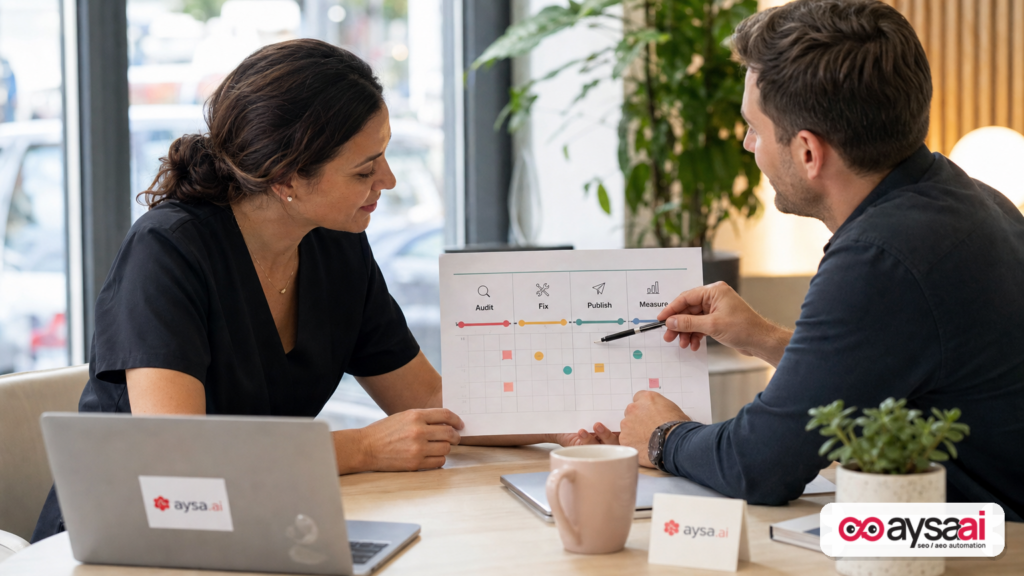
When an event like SMX Next emphasizes “navigating today’s complex search landscape” and “tactics that will define success in 2027 and beyond” (as described in Search Engine Land’s call for pitches), it’s acknowledging what many business owners feel but can’t name: the old mental model of search is broken.
The old model was linear:
- Pick keywords
- Create pages
- Build links
- Rank
- Get clicks
That model still exists, but it no longer explains outcomes for many businesses—especially SMEs that rely on search for predictable lead flow.
Now search is a system with feedback loops:
- SEO affects PPC (and vice versa) because SERP real estate, brand demand, and conversion paths overlap.
- AI visibility affects SEO because users may get answers without clicking, or may click deeper in the journey.
- Trust affects everything because AI systems and users both prefer sources that look legitimate, current, and consistent.
- Execution speed is the moat because everyone can “know” what to do; few can ship it safely every week.
This is why I think the most valuable outcome of a conference like SMX Next isn’t the slide decks—it’s the operational frameworks speakers bring. If you’re a business leader, your question shouldn’t be “What tactic should we try?” It should be: “What operating system do we run every week that compounds?”
What changed: from ranking pages to earning recommendations
Search Engine Land’s pitch call mentions a shift toward mastering AI Overviews, “search everywhere optimization,” and even autonomous agents browsing on behalf of users. That framing is important because it captures the direction of travel: the interface between the user and the web is changing.
Here’s the practical interpretation for a business owner:
- In classic search, your goal was to be the best blue link.
- In AI-mediated search, your goal is to be the trusted ingredient in an answer, shortlist, comparison, or recommendation.
That means your visibility can be influenced by factors that don’t show up in “rank tracking” in the way you’re used to.
For example, consider how a user might search for something like “best ergonomic office chair under $300”:
- They might get a synthesized summary with a few products highlighted.
- They might ask follow-up questions without returning to the SERP.
- They might click only once—late—after narrowing options.
So even if you’re “ranking,” you might not be getting chosen.
This is the core mindset shift of AEO/GEO (answer engine optimization / generative engine optimization): you’re optimizing for inclusion and preference, not just position.
From the Search Engine Land ecosystem, you can see adjacent themes emerging in their coverage—like how brands get cited in LLM experiences (example) and how AI affects the search landscape more broadly (example). You don’t need to adopt every new acronym, but you do need to accept that the “click economy” is no longer the only economy.
Why this is hard for SMEs
SMEs typically have two constraints:
- They can’t outspend the biggest advertisers in PPC.
- They can’t outpublish the biggest content factories in SEO.
So the advantage has to come from precision and execution:
- Being technically flawless where competitors are sloppy
- Proving real-world expertise (not generic content)
- Building a small set of high-performing pages that convert
- Protecting brand demand from competitors’ paid tactics
- Showing consistent trust signals across the web
PPC in the age of automation: control, privacy, and waste
Search Engine Land’s pitch call highlights a tension every paid search team feels right now: automation can drive scale and personalization, but it also introduces new risks—loss of strategic control, data privacy concerns, and plain old budget waste.
Even within Search Engine Land’s broader PPC coverage, you can see that practitioners are focused on pragmatic controls: reducing invalid clicks (example), defending branded traffic from competitors (example), and dealing with evolving campaign types like Performance Max (example).
What I want SMEs to understand is this: PPC is no longer just “turn on ads.” It’s a governance problem.
The governance checklist SMEs need (even if you’re small)
- Budget guardrails: caps, shared budgets used carefully, clear stop-loss rules.
- Query and placement visibility: you need to know where ads actually appear and what triggers them.
- Brand defense strategy: decide when to bid on your own brand and how to handle competitor conquesting.
- Landing page alignment: ads are only as efficient as the page experience and offer clarity.
- Waste audits: a recurring review process for invalid clicks, irrelevant queries, and low-quality placements.
As AI-generated ad experiences evolve—Search Engine Land has covered experiments like AI-generated summaries in Search ads (example)—your job becomes ensuring that what’s automated still matches your strategy, compliance requirements, and customer expectations.
Trust is the new ranking factor (even when there isn’t a “ranking”)
SMX Next’s pitch page emphasizes demonstrating trustworthiness and digital authority, and that’s exactly right. In AI-mediated search, trust isn’t just a “nice to have”—it’s how systems decide what to include, and how humans decide what to believe.
For SMEs, trust is often the most achievable advantage because it can be built with operational discipline rather than huge budgets.
What “trust” looks like on a website (in plain English)
- Clear identity: who you are, where you operate, how to contact you, who is responsible.
- Proof: case studies, reviews, certifications, real photos, verifiable claims.
- Transparency: pricing ranges, policies, warranties, shipping/returns, service areas.
- Consistency: same facts across your site, listings, and profiles.
- Freshness: updated pages and obvious signals that you’re active.
Notice what’s missing: “write 200 blog posts.” For many SMEs, trust comes more from a handful of excellent pages and strong business fundamentals than from publishing volume.
Local businesses: trust is fragile
If you run a local business, your trust layer includes reviews and listings stability. Search Engine Land has reported on issues like reviews going missing and pauses on local listings (example). The point isn’t to panic—it’s to recognize that visibility dependencies can break and you need monitoring plus contingency plans.
Measurement is lagging reality: what to monitor now
Most businesses still evaluate search with a 2015 scoreboard: rankings, clicks, sessions. Those still matter, but they’re incomplete—especially as SERPs change and AI experiences alter click behavior.
Also, basic reporting can be disrupted by platform issues. Search Engine Land noted, for example, a Google Search Console indexing report fix (example). When your instruments wobble, you need redundant signals.
What SMEs should monitor weekly vs. monthly
Weekly monitoring (to catch fires early):
- Search Console coverage/indexing anomalies (spikes in excluded pages, sudden drops in impressions)
- Top landing pages: impressions and clicks trend changes
- Branded search demand signals (impression share / CPC changes if you run ads; query trends if you don’t)
- Conversion integrity (forms, checkout, call tracking, appointment booking—are they working?)
- Local listing changes if relevant (hours, categories, review velocity)
Monthly monitoring (to steer strategy):
- Topic and page performance by intent stage (awareness vs. decision pages)
- Content decay (pages losing impressions over time)
- Competitor shifts (new entrants, new comparison content, ad aggressiveness)
- Technical debt review (speed, templates, structured data consistency)
This is where a monitoring-first approach matters. AYSA is built around ongoing monitoring (AYSA Monitoring) because you can’t execute your way out of a problem you don’t see early.
A durable weekly workflow: how real teams win in 2027
Search Engine Land’s broader editorial ecosystem includes tactical workflows like “How to build a 120-minute weekly SEO workflow that gets results” (Read the source article on searchengineland.com). That’s the right instinct: consistent, focused work beats occasional reinventions.
Here’s the workflow I recommend for SMEs and lean teams who need outcomes—not busywork.
Step 1 (20 minutes): inspect the demand layer
- Are impressions down on your top 5 pages?
- Did branded queries shift?
- Did PPC spend or CPC change materially?
Goal: determine whether you have a market change, a SERP change, or a site change problem.
Step 2 (20 minutes): inspect the access layer (technical basics)
- Indexing issues?
- Template changes?
- Broken internal links?
- Slow pages or Core Web Vitals regressions?
Goal: make sure search engines and users can reliably reach and use your site.
Step 3 (30 minutes): execute one “money page” improvement
Pick one page that matters commercially (service page, category page, product collection, pricing, comparison).
Make one meaningful improvement, such as:
- Add proof: FAQs, policies, certifications, real photos
- Clarify offer and intent match: what this is for, who it’s for, what happens next
- Improve internal linking from related pages
- Add structured clarity (not “markup for markup’s sake,” but consistent entity signals)
Goal: compounding improvements on pages that actually drive revenue.
Step 4 (20 minutes): protect your brand demand
- Check competitor ads on your brand name (if you run PPC, audit terms; if you don’t, manually spot check occasionally).
- Make sure your site titles/meta reflect your brand and core value proposition clearly.
- Ensure your listings and profiles are consistent and current.
Goal: don’t let others monetize the demand you created.
Step 5 (10 minutes): document what shipped
Write down:
- What changed
- Where
- Why
- What metric should move
- When you’ll check it
This is where teams fail: they “do SEO,” but they don’t create an execution log that allows learning. AYSA’s model is designed to make shipped work visible and reviewable—monitor, prepare, approve, execute—so you can run SEO like operations, not vibes.
A concrete SME scenario: local clinic + AI Overviews + paid brand defense
Let’s make this real.
Imagine a mid-sized local clinic (physical location, appointment bookings, high trust category). Historically, they relied on:
- Ranking for “urgent care near me” and similar terms
- A strong Google Business Profile
- Some PPC for urgent needs and seasonal spikes
Now the clinic notices something confusing:
- Rankings look “okay.”
- But organic clicks are flat or down.
- Calls are volatile week to week.
- Competitors show up in “best of” lists and comparisons more often.
What likely changed
- SERPs added more answer features and summaries, reducing clicks for broad queries.
- Users shifted toward comparison behavior (hours, insurance accepted, wait times, reviews).
- Competitors started bidding on the clinic’s brand name (common in local categories).
- Reviews or listing elements became unstable (and you may not notice until revenue feels it).
What the clinic should do in the next 30 days
- Rebuild the “trust center” on the site: clear policies, insurance info, staff credentials, hours, location details, what to expect, and real photos.
- Create intent-specific landing pages: not 50 blog posts—just pages that answer the core decision questions.
- Instrument conversions: bookings, calls, directions, form submits. If measurement is wrong, everything else is noise.
- Run a brand defense PPC audit: decide whether to bid on brand, and implement controls to reduce waste.
- Set up monitoring: track indexing anomalies and local listing changes so you see issues early.
Where AYSA fits in this scenario
This is exactly the kind of situation where businesses get stuck: they know what needs to change, but implementation drags for weeks across stakeholders.
AYSA is designed to reduce that friction:
- Monitor visibility and site signals (Monitoring)
- Prepare changes (content/technical improvements) and present them clearly
- Ask for explicit approval before edits go live
- Execute accepted website changes so improvements ship
This approved-execution loop matters more as search becomes more volatile and AI-driven interfaces make the “cost of waiting” higher.
What agencies should rethink: from deliverables to outcomes
Search Engine Land’s pitch call includes a line that many agency leaders should take seriously: we need advanced, actionable sessions backed by data, with clear takeaways. That’s also the direction agency-client relationships must move.
Clients are getting less patient with:
- Monthly deliverable theater
- Audits that don’t get implemented
- Content calendars disconnected from revenue
- Reports that describe what happened but don’t change what happens next
And, to be fair, agencies are getting squeezed by realities like:
- Limited access to client CMS environments
- Slow approvals
- Multiple stakeholders with conflicting priorities
- Tool sprawl and expensive stacks
Even Search Engine Land’s surrounding content points to this evolution: new tool stacks (Read the source article on searchengineland.com), new workflows, and an insistence that AI work should be judged by outcomes. The direction is clear: clients will pay for impact, not effort.
The agency operating system that will win
- Outcome-defined scopes: “increase qualified leads from non-brand pages,” not “publish 8 blogs.”
- Execution velocity: weekly shipping of improvements, not monthly presentations.
- Proof-based content: proprietary insights, real case examples, data clients actually own.
- Cross-channel coordination: SEO + PPC + CRO + analytics as one loop.
- Governance and safety: clear approval controls to reduce risk.
AYSA’s model supports this shift by giving agencies and in-house teams a system that can propose improvements, route approvals, and execute accepted changes—without turning every improvement into a ticketing nightmare. If you’re exploring what that looks like for your team, start with AYSA’s AI SEO tools and AI search visibility resources.
Your most defensible AI visibility asset is proprietary proof
One of the most important themes in modern AI search is that generic information is becoming cheap. Anyone (or any model) can produce a “what is X” explanation.
What’s harder to replicate—and more likely to be cited or trusted—is specific proof:
- Original processes
- Unique datasets (even small ones)
- Real customer outcomes (appropriately anonymized)
- Actual inventory, pricing logic, availability constraints
- Operational expertise (how you do the work)
This aligns with the broader Search Engine Land conversation around proprietary data as an asset for AI citation (see their coverage: Read the source article on searchengineland.com).
For SMEs, you don’t need a million-row dataset. You need credible, verifiable specificity on the pages that matter:
- A contractor can show before/after project galleries with dates and constraints.
- A SaaS company can publish real implementation checklists and integration guides.
- An ecommerce brand can publish sizing methodology, material testing notes, and care instructions that reflect real product knowledge.
This is the kind of content that tends to earn links, trust, and inclusion—because it’s not interchangeable.
If you want to speak (or lead): the anatomy of a pitch that matters
Search Engine Land’s SMX Next pitch guidance is practical: be original, be actionable, bring data, keep it focused, provide tangible takeaways. That advice applies beyond conference proposals—it’s a blueprint for how you should run search internally.
Use “pitch thinking” to build your internal roadmap
Try this exercise: write a one-page “session pitch” for your own business titled:
“How we will win search in 2027 in 30 minutes.”
It should include:
- The thesis: what changed and what you believe now.
- The framework: your operating system (weekly cadence + responsibilities).
- The evidence: what you’ve observed (Search Console patterns, PPC costs, conversion changes).
- The plan: what you will ship in the next 30/60/90 days.
- The takeaways: what success looks like in measurable terms.
If you can’t write this clearly, your team will struggle to execute clearly.
Common pitfalls that kill outcomes (and pitches)
- Too broad: “AI SEO trends” instead of “How we rebuilt product categories to earn AI citations and lift conversion.”
- No proof: opinions without examples or constraints.
- No action: “here’s what’s happening” without “here’s what to do Monday.”
- No scope realism: trying to solve the entire internet in 30 minutes (or one quarter).
Where AYSA fits: monitoring → recommendations → approval → execution
Most teams don’t lose because they lack ideas. They lose because the distance between insight and implementation is too long.
Here’s what that looks like in the real world:
- The SEO finds issues in Search Console.
- The developer queue is booked for 6 weeks.
- The content writer ships drafts that never get published.
- The PPC manager changes targeting but the landing page stays mismatched.
- Everyone reports. Nobody ships.
AYSA’s core value is execution with control.
AYSA is an approved execution system:
- Monitors your site and visibility signals (monitoring)
- Prepares recommended website changes (content and technical)
- Asks for approval so you stay in control
- Executes accepted changes so work actually ships
That loop matters specifically in AI search because conditions change quickly. The teams that win are the teams that can:
- See changes early
- Respond safely
- Keep improving money pages
- Build trust signals continuously
If you want to explore the ecosystem around this, start here:
What to do next (action list)
- Pick 5 “money pages” (service pages, category pages, pricing, comparison). Commit to improving one per week for 8 weeks.
- Set a weekly monitoring ritual: Search Console anomalies, conversion checks, brand demand spot check, local listing check (if relevant).
- Write a one-page “2027 search pitch” for your business: thesis, framework, evidence, 90-day plan.
- Audit PPC governance if you run ads: brand defense, waste checks, landing page alignment.
- Build proof assets that competitors can’t copy: process docs, real examples, unique data, transparent policies.
- Fix execution friction: decide how changes get approved and shipped. If that’s your bottleneck, evaluate an approved-execution system like AYSA.
Sources and further reading
- Search Engine Land: Want to present at SMX Next? Now’s the time to submit a pitch!
- Search Engine Land: How to build a 120-minute weekly SEO workflow that gets results
- Search Engine Land: The new SEO stack: What replaces your old toolset
- Search Engine Land: Google tests AI-generated summaries in Search ads
- Search Engine Land: ChatGPT Thinking mode changes which brands get cited
- Search Engine Land: Google is investigating reports of reviews going missing and pausing reviews on local listings
- Search Engine Land: Google indexing report in Google Search Console fixed
- Search Engine Land: Google adds Channel Diagnostics to Performance Max
- Search Engine Land: How competitors target your branded traffic with Google Ads
- Search Engine Land: A Google Ads targeting tactic that cut invalid clicks by 50%
- Search Engine Land: What 1 million keywords reveal about AI’s impact on search
- Search Engine Land: Why proprietary data is your most defensible AI citation asset
Note: This editorial draws on the themes and research leads surfaced in Search Engine Land’s SMX Next pitch call and related coverage. Where platform behavior is evolving quickly (AI Overviews, automation, local review stability), treat recommendations as operational guidance rather than fixed rules—and validate changes against your own analytics and business constraints.
Continue the AI search topic inside AYSA.
Use these pages to connect the article with AI SEO tools, AI visibility monitoring, AI Overviews and approved website execution.
Turn this topic into a website action plan.
Use these AYSA hubs to move from reading to technical fixes, AI visibility monitoring, research, glossary context and approval-first SEO execution.