
Can SEO Agencies Use AYSA? Yes, But Not As Another Reporting Tool
A strategic view on how agencies can use AYSA as an SEO execution layer without making AYSA a generic agency software vendor.
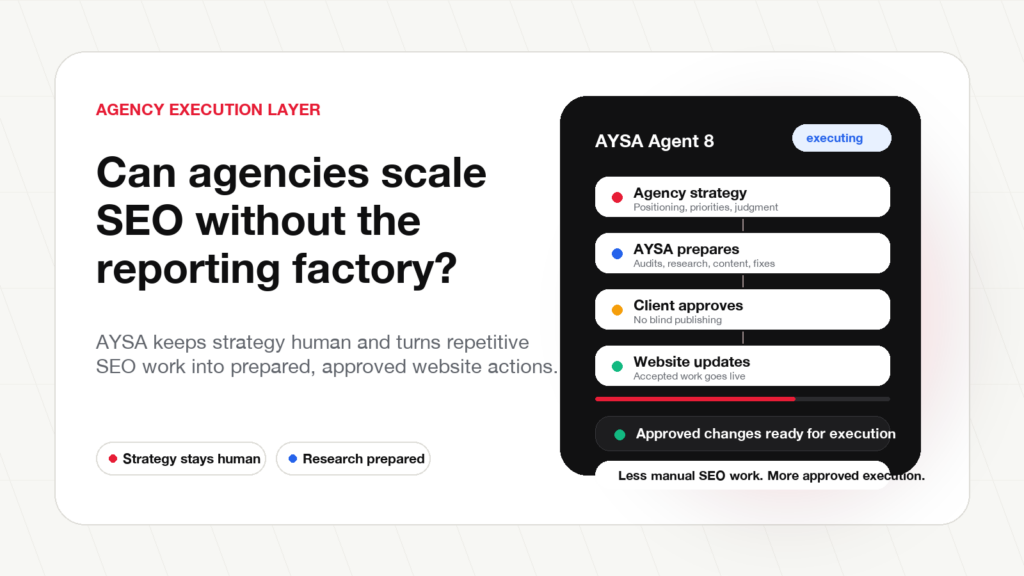
Summary: AYSA is not positioned as another classic “SEO software for agencies.” It is built first for businesses that want SEO work executed, not merely explained. But modern agencies can use AYSA as an execution layer: a system that helps prepare research, audits, technical checks, content plans, AI visibility monitoring and approved website changes faster, while the agency keeps strategy, client relationship and expert judgment.
My opinion: the agencies that survive the AI Search transition will not be the ones that sell more dashboards. They will be the ones that turn insight into implemented work faster, with better quality control and less manual handoff. AYSA fits there: not as a replacement for a serious strategist, but as operational infrastructure for approved SEO execution.
Strategy stays human
The real agency problem is not strategy. It is execution drag.
Most SEO agencies do not fail because they lack knowledge. They fail because SEO work is operationally heavy. Research takes time. Technical audits take time. Content briefs take time. Monitoring takes time. Reporting takes time. Client approvals take time. Developers delay implementation. Writers need context. Account managers translate technical issues into client language. Then, after all that, Google changes, AI search evolves, the client’s business changes, and the cycle starts again.
This is the uncomfortable truth: many agencies are paid for outcomes, but spend a huge part of their capacity producing intermediate artifacts. Audits, spreadsheets, briefs, tickets, reports, recommendations and follow-up emails are necessary, but they are not the result the client really wants. The client wants more qualified organic demand, more visibility, fewer technical issues, clearer pages, better content, stronger authority and a website that keeps improving.
The gap between “we found the problem” and “the website was improved” is where many SEO relationships lose momentum.
This is even more painful in 2026 because search is no longer only classic Google rankings. Google’s own AI optimization guidance keeps pointing back to fundamentals: helpful content, crawlability, accessibility, structured pages, clear experience and content that users can rely on. But the surface area has expanded. Agencies now need to think about AI Overviews, AI Mode, answer engines, Entity Clarity, citations, topical authority, Structured data, Internal linking, local trust signals and content that can be extracted by machines without becoming useless for humans.
That is a lot to manage manually, especially for small and mid-sized clients that cannot pay enterprise retainers.
At the same time, marketing teams are under pressure. Gartner’s 2026 CMO Spend Survey reported that CMOs allocate a meaningful share of budgets to AI, while many still lack the budget and resources needed to deliver their strategy. Salesforce’s 2026 State of Marketing coverage points to a similar tension: AI adoption is widespread, but many marketers still struggle to respond quickly and avoid generic execution. Microsoft’s 2026 Work Trend Index frames the next step as the rise of agent-powered organizations, where work is redesigned around human judgment plus AI agents, not simply more disconnected tools.
For agencies, this creates a simple question: how do you keep the strategic value of the agency while reducing the manual drag that slows delivery?
Why AYSA should not be positioned as “agency software” first
There is a trap here. If AYSA says “we are software for SEO agencies,” the market immediately expects a very specific product category: white-label dashboards, client seats, agency billing, multi-account reporting, branded PDFs, campaign templates, approval permissions, team management, reseller pricing and maybe a marketplace model. That category exists, but it is not the most powerful primary story for AYSA.
The stronger positioning is different:
AYSA is built for businesses that want SEO work executed, not only reported. Agencies can also use AYSA as an execution layer.
This matters because it protects the main brand promise. AYSA is not a report factory. It is not a cheaper dashboard. It is not “ChatGPT with an SEO prompt.” It is an agentic SEO execution system that connects to a website, learns business context, monitors opportunities, prepares work, asks for approval and helps execute accepted changes.
Agencies are a secondary audience, not because they are unimportant, but because the product’s core value is not “agency management.” The core value is approved SEO execution. Agencies that understand this can use AYSA very effectively. Agencies that only want a prettier report may be disappointed, and that is fine.
In my view, this distinction is strategically important. AYSA should not compete with the agency’s client relationship. It should make the agency’s delivery layer faster, cleaner and more consistent.
What an SEO execution layer actually means
An execution layer is the part of the system that turns decisions into implemented work. In traditional SEO, that layer is messy. A strategist finds a problem. A spreadsheet documents it. A project manager creates a task. A developer or content editor receives the task. The task waits. Someone asks for clarification. The client approves late. The change goes live weeks later. Then someone has to check whether the change actually happened.
That workflow was already slow in classic SEO. In the AI search era, it becomes dangerous because the environment changes faster. Google updates, AI interfaces, answer engines, SERP layouts, local packs, product feeds, business profiles and crawler behavior can all affect visibility. The agency that needs weeks to turn a finding into a website change is operating with a delay that clients increasingly cannot afford.
AYSA’s execution layer should be understood as a practical bridge:
- from research to proposed action;
- from technical audit to prioritized fix;
- from AI visibility gap to content update;
- from content opportunity to SEO/AEO-friendly draft;
- from internal linking gap to link plan;
- from authority opportunity to approved placement workflow;
- from client approval to website execution.
The agency still decides what matters. The client still stays in control. AYSA reduces the repetitive operational load.
Reports, tickets and waiting
The agency discovers issues, creates documents, waits for client or developer action, then reports progress later.
Prepare, approve, execute
AYSA helps turn the finding into approval-ready work, then supports execution after the client or strategist approves.
What agencies can use AYSA for
The best agency use cases are not vague. They are concrete, repetitive and tied to work that must be done across multiple clients.
1. SEO research at operational speed
Research is one of the most time-consuming parts of agency delivery. Keyword gaps, competitor analysis, missing page detection, content mapping, search intent grouping and opportunity prioritization can take days when done manually. In AYSA, the point is not to replace expert interpretation. The point is to prepare the research faster so the strategist can spend more time deciding what matters.
For agencies, this is valuable because every new client starts with uncertainty. What does the business sell? What locations matter? Which competitors are real? Which pages already rank? Which topics are missing? Which content should be created first? AYSA can help turn that messy onboarding phase into a structured workflow.
2. Technical SEO checks and prioritization
Technical SEO is full of recurring patterns: 404s, redirects, indexability issues, canonical conflicts, slow pages, sitemap problems, duplicate titles, missing meta descriptions, weak internal links, schema opportunities and crawl traps. A good technical SEO specialist still needs judgment, but not every check needs to start from scratch.
AYSA can help agencies standardize how technical issues are detected, explained and prepared for review. That matters especially for WordPress websites, where plugin bloat, theme complexity, page builders and poor hosting often create repeatable technical problems.
3. Monitoring and AI visibility tracking
Clients rarely want to hear “we checked once three months ago.” They want to know what is changing now. Rankings move. Competitors publish. Google updates roll out. AI answers cite different sources. Search Console queries shift. Pages lose impressions. Local results change.
Monitoring is hard to sell as manual work because it sounds passive. But monitoring becomes valuable when it triggers action. AYSA can help connect monitoring to recommendations: what changed, why it matters and what should be approved next.
4. Content planning and answer-ready pages
Agencies increasingly need to produce content that is useful for both humans and AI retrieval systems. That does not mean generic AI text. It means pages that answer real questions, expose business facts, explain comparisons, use clear structure and support decision-making.
Google’s AI guidance does not tell businesses to write for robots. It tells them to keep making content useful, accessible and aligned with the user. AYSA helps agencies operationalize that: identify missing topics, prepare SEO/AEO-friendly content, connect pages into topical clusters and make sure content is not left as a draft forever.
5. Internal linking and topical authority
Internal linking is one of the most under-executed agency tasks. Everyone agrees it matters. Few teams maintain it consistently. AYSA can help identify weak connections between related pages, propose internal links and prepare them for approval.
For agencies, this can become a recurring deliverable that is easy to explain: “We are not only publishing content; we are connecting it so Google, AI systems and users can understand the structure of the business.”
6. Authority building with approval
Off-page SEO is sensitive because it involves budgets, publishers, risk and trust. AYSA’s integration direction with Adverlink is important here because the goal is not reckless link buying. The better framing is authority building: surfacing relevant publisher opportunities, explaining context and cost, asking for approval, then tracking delivery.
For agencies, this can reduce outreach friction and manual coordination, while keeping the approval step explicit. That is the correct model: visibility opportunities should be faster to evaluate, but not invisible or uncontrolled.
The approval model protects both the agency and the client
One of the biggest concerns with AI automation is control. Clients do not want an AI system randomly changing their website. Agencies do not want uncontrolled publishing under their name. This is why approval-first execution is central to AYSA.
The right model is:
- AYSA monitors and prepares;
- the agency or business owner reviews;
- important actions require approval;
- accepted work can be executed inside the website workflow;
- the action history remains visible.
This is not “blind autopilot.” It is operational autonomy with human control. The agent reduces manual work, but the human keeps strategic authority.
For agencies, that is especially useful because it creates a cleaner client conversation. Instead of saying, “Here is a 50-page audit,” the agency can say, “Here are the actions AYSA prepared, here is why they matter, here is what we recommend approving first.” That is a different level of clarity.
Why ChatGPT, Claude and MCP do not fully solve this for agencies
Many agency owners now ask a fair question: if ChatGPT, Claude and MCP-connected tools can access data and take actions, why would an agency need a product like AYSA?
The answer is that general AI tools can be very useful, but they are not automatically a governed SEO execution system. A chat model can draft content, explain a technical concept or analyze exported data. With connectors, it can access more systems. But the agency still has to design the workflow, manage permissions, maintain context, validate outputs, create approval flows, prevent mistakes, track action history and make sure changes are applied safely.
That is exactly where many AI pilots fail: not because the model cannot answer, but because the workflow is not integrated. McKinsey, Deloitte, Microsoft and Gartner have all framed the AI productivity challenge in different ways, but the pattern is consistent: organizations need more than AI access. They need operating models, governance, data readiness and redesigned workflows.
AYSA’s advantage is focus. It is not trying to be a universal AI assistant. It is built around SEO, AEO, GEO and website execution. That specialization matters.
White label should be a future option, not the main promise
White label can make sense later, especially for selected partners. But I would not lead with it publicly right now.
Why? Because white label changes the product promise. It tells the market that AYSA is infrastructure hidden behind agencies. That may become a strong business line, but it can also dilute the direct brand: AYSA as the agent businesses trust to execute SEO work.
A safer message is:
Selected agency and partner workflows are planned, including white-label options where the relationship makes sense.
That keeps the door open without repositioning the entire company around agencies.
It also creates quality control. Not every agency should be a white-label partner. AYSA should not be used to mass-produce low-quality SEO. If the product promise is approved execution, then partners should respect that: clear recommendations, honest reporting, no spam, no guaranteed rankings, no uncontrolled publishing.
The best positioning: built for businesses, useful for modern agencies
Here is the positioning I would use:
AYSA is built for companies that want SEO execution without agency dependency. Agencies can also use AYSA as an execution layer to scale research, audits, monitoring, content planning and approved website changes across multiple clients.
This sentence does three things:
- It keeps the main buyer clear: businesses that want SEO work done.
- It avoids attacking agencies.
- It gives modern agencies a clear reason to care: scale execution without losing control.
That is the balance. AYSA should not say “we replace your agency” as a universal claim. Some agencies are valuable. Some clients need strategy, positioning, creative judgment and business consulting. But AYSA can replace a large amount of repetitive operational SEO work, and that is where the future is moving.
What agencies should not expect from AYSA
It is also important to be clear about what AYSA should not promise.
- It should not promise guaranteed rankings.
- It should not replace strategic thinking.
- It should not remove the need for editorial judgment.
- It should not become a spammy mass-content engine.
- It should not hide risky authority-building actions from clients.
- It should not turn SEO into blind automation.
The best agencies will not want that anyway. They will want leverage. They will want faster research, cleaner workflows, better monitoring, prepared actions and fewer manual bottlenecks.
What agencies should expect
They should expect a way to move from “we know what should be done” to “the work is ready to approve and execute.” That shift sounds simple, but it is the difference between a consultancy model and an operating model.
An agency using AYSA well could build packages around:
- monthly technical SEO execution;
- AI visibility monitoring and improvement;
- content opportunity discovery and publishing support;
- local SEO improvement workflows;
- internal linking and topical authority maintenance;
- approved authority-building opportunities;
- ongoing Search Console and website performance actions.
This is not about replacing the agency. It is about changing what the agency sells. Instead of selling hours, reports and manual coordination, the agency can sell controlled progress.
Execution, not noise
The agency of the future is smaller, faster and more operational
The old agency model was built around labor. More clients meant more account managers, more analysts, more writers, more spreadsheets, more meetings and more reporting. The new model will be built around leverage.
That does not mean one person can magically run everything. It means the repetitive parts of SEO delivery should be systematized. The strategist should spend more time on judgment, positioning, prioritization and business impact. The agent should handle more of the repetitive detection, preparation and execution workflow.
This is not only an efficiency argument. It is a quality argument. Manual SEO operations are inconsistent. One analyst checks redirects one way. Another writes briefs differently. One client gets internal links updated. Another waits. One report is detailed. Another is rushed. An execution layer can make the baseline more consistent.
Consistency matters in SEO because growth is rarely one big magic action. It is a sequence of small improvements: better titles, clearer pages, stronger internal links, fewer crawl traps, better technical hygiene, more useful content, stronger authority signals and faster reaction to change.
Final opinion
AYSA should not present itself as an agency replacement. That would be too simplistic and would attract the wrong debate. The better claim is stronger and more credible:
AYSA is an execution layer for SEO work. It is built for businesses that want less manual SEO work and more organic growth. Modern agencies can use it to scale delivery without losing strategic control.
That positioning respects good agencies, helps businesses understand the value and leaves room for future white-label partnerships without making white label the center of the brand.
In a world where SEO, AEO and AI search are moving faster than manual workflows can handle, the winning model is not “human or AI.” It is human judgment plus agentic execution. That is where AYSA belongs.
Need SEO work prepared, approved and executed faster?
AYSA helps monitor opportunities, prepare SEO and AI visibility actions, request approval and execute accepted changes inside the website workflow.
Continue the AI search topic inside AYSA.
Use these pages to connect the article with AI SEO tools, AI visibility monitoring, AI Overviews and approved website execution.
Turn this topic into a website action plan.
Use these AYSA hubs to move from reading to technical fixes, AI visibility monitoring, research, glossary context and approval-first SEO execution.

