
The Fable 5 Shutdown Is a Wake‑Up Call: Build AI Search Visibility That Survives Export Controls
A U.S. export-control order reportedly forced Anthropic to suspend access to its Fable 5 and Mythos 5 models, despite Anthropic disputing the underlying security concerns. Whether you agree with the directive or not, the business lesson is clear: frontier AI access can disappear overnight—and that volatility will ripple into marketing, operations, and AI-driven discovery. Here’s how SMEs and agencies build resilient AI Search visibility with fundamentals, monitoring, and approved execution.

By Marius Dosinescu / AYSA.ai
Concise summary: Search Engine Journal reported that a U.S. export-control directive forced Anthropic to suspend access to its Fable 5 and Mythos 5 models, with Anthropic disputing the government’s cybersecurity concerns and arguing its safeguards are strong. Whether the directive was justified isn’t something most businesses can adjudicate. But the operational signal is unmistakable: frontier AI access can be restricted abruptly, and that volatility will spill into marketing, customer support, and how customers discover brands via AI answers. This editorial explains what changed, why it matters for AI Search visibility (AEO/GEO), what can go wrong for SMEs and agencies, and what to do next—using Monitoring and Approved Execution so improvements don’t die in a backlog.
Key takeaways (read this if you do nothing else)
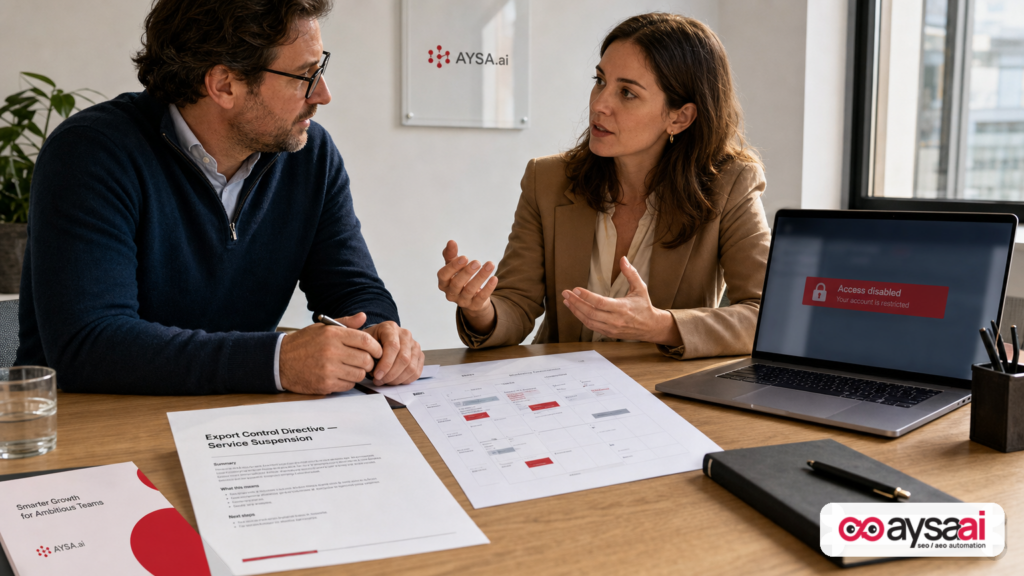
- AI access is now a policy surface. If a government can restrict model availability, your workflows and your customers’ discovery paths can change overnight.
- “Model risk” is real business risk. It’s not just an IT problem. It becomes a marketing, ops, and revenue stability problem.
- AI Search visibility is mostly fundamentals. The durable advantage is being easy to cite: clear facts, reference-grade pages, technical accessibility, and authority signals.
- Fragmentation is the new default. Not every customer will see the same answer experience, or have access to the same tools. Your brand needs to show up across many surfaces.
- Execution is the bottleneck. Monitoring without implementation is theater. You need a system that proposes changes, asks for approval, and implements accepted updates quickly.
Table of contents

- What happened—and why it matters beyond Anthropic
- Why export controls hit regular businesses (not just “national security” actors)
- The new risk category: “model risk” becomes “channel risk”
- What this changes in AI Search (AEO/GEO) and buyer behavior
- What can break when a model disappears: 10 failure modes SMEs actually feel
- Two concrete SME scenarios: ecommerce + local clinic
- A resilience framework for SMEs: make your brand easy to cite and hard to remove
- Agency playbook: how to sell outcomes in a world of model volatility
- Measurement that still works: what to monitor when answers are “zero-click”
- Where AYSA fits: monitoring + approved execution (so changes actually happen)
- What to do next: a 30–60 day action plan
- Sources and further reading
What happened—and why it matters beyond Anthropic
Search Engine Journal reported that the U.S. government issued an export-control directive that forced Anthropic to suspend access to its new Fable 5 and Mythos 5 models, because restricting access only to non-foreign nationals was described as effectively infeasible at scale. The report also stated Anthropic disputed the severity of the government’s cybersecurity concerns, arguing its guardrails and “defense in depth” strategy made misuse unlikely and comparable to risks posed by other already-deployed models.
I’m not going to pretend we can independently verify the technical substance of the alleged vulnerabilities from the supplied context. But from a business operator’s standpoint, the key facts that matter are simpler:
- Service access changed quickly. Not as a product decision. As a compliance decision.
- The restriction was broad. The reported scope involved foreign nationals, including inside the U.S., which creates practical enforcement challenges.
- Customers were surprised. The report described backlash and refund requests—classic symptoms of a dependency nobody planned for.
That’s why this is bigger than one vendor and one model name. It’s a warning label on the entire 2026 marketing stack: if a tool becomes “strategic,” it becomes “regulatable.” And when it becomes regulatable, you need a plan for disruption.
Source: Search Engine Journal coverage of the Anthropic Fable 5 shutdown.
Why export controls hit regular businesses (not just “national security” actors)
Most small and mid-sized companies hear “export controls” and think of semiconductors, defense contractors, or companies shipping physical goods overseas. But modern export restrictions can involve intangible things: software, technical data, and access.
Here’s the punchline for non-lawyers: if your vendor is regulated, you become operationally impacted. Not because you did anything wrong, but because your vendor must reduce risk and prove compliance.
That creates two brutal realities for SMEs:
1) Compliance is binary, so product experience becomes binary
In marketing we’re used to gradual changes: ranking shifts, CPC drift, conversion improvements. Policy-driven compliance events are different. If a provider can’t confidently ensure that a restricted capability is unavailable to restricted users, the simplest action is often to disable broadly until clarity exists.
That means your team’s workflows can go from “we publish weekly” to “we publish whenever we can” in one afternoon.
2) Policy timelines don’t care about your launch calendar
SMEs plan quarterly promos, seasonal peaks, and product launches. Export-control decisions can land on a random Tuesday and wipe out a critical dependency.
That’s why resilience planning is no longer an enterprise-only discipline. If you’re an SME, you might not have a compliance department—but you still need dependency awareness.
The new risk category: “model risk” becomes “channel risk”
Most teams already understand platform risk:
- A social platform changes reach.
- A marketplace tightens enforcement.
- A search engine changes layouts or ranking signals.
AI adds a new category: model risk—the risk that your workflows and your customers’ behaviors depend on a specific model’s availability, capability, or pricing.
And model risk becomes channel risk in two different ways:
A) Direct dependency: your team uses the model
If you rely on a specific frontier model for:
- content drafts and refreshes,
- product descriptions,
- support replies,
- internal knowledge summaries,
- Technical SEO troubleshooting,
- ad creative iterations,
…then losing access slows operations immediately. But the bigger danger is the “scramble switch”: your team picks an alternative tool fast, and output quality shifts unpredictably. That’s how brand voice, compliance posture, and factual accuracy deteriorate.
B) Indirect dependency: the market uses the model to decide
Even if you never touch an AI tool, your customers do. In 2026, AI answers influence:
- which brands people consider,
- which options get summarized,
- what “pros and cons” appear,
- and which sources get cited as trustworthy.
If access to a top-tier model changes for a slice of users, the distribution of discovery changes. Not everyone sees the same summary. Not everyone is exposed to the same set of citations. Discovery gets fragmented—and fragmentation punishes brands that haven’t made their facts and pages easy to reuse.
My opinion: the right response isn’t panic, and it isn’t “we’ll never use AI again.” It’s to build a discovery posture that works even when the AI layer changes.
What this changes in AI Search (AEO/GEO) and buyer behavior
AI Search isn’t one product. It’s a pattern: answer-driven experiences that synthesize information from multiple sources. In the supplied context, we have reporting about an AI model access shutdown—not detailed mechanics of specific search features. So let’s stick to what we can responsibly infer and what operators can do about it.
When frontier model access is restricted (for any reason), three business-relevant things tend to happen across the ecosystem:
1) Fragmentation increases
Different users get different answer quality and different “assistant behaviors.” Some will rely more on classic search results; others will lean on alternate AI tools; some will revert to social discovery. Your marketing needs to survive all of that.
Practical takeaway: You should stop building for one UI. Build for multiple surfaces:
- Classic organic results,
- Local discovery (Maps + reviews signals),
- Answer engines that cite sources,
- Social “search” behavior,
- Direct (email + Branded Search demand).
2) “Citable” becomes as important as “rankable”
Classic SEO taught businesses to chase positions and keywords. AI-driven discovery forces a second question: is your site easy to quote correctly?
Think in terms of “citation fitness”:
- Are your service definitions specific?
- Do you explain constraints and exclusions?
- Are pricing and policies clear enough that an answer engine won’t guess?
- Do you have evidence (credentials, reviews, case studies where appropriate)?
3) Governance pressure rises—and vendors tighten safety
In the SEJ report, a major theme is disagreement over jailbreak severity and cybersecurity misuse risk. Regardless of who’s right, a market pattern is clear: when regulators and policymakers scrutinize AI, vendors often respond with tighter guardrails, stricter access tiers, or reduced functionality in sensitive categories.
Practical takeaway: assume your content operations can’t rely on “the model will always answer freely.” Your site should carry the burden of clarity. If your best explanations live only in a chat workflow, you’re fragile.
What can break when a model disappears: 10 failure modes SMEs actually feel
If you’re an owner, you don’t care about “AI policy discourse.” You care about what breaks on Monday morning. Here are ten real failure modes I see when companies build on a single AI dependency—whether it’s for marketing or operations.
1) Publishing cadence collapses
You stop refreshing category pages, service pages, and FAQs. Those pages go stale. Stale pages get cited less often and convert worse.
2) Local facts drift (hours, services, phone numbers)
Small inconsistencies become big problems in answer-driven systems. If your site lists “Mon–Fri 9–6” and another profile shows “Mon–Fri 10–5,” systems hesitate or users show up at the wrong time.
3) Customer support slows and review velocity suffers
If your team used AI to draft replies or update help docs, losing it increases response times. That shows up in public sentiment and lost conversions.
4) Content quality becomes inconsistent during tool switching
Different models produce different tone, structure, and factual reliability. Your brand voice becomes a patchwork. Worse, you might publish claims you can’t substantiate.
5) Sales enablement degrades
Proposals, pitch decks, and follow-ups become slower and less tailored. Sales cycles lengthen.
6) Internal training stops improving
Many SMEs used AI to summarize SOPs and update training. When that stops, onboarding becomes slower, and mistakes rise.
7) SEO technical debt accumulates
If AI was your “first responder” for technical SEO questions, the team may avoid fixing issues (indexation, structured data, internal links) because nobody feels confident.
8) Agencies get stuck in recommendation mode
When the model that helped produce deliverables disappears, agencies shift to “here’s a doc of recommendations.” That doesn’t move metrics.
9) Over-reliance on paid traffic increases
When organic and content slows, companies often overcompensate with paid. That can work short-term, but it increases CAC and reduces resilience.
10) Leadership loses trust in “AI strategy” entirely
This is the hidden cost. After a disruption, leadership may decide AI is unreliable and cut budgets—even in areas where it could be used safely. That’s how volatility causes overcorrection.
Two concrete SME scenarios: ecommerce + local clinic
Let’s make this practical with two scenarios you can recognize. The goal is not to scare you—it’s to help you map dependencies and build a safer system.
Scenario 1: Ecommerce brand that used one model as its content engine
Imagine an ecommerce business selling premium kitchen knives. The team used a frontier model to:
- generate product descriptions,
- write “best of” guides,
- draft emails and ads,
- create care instructions and FAQs.
When access is disrupted, the company’s next move is predictable: it switches tools and keeps publishing. But here’s what goes wrong:
- Returns increase because care instructions become vague or inconsistent.
- Support tickets rise because sizing/spec differences aren’t explained clearly.
- Organic performance drifts because category and guide pages aren’t refreshed with consistent structure.
Resilient fix: move from “AI-generated copy” to reference-grade assets you own:
- A canonical “Knife Care & Maintenance” hub page.
- A “Steel Types Explained” page with clear definitions, pros/cons, and internal links to products.
- Consistent product attribute tables (materials, hardness, edge angle) where appropriate.
- Clear shipping/returns policies that remove ambiguity.
Those assets work in classic search, they work for AI citations, and they work when any model is unavailable.
Scenario 2: A multi-location clinic that built a workflow around one model
Now imagine a physical therapy clinic group. They used one model to:
- draft monthly blog posts answering patient questions,
- refresh location pages (services, insurance accepted, staff bios),
- write review responses,
- summarize call transcripts into FAQs.
Then a disruption hits. Three things break first:
- Review response time slows → reputation impact → fewer calls.
- Location details drift → inconsistent facts → decreased confidence in answers and listings.
- Patient education stops improving → fewer qualified leads and more “tire kickers.”
Resilient fix: build “citable” location and service content:
- Each location page contains the same structured sections: services, what to expect, insurance, policies, FAQs, contact, parking, accessibility.
- Each service page includes plain-language definitions, contraindications/disclaimers where appropriate, and next steps.
- A review response SOP that doesn’t require one model; use templates + approvals.
The clinic’s edge isn’t the model. It’s operational clarity published on the open web.
A resilience framework for SMEs: make your brand easy to cite and hard to remove
Here’s the framework I recommend when AI access is volatile. It’s simple by design, because SMEs win through consistent execution—not complexity.
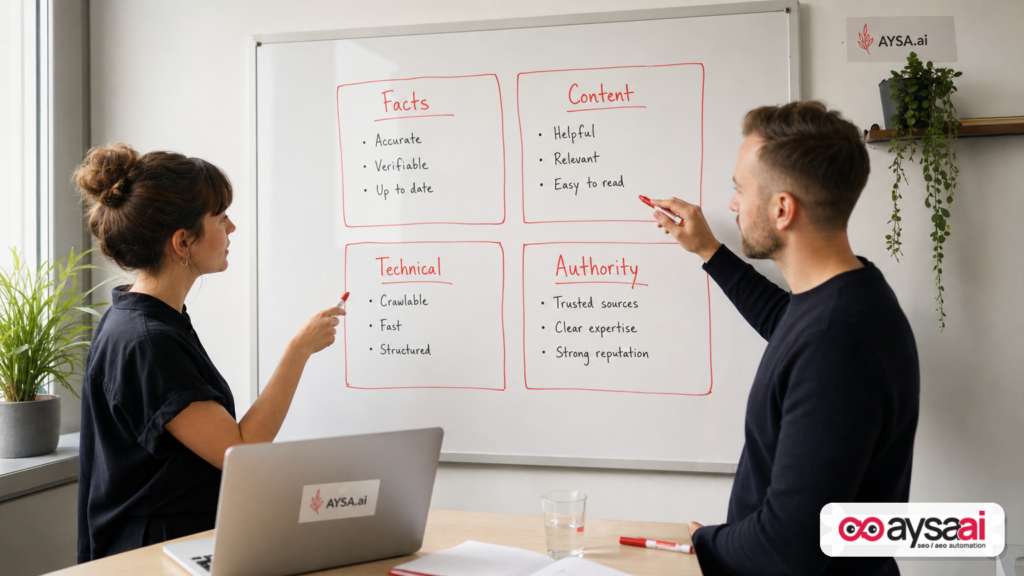
Pillar 1: Facts (inputs) — eliminate ambiguity
AI answer systems tend to be conservative when facts are inconsistent. If they can’t confidently state something, they’ll hedge, omit, or pick a different brand.
Start with the facts that drive purchase decisions:
- Business identity: legal name vs brand name, consistent contact info, consistent “about” statement.
- Offer clarity: what you do, what you don’t do, and who you’re for.
- Policies: refunds, returns, cancellations, warranties, shipping windows.
- Pricing framing: even if you can’t list exact pricing, publish ranges and what affects cost.
- Location facts (if relevant): hours, service areas, directions, parking, accessibility.
Operationally, you want one source of truth on your website that matches your public profiles and is easy to update.
Ongoing monitoring matters here. If facts drift, you need to catch it early: AYSA Monitoring.
Pillar 2: Content — build reference-grade pages, not “AI blog spam”
In AI Search, content that gets cited tends to share traits: clear structure, direct answers, minimal fluff, and strong internal linking to related proof.
For SMEs, I’d prioritize these “reference assets” before writing another generic blog post:
- Service pages that answer objections: who it’s for, what’s included, what results to expect, timelines, prerequisites, FAQs.
- Comparison pages: your approach vs alternatives (fair and specific, not trash talk).
- Process pages: “How it works” with steps, documents needed, what happens next.
- Policy pages that actually help: not legal boilerplate—plain language with examples.
- Proof pages: testimonials (where allowed), case studies (where appropriate), credentials, certifications, media mentions.
This is where AEO/GEO becomes real. You’re not optimizing for a robot. You’re publishing the best “quoted answer” on the internet for your niche.
More on the approach: AI Search Visibility.
Pillar 3: Technical — make your site easy to crawl, parse, and reuse
You don’t need a technical SEO PhD. You do need to eliminate friction and ambiguity.
Here’s what I’d consider “non-negotiable technical hygiene” for AI-era search:
- Indexation sanity: critical pages are indexable; duplicates are managed; canonicals are correct.
- Clean IA: categories and services are organized logically; internal links guide both users and crawlers.
- Scannable content: headings that match user questions; short sections; clear definitions.
- Structured data where appropriate: Organization/LocalBusiness, Product, and other relevant schema types (implemented correctly and honestly).
- Performance basics: mobile speed and stability (because slow pages are less usable and less competitive).
Technical work is where good intentions go to die, because it touches code and often requires approvals. This is exactly why “approved execution” matters (more on that below).
Pillar 4: Authority — prove you’re real beyond your own website
When models and answer systems become more conservative, they rely more on “consensus signals.” Authority is your insulation against volatility.
Authority signals that tend to hold up across ecosystems:
- Credible third-party mentions: local news, industry publications, partnerships.
- Reviews and reputation: consistent review acquisition, response SOPs, and transparency.
- Listings and associations: relevant directories, professional memberships (where applicable).
- Founder/expert visibility: the humans behind the business showing expertise in public.
This isn’t about chasing thousands of links. It’s about building proof that survives a change in any one model’s preferences.
Agency playbook: how to sell outcomes in a world of model volatility
If you run an agency, you’re in a tougher spot than in-house teams because your clients expect outcomes—and upstream volatility isn’t an excuse. Here’s how I’d adapt.
1) Stop selling “AI content.” Sell “citation-ready assets + execution.”
AI-generated copy is not a durable deliverable. It’s a production method. What clients actually need is:
- service/category pages that convert,
- structured content that can be cited,
- technical fixes implemented,
- ongoing monitoring and iteration.
Build packages around outcomes and assets, not around tool usage.
2) Put platform and model volatility into the SOW (without being evasive)
You don’t need to write legal poetry, but you should acknowledge that:
- third-party tools can change access, capabilities, or pricing,
- search layouts and AI answer experiences can change,
- timelines and deliverables may need adjustment if upstream dependencies change.
This protects both you and the client from unrealistic expectations.
3) Your differentiator is execution speed with governance
Most agencies can produce audits. Few can implement changes quickly and safely.
The agencies that win in AI Search will operationalize:
- monitor key signals,
- propose specific changes,
- get approval efficiently,
- execute without waiting months for dev cycles.
This is where AYSA’s model is aligned with reality: marketing outcomes require implementation, not just insight.
4) Be ready for “refund culture” when the tool stack breaks
One detail in the SEJ reporting that matters: users asking for refunds after losing access. That’s not just a vendor story—it’s a customer expectations story.
Clients will increasingly ask:
- “Why are we paying for content creation if the tool is unavailable?”
- “Why didn’t you anticipate this risk?”
- “What’s our contingency plan?”
Have an answer now: your plan is fundamentals + monitoring + execution. Not reliance on any one model.
Measurement that still works: what to monitor when answers are “zero-click”
AI-driven discovery makes measurement harder because the customer may get an answer without clicking. That doesn’t mean measurement is impossible—it means measurement must be more operational.
Without inventing new metrics or claiming special access, here’s the monitoring posture I recommend for SMEs:
1) Brand demand and branded search behavior
If your brand is being mentioned and remembered in answer experiences, you’ll often see some lift or stability in branded searches over time.
2) Conversion integrity (forms, calls, bookings)
When discovery shifts, traffic composition shifts. Watch what matters:
- lead volume and lead quality,
- booking completion rate,
- call volume and missed calls,
- top landing pages for converting sessions.
3) Site health signals that influence eligibility
Indexation issues, broken internal links, slow pages, and thin content don’t just hurt “rankings.” They reduce your eligibility to be used as a trusted source.
This is where automation helps—if it’s tied to action. Monitoring alone is not enough.
AYSA’s positioning here is straightforward: monitoring plus an execution workflow that doesn’t require you to become a full-time SEO project manager.
Where AYSA fits: monitoring + approved execution (so changes actually happen)
Here’s my blunt take after years of watching businesses try to “do SEO”: most companies don’t fail because they lack ideas. They fail because they can’t execute consistently.
And AI volatility makes inconsistency more expensive. When access changes, when search layouts shift, when AI answers cite different sources, you need the ability to respond fast—without breaking your site or your brand voice.
AYSA is built around an operational loop:
- Monitor the signals that affect AI Search visibility and classic SEO performance.
- Prepare concrete changes (not vague advice).
- Request approval so you keep governance and brand control.
- Execute accepted website changes so the work actually ships.
That last step is the missing piece in most stacks. A spreadsheet doesn’t change your indexation. A slide deck doesn’t add internal links. A “strategy doc” doesn’t update stale service pages.
If you want to see how we think about AI-era visibility as an execution system:
Important clarification: This editorial does not claim AYSA integrates with or depends on any specific third-party frontier model mentioned in the SEJ report. The point is the opposite: your marketing and visibility should be designed to remain effective even if model access changes.
What to do next: a 30–60 day action plan
If you’re an SME owner, a marketing lead, or an agency operator, you don’t need a policy memo. You need a plan you can execute. Here’s a practical 30–60 day sequence designed to reduce dependency on any single model and increase “citation fitness” across AI Search experiences.
Step 1 (Week 1): Inventory your AI dependencies like you would inventory suppliers
Write down:
- Which AI tools/models are used in marketing, support, sales, and dev?
- Which workflows are “nice to have” vs “mission critical”?
- What breaks if the tool is unavailable for 7 days? 30 days? 90 days?
Then define a fallback:
- manual SOP (minimum viable),
- secondary tool option,
- approval process so output quality doesn’t collapse under pressure.
Step 2 (Week 1–2): Lock your public facts and policies (remove ambiguity)
Audit and standardize:
- business name usage,
- contact details,
- hours/service areas,
- returns/refunds/cancellations,
- pricing framing and “what’s included.”
Publish the canonical version on your website. Make it easy to find. Link to it from high-traffic pages.
Step 3 (Week 2–4): Build 2–4 reference assets (pages that deserve citations)
Pick your highest-margin service or category and create:
- One definitive service/category page with clear sections and FAQs.
- One comparison page that addresses real alternatives.
- One process page that explains how it works.
- One policy/guide page that reduces support and removes buyer anxiety.
If you’re an agency, this is your new deliverable unit. If you’re in-house, this is your highest ROI content work.
Step 4 (Week 4–6): Fix the top technical blockers that prevent reuse
Prioritize:
- indexation issues (critical pages),
- internal link gaps (orphan pages),
- duplicate/thin pages that confuse entity understanding,
- structured data where appropriate and truthful,
- mobile performance basics.
Don’t over-engineer. Remove friction.
Step 5 (Week 6–8): Implement a monitoring cadence + an execution loop
Decide:
- what you’ll check weekly (brand demand, conversions, site health),
- who approves changes,
- how changes get implemented (and how quickly).
If you want an execution system that supports that loop (monitor → propose → approve → implement), look at AYSA’s approach here:
Step 6 (Ongoing): Reduce “single points of failure” across channels
AI volatility is a reminder to diversify:
- Build email capture into high-intent pages.
- Strengthen review acquisition and response SOPs.
- Invest in brand search demand through consistent messaging and proof.
- Create partnerships/mentions that strengthen authority signals.
Resilience is not one trick. It’s a habit.
Sources and further reading
- Search Engine Journal: Government Order Shuts Down Fable 5 Despite Anthropic’s Objections
- Search Engine Journal: Latest news (ongoing AI/search changes)
- Search Engine Journal: SEO news
- Search Engine Journal: PPC news
AYSA resources
Final note on sourcing: The supplied research context primarily includes Search Engine Journal’s report and SEJ navigation links. If you want this editorial expanded with primary documentation (e.g., official export-control language, agency statements, or filed legal documents), add those URLs to the research pack and we’ll incorporate them with direct citations. I’m deliberately not implying access to documents that aren’t provided.
Continue the AI search topic inside AYSA.
Use these pages to connect the article with AI SEO tools, AI visibility monitoring, AI Overviews and approved website execution.
Turn this topic into a website action plan.
Use these AYSA hubs to move from reading to technical fixes, AI visibility monitoring, research, glossary context and approval-first SEO execution.

